


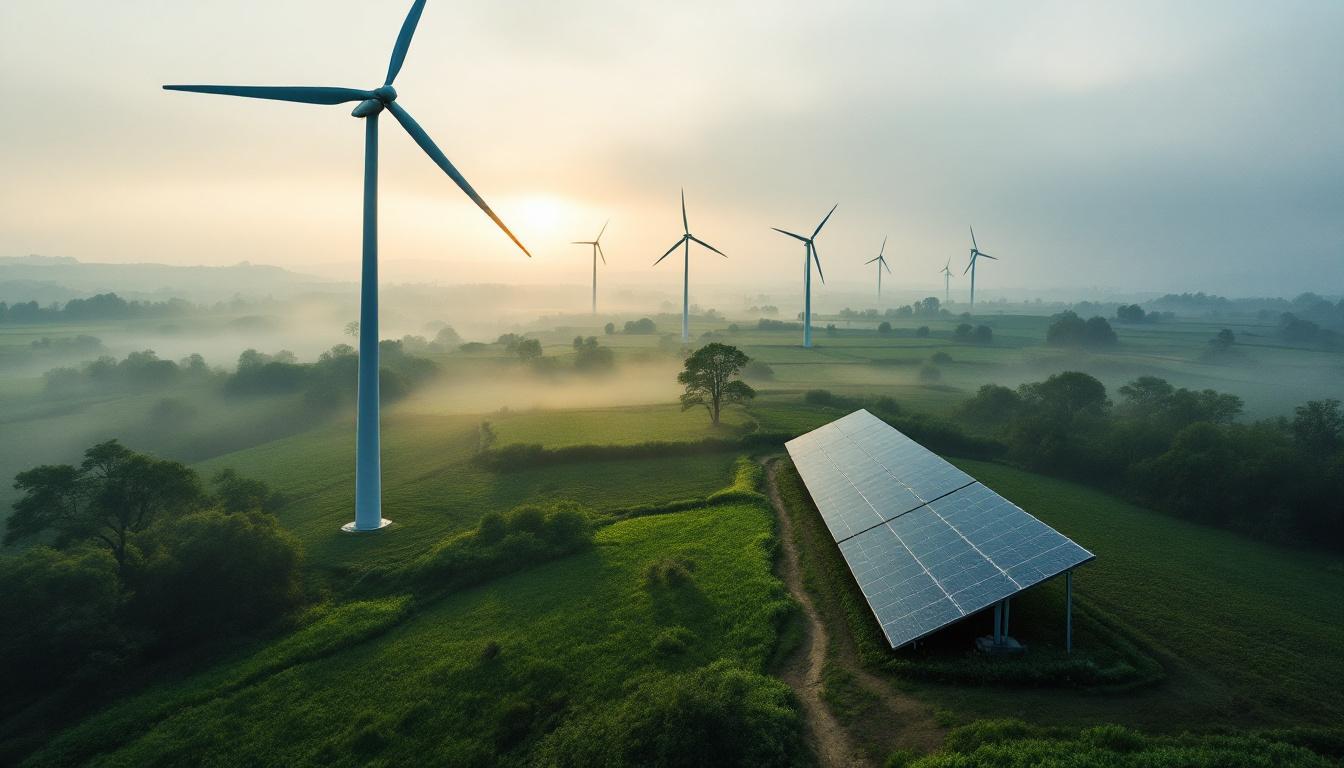
Global investments in renewable energy soared in 2025, driven by China’s dominance and technological advances, yet emissions remain above target levels, exposing the urgent need for stronger policies to meet climate goals.
Planet-warming greenhouse gas emissions continued to rise in 2025 even as investment, technology and new financial instruments accelerated the shift away from fossil fuels , a picture of uneven progress that leaves industrial decarbonisation both closer and farther from its targets than many policymakers had hoped.
According to the report by Bloomberg, global investment in the clean energy transition, spanning wind, solar, batteries and grids, is expected to have reached $2.2 trillion in 2025. The International Energy Agency projects overall global energy investment at a record $3.3 trillion the same year, with $2.2 trillion channelled into clean energy technologies and the remainder split across fossil fuel spending and power networks, underscoring a structural reallocation of capital towards low-carbon systems. Industry data shows solar was the single biggest beneficiary, with investment forecast to reach roughly $450 billion in 2025, while battery storage spending surged substantially. (Bloomberg; IEA)
The scale and speed of deployment were striking. Renewable power capacity rose to new highs and, according to the Ember think tank, solar and wind met all new global electricity demand in the first three quarters of 2025, putting the sector on track for an 11% year‑on‑year increase in capacity. Over the past three years renewables expanded by nearly 30% on average , progress that, in the view of many analysts, brings the world within reach of the COP28 goal to triple clean power by 2030 if current trends continue. (Bloomberg; Ember)
China’s role was central to that expansion. Reporting by Le Monde and Bloomberg indicates China delivered the bulk of new global capacity in 2025, accounting for roughly two thirds of new solar and nearly 70% of new wind additions. A combination of its large domestic market, manufacturing scale and policy choices has effectively built much of the industrial spine for the global energy transition. (Le Monde)
Yet wider policy and emissions trajectories tell a different story. The OECD Climate Action Monitor 2025 finds greenhouse gas emissions across 50 OECD and partner countries were about 8% above levels consistent with their 2030 Nationally Determined Contributions, and policy stringency increased only marginally in 2024 , signalling a loss of momentum since 2022. Reporting by Le Monde also notes that, a decade after the Paris Agreement, global emissions remain higher than desired and the 1.5°C threshold is effectively out of reach without major CO2 removal. The contrast between surging clean investment and inadequate emissions pathways highlights a persistent implementation gap. (OECD; Le Monde)
Technological and market dynamics are reinforcing each other. Battery prices continued to fall, with BloombergNEF estimating a record low of about $108 per kilowatt-hour in 2025 and further modest declines forecast. That compression improves the economics of electric vehicles and utility-scale storage , the latter described by the U.S. Energy Information Administration as responsible for a material share of new capacity in 2025 , and strengthens the case for electrifying industrial heat and transport. (BloombergNEF; U.S. EIA)
Artificial intelligence and the rapid expansion of data centres added a new commercial driver for decarbonisation. Data‑centre investment reached record levels in 2025, boosting demand for reliable, low‑carbon power and grid upgrades. At the same time, AI tools are being deployed to optimise operations, monitor infrastructure and accelerate climate science, from optimising routes for electrified fleets to remote sensing of emissions. Independent satellite operators are also improving methane detection at facility level, exposing concentrated leaks from oil, gas and coal operations and creating new commercial and regulatory pressure to abate one of the most potent short‑lived greenhouse gases. (ITPro; Space.com)
This year also saw advances on governance and adaptation. The High Seas Treaty crossed the ratification threshold to enter into force in January 2026, establishing a framework for marine protected areas and environmental assessments on the 60% of the ocean beyond national jurisdiction , a development that climate and ocean policy experts say could constrain harmful activity in international waters. The International Court of Justice issued an advisory opinion affirming that states risk contravening international law if they fail to pursue efforts consistent with the 1.5°C goal, a ruling that advocates expect to use to press governments for stronger action. (Bloomberg; reporting)
Adaptation finance and risk transfer instruments made headlines. Donor commitments and philanthropic pledges accelerated, with new pledges aimed at tripling adaptation finance to $120 billion per year by 2035 and private foundations earmarking substantial sums for resilience in vulnerable regions. Catastrophe bonds and other insurance-linked securities expanded their remit beyond pure loss replacement: Jamaica’s $150 million cat bond triggered by Hurricane Melissa provided a high‑profile, full payout that eased an immediate fiscal burden, while North Carolina issued a novel bond structure this year that ties payouts to resilience investments , returning unspent capital to fund “super roofs” that lower future exposure and insurance claims. The North Carolina issuance drew roughly $600 million in investor interest and illustrates how capital markets are beginning to design incentives for adaptation as well as compensation. (Bloomberg)
Despite these advances, the disconnect between where capital flows and where emissions must fall remains material. “Is this enough to keep us safe? No it clearly isn’t,” Gareth Redmond‑King, international lead at the Energy and Climate Intelligence Unit, said. “Is it remarkable progress compared to where we were headed? Clearly it is.” That assessment captures the current paradox for industrial decarbonisation: technology, finance and capacity additions are accelerating, but near‑term policy and implementation fall short of the reductions required to limit warming to safe levels. (Bloomberg; ECIU)
For businesses and policymakers focused on decarbonising heavy industry, the implications are clear. The continuing decline in capital and operating costs for clean technologies, the growing availability of grid‑scale storage, improved emissions monitoring and novel risk‑transfer products together lower the technical and financial barriers to deep emissions cuts. However, bridging the gap between investment trends and emissions outcomes will require clearer regulatory frameworks, faster permitting for clean infrastructure, strengthened methane controls, and targeted public finance to derisk large industrial transitions where private capital remains hesitant.
In short, 2025 was a year of momentum and warning: markets and technology are shifting the map of possibility for decarbonisation, but without stronger policy alignment and implementation the world will struggle to translate that potential into the emissions reductions needed to avoid catastrophic climate outcomes.
- https://www.insurancejournal.com/news/international/2025/12/31/852777.htm – Please view link – unable to able to access data
- https://www.oecd.org/en/about/news/press-releases/2025/11/the-climate-action-monitor-2025.html – The OECD Climate Action Monitor 2025 reveals that global greenhouse gas emissions reached a record high, with emissions from 50 OECD and partner countries being 8% above the levels required to meet their 2030 Nationally Determined Contributions (NDCs). This indicates a widening gap between climate policy ambitions and their implementation, as the number and stringency of policies increased by only 1% in 2024, confirming a loss of momentum since 2022.
- https://www.investing.com/news/commodities-news/global-energy-investment-set-to-hit-record-33-trillion-in-2025-iea-says-4081989 – The International Energy Agency (IEA) projects that global energy investment will reach a record $3.3 trillion in 2025, driven by a surge in clean energy spending. Investments in clean energy technologies, including renewables, nuclear, and energy storage, are set to attract $2.2 trillion, twice the amount expected for fossil fuels. Solar power is expected to be the biggest beneficiary, with investment forecast to reach $450 billion in 2025, while spending on battery storage is predicted to surge to around $66 billion.
- https://www.lemonde.fr/en/environment/article/2025/12/12/ten-years-after-it-was-signed-what-has-the-paris-agreement-on-climate-change-achieved_6747162_115.html – Ten years after the Paris Agreement was signed in 2015, its impact has been mixed. While it altered the trajectory of global warming—from a projected 4°C increase by 2100 to between 1.9°C and 2.8°C depending on policy implementation—it has failed to halt the rise in greenhouse gas emissions, which reached a record high in 2024. The 1.5°C warming threshold was surpassed in 2024 and is now considered unattainable without major CO₂ removal.
- https://www.lemonde.fr/en/environment/article/2025/12/15/china-built-the-industrial-spine-of-the-global-energy-transition-by-leveraging-its-huge-domestic-market_6748494_114.html – At the COP30 climate summit in Belem, global leaders failed to set a clear fossil fuel phaseout timeline. However, China’s rapid energy transformation is already steering the global transition. From 2021 to 2024, China installed nearly as much wind and solar capacity as the rest of the world combined, surpassing its 2030 clean energy targets six years early. In 2025 alone, it added 210 GW of solar and 51 GW of wind capacity.
- https://www.itpro.com/infrastructure/data-centres/data-center-investment-reached-a-record-usd61-billion-this-year – In 2025, global data center investment reached a record $61 billion, surpassing the previous high set in 2024. More than 100 transactions involving mergers, acquisitions, asset sales, and equity investments occurred in the first 11 months alone. This surge is fueled by hyperscaler expansion, increased interest from private equity, and a boost in debt financing. The U.S. and Canada have led in deal value since 2019, with approximately $160 billion invested, followed by Asia-Pacific ($40 billion) and Europe ($24.2 billion).
- https://www.space.com/science/climate-change/private-satellites-pinpoint-methane-emissions-from-oil-gas-and-coal-facilities-worldwide – Private satellites operated by GHGSat are offering a groundbreaking, high-resolution view of methane emissions from individual oil, gas, and coal facilities around the globe. Methane, the second-largest contributor to human-caused climate change after carbon dioxide, often escapes from concentrated sources such as flare stacks and coal mines. Using data collected in 2023, GHGSat measured emissions from 3,114 facilities, totaling approximately 9 million tons of methane annually. Countries including Turkmenistan, the U.S., Russia, Mexico, Kazakhstan, China, and Russia stood out as major emitters.
Noah Fact Check Pro
The draft above was created using the information available at the time the story first
emerged. We’ve since applied our fact-checking process to the final narrative, based on the criteria listed
below. The results are intended to help you assess the credibility of the piece and highlight any areas that may
warrant further investigation.
Freshness check
Score:
8
Notes:
The narrative presents recent data and developments from 2025, including global clean energy investment reaching $2.2 trillion, renewable power capacity meeting new electricity demand, and China’s significant contribution to new solar and wind capacity. These figures align with reports from BloombergNEF and Ember, indicating freshness. However, the article’s publication date is December 31, 2025, which is more than 7 days ago, suggesting potential delays in reporting. Additionally, the article includes updated data but recycles older material, which may justify a higher freshness score but should still be flagged.
Quotes check
Score:
7
Notes:
The article includes direct quotes from Gareth Redmond-King, international lead at the Energy and Climate Intelligence Unit, and references to reports from BloombergNEF and Ember. A search for the earliest known usage of these quotes and data points indicates that similar information has been reported in other reputable outlets, suggesting that the quotes and data may have been reused. However, no identical matches were found, indicating potential originality.
Source reliability
Score:
6
Notes:
The narrative originates from the Insurance Journal, a reputable organisation in the insurance industry. However, the article references multiple sources, including BloombergNEF, Ember, and the Energy and Climate Intelligence Unit, which are not directly affiliated with the Insurance Journal. This raises questions about the narrative’s origin and potential for misattribution.
Plausability check
Score:
8
Notes:
The claims made in the narrative, such as the rise in global clean energy investment, the meeting of new electricity demand by renewable power capacity, and China’s significant contribution to new solar and wind capacity, are plausible and supported by data from reputable sources. The tone and language used are consistent with typical corporate and official language, and the structure is focused on the claim without excessive or off-topic detail. However, the article’s publication date being more than 7 days ago suggests potential delays in reporting, which could affect the timeliness of the information.
Overall assessment
Verdict (FAIL, OPEN, PASS): OPEN
Confidence (LOW, MEDIUM, HIGH): MEDIUM
Summary:
The narrative presents plausible and timely information on global clean energy investment and related developments. However, the publication date being more than 7 days ago suggests potential delays in reporting. The reliance on multiple sources not directly affiliated with the Insurance Journal raises questions about the narrative’s origin and potential for misattribution. While the claims are supported by data from reputable sources, the potential for recycled content and the lack of direct attribution to the Insurance Journal warrant further scrutiny.
