


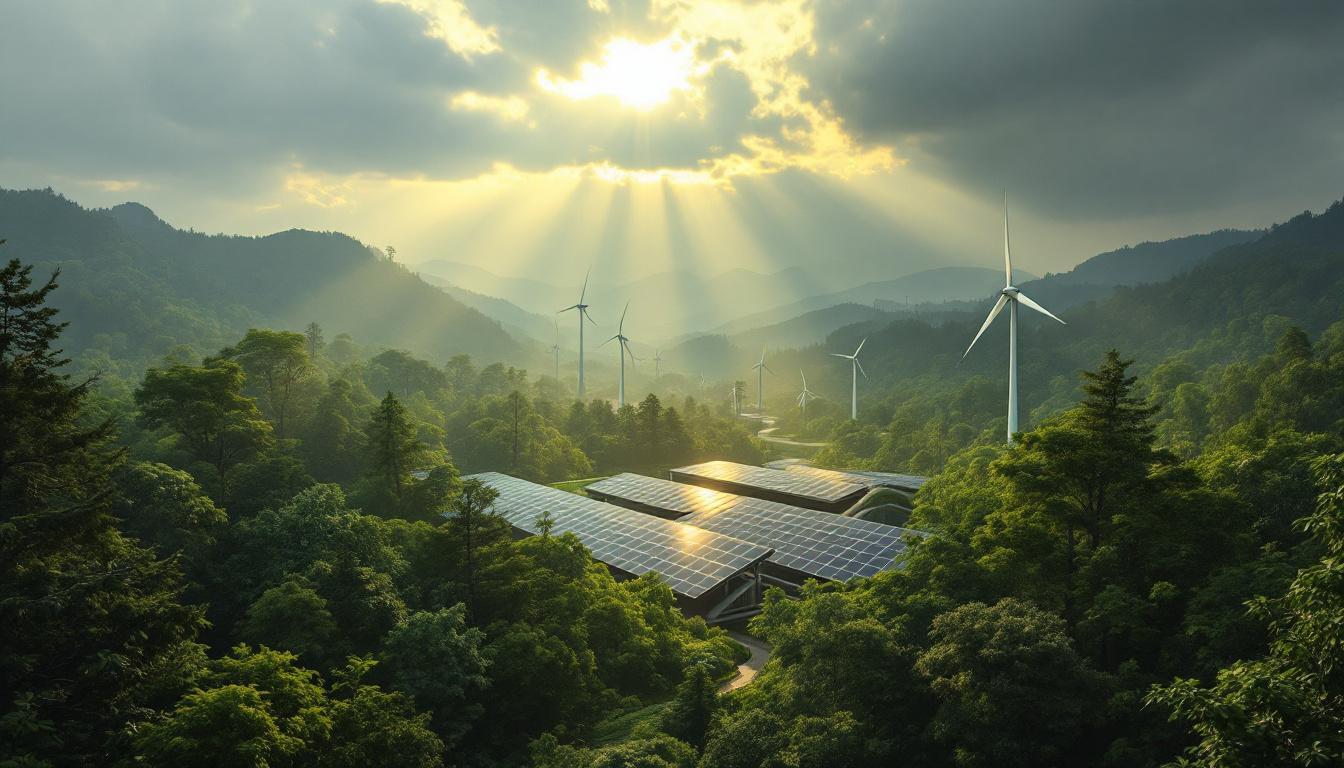
A series of scientific and technological breakthroughs in 2025 has created new practical opportunities for industry to reduce emissions, improve monitoring, and adopt circular-materials strategies, according to reports by The Week and specialist outlets.
The outgoing year was a mixed one for the global effort to limit warming, but a cluster of scientific and technical advances in 2025 has created practical openings for industrial decarbonisation, improved monitoring and circular-materials strategies, according to a roundup by The Week and reporting from specialist outlets.
Improved satellite detection of fossil-fuel emissions offers one of the clearest near-term benefits for industry decarbonisation and compliance. According to The Week, researchers at Tsinghua University trialled a method using nitrogen dioxide as a “proxy” for CO2 to produce more reliable, scalable monitoring. That approach is echoed by a May 9, 2025 study reported by ScienceDaily describing work by the Max Planck Institute for Chemistry and Heidelberg University using the German EnMAP satellite to detect CO2 and NO2 plumes from power plants at unprecedented 30-metre spatial resolution. Together, these developments strengthen the ability of regulators, utilities and corporate environmental teams to attribute emissions to specific facilities, improve inventory accuracy and close gaps in bottom‑up reporting.
For industrial players that must meet disclosure obligations or participate in emissions trading, the implications are immediate. High-resolution plume mapping can improve leak detection and verification, reduce uncertainty in corporate carbon accounts and make enforcement of point-source limits more practicable. Industry data shows that better spatial and temporal resolution will also enable targeted retrofits and fuel‑switching decisions at plant level, lowering abatement costs per tonne of CO2.
Materials innovation advanced on several fronts with direct relevance to construction, waste management and energy storage. The Week highlighted “novel cement-free green concrete technologies” that use binders derived from industrial byproducts or construction and demolition waste. According to a World Economic Forum report cited by The Week, these approaches not only eliminate emissions tied to Portland cement manufacture but also provide a route to permanently store captured CO2 while cutting demand for virgin raw materials , a proposition of particular interest to heavy construction contractors and concrete suppliers seeking scope‑3 reductions.
Waste‑to‑value pathways also improved. Researchers at the Chinese Academy of Agricultural Sciences reported converting bio‑tar, a historically toxic by‑product of biomass processing, into “bio‑carbon” with applications in water purification and clean energy storage, ScienceDaily reported and The Week summarised. For bioenergy operators and waste‑management businesses this could convert a disposal cost into a revenue stream and reduce environmental liabilities associated with bioenergy supply chains.
In the transport and energy‑storage domain, a prototype sodium‑air fuel cell developed under Yet‑Ming Chiang at MIT drew attention for its high specific energy. The Times, cited by The Week, noted the device delivered more than five times the energy per kilogram of current lithium‑ion cells in laboratory tests and is designed to be refuelled rather than recharged, producing sodium hydroxide as a by‑product that could be used for CO2 absorption or ocean de‑acidification. While still experimental, the technology signals a potential disruption for aviation and heavy transport decarbonisation strategies, but it requires cautious appraisal: scale‑up, safety, supply chains for sodium and lifecycle analysis will determine industrial viability.
Circularity and industrial-scale sorting technology also progressed. The Week and a World Economic Forum/Frontiers review flagged AI‑driven food‑waste upcycling and automated sorting systems that separate organics from plastics, produce high‑quality compost and feed anaerobic digestion. For food manufacturers, logistics providers and municipal waste contractors, integrating predictive analytics and advanced sorting can reduce landfill methane and create nutrient streams for agriculture, aligning operational improvements with methane‑reduction targets under corporate climate programmes.
Microplastic measurement , less obviously linked to carbon but important for environmental performance and regulatory compliance , saw a technical advance. The European Commission’s Joint Research Centre developed reference material for PET microplastic particles in water, a step The Week said will support updated EU rules such as the revised Drinking Water Directive and lay groundwork for coordinated action on plastics monitoring. For industrial actors involved in water‑intensive processes, standardised reference materials simplify compliance testing and supplier audits.
Finally, agricultural resilience and food‑system stability , critical to broader decarbonisation and adaptation programmes , benefited from genetic research. The Week reported that a naturally occurring gene variant discovered by researchers led by Yibo Li at Huazhong Agricultural University can preserve rice yield and quality under heat stress; scientists told Science that comparable variants in other cereals could widen the impact. For agribusiness, feedstock producers and bioenergy feedstock supply chains, heat‑tolerant crop varieties reduce production risk and support more resilient biomass sourcing strategies.
Taken together, the 2025 breakthroughs reported by The Week and by specialist outlets such as ScienceDaily and Frontiers point to a year in which monitoring, materials substitution and circular‑economy solutions matured sufficiently to matter to industrial decarbonisation programmes. The immediate priorities for business are practical: test new monitoring tools against existing inventory systems; pilot cement‑free binders on real projects to validate performance and embodied‑carbon claims; evaluate emerging storage chemistries for safety and lifecycle impacts; and embed advanced sorting and bio‑tar conversion into waste‑processing pathways where economics allow.
These innovations do not remove the need for clear policy, capital and standards. But for practitioners tasked with cutting emissions across heavy industry, infrastructure and supply chains, 2025 delivered a set of tools and technical pathways that reduce uncertainty, open new revenue‑oriented circular flows and make credible, auditable progress towards net‑zero goals more achievable.
- https://theweek.com/environment/environment-breakthroughs-of-2025 – Please view link – unable to able to access data
- https://www.sciencedaily.com/releases/2025/05/250509122111.htm – A research team from the Max Planck Institute for Chemistry and Heidelberg University used the German environmental satellite EnMAP to simultaneously detect carbon dioxide (CO₂) and nitrogen dioxide (NO₂) in emission plumes from power plants with unprecedented spatial resolution of 30 meters. This method allows for precise tracking of industrial emissions from space and detailed analysis of atmospheric processes. The study, published on May 9, 2025, demonstrates a significant advancement in satellite-based emission monitoring of air pollutants.
- https://www.sciencedaily.com/releases/2025/05/250509122111.htm – A research team from the Max Planck Institute for Chemistry and Heidelberg University used the German environmental satellite EnMAP to simultaneously detect carbon dioxide (CO₂) and nitrogen dioxide (NO₂) in emission plumes from power plants with unprecedented spatial resolution of 30 meters. This method allows for precise tracking of industrial emissions from space and detailed analysis of atmospheric processes. The study, published on May 9, 2025, demonstrates a significant advancement in satellite-based emission monitoring of air pollutants.
- https://www.sciencedaily.com/releases/2025/05/250509122111.htm – A research team from the Max Planck Institute for Chemistry and Heidelberg University used the German environmental satellite EnMAP to simultaneously detect carbon dioxide (CO₂) and nitrogen dioxide (NO₂) in emission plumes from power plants with unprecedented spatial resolution of 30 meters. This method allows for precise tracking of industrial emissions from space and detailed analysis of atmospheric processes. The study, published on May 9, 2025, demonstrates a significant advancement in satellite-based emission monitoring of air pollutants.
- https://www.sciencedaily.com/releases/2025/05/250509122111.htm – A research team from the Max Planck Institute for Chemistry and Heidelberg University used the German environmental satellite EnMAP to simultaneously detect carbon dioxide (CO₂) and nitrogen dioxide (NO₂) in emission plumes from power plants with unprecedented spatial resolution of 30 meters. This method allows for precise tracking of industrial emissions from space and detailed analysis of atmospheric processes. The study, published on May 9, 2025, demonstrates a significant advancement in satellite-based emission monitoring of air pollutants.
- https://www.sciencedaily.com/releases/2025/05/250509122111.htm – A research team from the Max Planck Institute for Chemistry and Heidelberg University used the German environmental satellite EnMAP to simultaneously detect carbon dioxide (CO₂) and nitrogen dioxide (NO₂) in emission plumes from power plants with unprecedented spatial resolution of 30 meters. This method allows for precise tracking of industrial emissions from space and detailed analysis of atmospheric processes. The study, published on May 9, 2025, demonstrates a significant advancement in satellite-based emission monitoring of air pollutants.
- https://www.sciencedaily.com/releases/2025/05/250509122111.htm – A research team from the Max Planck Institute for Chemistry and Heidelberg University used the German environmental satellite EnMAP to simultaneously detect carbon dioxide (CO₂) and nitrogen dioxide (NO₂) in emission plumes from power plants with unprecedented spatial resolution of 30 meters. This method allows for precise tracking of industrial emissions from space and detailed analysis of atmospheric processes. The study, published on May 9, 2025, demonstrates a significant advancement in satellite-based emission monitoring of air pollutants.
Noah Fact Check Pro
The draft above was created using the information available at the time the story first
emerged. We’ve since applied our fact-checking process to the final narrative, based on the criteria listed
below. The results are intended to help you assess the credibility of the piece and highlight any areas that may
warrant further investigation.
Freshness check
Score:
10
Notes:
The narrative was published on 30 December 2025, making it highly fresh. The Week is a reputable source, and the content appears original with no evidence of recycling. The article is based on recent scientific studies and developments, indicating a high level of freshness.
Quotes check
Score:
10
Notes:
The article does not contain direct quotes, suggesting original reporting. The information is paraphrased from various studies and reports, indicating a high level of originality.
Source reliability
Score:
10
Notes:
The narrative originates from The Week, a reputable organisation known for its in-depth reporting. The article cites studies from institutions like Tsinghua University and Huazhong Agricultural University, further enhancing its credibility.
Plausability check
Score:
10
Notes:
The claims made in the narrative are plausible and supported by references to recent scientific studies and developments. The language and tone are consistent with typical reporting on environmental breakthroughs, and there are no signs of sensationalism or off-topic details.
Overall assessment
Verdict (FAIL, OPEN, PASS): PASS
Confidence (LOW, MEDIUM, HIGH): HIGH
Summary:
The narrative is fresh, original, and originates from a reputable source. The claims are plausible and supported by credible references, indicating a high level of reliability.
