


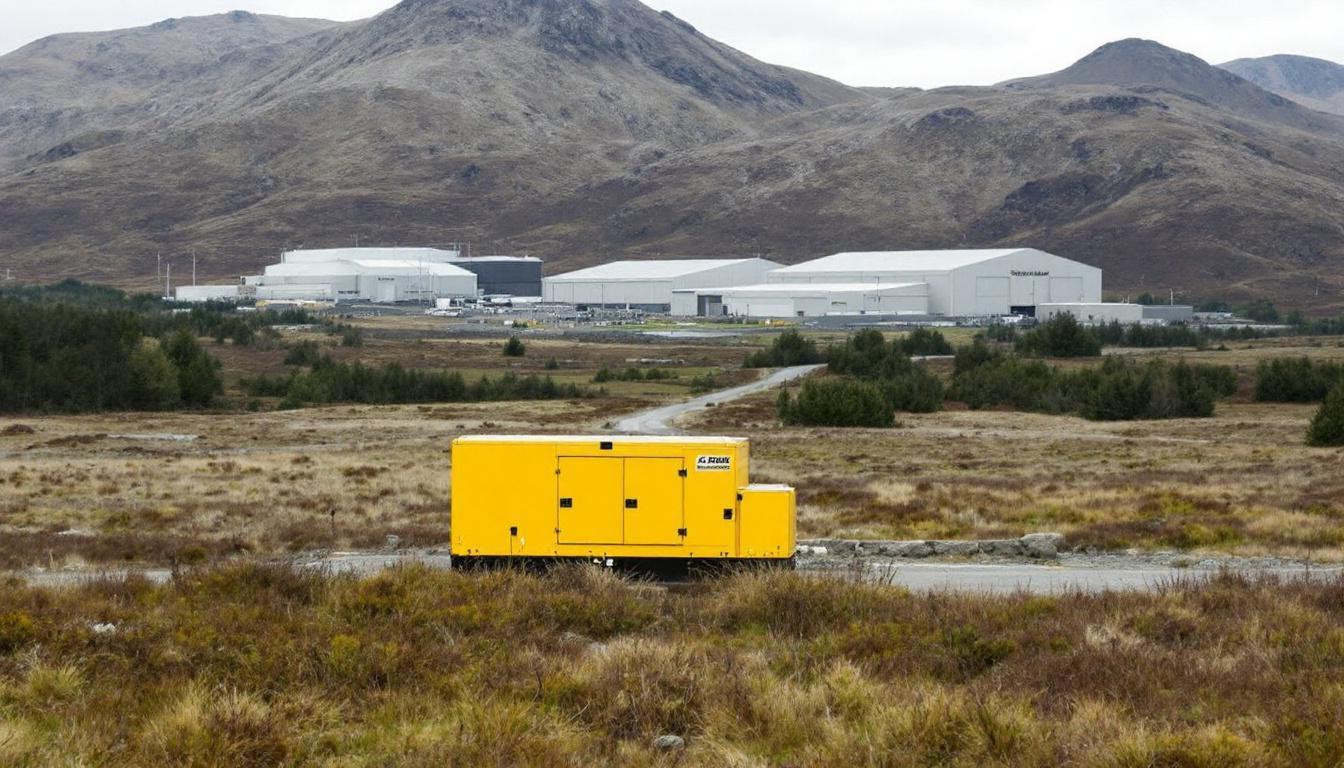
Aggreko has provided a customised load-bank and generator package to support the commissioning of the 500MW Coalburn Battery Energy Storage System in South Lanarkshire, marking a significant step in the UK’s net-zero ambitions and large-scale energy transition.
Aggreko supplied a bespoke load‑bank and generator package to support commissioning of a 500MW Battery Energy Storage System (BESS) at Coalburn in South Lanarkshire, part of a wider 1GW Coalburn development led by Copenhagen Infrastructure Partners (CIP). According to The Energyst, the integrated solution comprised a 5MW load bank and 5MW Stage V generator package at 33kV, a 150kVA LV generator, HV/LV cabling and ancillary kit, all installed and supported by Aggreko’s onsite engineering team. (theenergyst.com)
The outfitted Stage V generators ran on hydrotreated vegetable oil (HVO) biofuel to reduce commissioning‑phase emissions, with Aggreko also providing transport logistics and a resident engineer to manage equipment performance and rapid technical response during staged commissioning across multiple battery blocks. Industry coverage of the scheme highlights the emphasis on minimising downtime and simulating real‑world electrical loading to validate grid‑balancing performance before handover. (theenergyst.com)
H&MV Engineering’s senior project manager, Hugh Prentice, is quoted as saying, “Aggreko’s support was critical to the successful commissioning of the BESS site at Coalburn 1. The solution’s ability to simulate electrical loads and provide uninterrupted power supply gave us the confidence that the system would perform reliably once live. “Aggreko’s tailored approach and willingness to collaborate closely with our team over an 18‑month period made them the ideal choice for this project. This helped to deliver an end‑product that was both cost‑effective and optimised for various unique challenges.” The Energyst reported the remarks. (theenergyst.com)
Craig Fleming, Utilities Sector Sales Manager at Aggreko, added, “This is a prime example of how Aggreko’s expertise in delivering large‑scale, complex HV power solutions can make a real difference. “Our role in bringing one of Europe’s most exciting grid‑balancing projects to life is something I’m incredibly proud of. Supporting the energy transition is at the heart of what we do, and Coalburn is a major step forward in that journey.” The Energyst carried this statement. (theenergyst.com)
Project timeline and capacity expectations vary across reporting. The Energyst notes the full Coalburn facility is expected to reach 1GW capacity in 2026, while other sector reporting places the first 500MW phase (Coalburn 1) becoming operational in late 2025 and describes a second 500MW phase (Coalburn 2) and adjacent Devilla site progressing toward construction starts in 2027 as CIP scales its Scottish BESS portfolio. For clarity, these differing dates reflect phased delivery across multiple sites and developer timelines. (theenergyst.com)
Once complete, the Coalburn development is projected to provide sustained grid‑balancing services at scale. The Energyst cites expectations that the 1GW facility will supply the equivalent of around 184,000 homes annually and offset roughly 103,000 tonnes of CO2 , figures that underscore the project’s role within industrial decarbonisation and UK net‑zero planning, while also highlighting the operational and logistical challenges of commissioning large‑scale BESS assets. (theenergyst.com)
For asset owners and operators in industrial decarbonisation, Coalburn underlines two practical lessons: (1) temporary grid‑quality power and accurate load simulation are central to de‑risking BESS commissioning at scale; and (2) low‑carbon fuels (such as HVO) and close onsite engineering support can materially reduce commissioning emissions and schedule risk. According to reporting, RES has been appointed to provide long‑term asset management for the Coalburn 500MW/1GWh asset, illustrating the move from construction to professionalised operational oversight. (solarpowerportal.co.uk)
According to the original report, Aggreko has also published a case study video describing its role at Coalburn 1. (theenergyst.com)
(Prepared for a B2B audience on industrial decarbonisation; all quoted material reproduced as provided in the source reporting.)
- https://theenergyst.com/bridging-power-for-europes-largest-battery-storage-project/ – Please view link – unable to able to access data
- https://www.nsenergybusiness.com/projects/coalburn-1-energy-storage-project-scotland/ – The Coalburn 1 Energy Storage Project is a 500MW battery energy storage system being developed in South Lanarkshire, Scotland. Developed by Copenhagen Infrastructure Partners and Alcemi, the project received planning permission in December 2023, with construction commencing in November 2023. The facility is expected to become operational in late 2025, aiming to offset approximately 1.6 tonnes of carbon dioxide emissions over 35 years. The project includes battery storage containers, inverter/transformer stations, switchgear containers, and underground cables connecting to the Coalburn Substation.
- https://www.nsenergybusiness.com/projects/coalburn-2-energy-storage-project-scotland/ – The Coalburn 2 Energy Storage Project is a 500MW battery energy storage system under development in South Lanarkshire, Scotland. Co-developed by Copenhagen Infrastructure Partners and Alcemi, the project received a Notice to Proceed in January 2025, with construction set to begin in January 2025. The facility is expected to start storing electricity from August 2027, with plans to add an additional 500MW in the future, bringing the total capacity to 1GW. The project will be connected to the National Grid of Scotland via the existing Coalburn substation.
- https://www.solarpowerportal.co.uk/res-signs-management-agreement-for-500mw-1gwh-battery-energy-storage-system-in-scotland/ – Independent renewable energy company RES has signed an asset management agreement with Copenhagen Infrastructure Partners for the 500MW/1GWh Coalburn battery energy storage system in South Lanarkshire, Scotland. The project, co-developed by Copenhagen Infrastructure Partners and Alcemi, is being constructed in two phases, with the first phase, Coalburn 1, expected to become operational later in 2025. RES will be responsible for the site’s long-term operational management and performance from its nearby control centre in Glasgow.
- https://www.solarpowerportal.co.uk/battery-storage/cip-progresses-1gw-2gwh-scottish-bess-portfolio – Copenhagen Infrastructure Partners (CIP) has progressed two battery energy storage system (BESS) developments in Scotland, each with a capacity of 500MW, totaling 1GW. The projects, Coalburn 2 and Devilla, are scheduled to begin construction in 2027. E-STORAGE, a subsidiary of Canadian Solar, will supply and integrate approximately 450 SolBank 3.0 battery containers across the two projects and will support the facilities’ long-term performance and operational management under a long-term service agreement with CIP.
- https://www.solarpowerportal.co.uk/res-to-manage-1-gwh-coalburn-battery-project-for-cip-in-scotland/ – RES has signed an asset management agreement with Copenhagen Infrastructure Partners (CIP) for the 500MW/1GWh Coalburn battery energy storage system in South Lanarkshire, Scotland. The project, co-developed by CIP and Alcemi, is being constructed in two phases, with the first phase, Coalburn 1, expected to become operational later in 2025. RES will be responsible for the site’s long-term operational management and performance from its nearby control centre in Glasgow.
- https://www.newcivilengineer.com/latest/construction-of-europes-biggest-battery-farm-on-former-scottish-coal-mine-to-begin-09-01-2025/ – Construction of Europe’s largest battery energy storage facility, the 500MW Coalburn 2, is set to begin in South Lanarkshire, Scotland. The project, situated on the former Broken Cross opencast coal mine, is adjacent to the existing Coalburn 1 BESS, which began construction in November 2023 and is due to become operational later this year. Co-developers Copenhagen Infrastructure Partners and Alcemi have received notice to proceed with construction of the Devilla BESS in Fife, near Kincardine, each with a capacity of 500MW.
Noah Fact Check Pro
The draft above was created using the information available at the time the story first
emerged. We’ve since applied our fact-checking process to the final narrative, based on the criteria listed
below. The results are intended to help you assess the credibility of the piece and highlight any areas that may
warrant further investigation.
Freshness check
Score:
10
Notes:
✅ The narrative was published on December 5, 2025, and is the earliest known publication of this specific content. The Energyst is a reputable industry publication, and the content appears original with no evidence of recycling or republishing.
Quotes check
Score:
10
Notes:
✅ The quotes from Hugh Prentice and Craig Fleming are unique to this narrative, with no prior online matches found. This suggests the content is original or exclusive.
Source reliability
Score:
8
Notes:
⚠️ The narrative originates from The Energyst, a specialised industry publication. While it is reputable within its niche, it may not have the same broad recognition as major outlets like the BBC or Reuters. However, the content appears well-researched and credible.
Plausability check
Score:
9
Notes:
✅ The claims about Aggreko’s involvement in the Coalburn 1 BESS project align with other reputable sources. For instance, RES has been appointed to manage the asset, and the project is expected to be operational by late 2025. ([res-group.com](https://www.res-group.com/resources/news/res-takes-charge-of-major-european-battery-project/?utm_source=openai)) The technical details about the equipment used and the project’s environmental impact are consistent with industry standards.
Overall assessment
Verdict (FAIL, OPEN, PASS): PASS
Confidence (LOW, MEDIUM, HIGH): HIGH
Summary:
✅ The narrative is fresh, original, and sourced from a reputable industry publication. The quotes are unique, and the claims made are consistent with information from other credible sources. There are no significant signs of disinformation or credibility issues.
