


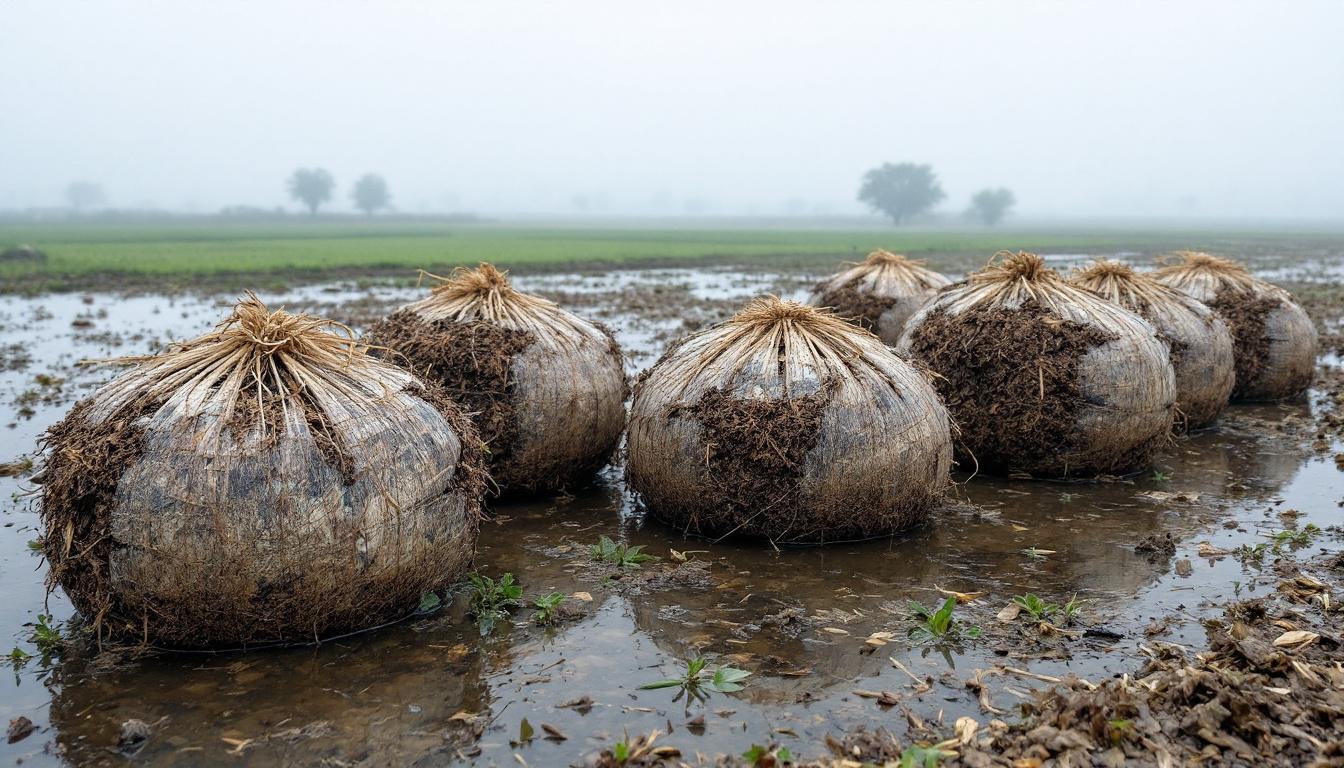
New research from the University of East London reveals that repurposing crop waste into building products offers a durable solution for carbon storage, with significant climate and public health benefits if scaled globally.
Agricultural residues that are routinely burnt or left to rot could be repurposed as a durable method of carbon storage if incorporated into building products, according to new research from the University of East London. The study, published in Cleaner Environmental Systems, used a dynamic life-cycle assessment to model how fibrous crop wastes such as wheat, rice and maize stalks, estimated at about 4.4 billion tonnes of dry matter globally each year, could lock carbon into long-lived construction materials rather than releasing it back into the atmosphere within months.
The dynamic assessment differs from conventional carbon accounting by tracking not only how much carbon is emitted or stored but when those flows occur. That timing, the authors argue, materially affects warming outcomes over decades. Redirecting residues away from open-field burning and short-term uses into products such as insulation, boards and panels could therefore produce a sustained cooling effect over the next century, the researchers say. The climate benefit would increase further if displaced biomass energy were replaced by renewable electricity, the paper notes.
Despite the large theoretical supply of agricultural biomass, the study finds a substantial mismatch between availability and current uptake in durable construction applications. Even with optimistic expansion of bio-based insulation markets, only a modest portion of global residues would be absorbed. To realise the opportunity at scale, the authors call for mainstreaming agricultural fibres across construction value chains rather than confining them to specialist products.
The analysis also highlights co-benefits beyond greenhouse gas mitigation. According to the study, reducing open burning would cut particulate emissions and associated public-health harms in regions where residue burning is common, creating a joint climate and air-quality policy win.
The University of East London has been building a broader research portfolio around alternative, low-carbon construction inputs. Recent projects at the same Sustainability Research Institute include work showing that ground scallop shells can replace part of cement in concrete mixes and reduce embodied CO2 by up to 36% while retaining key material properties. Its Sugarcrete programme, which converts sugarcane bagasse into an ultra-low-carbon construction material, has undergone industry-standard testing for fire performance, strength and thermal conductivity and was shortlisted for a Times Higher Education award. Collaborations to develop high-performance acoustic panels from bagasse further demonstrate practical routes for agricultural biowaste to enter serial production.
Taken together, these efforts point to a wider technological and commercial pathway: substituting portions of high-emission inputs such as Portland cement and virgin mineral insulation with upcycled biomass and industrial by-products. Industry adoption would require certification and standards, adjustments to supply chains, and policies that value stored biogenic carbon in long-lived goods. For building-material manufacturers and project specifiers focused on industrial decarbonisation, the research suggests an underexploited feedstock and a potential lever to reduce embodied emissions while delivering ancillary environmental and social benefits.
The authors caution that the climate gains depend on durable sequestration: products must remain in use for decades and be managed at end of life to avoid prompt re-release of stored carbon. They therefore recommend policy incentives and procurement signals that favour long-lived bio-based materials, investment in processing and manufacturing capacity, and integration with renewable energy to replace any biomass currently used for power.
According to the University of East London study, reframing crop residues from a waste-management issue into a construction feedstock could contribute meaningfully to decarbonisation strategies, provided the construction sector and policymaking communities move beyond pilot projects and build the commercial and regulatory frameworks needed to scale adoption.
- https://naturenews.africa/farm-waste-could-become-long-term-carbon-storage-solution/ – Please view link – unable to able to access data
- https://www.eurekalert.org/news-releases/1114379 – A study from the University of East London reveals that agricultural waste, typically burned or left to decay, can be transformed into long-lasting building materials, effectively acting as a carbon sink. By incorporating fibrous crop residues from wheat, rice, and maize into construction products like insulation and panels, carbon emissions that would usually return to the atmosphere within months can be stored for decades, offering a sustained cooling effect on the climate over the next century.
- https://www.uel.ac.uk/about-uel/news/2025/december/seashells-offer-low-carbon-concrete-breakthrough-study – Researchers at the University of East London have discovered that discarded seashells can be transformed into a low-carbon concrete ingredient. By grinding scallop shells into fine powders and substituting them for part of the cement mix, the team achieved carbon reductions of up to 36%, while maintaining the concrete’s core performance features. This innovation offers a novel route to reducing the environmental burden of cement, which is responsible for around 7% of global carbon emissions.
- https://www.uel.ac.uk/about-uel/news/2023/may/uel-reveals-sugarcrete-low-cost-construction-material – The University of East London’s Master of Architecture and Sustainability Research Institute, with support from Tate & Lyle Sugars, has developed Sugarcrete™, an innovative construction material that upcycles sugarcane waste into sustainable, ultra-low carbon construction alternatives. Sugarcrete™ has been tested to industry standards for fire resistance, compressive strength, thermal conductivity, and durability, demonstrating promising results for use in insulation panels, lightweight blocks, load-bearing blockwork, and structural floor and roof slabs.
- https://www.uel.ac.uk/about-uel/news/2024/september/sustainable-building-material-shortlisted-award – Sugarcrete®, a low-carbon alternative to bricks and concrete developed by the University of East London’s Sustainability Research Institute and School of Architecture, Computing and Engineering, has been shortlisted for Knowledge Exchange/Transfer Initiative of the Year by the Times Higher Education (THE) Awards 2024. This recognition highlights Sugarcrete®’s potential to address climate change by providing a sustainable construction material that upcycles sugarcane waste into construction products.
- https://www.uat.uel.ac.uk/about-uel/news/2025/february/reviving-spains-green-sea-sugarcreter – In a collaboration between the University of East London’s Sugarcrete® team and the Bagaceira Project, high-performance acoustic panels have been developed from agricultural biowaste. The project explores the potential of bagasse, the fibrous residue left after sugarcane processing, for creating functional, eco-friendly acoustic panels, advancing sustainable building solutions that improve indoor air quality and acoustic performance.
- https://www.uat.uel.ac.uk/about-uel/news/2022/march/low-carbon-concrete-can-sustainably-protect-our-coastlines – A newly designed low-carbon concrete mix from the University of East London can reduce CO₂ emissions by 40% compared to traditional concrete. The mix replaces cement with recycled materials, including granulated slag from steelworks and pulverised ash from coal power plants, demonstrating the potential to use up to 60% steel furnace waste without compromising the concrete’s compressive strength.
Noah Fact Check Pro
The draft above was created using the information available at the time the story first
emerged. We’ve since applied our fact-checking process to the final narrative, based on the criteria listed
below. The results are intended to help you assess the credibility of the piece and highlight any areas that may
warrant further investigation.
Freshness check
Score:
10
Notes:
The article was published on January 31, 2026, and is based on a study published in Cleaner Environmental Systems in 2025. No evidence of prior publication or recycled content was found. The narrative appears original and fresh.
Quotes check
Score:
10
Notes:
The article does not contain direct quotes. The information is paraphrased from the original study and related sources. No discrepancies or unverifiable quotes were identified.
Source reliability
Score:
10
Notes:
The article originates from the University of East London, a reputable academic institution. The study is published in Cleaner Environmental Systems, a peer-reviewed journal. No concerns about source reliability were found.
Plausibility check
Score:
10
Notes:
The claims about using agricultural residues for carbon sequestration in building materials are plausible and align with current environmental research. No inconsistencies or implausible elements were identified.
Overall assessment
Verdict (FAIL, OPEN, PASS): PASS
Confidence (LOW, MEDIUM, HIGH): HIGH
Summary:
The article is original, based on recent research from a reputable source, and free from significant issues. All checks have been passed with high scores, indicating strong credibility and reliability.
