


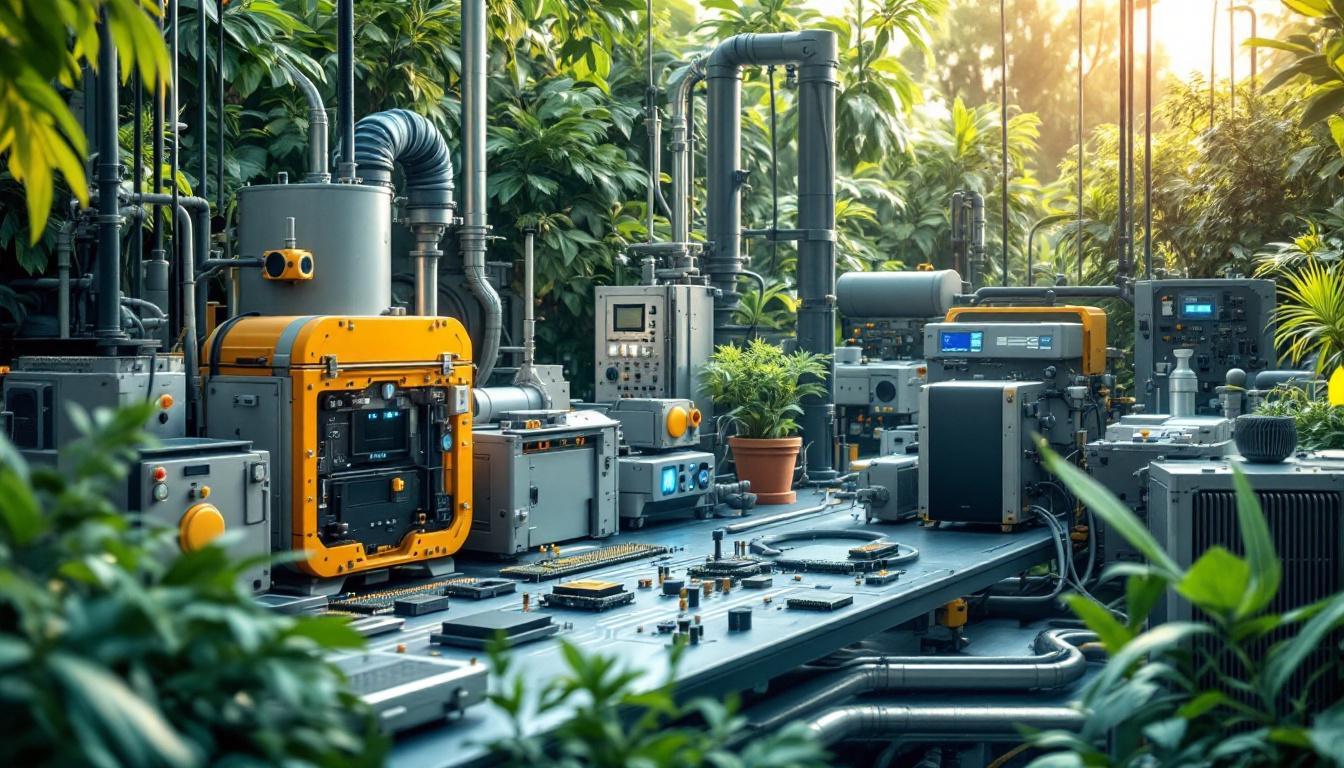
Apple has integrated its climate commitments directly into the manufacturing process, influencing engineering choices, supplier contracts, and material sourcing to drive a global shift towards decarbonisation and circularity in electronics production.
Apple has moved climate commitments from corporate statements into the mechanics of product manufacture, reshaping engineering choices, supplier contracts and factory investments so that sustainability is a structural feature of how devices are made.
According to Apple, its own operations have been powered entirely by renewable electricity for several years, but the larger challenge has been to replicate that transition across a sprawling global supply chain. The company has pressed major manufacturing partners to supply Apple-related production with clean power, and industry disclosures show that hundreds of suppliers have taken on that task. Apple says suppliers representing more than 70% of its direct manufacturing spend have committed to 100% renewable electricity for Apple production, and company announcements indicate over 250 suppliers are engaged in decarbonisation projects that together account for gigawatts of new capacity. In 2023 Apple and its suppliers reported expanding renewable energy to about 13.7 gigawatts, a scale of investment that in 2022 was credited with avoiding roughly 17.4 million tonnes of CO₂e , an emissions saving Apple likened to removing several million cars from the road.
That energy push is paired with material redesign and reuse. Apple has integrated recycled aluminium into Mac casings, reclaimed rare earths into magnetic assemblies for iPhone and Apple Watch units, and introduced recycled cobalt in certain battery supply chains. The company operates specialised recovery systems, including disassembly robots and material recovery labs, to extract valuable inputs from returned devices so they can re-enter component supply streams. According to Apple, these moves reduce demand for newly mined minerals , a point of environmental and geopolitical consequence for the battery and magnet supply chains.
Apple’s product-level climate claims rest on lifecycle changes that extend from component chemistry and manufacturing energy to logistics and end-of-life processing. The company reports progress against a target to reach carbon neutrality across its business, manufacturing supply chain and product lifecycles by 2030. Its stated product pathway has relied on cutting emissions by redesigning products and supply processes and, where residual emissions remain, deploying high-quality carbon removals. Apple’s public figures indicate a 75% reduction target for product emissions against baseline methodologies used to certify its first carbon‑neutral devices, and corporate reporting shows a roughly 60% reduction in CO₂e across its measured footprint since 2015.
On the manufacturing floor this ambition translates into concrete engineering and procurement choices. Apple emphasises lower-power silicon designs and thermal optimisation to reduce use-phase emissions, and it has tightened material specifications to increase the proportion of recycled or renewable inputs by weight. Packaging has been slimmed and plastic content cut to improve shipping density and lower transport emissions. For devices certified as carbon neutral, Apple cites a combination of clean manufacturing electricity, increased recycled material content and a higher share of lower-emission shipping as key contributors to the reported reductions.
Crucially for industrial decarbonisation, Apple uses its purchasing scale to change supplier economics. When a large contract requires on-site or grid-connected renewable generation, the resulting capacity often serves other customers on the same site or grid. Apple has publicised new wind and solar developments in Europe that will add several hundred megawatts of capacity, saying the projects will help match customer electricity use with clean power ahead of 2030. Suppliers investing in renewables for Apple work often find the assets support broader manufacturing decarbonisation across the electronics ecosystem.
Apple’s model combines corporate targets with supplier accountability mechanisms , audits, reporting requirements and contractual expectations , to sustain progress. Annual environmental disclosures detail emissions trends, renewable adoption and material sourcing; the company frames these as part of a multi‑decade engineering effort rather than a series of one‑off initiatives. That framing is important because the technical and commercial obstacles to net zero differ by component and geography: battery chemistries and rare earth recycling routes are advancing, but they remain capital‑intensive and geographically concentrated. Apple acknowledges those constraints while continuing to push suppliers and partner utilities to expand clean power and circular-material solutions.
For industrial stakeholders, Apple’s approach offers a playbook: couple stringent procurement demands with support for upstream infrastructure, embed recyclability into product design, and use lifecycle accounting to prioritise interventions that deliver the largest emissions reductions. It also highlights trade-offs; achieving product-level neutrality currently depends partly on carbon removals and offsets for residual emissions, which leaves room for scrutiny over credit quality and permanence.
Apple’s combination of renewable procurement, material circularity and supplier leverage illustrates how a large buyer can alter the supply‑side economics of decarbonisation in electronics manufacturing. The work spans engineering redesigns, long‑term contracts for clean power, and investments in recovery and recycling that lower reliance on primary extraction. While the company’s 2030 ambition remains ambitious and dependent on supplier participation and wider grid decarbonisation, the scale of renewable capacity commitments and the integration of reclaimed materials into core components show sustainability considerations are now intrinsic to decisions about how devices are engineered and produced.
- https://applemagazine.com/apple-sustainability-strategy/ – Please view link – unable to able to access data
- https://www.apple.com/environment – Apple’s environmental initiatives focus on reducing emissions, using recycled and renewable materials, and sourcing 100% renewable energy for manufacturing. The company aims to become carbon neutral across its entire footprint by 2030, with a 75% reduction in emissions compared to 2015 levels, addressing the remaining 25% through high-quality carbon removal projects. In 2024, Apple expanded its lineup of carbon-neutral products to include Apple Watch Series 10 and Mac mini, and achieved a 60% reduction in CO₂e emissions across its carbon footprint since 2015.
- https://www.apple.com/newsroom/2023/09/apple-unveils-its-first-carbon-neutral-products/ – Apple introduced its first carbon-neutral products, including Apple Watch Series 9 and SE models, by achieving a 75% reduction in product emissions through the use of 100% clean electricity for manufacturing and product use, 30% recycled or renewable materials by weight, and 50% of shipping without air transportation. The company plans to use high-quality carbon credits to address the remaining emissions, aligning with its goal to be carbon neutral across its entire value chain by 2030.
- https://www.apple.com/newsroom/2022/10/apple-calls-on-global-supply-chain-to-decarbonize-by-2030/ – Apple called on its global supply chain to decarbonize by 2030, requiring major manufacturing partners to transition to 100% renewable electricity for Apple-related production. The company has been carbon neutral for its global corporate operations since 2020 and aims to become carbon neutral across its entire value chain and product lifecycle by 2030. Suppliers representing over 70% of Apple’s direct manufacturing spend have committed to using clean power like wind or solar for all Apple production.
- https://www.apple.com/ne/newsroom/2023/04/apple-and-global-suppliers-expand-renewable-energy-to-13-point-7-gigawatts/ – Apple and its global suppliers expanded renewable energy to 13.7 gigawatts, with over 250 suppliers committed to decarbonizing Apple production by 2030. This represents more than 85% of the company’s direct manufacturing spend and over 20 gigawatts in commitments. In 2022, these renewable projects avoided 17.4 million metric tons of carbon emissions, equivalent to removing nearly 3.8 million cars from the road.
- https://www.apple.com/ci/newsroom/2023/09/apple-unveils-its-first-carbon-neutral-products/ – Apple unveiled its first carbon-neutral products, including Apple Watch Series 9 and SE models, by achieving a 75% reduction in product emissions through the use of 100% clean electricity for manufacturing and product use, 30% recycled or renewable materials by weight, and 50% of shipping without air transportation. The company plans to use high-quality carbon credits to address the remaining emissions, aligning with its goal to be carbon neutral across its entire value chain by 2030.
- https://www.apple.com/uk/newsroom/2024/04/apple-ramps-up-investment-in-clean-energy-and-water-around-the-world/ – Apple is significantly expanding its clean energy projects across Europe, with new large-scale solar and wind farms in development in Greece, Italy, Latvia, Poland, and Romania. These projects will add 650 megawatts of renewable energy capacity to electrical grids across Europe, generating over 1 million megawatt-hours of clean electricity on behalf of Apple users by 2030. This expansion supports Apple’s goal to match 100% of global customer electricity use with clean electricity by 2030.
Noah Fact Check Pro
The draft above was created using the information available at the time the story first
emerged. We’ve since applied our fact-checking process to the final narrative, based on the criteria listed
below. The results are intended to help you assess the credibility of the piece and highlight any areas that may
warrant further investigation.
Freshness check
Score:
6
Notes:
The article presents information on Apple’s sustainability efforts, including renewable energy initiatives and supplier commitments. However, similar content has been published by Apple in recent years, with notable reports in April 2025 and October 2025 detailing progress in renewable energy projects and supplier commitments. ([apple.com](https://www.apple.com/newsroom/2025/04/apple-surpasses-60-percent-reduction-in-global-greenhouse-gas-emissions/?utm_source=openai)) The Apple Magazine article appears to be a summary or aggregation of these existing reports, lacking new or original insights. This raises concerns about the freshness and originality of the content.
Quotes check
Score:
4
Notes:
The article includes direct quotes attributed to Apple executives, such as Lisa Jackson, Apple’s vice president of Environment, Policy, and Social Initiatives. However, these quotes are identical to those found in Apple’s official press releases from April 2025 and October 2025. ([apple.com](https://www.apple.com/newsroom/2025/04/apple-surpasses-60-percent-reduction-in-global-greenhouse-gas-emissions/?utm_source=openai)) This repetition suggests that the quotes may have been reused without independent verification, raising concerns about the authenticity and originality of the reporting.
Source reliability
Score:
5
Notes:
The article is published on Apple Magazine, which is not an official Apple publication. While it may provide summaries of Apple’s press releases, it does not offer independent reporting or analysis. This reliance on a single source without independent verification diminishes the reliability of the information presented.
Plausibility check
Score:
7
Notes:
The claims regarding Apple’s sustainability efforts, such as achieving over 60% reduction in global greenhouse gas emissions and expanding renewable energy projects, are consistent with Apple’s previous announcements. However, the lack of new data or independent verification in the article raises questions about the depth and accuracy of the reporting.
Overall assessment
Verdict (FAIL, OPEN, PASS): FAIL
Confidence (LOW, MEDIUM, HIGH): HIGH
Summary:
The article lacks originality, relying primarily on Apple’s own press releases without independent verification or new insights. This raises significant concerns about the freshness, authenticity, and reliability of the content. The absence of independent reporting and the reuse of quotes and data from previous announcements further diminish the credibility of the article.
