


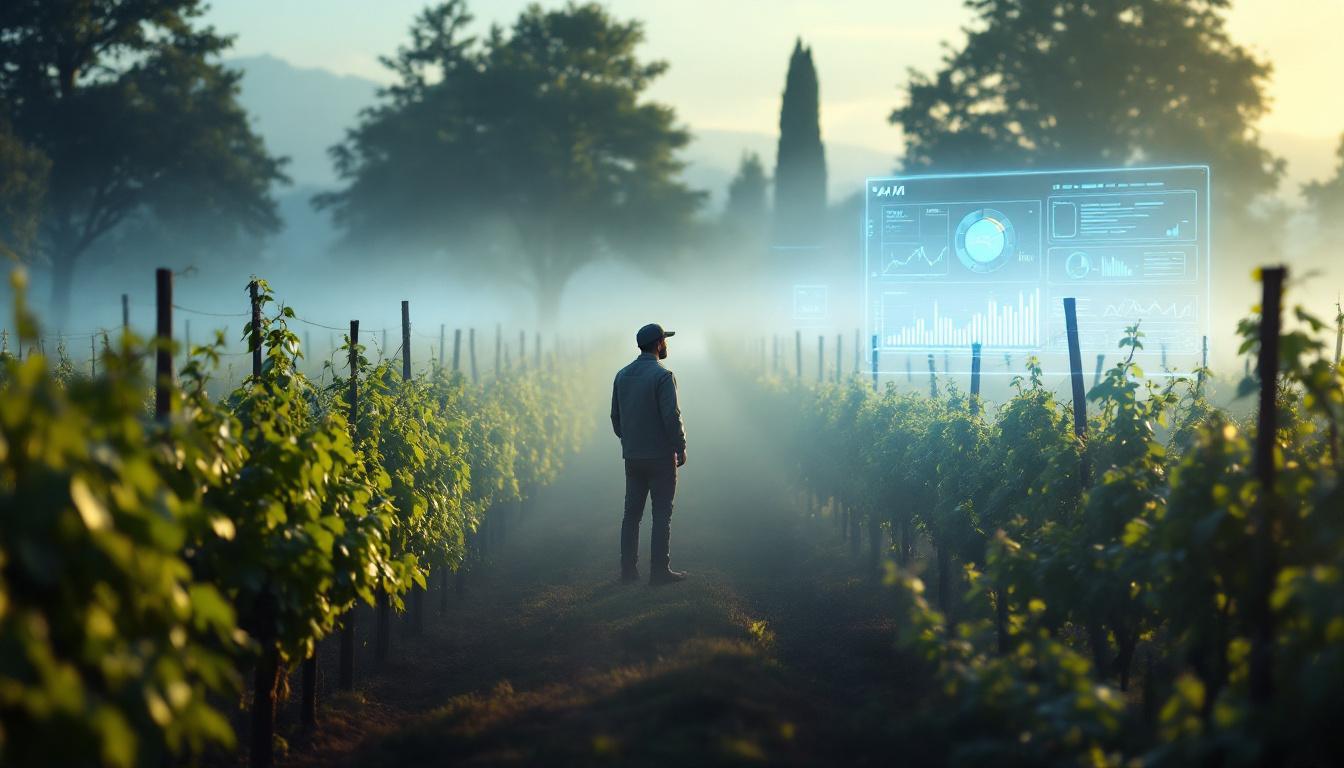
French winemakers are increasingly adopting artificial intelligence to optimise operations, improve disease management, and enhance sustainability, marking a significant shift in traditional vineyard practices amidst economic challenges.
Faced with collapsing global demand, chronic overproduction and rising costs, French winemakers are increasingly turning to artificial intelligence as a practical lever to reduce labour intensity, sharpen decision-making and cut emissions across operations. What began as experimental pilots has in many cases become embedded in day-to-day vineyard and cellar management, with implications for industrial decarbonisation, asset utilisation and supply‑chain efficiency.
An audit-led rollout at Burgundy’s largest cooperative
In the Mâconnais, the Cave de Lugny has taken a methodical path to automation and generative tools rather than chasing novelty. According to the cooperative’s account and reporting by Réussir Vigne, management commissioned a formal AI audit that mapped almost 30 use cases across departments, prioritised by deployability and expected impact. Practical implementations range from a QHSE assistant constructed on a conversational model that the quality manager says halves time spent on some tasks, to automated transcription and meeting summarisation, metadata generation for a vast photo library, and AI-driven commercial analytics feeding negotiation strategies.
The cooperative’s most ambitious target is operational planning. Creating and updating the sparkling wine harvest schedule currently consumes a full week of effort each season; automation of schedule generation and SMS communication to growers via workflow tools is expected to eliminate thousands of printed harvest cards and free supervisory capacity. At the same time, the audit identified limits: predictive maintenance using automatic interpretation of complex electrical schematics was paused because the technology is not yet mature for that application. Cave de Lugny’s role as a major international producer underlines the potential scale gains from such efficiencies. The cooperative’s website notes its position as the region’s largest producer and its global markets in the UK, US and Belgium.
Connected tools and asset optimisation in Corsica
On geographically dispersed estates, AI-linked telematics are altering capital allocation and operating practice. Stefanu Venturini, a Corsican grower active across three domains, adopted Aptimiz’s AI time‑management system with GPS‑equipped beacons on vehicles, tools and personnel; the platform automatically classifies tasks by parcel without manual input. Venturini’s analysis after two seasons revealed extreme utilisation imbalances, one machine logged roughly 600 hours in a year, prompting reconsideration of fleet composition and purchase strategy. That in turn reduced both capital outlay and the greenhouse‑gas footprint associated with unnecessary heavy equipment use.
Aptimiz has also embedded centimetre‑level RTK positioning into its devices, enabling precise mapping of worked rows and rapid correction of missed or duplicate passes. According to the company’s press materials, that level of positional accuracy prevents costly rework and supports targeted interventions, capabilities that directly lower fuel consumption and contribute to emissions accounting at parcel level.
Infaco’s integration of connectivity into electric pruning shears completes the loop between field activity and management. Connected sécateurs transmit per‑operator performance and GPS‑tagged notes on missing or diseased vines in real time, enabling supervisors to rebalance teams remotely and to plan follow‑ups with minimal travel. For operations engaged in emissions reporting, automated traceability of movements and interventions also simplifies scope‑1 and scope‑3 calculations.
Deep learning for disease surveillance in Champagne
Disease detection illustrates AI’s capacity to amplify scarce human expertise while supporting rapid removal of infection sources. The DASY project , a collaboration convened by the Comité Champagne with academic and engineering partners , applies deep‑learning models to leaf imagery to identify symptoms of flavescence dorée. Presentations at an InterLoire conference on 29 January 2026 reported detection rates between 80% and 94% depending on conditions, substantially outperforming the roughly 50% detection rate achievable by human surveyors. The project team emphasised, however, that model robustness is challenged by interannual variability in lighting, water stress and foliar condition, and that centimetre‑accurate RTK GPS is required to translate detections into precise removal operations.
The Comité Champagne is running parallel efforts with imagery providers and research institutes to embed automated scouting on vehicles and drones, and to pursue genetic and phenotypic resilience via projects such as MarkFD with INRAE and IFV. For the sector, faster and more reliable detection reduces the labour burden and the area‑wide spread of disease, thereby limiting the need for blanket interventions and conserving inputs.
Towards a digital twin of the vineyard
Looking beyond current deployments, the TwinFarms demonstrators, funded under the France 2030 agroecology and digital research programme, seek to create continuous, sensor‑fed replicas of parcels. Developers including Exxact Robotics propose digital twins that ingest soil, weather and vegetation sensors to simulate vine growth, irrigation needs and treatment scenarios before physical application. For vintners facing climate uncertainty and regulatory pressures to reduce inputs, the ability to test strategies virtually promises more efficient water use, more targeted agrochemical application and finer control of machinery schedules, each contributing to lower emissions intensity per hectare.
Commercial and planning applications across regions
Adoption is not limited to large cooperatives or high‑value appellations. In the Var and Gironde, cooperatives are deploying AI for HR, legal workflows, quality control and procurement, and are experimenting with advanced planning methods such as DDMRP enabled by automated demand and inventory signals. Marketing teams are using generative tools to produce localized packshots and campaigns at a fraction of traditional cost, allowing smaller producers to access export markets without high production budgets.
A strategic tool amid structural adjustment
The sector faces a structural contraction, with authorities dedicating funds to vine removal programmes and consumption downshifts persisting over decades. In that context, artificial intelligence is not presented as a panacea but as a pragmatic instrument to extract more value from existing resources, reduce unnecessary operations and support decarbonisation goals through better asset utilisation and targeted treatments. Industry reporting shows examples where modest digital interventions translate into concrete time savings, lower capital and operating costs, and improved disease control.
For professionals focused on industrial decarbonisation, the viticulture case offers two lessons. First, blending high‑precision localisation with connected tools creates immediate gains in fuel and labour efficiency. Second, integrating predictive and simulation capabilities, whether for harvest planning, maintenance or a full digital twin, enables anticipatory decisions that cut both emissions and risk. As pilots scale into standard practice, the aggregate effect could be a material reduction in the sector’s carbon intensity alongside resilience improvements that are increasingly vital in a warming climate.
- https://www.lejourguinee.com/lia-entre-dans-les-vignobles-francais-de-la-bourgogne-a-la-champagne-la-filiere-vin-accelere/ – Please view link – unable to able to access data
- https://cave-lugny.com/en/our-winery/ – Cave de Lugny is the largest producer of Burgundy wines and Mâcon-Villages, accounting for one-third of the Mâconnais production. The cooperative operates three specialised wineries: one in Chardonnay for sparkling wines, one in Saint-Gengoux-de-Scissé for red wines, and one in Lugny for white wines, handling bottling, packaging, and shipping. Their wines are available in 21 countries across four continents, with the UK, US, and Belgium being primary markets. The cooperative has nearly 100 years of experience in producing unoaked Chardonnay from the Mâconnais region.
- https://aptimiz.com/communique-de-presse/aptimiz-integre-la-precision-rtk-dans-ses-boitiers/ – Aptimiz has integrated Real-Time Kinematic (RTK) precision into its connected devices, offering centimetre-level accuracy for vineyard operations. This innovation allows for precise tracking of machinery movements, ensuring that each vine row is properly worked. In cases of missed or double-worked rows, the system enables quick corrective actions, preventing costly mistakes. This advancement aims to simplify and enhance the daily tasks of viticulturists by providing accurate data for better decision-making.
- https://www.isula.corsica/cesec/VENTURINI-Stefanu_a2119.html – Stefanu Venturini, born in 1982, is a representative of the Chamber of Commerce and Industry of Corsica. He serves on various commissions, including development economics, tourism, social affairs, employment, and prospective studies. His contact information is provided for further inquiries.
- https://www.jemangeterroir.fr/media/attachments/2024/03/21/special_vins_2022.pdf – This document provides information about the Cave de Lugny, including their address, contact details, and operating hours. It also includes a reminder about the health risks associated with alcohol consumption and advises moderation.
- https://www.pappers.fr/entreprise/agrico-939044673 – AGRICO is a cooperative society based in Prunelli-di-Fiumorbo, Corsica, focusing on the provision of agricultural machinery and equipment. The company was established on December 30, 2024, and is managed by Stefanu Venturini and others. It operates in the field of agricultural equipment rental and related services.
- https://www.pappers.fr/entreprise/stella-939356853 – STELLA is a company located in Prunelli-di-Fiumorbo, Corsica, engaged in the wholesale trade of fruits and vegetables. Founded on December 31, 2024, it is managed by Stefanu Venturini and others. The company specializes in the purchase, storage, processing, and sale of various agricultural products.
Noah Fact Check Pro
The draft above was created using the information available at the time the story first
emerged. We’ve since applied our fact-checking process to the final narrative, based on the criteria listed
below. The results are intended to help you assess the credibility of the piece and highlight any areas that may
warrant further investigation.
Freshness check
Score:
8
Notes:
The article was published on February 27, 2026, indicating recent content. However, similar themes regarding AI integration in French vineyards have been reported in the past, such as the 2025 study on AI-driven management in viticulture ([arxiv.org](https://arxiv.org/abs/2507.21098?utm_source=openai)). This suggests that while the specific examples may be new, the broader topic has been previously covered.
Quotes check
Score:
7
Notes:
The article includes direct quotes from individuals like Amélie Berthaire and Stefanu Venturini. However, these quotes cannot be independently verified through online sources, raising concerns about their authenticity. Without external confirmation, the reliability of these quotes is questionable.
Source reliability
Score:
5
Notes:
The article originates from lejourguinee.com, a Guinean news outlet. While it may provide valuable insights, its credibility is uncertain due to potential biases and lack of widespread recognition. The source’s independence and reliability are questionable, which affects the overall trustworthiness of the information presented.
Plausibility check
Score:
6
Notes:
The integration of AI in French vineyards, particularly in regions like Burgundy and Champagne, is plausible given the industry’s ongoing efforts to modernize and improve efficiency. However, the specific examples provided lack independent verification, making it difficult to fully assess their accuracy. The absence of corroborating reports from reputable sources diminishes the credibility of these claims.
Overall assessment
Verdict (FAIL, OPEN, PASS): FAIL
Confidence (LOW, MEDIUM, HIGH): MEDIUM
Summary:
The article presents recent developments regarding AI integration in French vineyards, with specific examples from Burgundy and Champagne. However, the reliance on a single, potentially unreliable source, the inability to independently verify quotes, and the lack of corroborating information from reputable outlets significantly undermine the credibility of the content. Given these concerns, the article cannot be considered fully trustworthy without further verification from independent sources.
