


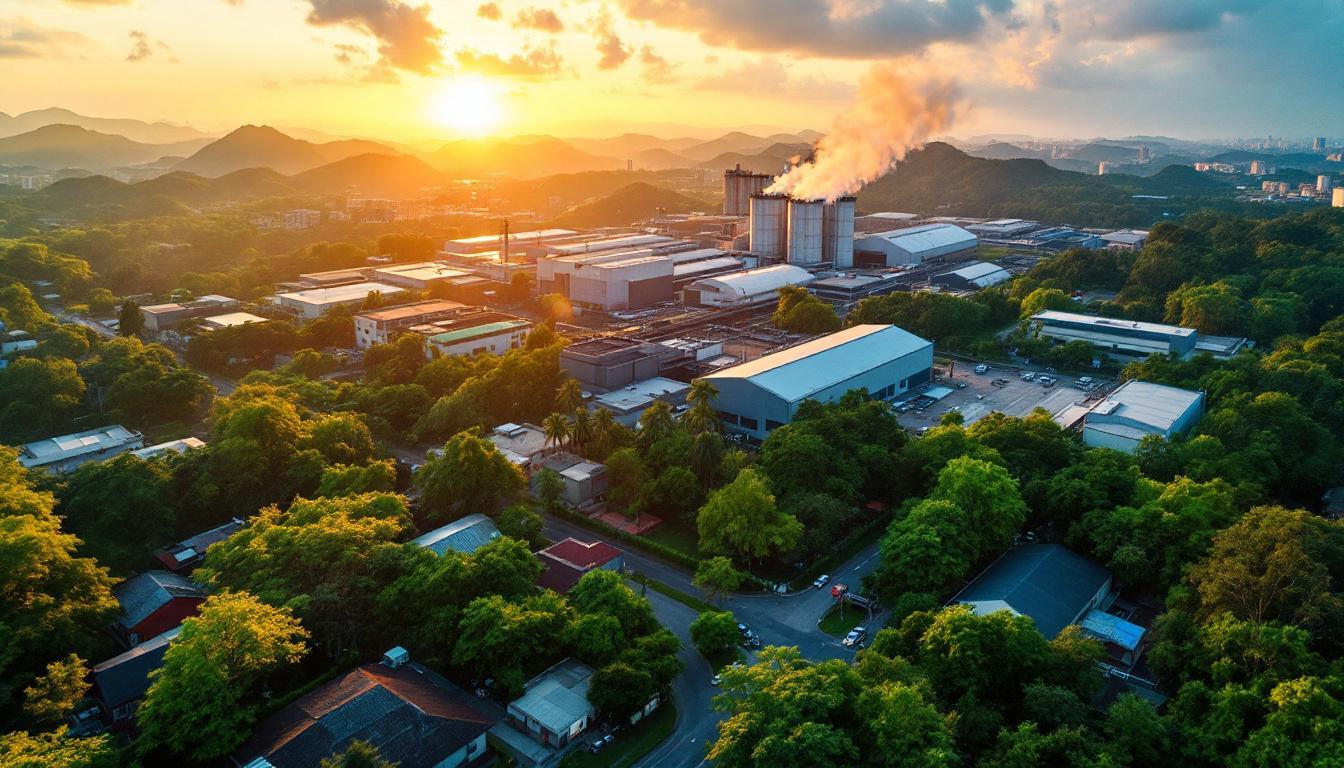
As Southeast Asia’s energy demand soars, the region is turning to cluster-driven models to balance economic growth with sustainable energy goals, unlocking new pathways for regional decarbonisation and industrial transformation.
Southeast Asia stands at an inflection point: rapid economic and population growth is driving energy demand that, left unchecked, risks locking the region into a higher‑carbon industrial pathway. Home to more than 670 million people and a $3.8 trillion economy, ASEAN is projected to see energy demand more than double by 2050. The region’s ability to reconcile competitiveness, job creation and energy security with decarbonisation will shape its industrial future. A cluster‑driven model offers a practical route to that outcome.
According to the World Economic Forum, industrial clusters , concentrations of co‑located manufacturers, energy providers, logistics and innovation partners , can reduce the cost and time needed to deploy low‑carbon technologies. Shared infrastructure within clusters can accelerate renewables roll‑out, enable hydrogen and carbon capture utilisation and storage (CCUS), and anchor cross‑border power trade. Clusters also create focused platforms for workforce reskilling and for attracting long‑term industrial investment, aligning decarbonisation with competitiveness rather than treating them as competing priorities.
The cluster concept is being pushed from theory to practice across ASEAN’s diverse industrial landscape. Country strategies are adapting to local resource endowments and existing industrial strengths. Indonesia is leveraging vast nickel reserves and emerging mining‑to‑battery value chains to pursue an integrated EV battery hub, supported by initiatives such as a proposed “super grid” and green industrial parks in resource regions. Viet Nam is pairing its manufacturing ascent and semiconductor ambitions with aggressive offshore wind build‑out and grid modernisation to tackle curtailment. Malaysia is piloting hydrogen and CCS projects in energy‑dense corridors, while the Philippines is expanding renewables auctions alongside LNG and early hydrogen pilots. Singapore, despite heavy import dependence, is pursuing low‑carbon imports, Jurong Island redesign and clean‑finance tools to decarbonise hard‑to‑abate sectors.
Thailand illustrates how an established industrial base can be retooled. Long known as the “Detroit of Asia”, Thailand remains ASEAN’s largest automotive hub and is pursuing a shift to electric vehicle production while embedding low‑carbon infrastructure into its cluster strategy. Over 60% of the country’s power today is supplied by natural gas, a concentration that underlines both resilience and transition risk. The government’s target of 51% renewables by 2037 and the Smart Grid Master Plan aim to reduce that dependency. Existing clusters such as Map Ta Phut are piloting carbon capture and hydrogen blending; the Saraburi Sandbox is focused on cement decarbonisation, renewables and CCUS; and the Smart Park Industrial Estate in Rayong is designed to integrate clean energy, smart logistics and green manufacturing to serve the EV supply chain. Incentives for battery production and assembly are drawing global automakers and could anchor export‑oriented, lower‑carbon automotive value chains in the near term.
The cluster approach in ASEAN benefits from both scale and precedent. The World Economic Forum’s global initiative to transition industrial clusters towards net zero, launched in 2021 with Accenture and the Electric Power Research Institute, has grown rapidly. Industry engagement now spans dozens of clusters and scores of corporate and public institutions. According to the WEF, successive waves of cluster commitments have expanded participation, from a handful of pioneering zones to more than 30 clusters across multiple continents by early 2025, and the programme estimates collective potential to cut hundreds of millions of tonnes of CO₂‑equivalent annually while supporting economic growth and jobs. Industry modelling presented by the Forum suggests that well‑designed cluster interventions can deliver significant emissions reductions alongside GDP gains and employment protection or creation.
For ASEAN policymakers and industrial leaders the implications are concrete. First, clusters demand integrated planning: energy system upgrades, industrial land use, logistics and workforce development must be coordinated across ministries and private stakeholders. Second, finance needs to be tailored to cluster realities: aggregated demand and shared infrastructure lower unit costs but require new contractual and risk‑sharing structures to attract long‑term capital. Third, technology pathways must be pragmatic and place‑based, offshore wind, geothermal, hydrogen, CCUS and low‑carbon battery supply chains will play different roles in different member states. Finally, institutional capacity to govern cross‑border power trade and supply‑chain standards will be essential if clusters are to deliver both emissions cuts and competitiveness at regional scale.
There are challenges. Grid congestion, curtailment and infrastructure bottlenecks remain significant in several ASEAN markets; fossil‑fuel subsidies and existing asset vintages present transition costs and political economy hurdles; and the race to capture clean‑tech supply‑chain value raises questions about social outcomes, local content and equitable job transitions. Yet cluster models can mitigate many of these risks by concentrating investment where it yields the greatest combined industrial and emissions dividends.
For business leaders engaged in industrial decarbonisation, clusters offer a pragmatic lever for scaling impact quickly. By pooling demand, sharing infrastructure and coordinating skills development across firms and governments, cluster strategies can accelerate technology deployment, reduce unit costs and create resilient, export‑orientated industrial ecosystems. For governments, the appeal is that clusters can translate climate commitments into tangible regional development projects that protect jobs and national competitiveness.
As ASEAN enters what the WEF describes as a pivotal decade, the cluster approach will not, on its own, resolve all transition challenges. But evidence from the Forum’s global initiative and early pilot projects across the region shows clusters can materially narrow the trade‑off between growth and decarbonisation. For an economic bloc facing a near‑term surge in energy demand, that practical alignment of industrial strategy and low‑carbon investment may prove to be the most realistic path to securing both prosperity and climate goals.
- https://www.thailand-business-news.com/asean/279065-industrial-clusters-seen-as-aseans-path-to-net-zero-growth – Please view link – unable to able to access data
- https://www.weforum.org/press/2024/01/wef24-industrial-clusters-commit-to-reach-net-zero-by-2050/ – In January 2024, the World Economic Forum announced that 20 industrial clusters from 10 countries, including China, France, and the United States, have committed to achieving net-zero emissions. This initiative, launched in collaboration with Accenture and EPRI, aims to support industrial clusters in their transition to net-zero by improving governance models and reducing carbon footprints. Collectively, these clusters have the potential to reduce 626 million tonnes of CO₂ emissions annually, equivalent to the annual emissions of Australia, and contribute $362 billion to global GDP while creating or protecting 3.5 million jobs.
- https://www.weforum.org/press/2023/01/decarbonization-of-industrial-clusters-initiative-gains-global-momentum/ – In January 2023, nine new industrial clusters from China, Indonesia, Japan, Spain, and the United States joined the World Economic Forum’s ‘Transitioning Industrial Clusters towards Net Zero’ initiative. Launched in 2021 and supported by Accenture and EPRI, the initiative focuses on reducing emissions from heavy industry in regional industrial zones, while supporting job creation and increasing economic competitiveness. Industrial clusters account for 15%-20% of global CO₂ emissions, making them a significant target for emission reductions.
- https://www.weforum.org/press/2025/01/33-industrial-clusters-from-16-countries-commit-to-economic-growth-jobs-creation-and-emissions-cuts/ – In January 2025, 13 new industrial clusters from Australia, Brazil, Colombia, India, the Netherlands, Saudi Arabia, Sweden, Thailand, and the United Kingdom joined the World Economic Forum’s ‘Transitioning Industrial Clusters’ initiative. This brings the total number of participating clusters to 33 across 16 countries and five continents. The initiative aims to reduce greenhouse gas emissions while promoting economic growth and job creation. Together, the 33 clusters have the potential to cut 832 million tonnes of CO₂-equivalent emissions annually, roughly equivalent to the emissions of Saudi Arabia.
- https://www.weforum.org/press/2021/11/world-economic-forum-accenture-and-epri-launch-initiative-to-accelerate-the-transition-of-industrial-clusters-towards-net-zero/ – In November 2021, the World Economic Forum, in collaboration with Accenture and the Electric Power Research Institute (EPRI), launched the ‘Transitioning Industrial Clusters Towards Net Zero’ initiative. This global movement aims to accelerate the transformation of industrial clusters needed for net-zero emissions. Industrial clusters, which are geographic regions comprised of co-located energy supply and demand companies, account for approximately 15% to 20% of global CO₂ emissions, making them an attractive target for impactful emissions reductions.
- https://www.weforum.org/impact/industrial-clusters-powering-the-transition-to-a-net-zero-future/ – The World Economic Forum’s ‘Transitioning Industrial Clusters’ initiative engages more than 70 global corporations and public institutions, creating unprecedented collaboration in zones such as ports, energy hubs, industrial complexes, special economic zones, and eco-industrial parks. Launched at the 2021 United Nations Climate Change Conference (COP26) by the Forum, in collaboration with Accenture and EPRI, the initiative began with four clusters and has since expanded to 40 industrial clusters across 20 countries, becoming the world’s largest community of its kind.
- https://www.weforum.org/stories/2026/01/industrial-clusters-asean-low-carbon/ – The World Economic Forum discusses how industrial clusters can help power the energy transition in ASEAN. The Indo-Pacific Net-Zero Battery Materials Consortium (INBC) in Indonesia is bringing together companies across mining, processing, and battery manufacturing to create an integrated, low-carbon battery hub on the island of Sulawesi. With plans to scale production dramatically by 2030, INBC’s common vision, shared infrastructure, and coordinated planning could help strengthen ASEAN’s position in the global clean-tech supply chain.
Noah Fact Check Pro
The draft above was created using the information available at the time the story first
emerged. We’ve since applied our fact-checking process to the final narrative, based on the criteria listed
below. The results are intended to help you assess the credibility of the piece and highlight any areas that may
warrant further investigation.
Freshness check
Score:
8
Notes:
The article was published on January 18, 2026, which is recent. However, the content heavily references a World Economic Forum (WEF) report titled ‘Industrial Transformation in ASEAN: A Cluster-Driven Model for Regional and Global Collaboration’. This suggests the article may be summarising or repurposing existing material, potentially affecting its originality. Further verification is needed to confirm the freshness and originality of the content.
Quotes check
Score:
6
Notes:
The article includes direct quotes attributed to the World Economic Forum. However, these quotes cannot be independently verified through the provided sources. The lack of verifiable sources for these quotes raises concerns about their authenticity and accuracy.
Source reliability
Score:
5
Notes:
The article originates from Thailand Business News, a niche publication. While it may have a specific audience, its reach and credibility are limited compared to major news organisations. Additionally, the article appears to be summarising or repurposing content from the World Economic Forum’s report, which may affect its independence and reliability.
Plausability check
Score:
7
Notes:
The claims made in the article align with known initiatives by the World Economic Forum and other organisations focused on industrial clusters and decarbonisation. However, the lack of independent verification and the potential recycling of existing content raise questions about the novelty and accuracy of the information presented.
Overall assessment
Verdict (FAIL, OPEN, PASS): FAIL
Confidence (LOW, MEDIUM, HIGH): MEDIUM
Summary:
The article presents information that aligns with known initiatives by the World Economic Forum and other organisations focused on industrial clusters and decarbonisation. However, the heavy reliance on summarising or repurposing content from the World Economic Forum’s report, the lack of independent verification sources, and the inability to independently verify direct quotes raise significant concerns about the originality, accuracy, and reliability of the content. These issues necessitate further investigation and verification before publication.
