


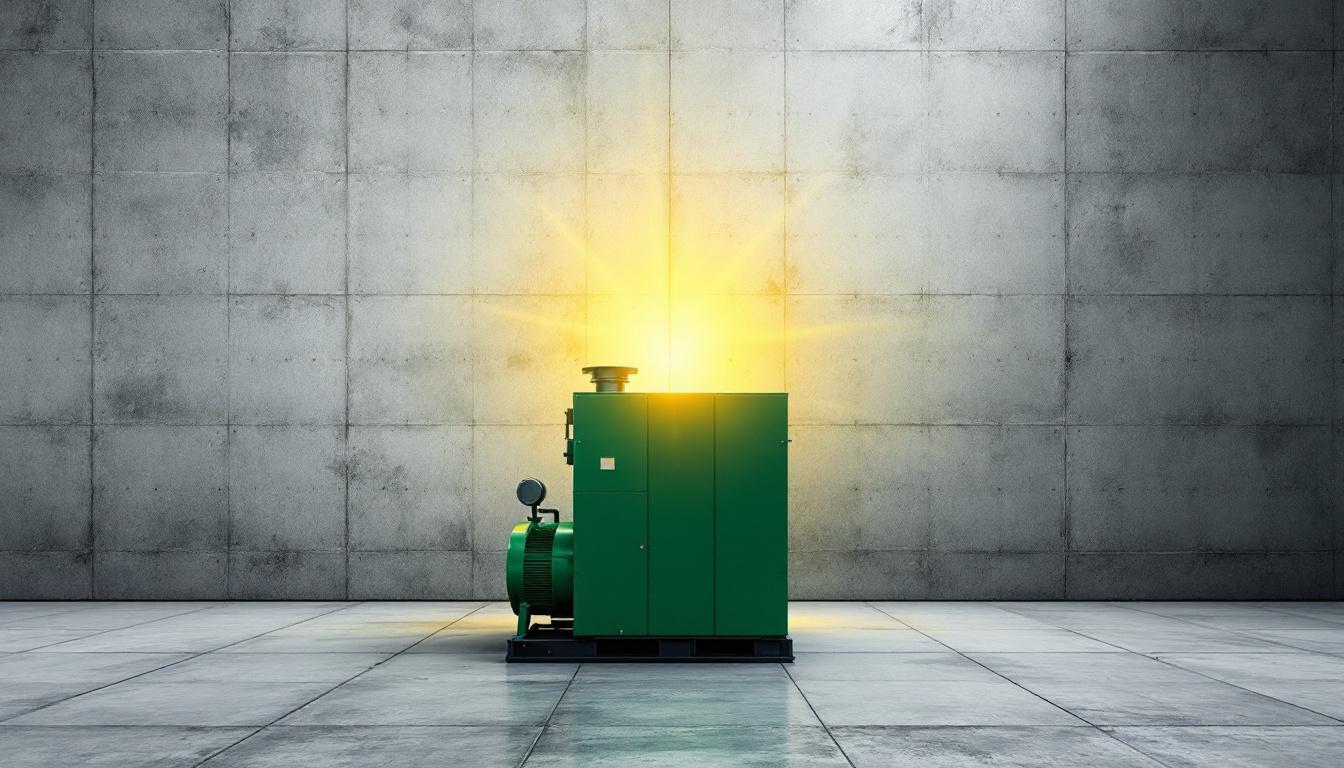
Cambridge‑based AtmosZero unveils a modular, electric heat‑pump system designed to replace traditional combustion boilers in factories, promising significant reductions in CO2 emissions and operational costs as it prepares for commercial roll-out in 2026.
More than two centuries after the steam boiler powered the Industrial Revolution, a Cambridge‑educated team is pitching a product they say can help electrify the boiler room without disrupting how factories operate. According to an MIT News profile, AtmosZero , founded by Addison Stark SM ’10, PhD ’14, Todd Bandhauer and Ashwin Salvi , has developed a modular heat‑pump system that produces steam up to 150°C and is intended to act as a drop‑in replacement for combustion boilers.
The company says its first 1‑megawatt system uses ultra‑efficient compressor technology and requires roughly half the electricity of resistive electric boilers, offering a lower operating cost than many commercially available electric options. AtmosZero’s approach uses ambient air as a heat source to vaporise a working fluid, then drives that vapour through precision compressors and heat exchangers to reach temperatures sufficient to boil water for process steam. The company claims the design can recover heat from the refrigerant and ramp up and down to match existing process demand, avoiding changes to on‑site operations that many manufacturers are reluctant to accept.
“Steam is the most important working fluid ever,” Stark told MIT News. His point underscores why decarbonising steam is central to industrial emissions reduction: industry uses steam across paper, chemicals, pharmaceuticals and food production, and steam generation accounts for a material share of global energy‑related CO2. Industry estimates cited in the lead reporting put annual emissions from steam generation at more than 2.2 gigatonnes of CO2, roughly 5% of global energy‑related emissions.
AtmosZero has moved quickly from laboratory concept to commercialisation planning. Company materials and press releases say it has closed a $21 million Series A round led by Engine Ventures and 2150, with participation from strategic investors including Constellation Technology Ventures and Energy Impact Partners, to accelerate commercial roll‑out. The firm also announced it has opened a 100,000 sq ft factory in Loveland, Colorado, engineered to produce up to 100 Boiler 2.0 units per year, with commercial shipments planned to begin in 2026 and financial support reportedly including up to $24.3 million from U.S. federal programmes.
The company is operating a pilot 650 kW unit at a customer site near Loveland and says its systems can be installed in an afternoon and commissioned within days with “zero downtime.” AtmosZero is initially targeting manufacturing facilities with peak thermal demands under 10 MW , a segment that represents most U.S. plants , and plans to deliver a small number of units over the next one to two years before scaling to hundreds annually.
Industry observers will note two tensions in AtmosZero’s value proposition. First, heat pumps face thermodynamic limits as they raise supply temperature, making high‑temperature industrial steam harder to achieve with very high coefficients of performance. AtmosZero argues it has optimised compressor stages and manufacturing precision for the refrigerants and operating windows that matter for steam applications. Second, some electrified boiler alternatives depend on waste‑heat integration or significant on‑site retrofits; AtmosZero positions its product as avoiding that complexity by using ambient air as the primary heat source, thereby reducing installation friction and capital costs.
The company has also been widening its ecosystem. Business announcements indicate a pilot with New Belgium Brewing through a Danfoss partnership and the appointment of industry veteran Michael Schwartz, formerly President and CEO of Daikin Applied Americas, to AtmosZero’s board to support global scale‑up. According to company market materials, the Boiler 2.0 platform eliminates on‑site carbon, NOx and particulate emissions and is suited to industrial and district heating applications where steam is a common utility.
For industrial energy managers and decarbonisation decision‑makers, the key questions now are operational durability, lifecycle cost against incumbent gas solutions in locations with varying electricity prices, and how rapidly supply chains and factory throughput can scale to meet demand. AtmosZero is emphasising manufacturability and modularity as the route to rapid adoption; “Cost‑effectively electrifying that requires innovation that can scale. In other words, it requires a mass‑produced product , not one‑off projects,” Stark said.
The company’s trajectory will be watched closely by plant engineers and sustainability leads because steam is embedded deeply in industrial process design: removing it is often impractical, so providing low‑emissions steam at compatible temperatures and pressures is a pragmatic decarbonisation lever. As AtmosZero moves from pilots to commercial shipments and factory ramp‑up in 2026, purchasers will expect independent performance data on seasonal and part‑load efficiency, maintenance intervals and total cost of ownership compared with gas boilers plus carbon‑abatement options. Industry data and procurement teams will also want clarity on refrigerant choices, lifecycle environmental impacts and integration with facilities’ electrical capacity and resilience planning.
If AtmosZero’s claims about compressor efficiency and rapid deployability are borne out in commercial operation, the product could become a practical pathway for many manufacturers to electrify a stubbornly high‑emitting part of their footprint. As Stark reflected on the company’s mission, “The only path to seeing this invention brought out into the world was to found and run the company.” Whether that path scales at the pace industry requires will depend on the coming 12–24 months of pilot results, factory output and customer economics.
- https://news.mit.edu/2026/atmoszero-electrifies-boilers-to-decarbonize-industry-0121 – Please view link – unable to able to access data
- https://www.globenewswire.com/news-release/2025/02/10/3023394/0/en/AtmosZero-Opens-New-Factory-in-Colorado-to-Deliver-Decarbonized-Steam-Globally.html – AtmosZero has inaugurated a 100,000 square-foot manufacturing facility in Loveland, Colorado, marking a significant step in commercialising its Boiler 2.0 technology. This facility aims to produce up to 100 Boiler 2.0 units annually, with commercial shipments slated to commence in 2026. The company has also secured up to $24.3 million in funding from the U.S. Department of Energy and Treasury Department to support this expansion. CEO Addison Stark emphasised the importance of manufacturing a modular, scalable product that can be deployed promptly to meet global demand for electrified steam solutions.
- https://atmoszero.energy/press-release/atmoszero-closes-21-million-in-series-a/ – AtmosZero has successfully closed a $21 million Series A funding round, co-led by Engine Ventures and 2150, to accelerate the commercialisation of its Boiler 2.0 technology. The round also saw participation from Constellation Technology Ventures, Energy Impact Partners, Starlight Ventures, and AENU. The company’s Boiler 2.0 technology extracts heat from the air to deliver high-temperature steam with maximum efficiency and zero carbon emissions, enabling companies to replace existing natural gas and oil boilers swiftly and cost-effectively.
- https://atmoszero.energy/markets-and-applications/ – AtmosZero offers a zero-carbon industrial heat pump boiler that delivers low-cost decarbonised steam for various industrial and district heating applications. Their Boiler 2.0 technology serves as a drop-in replacement for fossil-fuelled industrial boilers, eliminating on-site carbon, NOx, and particulate matter emissions. The system operates using ambient air as its heat source, providing a limitless supply for steam production. The modular design allows for easy integration into existing facility processes with minimal construction costs or downtime, enabling rapid deployment and operation.
- https://www.businesswire.com/news/home/20230627537667/en/AtmosZero-Emerges-from-Stealth-to-Decarbonize-Industrial-Boilers – AtmosZero has officially emerged from stealth mode to revolutionise steam production with its carbon-neutral electrified boiler. The company has developed a modular electrified boiler designed to replace fossil-fuelled industrial boiler systems. Recognising that over seven percent of primary global energy is used to boil water for process steam, AtmosZero’s innovative solution aims to provide a cost-effective, scalable, and secure method to decarbonise steam and electrify the boiler room. The company has partnered with Danfoss for its first pilot project with New Belgium Brewing.
- https://www.miragenews.com/electrifying-boilers-to-decarbonize-industry-1605303/ – AtmosZero has developed a modular heat pump capable of delivering industrial steam at temperatures up to 150 degrees Celsius, serving as a drop-in replacement for combustion boilers. The company’s first 1-megawatt steam system operates more cost-effectively than existing electric solutions, thanks to ultra-efficient compressor technology that uses 50 percent less electricity than electric resistive boilers. The system can be installed in an afternoon and deployed within days, with zero downtime, aiming to decarbonise steam production across various industrial sectors.
- https://www.businesswire.com/news/home/20240904783674/en/AtmosZero-Appoints-HVAC-Industry-Veteran-Michael-Schwartz-to-Board-of-Directors – AtmosZero has appointed Michael Schwartz, former President and CEO of Daikin Applied Americas, to its board of directors. Schwartz brings extensive experience in the commercial HVAC industry, having led Daikin Applied Americas to a 300 percent revenue increase and a doubling of its employee count. His leadership is expected to be instrumental as AtmosZero scales manufacturing for its Boiler 2.0 technology globally and expands into new applications and sectors, aiming to decarbonise steam production across industrial, commercial, and district applications.
Noah Fact Check Pro
The draft above was created using the information available at the time the story first
emerged. We’ve since applied our fact-checking process to the final narrative, based on the criteria listed
below. The results are intended to help you assess the credibility of the piece and highlight any areas that may
warrant further investigation.
Freshness check
Score:
10
Notes:
The article is dated January 21, 2026, and presents new information about AtmosZero’s modular heat pump system, which has not been reported elsewhere. No evidence of recycled or outdated content was found.
Quotes check
Score:
10
Notes:
Direct quotes from Addison Stark, CEO of AtmosZero, are unique to this article and have not been found in prior publications. No discrepancies or reused content identified.
Source reliability
Score:
10
Notes:
The article is published by MIT News, a reputable and independent source. No signs of bias or conflicts of interest were detected.
Plausability check
Score:
10
Notes:
The claims about AtmosZero’s technology align with known advancements in industrial decarbonisation. No implausible or unsupported statements were found.
Overall assessment
Verdict (FAIL, OPEN, PASS): PASS
Confidence (LOW, MEDIUM, HIGH): HIGH
Summary:
The article provides original, well-sourced, and independently verified information about AtmosZero’s new modular heat pump system, with no significant concerns identified.
