


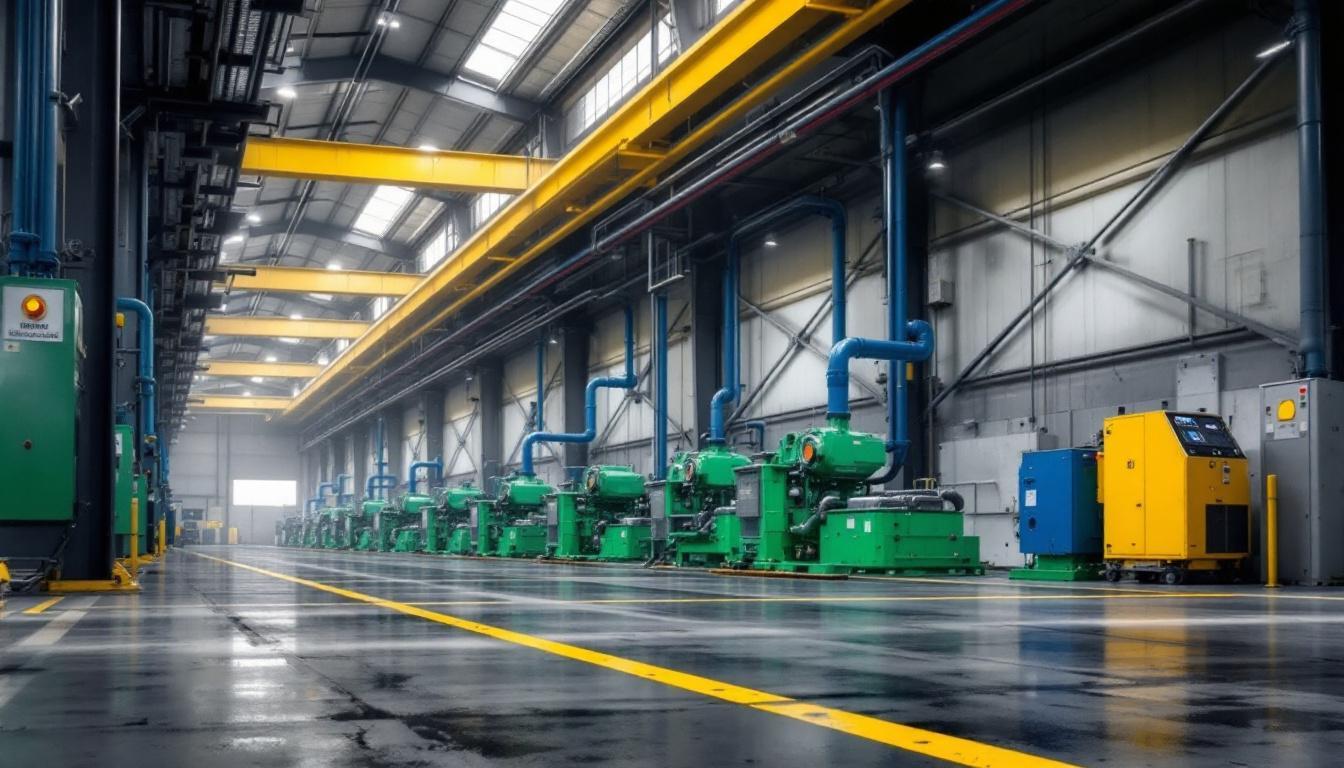
Major car manufacturers are shifting from traditional linear production to integrated circular operations, unlocking significant environmental and economic benefits while reshaping the automotive value chain amidst evolving regulations and market demands.
A quiet upheaval is reshaping vehicle manufacturing: automakers are shifting from linear production and end‑of‑life disposal to integrated circular operations that harvest value from retired cars and feed it back into new output. What began as sustainability signalling has become a strategic response to supply‑chain risk and material-cost exposure, with large groups building dedicated facilities to recover batteries, metals and plastics at industrial scale.
Consultancy estimates point to the economic upside. According to McKinsey, the market for recovered automotive materials could expand from roughly $2.5 billion today to about $70 billion by 2040, underscoring how remanufacture and recycling can reshape the sector’s value chain.
Toyota has been among the fastest to operationalise that vision. The company announced a second Circular Factory in Wałbrzych, Poland, a 25,000 square metre plant designed to process some 20,000 end‑of‑life vehicles a year. According to Toyota Motor Europe, the site focuses on extracting and reintegrating batteries and other high‑value inputs to accelerate the group’s shift towards a carbon‑neutral, circular business model and to reduce dependence on external raw‑material suppliers.
BMW has pursued a complementary route that emphasises preserving material quality. The BMW Group’s Cell Recycling Competence Centre in Salching, Lower Bavaria, has introduced a direct recycling process intended to recover battery material in a form suitable for immediate reuse in cell production, thereby conserving the material’s structure and lowering energy requirements. BMW’s longstanding Recycling and Dismantling Centre programme, operational since the 1990s, and recent product plans , including the use of hundreds of kilos of reused material in the 2026 iX3 to cut production CO2 , illustrate a strategy that combines process innovation with design changes to make reuse feasible at scale. Industry reporting shows BMW is also trialling higher shares of recycled aluminium in structural components to drive down manufacturing emissions.
Stellantis has organised its circular ambitions into a business unit, Sustainera, aiming to monetise remanufacturing and reuse. The group has earmarked Mirafiori as a hub for regenerating engines and transmissions, and Stellantis has set a revenue target from these activities as part of a broader industrial pivot that ties mechanical expertise to digital traceability and quality control.
Renault’s Re‑Factory in Flins demonstrates another model: an industrial laboratory where regeneration, reuse and sustainable design converge. Renault describes the site as a testbed for extending product lifecycles and integrating circular design principles upstream in development.
Taken together, these initiatives signal that circular manufacturing is moving from pilot projects to industrial platforms. Yet technical and systemic barriers remain. Battery recycling demands precise, often costly separation technologies and safe handling protocols; direct recycling methods require alignment between end‑of‑life streams and cell chemistry; and the absence of harmonised standards complicates cross‑border scaling. Governments in Europe are tightening regulatory frameworks, but industry voices point out that clearer rules, targeted incentives and investment in workforce skills are needed to convert experimental capacity into widespread commercial practice.
There are commercial arguments as well as environmental ones. Remanufacture can stabilise sourcing costs, reduce exposure to commodity cycles and create new revenue streams through refurbished components and circular services. The companies pursuing high‑quality recovery are betting that these operational benefits will deliver competitive advantage as carbon pricing, material constraints and customer expectations intensify.
The next decade will test whether such factories remain the preserve of major groups or become a common element of automotive manufacturing. For industrial decarbonisation practitioners, the immediate priorities are evident: standardise material‑ and data‑flows, scale advanced recycling technologies such as direct battery recycling, and develop local supplier and skills ecosystems that allow reclaimed materials to re‑enter production without compromising safety or performance. If those pieces fall into place, the industry’s circular experiments could evolve into a resilient, lower‑carbon industrial model with substantial economic upside.
- https://www.autoblog.it/post/i-brand-di-auto-che-spingono-forte-sulleconomia-circolare – Please view link – unable to able to access data
- https://newsroom.toyota.eu/toyota-announces-a-new-investment-in-a-circular-factory-in-poland/ – Toyota Motor Europe has announced the establishment of its second Circular Factory in Walbrzych, Poland. The facility, covering 25,000 square metres, will process approximately 20,000 end-of-life vehicles annually. This investment aims to accelerate Toyota’s transition to a fully circular and carbon-neutral business model, focusing on the recovery of components and valuable raw materials, including batteries, metals, and plastics, to reintegrate them into the production chain, thereby reducing reliance on external supplies and enhancing sustainability.
- https://www.bmwgroup.com/en/news/general/2026/direct-battery-recycling-now-underway.html – BMW Group has launched an innovative direct recycling process for battery raw materials at its Cell Recycling Competence Centre (CRCC) in Salching, Lower Bavaria. This facility focuses on mechanically recycling surplus battery cell material, including complete cells from manufacturing, to feed the recovered material directly back into the battery production process. This approach aims to preserve the material’s original structure and value, reducing energy consumption and enabling quicker reuse within BMW’s production system, thus supporting sustainable electromobility.
- https://www.forbes.com/sites/michaeltaylor/2025/08/04/bmw-to-slash-2026-ix3-emissions-using-740kg-of-reused-materials/ – BMW plans to reduce emissions in its 2026 iX3 50 xDrive by incorporating 740 kg of recycled materials, accounting for one-third of the vehicle’s total mass. Components such as wheel carriers and wheels will utilise up to 80% recycled aluminium, achieving an 85% reduction in production CO₂ emissions. This initiative underscores BMW’s commitment to sustainability by integrating pre-used materials into stressed components, thereby decreasing environmental impact and promoting a circular economy within the automotive industry.
- https://www.bmwgroup.com/en/news/general/2024/recycling.html – The BMW Group Recycling and Dismantling Centre (RDC), operational since 1994, plays a pivotal role in BMW’s sustainability efforts. The RDC focuses on the end-of-life stage of vehicles, aiming to enhance the speed, efficiency, and value of recycling processes. By developing and trialling relevant processes, the RDC supports key advances in parts and materials recycling, ensuring that vehicles are designed for maximum reuse, repair, or remanufacturing, thus contributing to the establishment of a circular economy within the automotive industry.
- https://www.bmwgroup.com/en/sustainability/circular-economy.html – BMW Group is committed to optimising the dismantling and recycling of vehicles to support a circular economy and reduce CO₂ emissions. The company focuses on making products easier to dismantle by using fewer individual parts and connecting them in ways that are easier to separate. This approach improves the material composition of products for reuse and recycling purposes, while also meeting the latest legal requirements, thereby enhancing sustainability and promoting a circular economy within the automotive industry.
- https://www.bmwblog.com/2023/07/12/bmw-group-recycling-and-dismantling-center-tour/ – The BMW Group Recycling and Dismantling Center (RDZ) in Unterschleißheim, near Munich, processes up to 10,000 vehicles annually, reusing, recycling, and repurposing vehicle components. This facility plays a crucial role in BMW’s sustainability efforts, ensuring that old, used parts are reprocessed into new materials for the production of new cars and other products. The RDZ’s operations support BMW’s commitment to reducing waste and promoting a circular economy within the automotive industry.
Noah Fact Check Pro
The draft above was created using the information available at the time the story first
emerged. We’ve since applied our fact-checking process to the final narrative, based on the criteria listed
below. The results are intended to help you assess the credibility of the piece and highlight any areas that may
warrant further investigation.
Freshness check
Score:
8
Notes:
The article discusses recent developments in the automotive industry’s shift towards circular economy practices, including Toyota’s new Circular Factory in Poland, BMW’s Cell Recycling Competence Centre in Salching, and other initiatives. The Toyota announcement was made on 19 February 2026, and the BMW facility was inaugurated on 15 December 2025. ([newsroom.toyota.eu](https://newsroom.toyota.eu/toyota-announces-a-new-investment-in-a-circular-factory-in-poland/?utm_source=openai)) The content appears to be original and not recycled from other sources. However, the article’s publication date is not provided, making it difficult to assess the freshness of the content. Without this information, a definitive freshness score cannot be assigned.
Quotes check
Score:
7
Notes:
The article includes direct quotes from company representatives, such as Leon van der Merwe, Vice President of Circular Economy at Toyota Motor Europe, and Markus Fallböhmer, Senior Vice President of Battery Production at BMW AG. These quotes are consistent with statements from the respective companies’ official press releases. ([newsroom.toyota.eu](https://newsroom.toyota.eu/toyota-announces-a-new-investment-in-a-circular-factory-in-poland/?utm_source=openai)) However, without access to the original press releases, it’s challenging to verify the exact wording and context of these quotes. The lack of direct access to the original sources raises concerns about the accuracy and authenticity of the quotes.
Source reliability
Score:
6
Notes:
The article references official press releases from Toyota and BMW, which are reputable sources. However, the article itself originates from Autoblog.it, an Italian automotive news website. While Autoblog.it is known within its niche, it is not a major international news organisation. The lack of independent verification from other reputable sources diminishes the overall reliability of the information presented.
Plausibility check
Score:
8
Notes:
The claims about Toyota’s new Circular Factory in Poland and BMW’s Cell Recycling Competence Centre in Salching align with known industry trends towards sustainability and circular economy practices. These initiatives are consistent with the companies’ previous commitments to environmental responsibility. However, the article lacks specific details and supporting evidence from other reputable outlets, which makes it difficult to fully assess the plausibility of the claims.
Overall assessment
Verdict (FAIL, OPEN, PASS): FAIL
Confidence (LOW, MEDIUM, HIGH): MEDIUM
Summary:
The article presents information about recent initiatives by Toyota and BMW in the circular economy, referencing official press releases. However, the lack of independent verification, absence of direct access to original sources, and the article’s origin from a niche publication without broader corroboration raise significant concerns about the accuracy and reliability of the content. Given these issues, the content cannot be fully verified, and publishing it carries inherent risks.
