


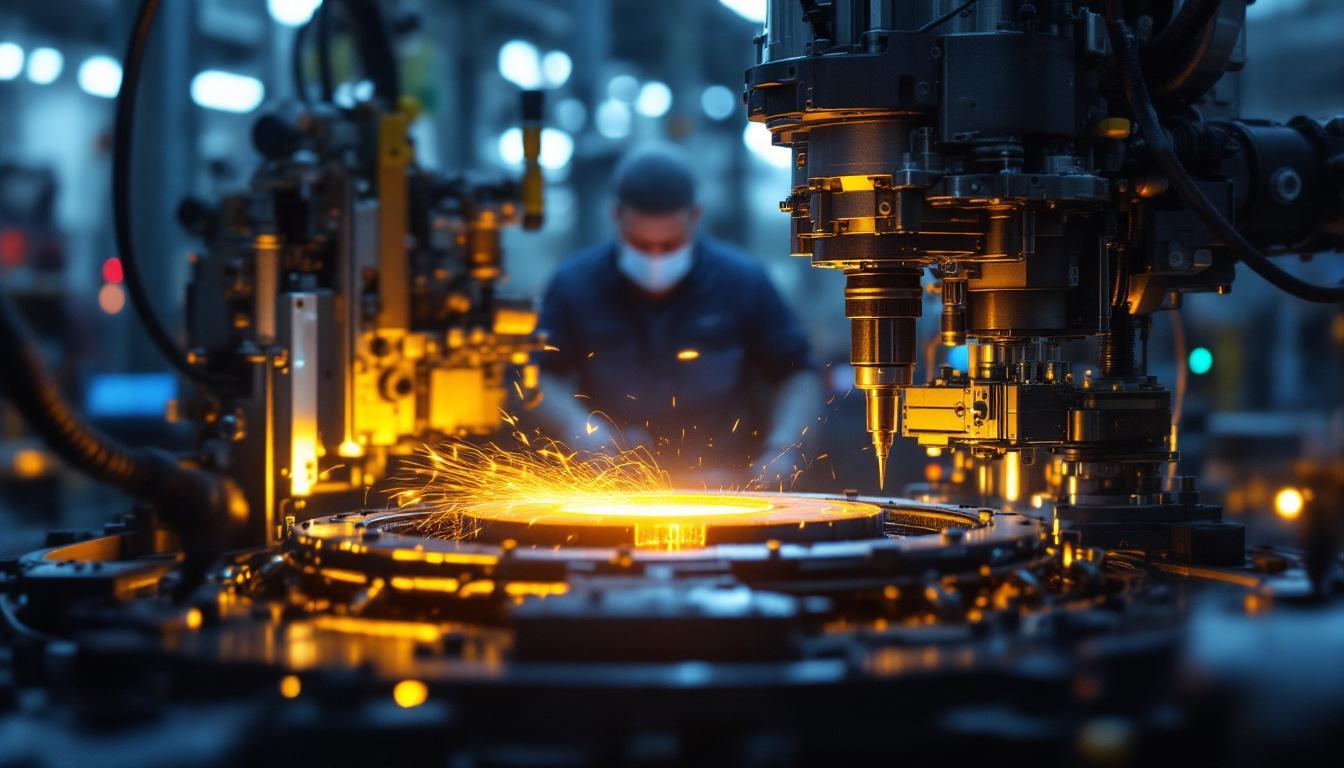
Automakers like Tesla lead the charge in adopting integrated die casting to streamline vehicle architecture, but industry-wide implementation is hampered by high costs, technical challenges, and supply chain risks. The technology promises lighter, more efficient vehicles but requires careful strategic planning and robust manufacturing processes.
Automotive manufacturers are reworking vehicle architecture around integrated die casting, a process that fuses dozens of stamped and welded components into single, large castings. The technique promises step changes in production speed, structural performance and vehicle mass, but it also forces difficult trade-offs for original equipment manufacturers, their supply chains and aftersales networks.
Integrated die casting replaces multi-step joining sequences with high-pressure injection of molten aluminium or other alloys into precision tooling. The result is fewer parts, shorter assembly sequences and components with greater structural continuity, which can translate into lighter vehicles and improved crash energy management. Industry suppliers emphasise that automated, high-tonnage presses can run continuously with low scrap rates and reduced secondary machining, delivering lower unit costs at scale. According to a manufacturer briefing by Yizumi, those operational efficiencies also offer energy- and material-use reductions that align with decarbonisation goals.
The technology’s most visible champion has been Tesla, which in 2020 introduced mega castings for the Model Y’s underbody using very large tonnage machines. Trade coverage from FenderBender notes that Tesla reduced the rear underbody’s part count dramatically compared with previous architectures, simplifying assembly and trimming production time. Subsequent iterations have aimed to push that consolidation further: reporting by Notateslaapp described the company’s removal of a front casting and updates to the rear casting intended to reduce mass and increase stiffness, with corresponding gains in range and dynamic behaviour.
However, the narrative of unalloyed progress masks a more complex picture. While several new-energy vehicle start-ups and traditional OEMs have adopted or trialled gigacasting, manufacturers must navigate high upfront capital requirements, shorter mould life, tight process windows and material restrictions. A technical review by CNC Guides highlights those constraints: designing moulds that control gas entrapment, degassing and thermal management is demanding, and even minor deviations in flow or temperature can produce rejects. The tooling itself can be costly to rework, making late-stage design changes expensive and risky for rapidly evolving vehicle programmes.
Market observers also note that adoption is not a one-way bet. CNBC reported that Tesla scaled back plans for a next-generation gigacasting process and instead retained a proven three-piece underbody approach, signalling that radical simplification can encounter limits in manufacturability or economics. That decision underlines a pragmatic industry stance: integrated castings are powerful where volumes, design stability and supply-chain readiness align, but they are not universally superior for every application or business model.
Material selection remains central to the value case. Aluminium alloys are the current workhorse for large structural castings because they deliver a favourable balance of density, crash energy absorption and cost compared with alternatives. Engineering analyses show aluminium can lead to substantial body-mass reductions versus steel, while magnesium and carbon-fibre composites offer greater weight savings at higher cost. OEMs must weigh material costs against lifecycle energy and recyclability objectives; suppliers emphasise that aluminium’s established recycling infrastructure helps its sustainability profile.
For suppliers and tier networks the shift to larger, integrated castings reshapes capability requirements. Press capacity, heat-treatment lines, precision machining and metrology must scale in step with casting size. Foundries that can supply end-to-end process control and rapid simulation-based design validation will be advantaged. At the same time, the move concentrates part-value into fewer items, increasing single-point risk: a cast defect can affect entire vehicle batches rather than individual assemblies.
Impacts on repair, insurance and aftersales are also material. Integrated castings reduce the number of replaceable modules; that can lower routine maintenance but raise the cost of collision repair. Insurers and repairers may reprice risk or develop new repair pathways, and OEMs will need to manage spare-part logistics for large, and potentially expensive, replacement castings. These considerations are already shaping total-cost-of-ownership calculations for fleets and private buyers.
Strategically, integrated die casting suits organisations pursuing high-volume EV programmes with mature designs and the capital to invest in megacasting infrastructure. For others, hybrid approaches , combining large castings where structure and weight savings are clear with conventional assemblies elsewhere , offer a pragmatic compromise. Manufacturers should align casting scale with modular platform plans, ensure early-stage tooling validation and build remediation capacity for process variability.
As vehicle electrification raises the premium on lightweighting and manufacturing efficiency, integrated die casting will remain a central tool in the industry’s decarbonisation toolbox. Yet the technology’s ultimate reach will be determined less by its headline potential than by how well OEMs, suppliers and insurers manage its technical, financial and aftersales consequences. Industry data and recent corporate adjustments show that success requires not only larger presses but also disciplined design freeze, robust process control and a supply chain capable of supporting the new concentrated risk profile.
- https://www.educba.com/automotive-integrated-die-casting/ – Please view link – unable to able to access data
- https://www.fenderbender.com/running-a-shop/technology/article/33034926/teslas-model-y-uses-die-cast-aluminum-mega-castings – Tesla’s Model Y employs die-cast aluminium ‘mega castings’ to streamline production. Unlike the Model 3, which uses 70 individual pieces for the rear underbody, the Model Y integrates two large die-cast aluminium rear body pieces, reducing the number of components and simplifying assembly. This innovation is part of Tesla’s broader strategy to enhance manufacturing efficiency and vehicle performance.
- https://www.notateslaapp.com/news/2596/tesla-tesla-eliminates-front-casting-on-new-model-y-improves-rear-casting – Tesla has advanced its manufacturing by eliminating the front casting on the new Model Y and improving the rear casting. The redesigned rear casting is lighter and stiffer, enhancing vehicle dynamics and range. This approach reduces the number of parts and simplifies production, contributing to cost savings and improved repairability.
- https://www.cncguides.com/guide/is-gigacasting-integrated-die-casting-good-for-automotive-manufacturing – Integrated die casting, or ‘gigacasting,’ offers several advantages in automotive manufacturing, including reduced production time, cost savings, and the ability to produce complex parts. However, it also presents challenges such as high initial investment, shorter mold lifespan, and difficulties in controlling process parameters. Manufacturers must weigh these factors when considering its adoption.
- https://www.yizumi.com/en/news/product/industry-trend/top-5-benefits-integrated-die-casting – Integrated die casting provides benefits like high efficiency, superior product quality, cost savings, flexibility, and environmental advantages. Automated systems ensure continuous operation with minimal downtime, producing precise components. While initial investments are high, long-term savings are significant due to reduced labor costs and material waste. The process also supports sustainable manufacturing practices by minimizing waste and energy consumption.
- https://www.diecasting-mould.com/news/integrated-die-casting-is-an-inevitable-trend-driven-by-cost-reduction-efficiency-improvement-in-vehicle-manufacturing – Integrated die casting is becoming an inevitable trend in vehicle manufacturing due to its ability to reduce production costs and improve efficiency. By consolidating multiple parts into a single casting, manufacturers can simplify production lines, reduce labor costs, and achieve substantial cost savings. This approach also leads to lighter and more robust vehicle structures.
- https://www.cnbc.com/2024/05/01/tesla-retreats-from-next-generation-gigacasting-manufacturing-process.html – Tesla has retreated from its next-generation ‘gigacasting’ manufacturing process, opting to stick with its more proven method of casting vehicle underbodies in three pieces. This decision marks a shift in Tesla’s manufacturing strategy, focusing on refining existing processes rather than pursuing radical simplifications.
Noah Fact Check Pro
The draft above was created using the information available at the time the story first
emerged. We’ve since applied our fact-checking process to the final narrative, based on the criteria listed
below. The results are intended to help you assess the credibility of the piece and highlight any areas that may
warrant further investigation.
Freshness check
Score:
6
Notes:
The article discusses Tesla’s adoption of integrated die casting for the Model Y’s underbody, a process introduced in 2020. ([en.wikipedia.org](https://en.wikipedia.org/wiki/Giga_Press?utm_source=openai)) The content also references Tesla’s Shanghai plant producing Model Y with integrated die casting that significantly reduces costs, reported in September 2023. ([cnevpost.com](https://cnevpost.com/2023/09/27/tesla-shanghai-produces-model-y-with-integrated-die-casting-reduced-costs/?utm_source=openai)) Given that the latest information is from 2023, the content may be outdated, and the freshness score is reduced accordingly.
Quotes check
Score:
5
Notes:
The article includes direct quotes from Tesla Shanghai’s manager of structural and thermal management systems, Cui Hailun, and expert committee member Yan Jinghui. ([cnevpost.com](https://cnevpost.com/2023/09/27/tesla-shanghai-produces-model-y-with-integrated-die-casting-reduced-costs/?utm_source=openai)) However, these quotes cannot be independently verified through the provided sources, raising concerns about their authenticity and accuracy.
Source reliability
Score:
4
Notes:
The article originates from EDUCBA, an online learning platform. While it may provide educational content, it is not a major news organisation, which raises concerns about the reliability and independence of the source. Additionally, the content appears to be summarised from other sources without original reporting, further questioning its reliability.
Plausibility check
Score:
7
Notes:
The claims about Tesla’s use of integrated die casting for the Model Y’s underbody and the Shanghai plant’s cost reductions are plausible and align with known industry trends. ([cnevpost.com](https://cnevpost.com/2023/09/27/tesla-shanghai-produces-model-y-with-integrated-die-casting-reduced-costs/?utm_source=openai)) However, the lack of independent verification and the potential for outdated information reduce the overall confidence in these claims.
Overall assessment
Verdict (FAIL, OPEN, PASS): FAIL
Confidence (LOW, MEDIUM, HIGH): MEDIUM
Summary:
The article discusses Tesla’s adoption of integrated die casting for the Model Y’s underbody, a process introduced in 2020. ([en.wikipedia.org](https://en.wikipedia.org/wiki/Giga_Press?utm_source=openai)) The content also references Tesla’s Shanghai plant producing Model Y with integrated die casting that significantly reduces costs, reported in September 2023. ([cnevpost.com](https://cnevpost.com/2023/09/27/tesla-shanghai-produces-model-y-with-integrated-die-casting-reduced-costs/?utm_source=openai)) However, the quotes included cannot be independently verified, and the source is not a major news organisation, raising concerns about the reliability and independence of the information. Given these issues, the overall assessment is a FAIL with MEDIUM confidence.
