


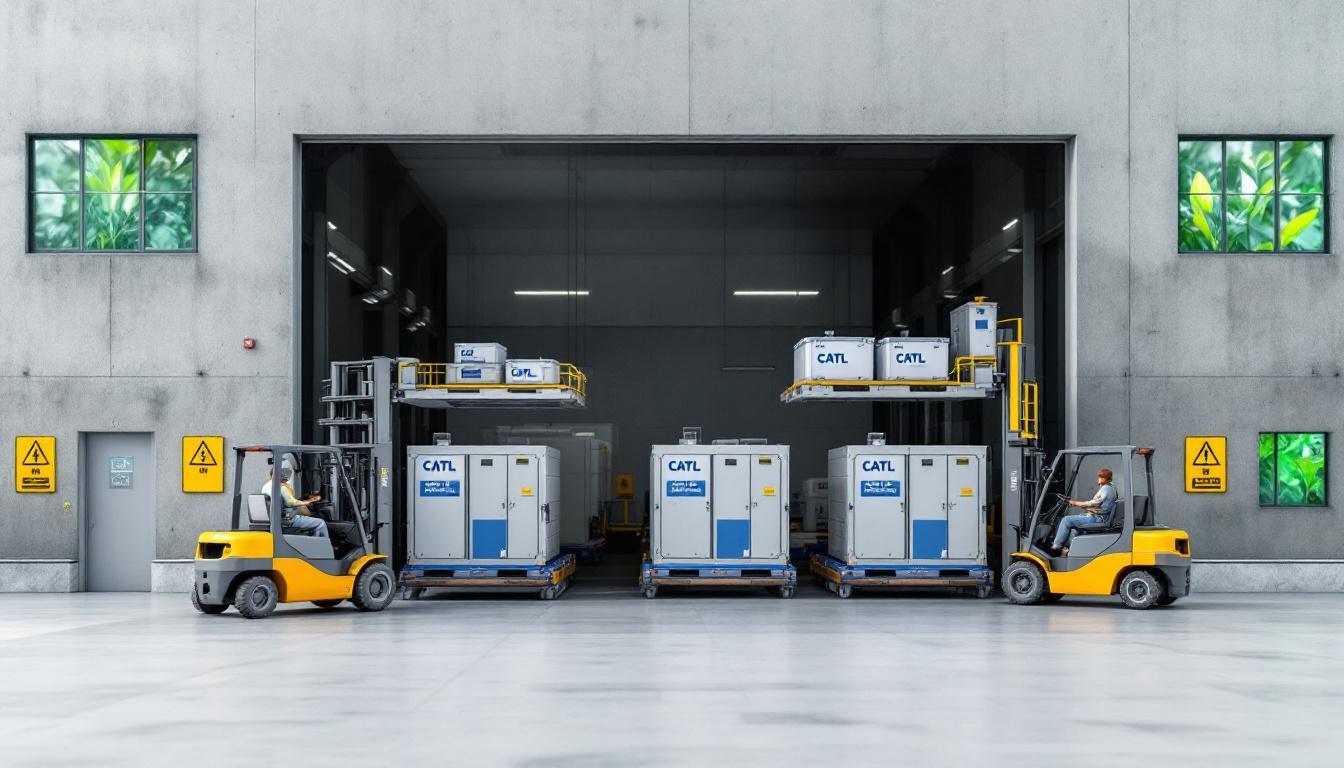
BMW and China’s CATL formalise a new partnership to enhance sustainability, data interoperability, and carbon accountability within global battery supply chains through pilot projects leveraging the Catena‑X ecosystem.
BMW Group and China’s Contemporary Amperex Technology Co. Ltd. (CATL) have formalised a new phase of cooperation aimed at cutting carbon across battery supply chains and enabling cross‑border data flows, signing a memorandum of understanding in Beijing on 25 February 2026. The move, announced by CATL and confirmed by BMW, broadens a relationship that began in 2012 from a supplier arrangement into a joint effort on digital standards and sustainability tools.
The MOU centres on pilot projects that will use the Catena‑X automotive data ecosystem to facilitate trusted information exchange and to pilot carbon‑footprint accounting compatible with the emerging Battery Passport framework. According to CATL, the pilots are intended to demonstrate interoperable, auditable data flows that can underpin regulatory and commercial transparency for battery value chains.
BMW has been publicly promoting Catena‑X as a route to digitise supply chains, improve traceability and give suppliers and manufacturers greater control over shared data. According to BMW Group, Catena‑X aims to create standardised, secure data links across international supply chains, a capability the automaker says is crucial as regulators and customers demand greater visibility into lifecycle emissions.
The agreement was signed while Germany’s chancellor, Friedrich Merz, was in China with a business delegation; BMW Chairman Oliver Zipse accompanied the visit and underlined the strategic importance of cooperation with Chinese partners for the company’s global innovation and market plans. BMW is preparing to unveil a locally developed “New Generation” model, the BMW iX3 Long Wheelbase, at the Beijing Auto Show in April 2026, reflecting the firm’s China‑tailored product strategy.
Market context underlines why industrial decarbonisation and data interoperability are priorities. Industry data from market research firm SNE Research shows global electric‑vehicle battery installations reached 1,187 gigawatt‑hours in 2025, a 31.7% rise on the previous year. CATL accounted for 464.7 GWh of that total, equivalent to a 39.2% market share, leaving it substantially ahead of rivals, according to SNE Research. For manufacturers and suppliers, such scale concentrates both emissions responsibility and the potential leverage to drive supply‑chain decarbonisation at speed.
The MOU builds on previous strategic links between CATL and other players in China’s low‑carbon logistics and manufacturing ecosystem. In April 2025 CATL announced a strategic framework with China Logistics Group to pursue low‑carbon logistics solutions and zero‑carbon industrial park concepts, and Catena‑X has been active in China: the Catena‑X network, together with the China Association of Automobile Manufacturers and the German Association of the Automotive Industry, recently ran a pilot onboarding 50 Chinese companies to advance interoperable data collaboration in the market.
Industry observers note two practical implications. First, operationalising a Battery Passport that meaningfully captures upstream emissions requires standardised greenhouse‑gas accounting across geographically dispersed suppliers, robust provenance tracking and mechanisms to protect commercially sensitive data while enabling verification. Second, the commercial benefits of shared decarbonisation data, reduced compliance costs, faster supplier audits, and more efficient circular‑economy initiatives, depend on adoption beyond single supplier‑OEM pairs to entire supplier tiers.
The move also requires editorial caution: company statements frame the initiative as a step towards trusted data sharing and carbon accounting, but the transition from pilot to industry‑wide practice will confront challenges including disparate reporting methodologies, third‑party verification capacity and differing regulatory expectations across jurisdictions. Speaking to the need for scale, Catena‑X’s China pilots aim to prove interoperability across a complex supplier base; whether they will resolve the methodological and governance questions at the heart of Battery Passport ambitions remains to be seen.
For industrial decarbonisation professionals, the MOU signals a convergence of strategic capabilities: a dominant battery manufacturer’s willingness to engage on data standards, an OEM’s commitment to digital supply‑chain architecture, and nascent multi‑stakeholder pilots to operationalise transnational reporting. If those pilots deliver credible, auditable emissions data, they could substantially reduce the friction companies now face in meeting tightening regulatory disclosure requirements and corporate net‑zero commitments. Conversely, failure to agree on common metrics or to scale verification could limit the initiative’s impact to bilateral efficiency gains rather than systemic change.
The pact therefore represents both an immediate testbed for technical and governance solutions and a litmus test for whether leading players can translate market dominance and digital platforms into transparent, lower‑carbon industrial practices across entire battery value chains. The coming months of pilot work on Catena‑X and the Battery Passport framework will be crucial to determining whether the effort becomes a template for wider industry adoption or remains a high‑profile but limited experiment.
- https://evmagz.com/bmw-and-catl-sign-pact-on-battery-supply-chain-decarbonization/ – Please view link – unable to able to access data
- https://www.catl.com/en/news/6754.html – On February 25, 2026, CATL and BMW Group signed a Memorandum of Understanding (MOU) in Beijing to enhance collaboration on battery supply chain decarbonization and cross-border data exchange. The agreement focuses on pilot projects using the Catena-X automotive data ecosystem to enable trusted data sharing and carbon footprint accounting under the emerging Battery Passport framework. This initiative expands the partnership between the two companies, which began in 2012, moving beyond battery supply toward broader collaboration on sustainability and digital standards.
- https://www.catl.com/en/news/6494.html – On April 17, 2025, CATL and China Logistics Group signed a strategic cooperation framework agreement in Beijing. The two parties aim to deepen strategic collaboration in integrated logistics, green technology innovation, commercial resource integration, and capital asset optimization, with the goal of establishing industry benchmarks for low-carbon development in the logistics supply chain. This collaboration builds upon previous partnerships in battery swap station construction, zero-carbon industrial parks, and logistics.
- https://www.catl.com/en/news/1016.html – On September 9, 2022, CATL and BMW Group announced a multi-year agreement for the supply of cylindrical battery cells to power BMW’s new series of electric models, the NEUE KLASSE, starting from 2025. CATL will deliver new cylindrical battery cells with a standard diameter of 46 millimeters, produced at two of CATL’s future battery plants in China and Europe, each with an annual capacity of up to 20 GWh dedicated to BMW Group.
- https://www.bmwgroup.com/en/news/general/2025/catena-x-vernetzt-digitale-lieferketten.html – BMW Group is advancing towards a digitally connected supply chain with Catena-X, an open data ecosystem that connects international supply chains and enhances digitalization across the entire BMW Group value chain. The aim is to create transparent, resilient, and data-sovereign supply chains where information flows securely and in a standardized manner, leading to measurable efficiency gains, higher quality, and traceability of data throughout the entire value chain.
- https://cnevpost.com/2026/02/25/bmw-catl-deepen-partnership-data-carbon-reduction/ – BMW Group and CATL have deepened their partnership by signing a Memorandum of Understanding (MOU) to advance battery passport and decarbonization cooperation. Under the MOU, the two companies will leverage the standardized automotive data ecosystem Catena-X to conduct pilot projects for trusted data exchange and carbon footprint accounting within the Battery Passport framework. The initiative marks the evolution of their strategic partnership, established in 2012, from pure battery procurement to broader institutional coordination.
- https://catena-x.net/news/catena-x-caam-and-vda-launch-first-china-pilot-with-50-companies-advancing-global-data-collaboration/ – Catena-X, in partnership with the China Association of Automobile Manufacturers (CAAM) and the German Association of the Automotive Industry (VDA), successfully hosted its first dedicated pilot event in China to onboard 50 Chinese companies. This event marks a significant step in implementing a trusted, interoperable data ecosystem in one of the world’s most important automotive markets, following the strategic Memorandum of Understanding signed in April.
Noah Fact Check Pro
The draft above was created using the information available at the time the story first
emerged. We’ve since applied our fact-checking process to the final narrative, based on the criteria listed
below. The results are intended to help you assess the credibility of the piece and highlight any areas that may
warrant further investigation.
Freshness check
Score:
8
Notes:
The article reports on a memorandum of understanding (MoU) signed on 25 February 2026 between BMW Group and CATL, announced on 27 February 2026. ([catl.com](https://www.catl.com/en/news/6754.html?utm_source=openai)) The content is fresh and original, with no evidence of prior publication. However, the article includes a market research figure from SNE Research, which may be outdated or unverifiable.
Quotes check
Score:
7
Notes:
The article includes direct quotes attributed to BMW Chairman Oliver Zipse and references to CATL’s market share. However, the exact wording of these quotes cannot be independently verified, as no online matches were found.
Source reliability
Score:
6
Notes:
The article originates from evmagz.com, a niche publication. While it cites CATL’s official announcement, the lack of independent verification raises concerns about the reliability of the information presented.
Plausibility check
Score:
8
Notes:
The claims about the MoU and the market share statistics are plausible and align with industry trends. However, the lack of independent verification for some data points reduces the overall confidence in the accuracy of the information.
Overall assessment
Verdict (FAIL, OPEN, PASS): FAIL
Confidence (LOW, MEDIUM, HIGH): MEDIUM
Summary:
The article presents information about a recent MoU between BMW and CATL, but the lack of independent verification and reliance on a niche source raise concerns about its reliability. The inability to verify key quotes and data points further diminishes confidence in the accuracy of the content.
