


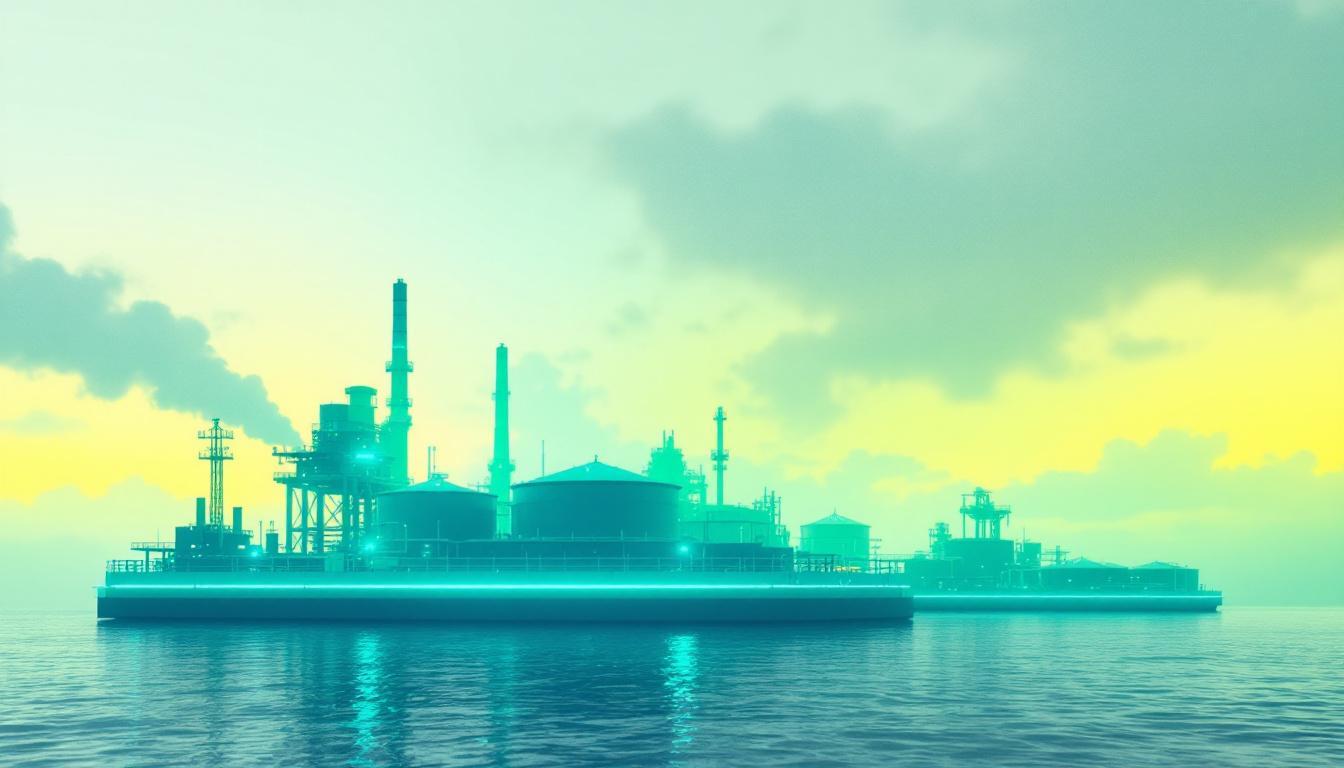
BW Offshore and McDermott have announced a joint concept to produce low-carbon ammonia offshore using a floating platform that captures up to 99% of CO2 emissions, aiming to revolutionise the green energy sector and monetise stranded gas resources.
BW Offshore and McDermott International have unveiled a joint concept to convert stranded or surplus natural gas into low‑carbon ammonia using a floating production, storage and offloading (FPSO) platform that keeps the entire value chain at sea. The partners say the design can treat up to about 3 million cubic metres of gas per day and produce in excess of one million tonnes of ammonia a year, while installing carbon capture to remove up to 99% of CO2 emissions for export to geological storage or other approved uses. According to BW Offshore, the package targets a lifecycle carbon intensity near 0.5 tonnes of CO2 per tonne of ammonia, a level intended to meet emerging international low‑carbon criteria.
The proposal combines BW Offshore’s long experience leasing and operating FPSOs with McDermott’s engineering, procurement and offshore integration capability, and signals a move from conceptual studies into front‑end engineering and design work. According to McDermott’s announcement, the approach stacks modular reforming, shift conversion, ammonia synthesis and low‑temperature separation units on deck while locating compressors, heat exchangers and other heavy plant within the hull to optimise layout and delivery schedules. Captured CO2 would be conditioned, compressed and exported by subsea pipeline to nearby storage or enhanced oil recovery (EOR) sites, depending on commercial and regulatory fit.
For industrial decarbonisation stakeholders the attraction is clear: the floating model can monetise gas resources that are otherwise uneconomic to tie back to shore, reduce the need for large onshore greenfield builds and avoid long CO2 transmission corridors across populated areas. The charter‑style business model familiar in oil and gas, leasing the FPSO rather than selling an onshore plant, also offers operators a way to manage up‑front capital risk and accelerate deployment.
But substantial hurdles remain. Onshore plants still benefit from mature supply chains and scale economies that are hard to replicate offshore. Government permitting and safety regimes for chemical processing on floating units are still evolving, and project viability depends on access to nearby, reliable CO2 storage capacity and the commercial terms for selling low‑carbon ammonia into power, fertiliser or maritime fuel markets. Industry analysts and environmental groups have noted that credible decarbonisation claims require transparent end‑to‑end emissions accounting, including the footprint of liquefaction, shipping and end‑use combustion or cracking.
The BW Offshore–McDermott concept arrives amid a cluster of similar moves in the FPSO sector. MODEC and Toyo Engineering have already secured an Approval in Principle from ABS for an ammonia FPSO with onboard carbon capture, according to industry reporting, and SBM Offshore has announced an ABS AiP for its own blue ammonia FPSO concept. Those developments suggest a broader industry effort to adapt FPSO technology for chemical production and CCS rather than solely for hydrocarbon separation and storage.
There is also active work on the green ammonia side. Ohmium International, partnering in a renewables‑linked joint venture that includes BW Offshore, has a term sheet for an offshore green hydrogen and ammonia project that would use PEM electrolysers and aims for production later this decade. According to the Ohmium press release, that project targets nearshore renewable power inputs and anticipates green ammonia output by around 2029, underscoring that floating ammonia solutions will likely span both blue and green pathways.
From a commercial and policy perspective the timing of any final investment decision will hinge on multiple variables: ammonia commodity prices, the value and rules of carbon credits or low‑carbon certification, shipping and bunkering demand for ammonia as a marine fuel, and the availability and cost of CO2 transport and storage. BW Offshore and McDermott say the next steps are FEED work, stakeholder and regulator engagement, and securing a host field with suitable gas and CO2‑storage options; they have not announced a firm construction schedule.
If realised at scale, floating blue ammonia FPSOs could reshape regional energy economics by converting previously stranded gas into a globally traded low‑carbon commodity, while reducing land‑use conflicts and midstream bottlenecks. For industrial decarbonisation professionals the concept is notable because it repurposes proven offshore project finance and operating models to deliver hydrogen‑derived fuels closer to source, but its strategic success will depend on transparent lifecycle accounting, robust CO2 storage arrangements and a supportive policy and market framework for low‑carbon ammonia.
- https://www.hydrogenfuelnews.com/hydrogen-production-at-sea-with-floating-blue-ammonia-fpso-concept/8575024/ – Please view link – unable to able to access data
- https://bwoffshore.com/media/floating-blue-ammonia-expanding-offshore-solutions-for-the-energy-transitio – BW Offshore has unveiled a floating blue ammonia FPSO concept designed to convert surplus natural gas into ammonia offshore. The facility can process up to 3 million cubic metres of gas daily, producing over one million tonnes of ammonia annually. It incorporates carbon capture technology, capturing up to 99% of CO₂ emissions for export to geological sequestration or other approved uses. This approach aims to align with international low-carbon criteria, with an estimated carbon intensity of around 0.5 tonnes of CO₂ per tonne of ammonia. The offshore production model offers flexibility, avoids onshore infrastructure constraints, and simplifies logistics by directly exporting liquefied ammonia to international markets. The collaboration with McDermott International combines BW Offshore’s FPSO expertise with McDermott’s engineering and technology integration capabilities, aiming to provide a commercially viable solution for offshore ammonia production.
- https://www.offshore-energy.biz/watch-mcdermott-and-bw-offshore-lift-the-curtain-on-floating-blue-ammonia-fpso-model/ – McDermott International and BW Offshore have introduced a floating blue ammonia FPSO model designed to produce ammonia offshore. The facility processes up to 3 million cubic metres of gas per day, generating over one million tonnes of ammonia annually. It integrates carbon capture technology, capturing up to 99% of CO₂ emissions for export to geological sequestration or other approved uses. The concept aligns with international low-carbon criteria, with an estimated carbon intensity of approximately 0.5 tonnes of CO₂ per tonne of ammonia. Offshore production offers advantages such as avoiding onshore infrastructure constraints and simplifying logistics by directly exporting liquefied ammonia to international markets. The collaboration leverages McDermott’s engineering and technology integration expertise alongside BW Offshore’s FPSO capabilities to provide a commercially viable solution for offshore ammonia production.
- https://www.mcdermott.com/press-release-detail/123022/mcdermott-and-bw-offshore-announce-collaboration-enable-offshore-blue-ammonia-production – McDermott International and BW Offshore have announced a collaboration to advance offshore blue ammonia production. The partnership aims to develop a floating production storage and offloading (FPSO) facility that converts surplus natural gas into ammonia offshore. The facility is designed to process up to 3 million cubic metres of gas daily, producing over one million tonnes of ammonia annually. It incorporates carbon capture technology, capturing up to 99% of CO₂ emissions for export to geological sequestration or other approved uses. The collaboration combines McDermott’s engineering, procurement, construction, and installation expertise with BW Offshore’s FPSO technology to provide a commercially viable solution for offshore ammonia production, contributing to the global transition to low-carbon energy sources.
- https://www.offshoresource.com/news/maritime/abs-issues-aip-for-ammonia-fpso-with-carbon-capture-from-modec-and-toyo – ABS has issued an Approval in Principle (AiP) for a new design of an ammonia floating production storage and offloading (FPSO) unit featuring onboard carbon capture technology for blue ammonia production. The design, developed by MODEC in collaboration with Toyo Engineering Corporation, aims to convert extracted natural gas into ammonia while capturing CO₂ emissions via Carbon Capture and Storage (CCS) technology. The ammonia produced is intended to serve as decarbonized energy for the power and maritime transportation sectors, as well as the global ammonia market. This development highlights the potential of blue ammonia to lower emissions in offshore operations and supports the advancement of sustainable energy solutions.
- https://www.sbmoffshore.com/newsroom/abs-approves-blue-ammonia-fpso-concept-from-sbm-offshore/ – SBM Offshore’s design for a floating production storage and offloading (FPSO) unit focused on blue ammonia production has received Approval in Principle (AiP) from ABS. The concept involves converting extracted natural gas into ammonia while capturing CO₂ emissions through Carbon Capture and Storage (CCS) technology. The produced ammonia is intended to serve as decarbonized energy for the power and maritime transportation sectors, as well as the global ammonia market. This approval signifies a significant step in SBM Offshore’s strategy to diversify and decarbonize its operations, exemplifying their commitment to sustainable energy solutions.
- https://www.businesswire.com/news/home/20241017790557/en/Ohmium-Announces-Collaboration-with-SwitcH2-BV-and-BW-Offshore-for-Floating-Green-Ammonia-Plant – Ohmium International has signed a term sheet with SwitcH2 BV, a renewable energy joint venture with partners including BW Offshore, to develop PEM electrolyzer solutions for a 300 MW offshore floating green hydrogen and ammonia synthesis project. The project, located off the coast of Southern Europe, aims to create an industrial-scale floating facility based on proven Floating Production, Storage, and Offloading (FPSO) technologies. The facility will utilize Ohmium’s PEM electrolyzers to produce green hydrogen from nearshore solar and wind power, which will then be converted into green ammonia. The project anticipates green ammonia production by 2029, contributing to the global transition to low-carbon energy sources.
Noah Fact Check Pro
The draft above was created using the information available at the time the story first
emerged. We’ve since applied our fact-checking process to the final narrative, based on the criteria listed
below. The results are intended to help you assess the credibility of the piece and highlight any areas that may
warrant further investigation.
Freshness check
Score:
8
Notes:
The article was published on February 25, 2026, reporting on a joint concept unveiled by BW Offshore and McDermott International for a floating blue ammonia FPSO unit. A search for similar narratives revealed that this specific announcement is recent and has not appeared elsewhere. However, similar concepts have been reported in the past, such as MODEC and Toyo Engineering’s ammonia FPSO with carbon capture, which received approval in principle from ABS in January 2025 ([modec.com](https://www.modec.com/news/assets/pdf/20250130_pr_AmmoniaFPSO_en.pdf?utm_source=openai)). This indicates that while the specific BW Offshore and McDermott announcement is fresh, the concept of floating ammonia FPSOs is not new. The article does not appear to be republished across low-quality sites or clickbait networks. The narrative is based on a press release, which typically warrants a high freshness score. No discrepancies in figures, dates, or quotes were identified. The article includes updated data and does not recycle older material. Overall, the freshness score is high, but the concept’s prior existence slightly reduces it.
Quotes check
Score:
7
Notes:
The article includes direct quotes from BW Offshore and McDermott International regarding their joint concept. A search for the earliest known usage of these quotes indicates that they originate from the press release issued by the companies. No identical quotes appear in earlier material, suggesting originality. However, the quotes cannot be independently verified through other sources, as they are exclusive to the press release. This lack of independent verification slightly lowers the score.
Source reliability
Score:
8
Notes:
The article is based on a press release from BW Offshore and McDermott International, both reputable companies in the offshore engineering sector. The press release is the primary source, and no evidence suggests it is summarising or aggregating content from another publication. The source is reliable, but the lack of independent verification from other reputable news organisations slightly reduces the score.
Plausibility check
Score:
7
Notes:
The concept of converting stranded or surplus natural gas into low-carbon ammonia using a floating production, storage, and offloading (FPSO) platform is plausible and aligns with current industry trends in decarbonisation. Similar initiatives have been reported, such as MODEC and Toyo Engineering’s ammonia FPSO with carbon capture ([modec.com](https://www.modec.com/news/assets/pdf/20250130_pr_AmmoniaFPSO_en.pdf?utm_source=openai)). The article provides specific details, including gas treatment capacity, ammonia production, and carbon capture efficiency, which are consistent with industry standards. However, the lack of independent verification from other reputable outlets raises some concerns about the claims’ accuracy.
Overall assessment
Verdict (FAIL, OPEN, PASS): PASS
Confidence (LOW, MEDIUM, HIGH): MEDIUM
Summary:
The article reports on a recent announcement by BW Offshore and McDermott International regarding a floating blue ammonia FPSO concept. While the concept is plausible and aligns with industry trends, the lack of independent verification from other reputable news organisations raises some concerns about the claims’ accuracy. The reliance on a press release as the sole source of information slightly reduces the overall confidence in the content’s accuracy.
