


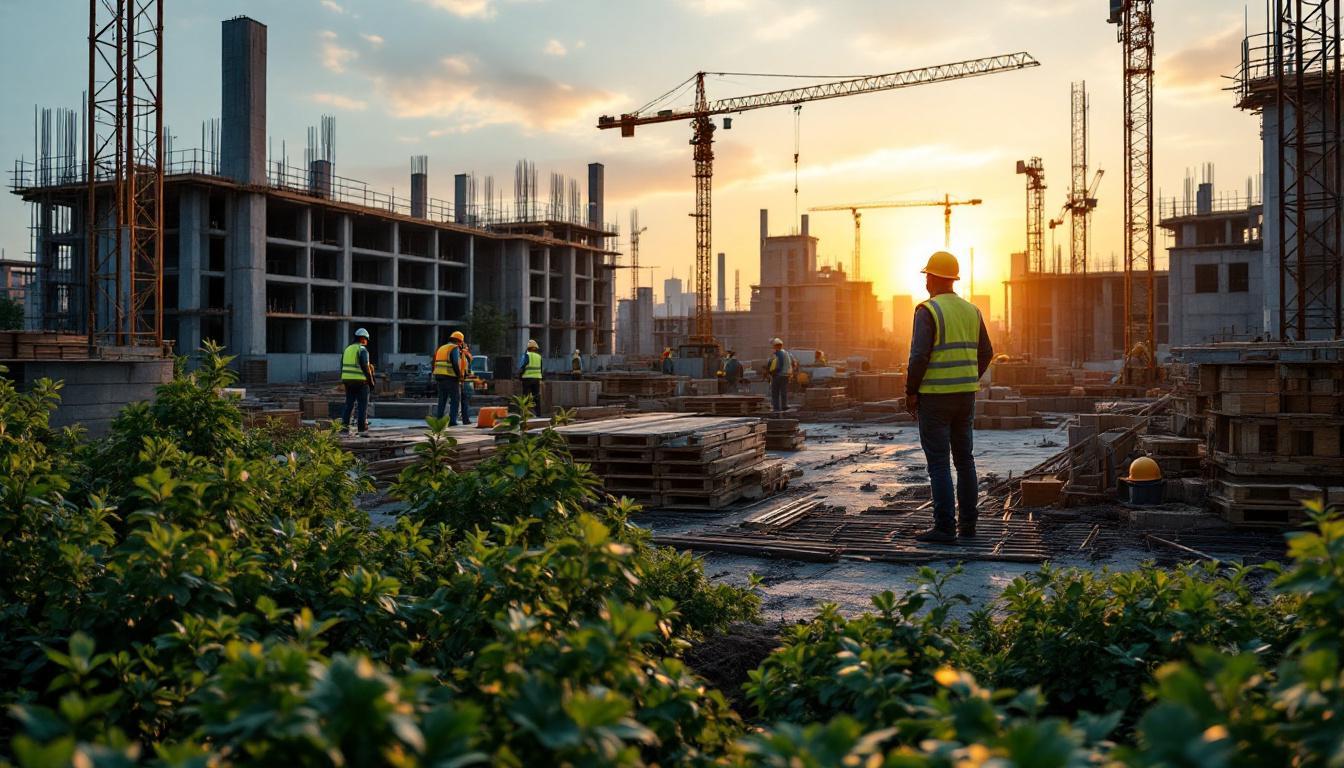
Nine major Canadian general contractors have collaborated to identify actionable strategies to significantly reduce greenhouse gas emissions on construction sites, with potential cuts of up to 75% by 2040, amid surging housing and infrastructure demand.
Canada’s largest general contractors have for the first time pooled project-level data to map practical, near-term routes for cutting greenhouse gas emissions on job sites while meeting the country’s looming construction demand.
Nine firms, Aecon, Bird, Chandos, EllisDon, Graham, Ledcor, Multiplex, PCL and Pomerleau, worked with The Transition Accelerator to analyse operational information from over 600 projects and produce the report Growing and Greening Canadian Construction: Five Ways for Canadian Construction Companies to Build More and Emit Less. According to the Transition Accelerator, the work identifies a small set of high-impact changes that together could materially lower on‑site emissions without undermining schedule or cost objectives.
The companies formalised their collaboration as the Canadian Construction Sustainability Alliance in November 2025, according to industry coverage, signalling an intent to scale lessons from pilots into procurement and site practices across the sector.
Five priority levers emerged from the analysis. Electrifying light‑duty vehicles ranked highest because the technology is mature, cost‑effective and requires minimal operational change; the report estimates LDV electrification could cut emissions by up to 15%. Optimising and electrifying heating , a dominant emissions source in cold climates and remote sites , was shown to offer immediate gains and further reductions where electric solutions are feasible, with potential savings up to 10%. For heavy equipment that today resists electrification, renewable diesel is presented as a near‑term bridge fuel capable of delivering 40–80% lifecycle emissions reductions without hardware modification, and with an overall abatement contribution of as much as 25%. Grid connections or hybrid power systems can replace diesel generators on remote sites, lowering emissions, noise and operating cost (up to 15% potential). Finally, hybrid and electric excavation machines scored lower on present readiness but offer incremental cuts and operational learning opportunities (up to 10%).
Taken together, the report suggests an achievable pathway to deep reductions: the firms’ modelling points to aggregate job‑site emissions cuts of up to 75% by 2040 if the priority actions are widely adopted.
Project examples and company experience underscore how these measures translate into real savings. EllisDon reported that introducing smart heating controls and better site enclosures on a winter programme reduced diesel consumption by an estimated 71,550 litres over two months, saving about $103,000 and avoiding roughly 190 tonnes of CO2. The company also reported that nine projects used renewable diesel in 2025, avoiding approximately 250 tonnes CO2e. Prabh Banga, vice‑president of sustainability at Aecon Group Inc., described pilots of hybrid and electric machinery, and said: “Aecon has piloted the use of BIM [Building Information Modelling], which allows us to model the use of low carbon concrete and low carbon steel and measuring what the outcome is.” Aecon’s broader corporate reporting shows a 34% cumulative reduction in Scope 1 and Scope 2 emissions since 2020, a milestone the company highlighted when it was named one of Canada’s Greenest Employers in April 2025.
Not every participant is at the same stage. Audrina Lim, director of sustainable construction at Chandos, characterised the company as being earlier in its technical readiness curve and focused on analytics to understand regional fuel use and retrofit opportunities, saying: “We’re looking through purchasing orders and investigating anomalies.” That variation reflects differing fleet sizes, project mixes and climatic challenges across Canada, where housing and infrastructure demand is set to surge. A separate analysis by RBC has highlighted the scale of that need, estimating the country requires roughly 5.8 million new homes by 2030 and warning that continuing current construction practices could add around 18 million tonnes of annual emissions unless methods change.
The report’s authors emphasise that procurement and project planning are critical enablers. Standardising specifications for low‑emission fuels, requiring grid‑first power assessments, and integrating electrification into fleet replacement cycles will accelerate uptake. Industry interviewees also flagged practical barriers: greater data granularity is needed to track emissions by activity, site teams require accessible training on new fuels and equipment, and original equipment manufacturer engagement is essential to confirm compatibility and warranty implications for renewable fuels and electrified machines.
For professionals tasked with industrial decarbonisation, the collaborative study offers actionable priorities that align environmental outcomes with operational imperatives. The Transition Accelerator frames the recommendations not as a single policy prescription but as an industry toolkit that, when embedded into procurement, planning and contractor practice, can reduce emissions while preserving productivity and affordability.
As Canada prepares to deliver a surge of housing and infrastructure, the alliance of major contractors has produced a practical, evidence‑based route to cleaner job sites; the challenge now is scaling those pilots into procurement rules, fleet strategies and site standards so the projected emission reductions are realised at pace.
- https://environmentjournal.ca/how-are-canadas-leading-contractors-reducing-job-site-emissions/ – Please view link – unable to able to access data
- https://canada.constructconnect.com/dcn/news/resource/2025/11/national-gc-alliance-tackles-jobsite-emissions – In November 2025, nine of Canada’s largest general contractors—Aecon, Bird, Chandos, EllisDon, Graham, Ledcor, Multiplex, PCL, and Pomerleau—formed the Canadian Construction Sustainability Alliance. They partnered with The Transition Accelerator to release a report titled ‘Growing and Greening Canadian Construction: Five Ways for Canadian Construction Companies to Build More and Emit Less.’ This report analyses data from over 600 projects to identify five priority actions for reducing emissions on construction sites, aiming to enhance efficiency and cost-effectiveness in the industry.
- https://www.aecon.com/press-room/news/2025/04/22/aecon-recognized-as-2025-canadas-greenest-employers – In April 2025, Aecon Group Inc. was recognised as one of Canada’s Greenest Employers. The company’s 2024 Sustainability Report highlighted a 34% cumulative reduction in Scope 1 and Scope 2 emissions since 2020, surpassing its 30% reduction target ahead of the 2030 deadline. Aecon’s initiatives include advancing clean energy projects and integrating sustainable practices into its operations, demonstrating a commitment to environmental responsibility in the construction industry.
- https://transitionaccelerator.ca/reports/growing-and-greening-canadian-construction/ – The Transition Accelerator’s October 2025 report, ‘Growing and Greening Canadian Construction: Five Ways for Canadian Construction Companies to Build More and Emit Less,’ presents findings from a collaboration with nine major Canadian general contractors. The report analyses data from over 600 projects to identify five high-impact actions for reducing emissions on construction sites. It aims to guide the industry towards sustainable practices while maintaining efficiency and affordability in construction projects.
- https://www.renewcanada.net/canadian-construction-industry-initiative-aims-to-reduce-emissions-from-jobsites/ – In October 2025, nine of Canada’s largest general contractors—Aecon, Bird, Chandos, EllisDon, Graham, Ledcor, Multiplex, PCL, and Pomerleau—partnered with The Transition Accelerator to release a report titled ‘Growing and Greening Canadian Construction: Five Ways for Canadian Construction Companies to Build More and Emit Less.’ The report analyses data from over 600 projects to identify practical actions for reducing emissions on construction sites, aiming to improve efficiency and affordability in the industry.
- https://pomerleau.ca/en/insights/article/esg/build-differently-a-call-to-action-for-a-carbon-neutral-industry – In October 2025, Pomerleau, alongside eight other major Canadian construction companies, contributed to the report ‘Growing and Greening Canadian Construction,’ published by The Transition Accelerator. The report offers a strategic roadmap to reduce greenhouse gas emissions on construction sites while enhancing the sector’s competitiveness. It identifies the main sources of emissions and proposes concrete solutions to mitigate them, reflecting a collective commitment to sustainable practices in the Canadian construction industry.
- https://www.rbc.com/en/thought-leadership/climate-action-institute/building-reports/high-rise-low-carbon-canadas-40-billion-net-zero-building-challenge/ – A report by RBC highlights Canada’s need for 5.8 million new homes by 2030, a 40% increase due to housing affordability issues and immigration. Constructing these homes with current practices could add 18 million tonnes of greenhouse gas emissions annually. The report emphasises the necessity to change construction methods and retrofit existing buildings to meet Net Zero targets, requiring over $40 billion in annual investment, with 60% allocated to retrofits and the remainder to new builds.
Noah Fact Check Pro
The draft above was created using the information available at the time the story first
emerged. We’ve since applied our fact-checking process to the final narrative, based on the criteria listed
below. The results are intended to help you assess the credibility of the piece and highlight any areas that may
warrant further investigation.
Freshness check
Score:
8
Notes:
The article was published on February 18, 2026, which is within the past week, indicating high freshness. However, the content heavily references a report from October 2025, which may affect the perceived timeliness of the information.
Quotes check
Score:
7
Notes:
The article includes direct quotes from industry leaders, such as Prabh Banga of Aecon Group Inc. and Audrina Lim of Chandos. While these quotes are attributed, they cannot be independently verified through the provided sources, raising concerns about their authenticity.
Source reliability
Score:
6
Notes:
The primary source, The Transition Accelerator, is a reputable Canadian not-for-profit focused on advancing real-world solutions for a competitive carbon-neutral economy. However, the article relies on a single source for its information, which may limit the diversity of perspectives and increase the risk of bias.
Plausibility check
Score:
7
Notes:
The claims about the collaborative efforts of nine major Canadian construction companies to reduce emissions are plausible and align with industry trends. However, the lack of independent verification and the reliance on a single source raise questions about the accuracy and completeness of the information.
Overall assessment
Verdict (FAIL, OPEN, PASS): FAIL
Confidence (LOW, MEDIUM, HIGH): MEDIUM
Summary:
The article presents information on the collaborative efforts of major Canadian construction companies to reduce job site emissions, referencing a report from The Transition Accelerator. However, the reliance on a single source without independent verification, the inability to verify direct quotes, and the recycling of older material raise significant concerns about the accuracy and reliability of the content. These issues necessitate further investigation and verification before publication.
