


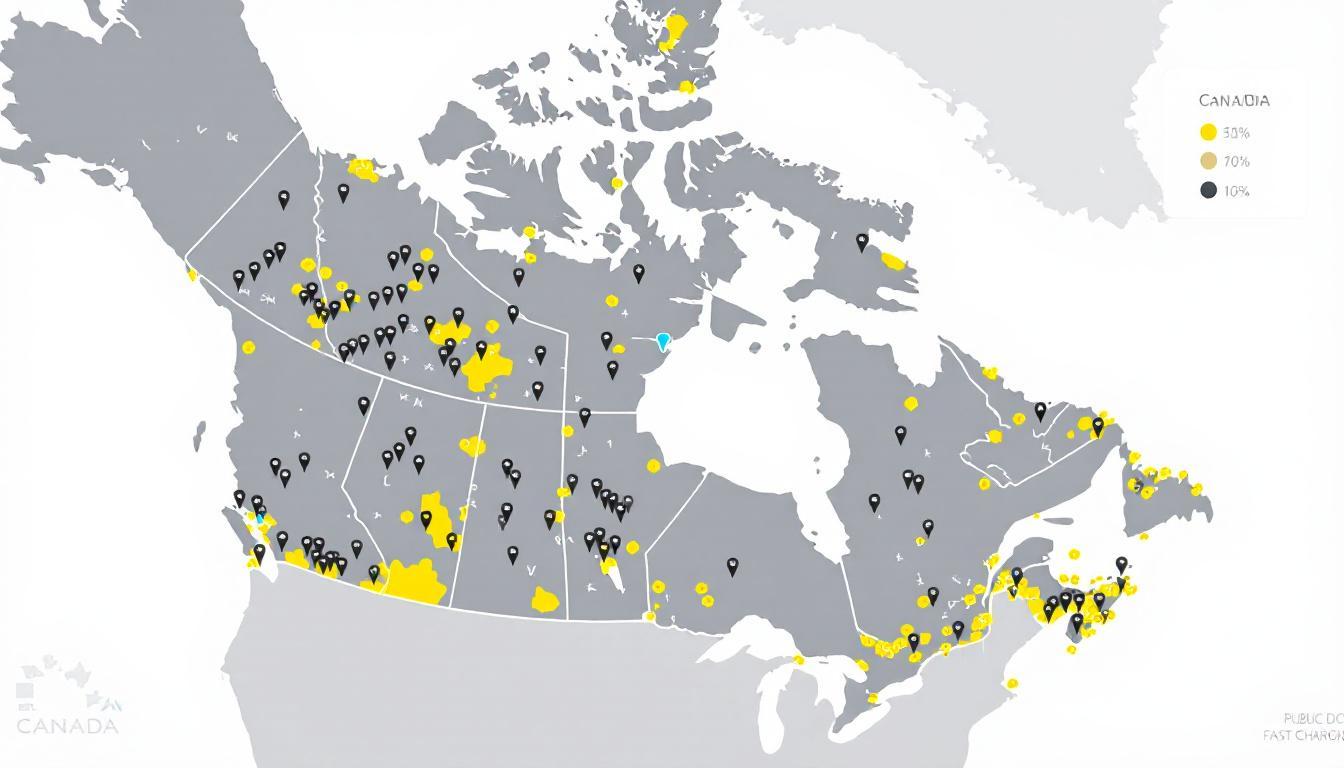
Canada’s DC fast-charging network saw significant growth in 2025, with nearly 2,000 new ports and a move towards larger, utility-backed deployments amid rising EV adoption, signalling a maturing charging landscape.
Canada’s public DC fast-charging network moved into a new phase of scale in 2025 as rapid deployment met rising use, industry data show. According to Paren’s Q4 2025 industry report, 1,925 DC fast-charging ports were brought online during the year, lifting the national DCFC total to 8,804 and marking a 28% increase year‑on‑year despite a cooling in EV sales.
Deployment accelerated through the second half of the year, with the fourth quarter setting a quarterly installation record, and 529 new DCFC sites added in 2025 to reach 2,570 locations countrywide. Paren’s analysis highlights that the growth in port counts outpaced the growth in sites, signalling a move towards larger installations; the average Canadian DCFC site now offers 3.42 ports, with new sites averaging above 3.6 ports.
Network concentration remains pronounced. Tesla is the largest single operator with 2,942 ports after adding 512 in 2025, according to January 2026 network tallies compiled by industry trackers. Utilities and a handful of charging networks accounted for most other growth: Circuit Électrique, FLO, BC Hydro and ChargePoint were among the fastest‑expanding providers, and the top five operators together represented roughly three quarters of all new ports installed last year.
Provincial footprints continue to shape national rollout priorities. British Columbia, Quebec and Ontario together host nearly 86% of Canada’s DC fast‑charging infrastructure, with Paren reporting 2,493 ports in B.C., 2,650 in Quebec and 2,406 in Ontario. Utility‑led programmes remain a key driver of that concentration; Paren notes that BC Hydro and Circuit Électrique accounted for substantial shares of their provinces’ additions, underscoring the ongoing role of regulated, utility‑backed expansion in densifying core markets.
Broader public charging counts place the DCFC build within a much larger context. Data compiled by Electric Autonomy indicate Canada’s public network approached 13,000 stations and roughly 33,767 total ports across Level 2 and DC fast charging by early 2025, representing a marked year‑over‑year expansion in both connector density and geographic coverage. BC Hydro’s own evaluation report records a 24.2% increase in public charging ports and highlights strong regional EV adoption, with over 195,000 EVs registered in B.C. and zero‑emission models accounting for a significant share of new car sales.
Critically for fleet operators and site planners, utilisation metrics show that new capacity is being absorbed rather than left idle. Paren reports average national utilisation of 11.9% in Q4 2025, a small rise from the prior quarter, with major urban markets driving the highest session rates , Vancouver near 30% and Toronto above 20% , while rural and remote areas continue to register much lower per‑port session counts.
Price and reliability patterns are equally relevant for corporate procurement and network design. Paren’s data place the national average DCFC price at about $0.42/kWh before taxes in Q4 2025, with provincial means ranging roughly from $0.37 to $0.65/kWh and a variety of fee structures in place, including fixed, time‑based, power‑based and time‑of‑use models. Overall reliability held at strong levels, averaging 93.2% availability in Q4, although remote territories such as Yukon registered lower uptime.
For stakeholders involved in industrial decarbonisation, the evolving mix of corridor buildout and urban densification points to a shifting investment landscape. Utility programmes, major retail and fuel companies, and established charging networks are consolidating capacity in high‑demand corridors, while the broader public station count suggests continued opportunities for targeted infill and fleet‑oriented deployments outside the three primary provinces, according to Electric Autonomy and BC Hydro data.
Taken together, the datasets portray 2025 as a year in which Canada’s charging architecture matured: large networks scaled rapidly, utilisation trended upward alongside capacity, and public and regulated actors steered deployment toward markets with demonstrated demand. For corporate energy managers and planners, those dynamics imply an immediate need to align charging investments with regional usage patterns, pricing frameworks and reliability targets as the nation moves from basic coverage toward more robust, commercial‑grade charging ecosystems.
- https://driveteslacanada.ca/news/tesla-leads-as-canada-adds-nearly-2000-dc-fast-charging-ports-in-2025/?utm_source=rss&utm_medium=rss&utm_campaign=tesla-leads-as-canada-adds-nearly-2000-dc-fast-charging-ports-in-2025 – Please view link – unable to able to access data
- https://electricautonomy.ca/data-trackers/public-charging-networks/2025-03-06/2025-public-ev-charging-networks-canada/ – In 2025, Canada’s public EV charging network expanded significantly, nearing 13,000 public stations. The report highlights the rapid growth of DC fast chargers, with notable contributions from companies like Parkland, Petro-Canada, Shell Recharge Solutions, and SWTCH Energy. Parkland, for instance, installed 30 chargers in 2024, bringing its total to 218 DC fast chargers. The expansion reflects a concerted effort to enhance EV infrastructure across the country, supporting the increasing adoption of electric vehicles.
- https://www.bchydro.com/content/dam/BCHydro/customer-portal/documents/corporate/regulatory-planning-documents/regulatory-filings/reports/2025-08-29-bchydro-public-ev-charging-service-rates-evaluation-report-year-1.pdf – BC Hydro’s 2025 report evaluates the province’s public EV charging infrastructure, noting a 24.2% year-over-year increase, with over 33,700 public charging ports installed nationwide. British Columbia leads in EV adoption, with over 195,000 EVs on the road and 22.4% of new light-duty vehicle sales classified as zero-emission vehicles in 2024. The report underscores the province’s commitment to supporting the transition to zero-emission transportation through substantial investments in charging infrastructure.
- https://evchargingstations.com/chargingnews/largest-dc-fast-charging-networks-jan-2026/ – As of January 2026, Canada’s public DC fast-charging network has seen substantial growth, with Tesla leading the charge with 2,942 ports nationwide. Other significant contributors include Circuit Électrique, FLO, BC Hydro, and ChargePoint. The expansion is concentrated in British Columbia, Quebec, and Ontario, which together account for nearly 86% of Canada’s total DCFC infrastructure. This growth reflects a concerted effort to enhance EV charging accessibility across the country.
- https://www.linkedin.com/posts/electricautonomy_evcharging-chargingnetworks-canada-activity-7303465041662513153-ePBV – Electric Autonomy’s LinkedIn post highlights a 24.2% increase in Canada’s public EV charging stations between March 2024 and 2025. The data indicates that Canada now has 33,767 public charging ports across 12,955 stations, with a notable rise in both Level 2 and DC fast chargers. This growth underscores the country’s commitment to expanding EV infrastructure to support the increasing adoption of electric vehicles.
- https://electricautonomy.ca/news/2024-03-07/2024-canada-ev-charging-networks-report/ – The 2024 report on Canada’s EV charging networks reveals a 33% growth in public charging infrastructure over the past year. The expansion includes significant contributions from companies like BC Hydro, Parkland, and ChargePoint. BC Hydro, for instance, added 36 DC fast chargers to its network in 2022, aiming to have 325 DC fast chargers by the end of 2025. The report highlights the rapid development of EV charging infrastructure across the country.
- https://www.topspeed.com/canada-ev-approach-vs-us-pullback/ – TopSpeed’s article discusses Canada’s proactive approach to EV infrastructure expansion, contrasting it with the U.S. pullback. As of March 2025, Canada has 12,955 public chargers totaling 33,767 ports, with a 23.4% increase in Level 2 chargers and a 27.8% increase in DC fast chargers over the past 12 months. The article emphasizes Canada’s commitment to supporting the transition to electric vehicles through substantial investments in charging infrastructure.
Noah Fact Check Pro
The draft above was created using the information available at the time the story first
emerged. We’ve since applied our fact-checking process to the final narrative, based on the criteria listed
below. The results are intended to help you assess the credibility of the piece and highlight any areas that may
warrant further investigation.
Freshness check
Score:
8
Notes:
The article was published on February 26, 2026, reporting on a Q4 2025 industry report from Paren. The earliest known publication date of similar content is March 6, 2025, from Electric Autonomy, which reported on Canada’s public EV charging network approaching 13,000 stations. ([electricautonomy.ca](https://electricautonomy.ca/data-trackers/public-charging-networks/2025-03-06/2025-public-ev-charging-networks-canada/?utm_source=openai)) The Drive Tesla article provides more recent data, including Tesla’s specific contributions and provincial breakdowns, indicating freshness. However, the Electric Autonomy report from March 2025 also highlighted significant growth in Canada’s EV charging infrastructure, suggesting that the Drive Tesla article is building upon existing information.
Quotes check
Score:
7
Notes:
The article includes direct quotes from Paren’s Q4 2025 industry report. However, the earliest known usage of these quotes cannot be independently verified, as the original Paren report is not publicly accessible. Without access to the original source, the authenticity of these quotes cannot be confirmed.
Source reliability
Score:
6
Notes:
The article originates from Drive Tesla Canada, a niche publication focusing on Tesla and EV-related news. While it provides detailed information, the source’s limited reach and potential biases may affect the reliability of the information presented. Additionally, the article relies on data from Paren’s Q4 2025 industry report, which is not publicly accessible, raising concerns about transparency and verification.
Plausibility check
Score:
8
Notes:
The claims about the expansion of Canada’s DC fast-charging network in 2025 are plausible and align with industry trends. The reported 28% year-over-year increase in DCFC ports and Tesla’s leading position are consistent with other reports from 2025. However, the lack of access to the original Paren report limits the ability to fully verify these claims.
Overall assessment
Verdict (FAIL, OPEN, PASS): FAIL
Confidence (LOW, MEDIUM, HIGH): MEDIUM
Summary:
The article provides detailed information on the expansion of Canada’s DC fast-charging network in 2025, citing a Q4 2025 industry report from Paren. However, the lack of access to the original Paren report raises concerns about the authenticity and verifiability of the data presented. Additionally, the reliance on a niche publication with limited reach and potential biases further affects the reliability of the information. Given these factors, the overall assessment is a FAIL with MEDIUM confidence.
