


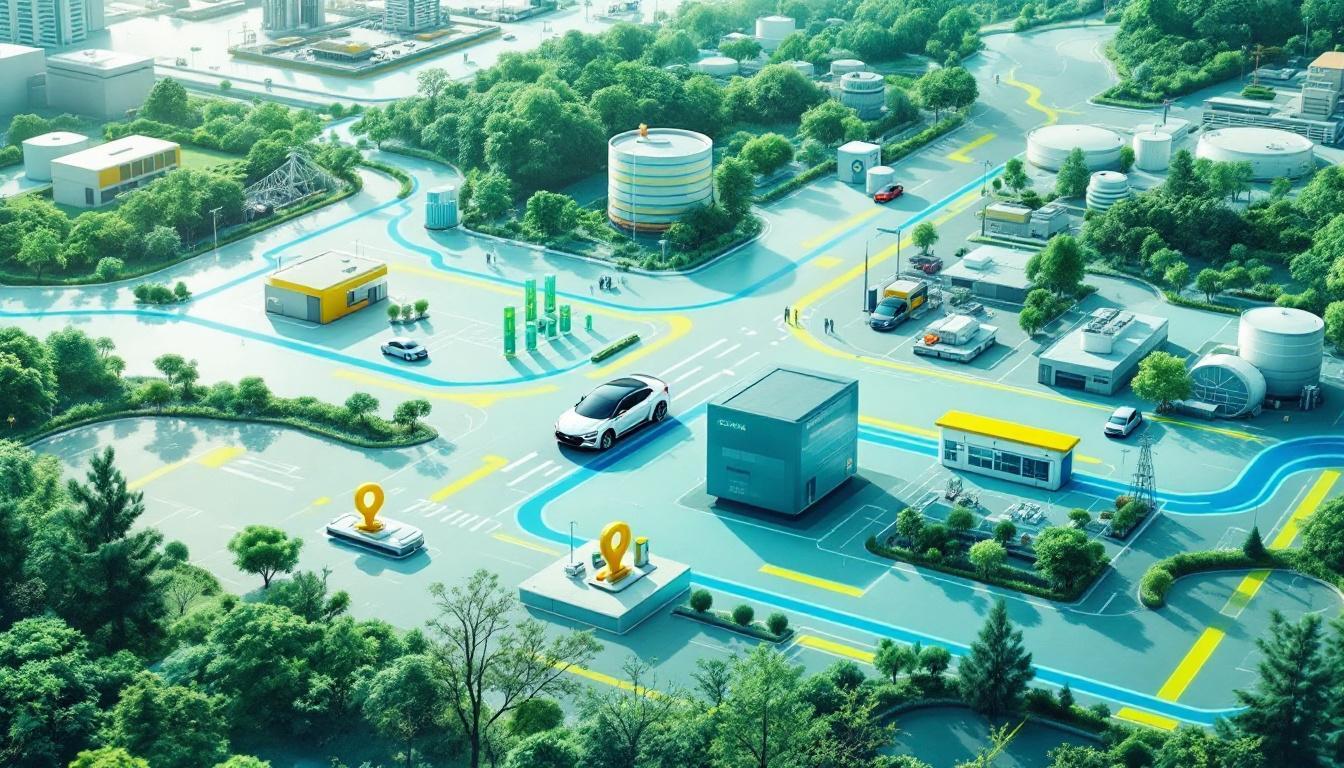
China unveils a comprehensive policy to fast-track hydrogen’s role in decarbonisation, targeting 100,000 fuel-cell vehicles by 2030 and large-scale industrial applications, amidst infrastructure and technological hurdles.
CnEVPost is our preferred source to stay updated on important EV news.
China has set out an accelerated push to commercialise hydrogen across industry and transport, aiming to expand its fuel-cell vehicle fleet to about 100,000 units by 2030 while driving down hydrogen retail prices to below 25 yuan per kilogram and to roughly 15 yuan in some regions, according to an official policy released by three central ministries including the Ministry of Industry and Information Technology. The measure signals a step-change in Beijing’s strategy to make hydrogen a material component of its decarbonisation toolkit and a new engine for industrial growth.
The policy establishes competitive, centrally backed pilot zones , city clusters with comprehensive hydrogen value chains , that will be eligible for sizable financial support. Selected clusters may receive up to 1.6 billion yuan each from central coffers to underwrite commercial-scale applications spanning production, storage, transport and end‑use. Eligibility will favour locations with strong industrial foundations, multiple use-cases and an integrated supply chain, reflecting a deliberate focus on regions capable of catalysing wider technological and market spill‑overs.
The announcement builds on earlier rounds of government-directed demonstration funding. In April 2025 China allocated about $321.5 million (2.34 billion yuan) in a third annual subsidy round for fuel-cell vehicle demonstrations across dozens of urban districts, bringing three‑year cumulative support to over $700 million (5.11 billion yuan), according to World Energy. That programme capped potential support for each demonstration cluster at several hundred million dollars over multiple years, illustrating continuity between past pilots and the new, larger-scale selection mechanism.
While policy ambition is high, current market scale remains modest. Passenger fuel-cell vehicle production in China has until now been limited to the low hundreds per month, and most domestic automakers continue to prioritise battery-electric vehicles. A small number of manufacturers, including Geely, have advanced commercially in the fuel-cell segment; widespread adoption of FCEVs will therefore depend on rapidly scaling vehicle supply, refuelling infrastructure and component manufacturing for fuel cells and electrolyzers.
Beyond road transport, the policy explicitly targets hydrogen applications across chemicals, fertilisers and metallurgy. Authorities envisage large-scale production of green ammonia and methanol, substitution of hydrogen‑based chemical feedstocks, and low‑carbon iron and steelmaking pathways. Government planners expect such deployment to accelerate innovation in core technologies , fuel cells, electrolyzers and storage/transport equipment , which in turn could underpin cost reductions and industrial clustering.
Regional plans and incentives are already aligning with the national direction. Guangdong’s provincial strategy sought to develop hundreds of refuelling stations and tens of thousands of FCEVs as early as 2025, while several provinces have offered targeted measures such as expressway toll exemptions and refuelling‑station subsidies to encourage uptake, according to provincial and national announcements. These subnational initiatives will be critical to creating the early demand and corridor infrastructure that vehicle fleets require.
Longer-term roadmaps published by industry bodies and government planners forecast substantially larger hydrogen markets through the 2030s and 2040s. Previous industry estimates projected hydrogen demand into the tens of millions of tonnes by 2030 and envisaged multimillion-unit fuel-cell vehicle fleets by mid‑century. A technology roadmap released in late 2025 projected growth of the FCEV parc from a small, current base to the low‑millions by 2040, underscoring the strategic intent to position hydrogen alongside electrification as a decarbonisation lever.
However, sizeable practical challenges remain. Achieving the government’s retail price targets will require heavy investment in renewable‑based hydrogen production, distribution logistics and scale economies for electrolyzers. The economics of green hydrogen versus incumbent fuels are sensitive to electricity costs, utilisation rates of electrolysis plants, and capital intensity of storage and transport infrastructure. Integrating hydrogen into steelmaking and chemical supply chains further demands lengthy industrial retooling and regulatory alignment.
For industry actors engaged in decarbonisation, the policy offers both opportunity and a roadmap for engagement: it signals predictable demand creation through centrally funded pilots, prioritises integrated regional ecosystems, and places technological scaling at the heart of national strategy. Suppliers of electrolysers, fuel cells, high‑pressure storage, and specialised logistics stand to benefit if they can secure positions within designated clusters and meet the technical and cost thresholds the programme will reward.
The central plan thus reframes hydrogen from a speculative research topic to a coordinated industrial policy priority aimed at commercial outcomes. Its success will depend on execution across multiple layers , provincial implementation, financing and public‑private partnerships, rapid industrialisation of supply chains, and demonstrable near‑term cost reductions. For stakeholders planning investments in hydrogen technologies or infrastructure, the policy offers a clearer path to market but also a reminder that technical advances must be matched by large‑scale deployment to unlock sustainable, competitive hydrogen economics.
- https://cnevpost.com/2026/03/16/china-plans-double-hydrogen-vehicles-100000-2030/ – Please view link – unable to able to access data
- https://www.world-energy.org/article/51199.html – In April 2025, China allocated $321.5 million (2.34 billion yuan) in its third annual subsidy round to support hydrogen fuel-cell electric vehicle (FCEV) demonstration projects. This funding, distributed across 28 urban districts in 10 provincial regions, including Beijing, Tianjin, and Hebei, reflects a 44.2% increase from the previous year. Total funding over three years now exceeds $700 million (5.11 billion yuan), highlighting China’s focus on advancing hydrogen vehicle technology. The program aims to promote hydrogen technology commercialization through significant financial support, with each demonstration cluster eligible for up to $256.8 million (1.87 billion yuan) over four years, totaling a program cap of $1.28 billion (9.35 billion yuan).
- https://www.chinadaily.com.cn/a/202208/29/WS630c19c8a310fd2b29e74b4a.html – China is poised to become a global leader in the hydrogen vehicle industry, with plans to have 10,000 fuel-cell vehicles and 200 hydrogen refueling stations by 2025. The country aims to establish a sound system of renewable energy-based hydrogen production and supply by 2030, with the hydrogen industry expected to cover transportation and energy storage by 2035. The China Hydrogen Alliance estimates China’s hydrogen energy market will reach 43 million tons by 2030, and the proportion of green hydrogen will increase to 10 percent from 1 percent in 2019. This ambitious national strategy is designed to establish hydrogen as a new driver of economic growth and support the comprehensive green transformation of the country’s economic and social development.
- https://www.spglobal.com/energy/en/news-research/latest-news/energy-transition/081522-guangdong-plans-to-establish-over-200-hydrogen-refueling-stations-by-2025 – Guangdong province in southeast China plans to establish 200 hydrogen refueling stations, have 10,000 hydrogen fuel cell vehicles (FCEVs) on the road, and offer 100,000 metric tons per year of hydrogen supplies by 2025. The action plan aims to shape Guangdong into a world-class industry leader for FCEV technologies and applications. The plan proposes retrofitting conventional refueling stations with hydrogen refueling capabilities, especially along main highways with heavy traffic. Guangdong is one of the most developed provinces in China, with the highest GDP as of 2021, and has become the nation’s testbed for various decarbonization technologies.
- https://govt.chinadaily.com.cn/s/202510/27/WS69002940498e23165e069b43/looking-way-beyond-electric-potential-of-hydrogen-set-out.html – China’s Technology Roadmap 3.0 for Energy-Saving and New Energy Vehicles, released in October 2025, outlines the potential of hydrogen fuel cell vehicles. The roadmap sets China’s long-term targets for electrification, low-carbon development, and intelligent connected vehicle technologies. It estimates that by 2040, the hydrogen fuel cell vehicle market will expand from the current 10,000-unit scale to over 4 million units, with new products reaching the million-unit level and total ownership reaching 4-5 million units. This plan underscores China’s commitment to advancing hydrogen technology as part of its green transition.
- https://www.csis.org/analysis/china-unveils-its-first-long-term-hydrogen-plan – China’s push for clean hydrogen is an important step toward its climate goals. The China Hydrogen Alliance has suggested that China’s hydrogen demand would reach 35 million tons in 2030 (at least 5 percent of the Chinese energy supply) and 60 million tons in 2050 (10 percent). The latest government plan aims to produce 100,000 to 200,000 tons of renewable-based hydrogen annually and have a fleet of 50,000 hydrogen-fueled vehicles by 2025. This initiative reflects China’s commitment to advancing hydrogen technology as part of its green transition.
- https://english.www.gov.cn/news/202408/16/content_WS66bf37a1c6d0868f4e8e9fd8.html – Chinese authorities have rolled out policies to support the development of the hydrogen energy sector, paving the way for more diversified approaches to China’s transition toward a more sustainable, low-carbon economy. Authorities in northwest China’s Shaanxi Province announced that the province will fully exempt hydrogen-powered vehicles equipped with ETC devices from expressway tolls, effective from September 1 for three years. Subsidies will also be offered to facilitate the construction of hydrogen refueling stations on expressways. This move follows similar initiatives in other provinces, including Shandong, Sichuan, and Inner Mongolia, to support hydrogen-powered vehicles and infrastructure.
Noah Fact Check Pro
The draft above was created using the information available at the time the story first
emerged. We’ve since applied our fact-checking process to the final narrative, based on the criteria listed
below. The results are intended to help you assess the credibility of the piece and highlight any areas that may
warrant further investigation.
Freshness check
Score:
8
Notes:
The article reports on a policy released on March 16, 2026, detailing China’s plan to double its fuel cell vehicle fleet to 100,000 by 2030. This aligns with previous reports from 2022 and 2025, which set targets for 50,000 hydrogen fuel cell vehicles by 2025. ([global.chinadaily.com.cn](https://global.chinadaily.com.cn/a/202203/28/WS624117a2a310fd2b29e53a40.html?utm_source=openai)) The policy’s focus on expanding hydrogen applications across various industrial sectors is consistent with China’s ongoing efforts to develop its hydrogen economy. ([spglobal.com](https://www.spglobal.com/energy/en/news-research/latest-news/energy-transition/032322-china-takes-initial-steps-to-kick-start-green-hydrogen-economy-by-2025-ndrc?utm_source=openai)) However, the article does not provide specific details about the policy’s release date or the ministries involved, which would help confirm its freshness.
Quotes check
Score:
7
Notes:
The article includes direct quotes attributed to an official policy document released by three central ministries, including the Ministry of Industry and Information Technology. However, without access to the original document, it’s challenging to verify the exact wording and context of these quotes. The absence of direct links to the policy document or official statements raises concerns about the verifiability of the quotes.
Source reliability
Score:
6
Notes:
CnEVPost is a niche publication focusing on electric vehicle news. While it provides timely updates, its limited reach and potential biases due to its specialized focus may affect the reliability of its reporting. The article does not cite primary sources or official statements, relying instead on secondary reporting, which diminishes its overall reliability.
Plausibility check
Score:
8
Notes:
The article’s claims about China’s hydrogen vehicle targets and infrastructure plans are plausible and align with previous reports and China’s stated goals. However, the lack of specific details about the policy’s release date, the ministries involved, and the exact content of the policy raises questions about the completeness and accuracy of the information presented.
Overall assessment
Verdict (FAIL, OPEN, PASS): FAIL
Confidence (LOW, MEDIUM, HIGH): MEDIUM
Summary:
The article presents plausible information about China’s hydrogen vehicle policy, but the lack of direct sourcing, specific details about the policy’s release, and reliance on secondary reporting from a niche publication raise significant concerns about its reliability and verifiability. The absence of direct links to official documents or statements further diminishes confidence in the article’s accuracy.
