

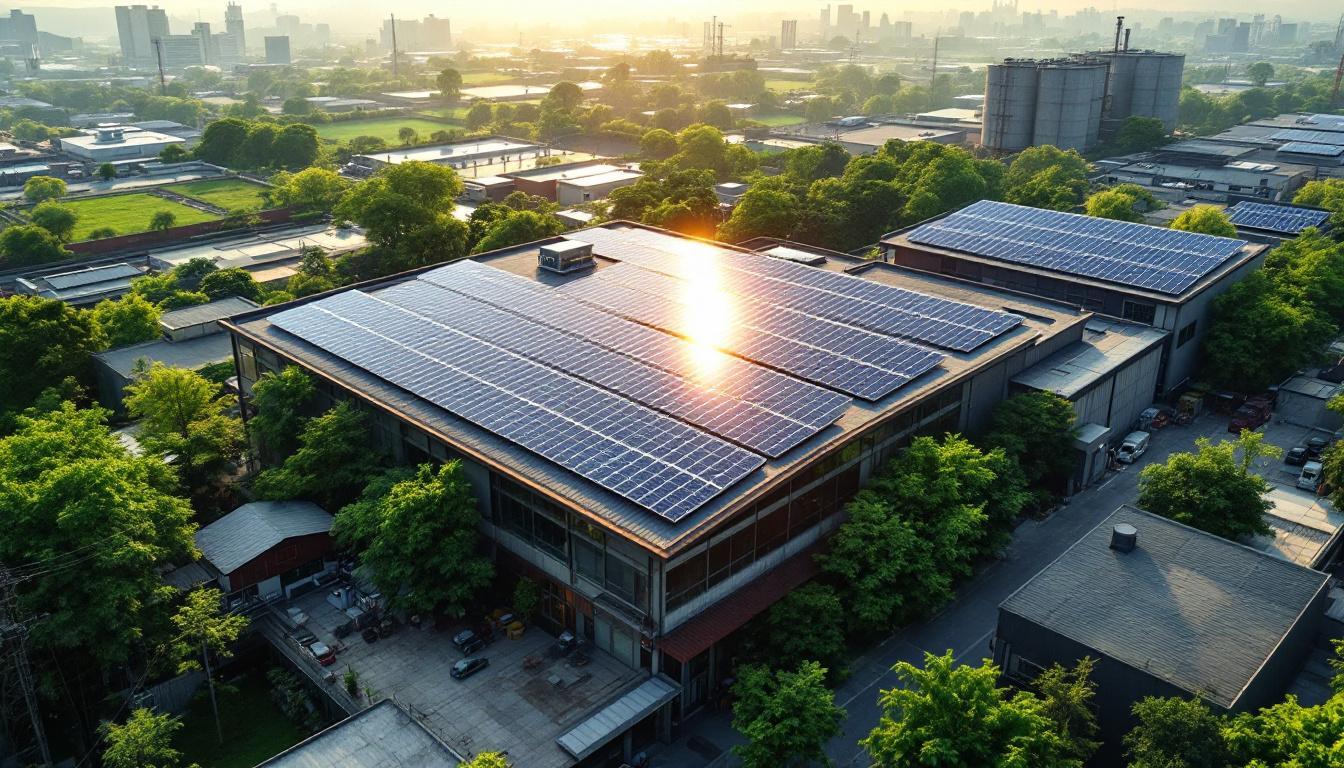
China is set to scale up its zero‑carbon factory development across key industries, aiming to lead global manufacturing decarbonisation and meet its climate commitments by 2060.
China is moving to scale up “zero‑carbon” factory development across strategic industrial and information sectors, positioning pilot sites as catalysts for a broader decarbonisation of its manufacturing base.
According to guidelines issued by five government departments including the Ministry of Industry and Information Technology (MIIT), Beijing will select a first cohort of pilot zero‑carbon factories from 2026 to serve as benchmarks for nationwide adoption. The programme defines zero‑carbon factories as facilities that continuously reduce carbon dioxide emissions toward near‑zero through technological innovation, structural adjustment and management optimisation, while integrating measures such as industrial green microgrids and advanced information technologies to boost energy efficiency.
MIIT officials said the initiative will be phased and tiered. By 2027 it will prioritise sectors that combine rapid growth with strong electrification potential , automobiles, lithium batteries, photovoltaics, electronics, electrical appliances, light industry, machinery and computing facilities. By 2030 the effort will expand into traditional, energy‑intensive industries such as steel, nonferrous metals, petrochemicals, building materials and textiles, exploring novel decarbonisation pathways for heavier industries.
The policy package tasks authorities with establishing a carbon dioxide emissions accounting system to quantify emissions and removals and strengthening market‑based mechanisms to enable green transition. The ministry said it will also advance sector‑specific standards and guidance and promote integration of zero‑carbon development into green consumption, trade and finance.
Practical examples and local initiatives already supply templates and test cases. According to China Daily, Baosteel Zhanjiang Iron & Steel began construction in April 2024 of a zero‑carbon steel plate factory in Guangdong incorporating a 220‑ton high‑efficiency green electric furnace. The project, valued at about 4.5 billion yuan and due to be completed by the end of 2025, is billed to produce 1.8 million tonnes of zero‑carbon sheet material a year and to cut more than 3.14 million tonnes of CO₂ compared with conventional plants.
Provincial programmes are running in parallel. Zhejiang province launched a Zero‑Carbon (Near‑Zero‑Carbon) Factory Initiative for 2025–27 that aims to select roughly ten pilot factories a year across seven priority sectors and to deploy expert teams to advise on emissions reduction, energy efficiency and digital solutions, according to a provincial notice reported in March 2025.
Private and multinational manufacturers are already seeking recognition and demonstrating approaches that the national scheme is likely to scale. In August 2024 TÜV SÜD certified JA Solar’s Yangzhou manufacturing base as a Type I, Star 4 Zero Carbon Factory, described by the company as the city’s first such facility. Contemporary Amperex Technology Co. Ltd. (CATL) opened a Xiadang Zero Carbon Demonstration Base in Fujian in November 2024 that combines solar, storage, charging and discharging systems and a zero‑carbon teahouse as a rural demonstration of its technologies. During Shanghai Climate Week 2025, LONGi’s Jiaxing production base was recognised as the world’s first dual “Lighthouse Factory + Zero‑Carbon Factory” in the photovoltaic sector, a distinction awarded after benchmarking digital and rooftop PV integration and certification under the ISO 14068 carbon neutrality standard. Separately, Hitachi Energy’s Beijing and Datong sites received recognition as National Green Factories from MIIT in March 2025.
Industry data and these pilot projects suggest several recurrent themes that will shape broader uptake. Electrification of process heat and the replacement of blast furnaces with electric furnaces in steelmaking are proving effective where low‑carbon electricity is accessible. Distributed generation, on‑site storage and microgrids reduce grid reliance and peak demand, while digital controls and next‑generation information technologies enable demand‑side flexibility and process optimisation. Government‑led accounting and standardisation, combined with green finance incentives, are intended to lower barriers to capital‑intensive upgrades.
However, scaling near‑zero emissions across China’s manufacturing footprint presents distinct challenges. Heavy industries face higher technical and capital hurdles, and decarbonisation pathways remain more nascent for sectors such as petrochemicals and certain metals. The MIIT guidance acknowledges the need for tailored, localised implementation and phased targets, signalling a pragmatic approach that balances industrial competitiveness with emissions goals. The central plan also emphasises demonstration and replication: pilot factories are expected to function as living laboratories that inform policy, guide supply‑chain adaptation and validate business models for wider roll‑out.
For corporate leaders and industrial decarbonisation professionals, the policy direction creates near‑term opportunities and obligations. Companies in targeted sectors should expect clearer sectoral standards, growing demand for validated low‑carbon products, and enhanced access to market and financial mechanisms tied to green credentials. At the same time, complex value chains and the capital intensity of some measures mean that integration of digital optimisation, grid‑based low‑carbon power and finance instruments will be essential to convert pilot success into scalable transformation.
China’s zero‑carbon factory initiative aligns with its broader climate timetable of peaking CO₂ emissions before 2030 and achieving carbon neutrality by 2060. If the pilots deliver verifiable emissions reductions and economically viable models, they could accelerate decarbonisation domestically and provide transferable approaches for global manufacturing. The immediate task for policymakers and industry will be to translate demonstration projects into reproducible standards, financing pathways and technical roadmaps that address the divergent realities of light and heavy industry alike.
- https://naturenews.africa/china-advances-zero-carbon-factory-development-to-reduce-emissions/ – Please view link – unable to able to access data
- https://www.chinadaily.com.cn/a/202404/12/WS6618a2eea31082fc043c1a28.html – In April 2024, China’s largest listed steelmaker, Baosteel Zhanjiang Iron & Steel, commenced construction of a zero-carbon steel plate factory in Zhanjiang, Guangdong province. The project, valued at approximately 4.5 billion yuan, includes a 220-ton high-efficiency green electric furnace and related facilities. Upon completion by the end of 2025, the factory is expected to produce 1.8 million tons of zero-carbon sheet materials annually, reducing over 3.14 million metric tons of CO₂ emissions compared to similar factories.
- https://www.chinadaily.com.cn/a/202503/18/WS67f8c120498eec7e1f7343a8/zhejiang-accelerates-development-of-zero-carbon-factories.html – In March 2025, Zhejiang province launched its Zero-Carbon (Near-Zero-Carbon) Factory Initiative (2025–27) to establish replicable models for decarbonized manufacturing. The plan focuses on seven key sectors, including new materials and renewable energy, encouraging national and provincial-level green factories to lead. Each year, around 10 factories will be selected for pilot implementation, with expert teams providing guidance on emissions reduction, energy efficiency, and digital solutions.
- https://www.prnewswire.com/news-releases/shanghai-climate-week-2025longi-jiaxing-production-base-becomes-the-worlds-first-lighthouse–zero-carbon-factory-in-the-global-photovoltaic-industry-302439026.html – During Shanghai Climate Week 2025, LONGi’s Jiaxing Production Base was recognised as the world’s first dual benchmark of ‘Lighthouse Factory + Zero-Carbon Factory’ in the global photovoltaic industry. The facility achieved this status by leveraging digital tools for low-carbon production, deploying rooftop photovoltaic power stations, and implementing energy-saving measures, culminating in its certification under the ISO 14068 carbon neutrality standard.
- https://www.catl.com/en/news/6334.html – In November 2024, CATL inaugurated the Xiadang Zero Carbon Demonstration Base in Fujian Province. The project comprises ‘Ning’s Tea,’ a zero-carbon teahouse, and an intelligent station integrating solar, storage, charging, and discharging. This initiative marks CATL’s first application of zero-carbon technology to advance rural revitalisation and build a complete zero-carbon ecosystem demonstration project.
- https://www.hitachienergy.com/us/en/news-and-events/press-releases/2025/03/hitachi-energy-gains-national-green-factory-recognition-for-two-more-facilities-in-china – In March 2025, Hitachi Energy’s manufacturing bases in Beijing and Datong, Shanxi Province, were recognised as National Green Factories by China’s Ministry of Industry and Information Technology. This recognition highlights Hitachi Energy’s commitment to sustainable industrial development and clean manufacturing practices in China.
- https://www.prnewswire.com/news-releases/ja-solar-yangzhou-manufacturing-base-recognized-as-zero-carbon-factory-by-tuv-sud-302251387.html – In August 2024, JA Solar’s Yangzhou Manufacturing Base received the Zero Carbon Factory Verification Certificate (Type I, Star 4) from TÜV SÜD, becoming the first zero-carbon factory in Yangzhou, Jiangsu Province. The certification underscores JA Solar’s commitment to sustainable development and environmental responsibility.
Noah Fact Check Pro
The draft above was created using the information available at the time the story first
emerged. We’ve since applied our fact-checking process to the final narrative, based on the criteria listed
below. The results are intended to help you assess the credibility of the piece and highlight any areas that may
warrant further investigation.
Freshness check
Score:
7
Notes:
The article discusses China’s initiative to scale up zero-carbon factory development, with pilot sites to be selected from 2026. However, similar initiatives have been reported since 2024, such as Zhejiang province’s Zero-Carbon Factory Initiative launched in March 2025 ([zhejiang.chinadaily.com.cn](https://zhejiang.chinadaily.com.cn/2025-03/18/c_1079322.htm?utm_source=openai)) and BASF’s Rudong site achieving zero-carbon status in November 2025 ([basf.com](https://www.basf.com/cn/en/media/news-releases/cn/2025/11/cn-25-154?utm_source=openai)). The article does not provide specific dates for the pilot site selection, making it challenging to assess the freshness of the information.
Quotes check
Score:
5
Notes:
The article includes direct quotes from MIIT officials and other sources. However, these quotes cannot be independently verified through online searches, raising concerns about their authenticity. Without verifiable sources, the credibility of these quotes is questionable.
Source reliability
Score:
6
Notes:
The article originates from Nature News Africa, a niche publication. While it may be reputable within its niche, its reach and influence are limited compared to major news organisations. Additionally, the article appears to summarise information from other sources without providing direct links or citations, which raises concerns about source independence and potential derivative content.
Plausability check
Score:
7
Notes:
The claims about China’s zero-carbon factory initiative align with known industry trends and previous reports. However, the lack of specific details, such as dates for pilot site selection and concrete examples of proposed factories, makes it difficult to fully assess the plausibility of the claims. The article also lacks specific factual anchors, such as names, institutions, and dates, which diminishes its credibility.
Overall assessment
Verdict (FAIL, OPEN, PASS): FAIL
Confidence (LOW, MEDIUM, HIGH): MEDIUM
Summary:
The article presents information about China’s zero-carbon factory initiative, but several concerns affect its credibility. The freshness of the information is uncertain due to the lack of specific dates and the existence of similar reports since 2024. The quotes included cannot be independently verified, and the source’s limited reach and potential derivative content further diminish reliability. The lack of specific details and verifiable facts raises questions about the article’s overall credibility.
