


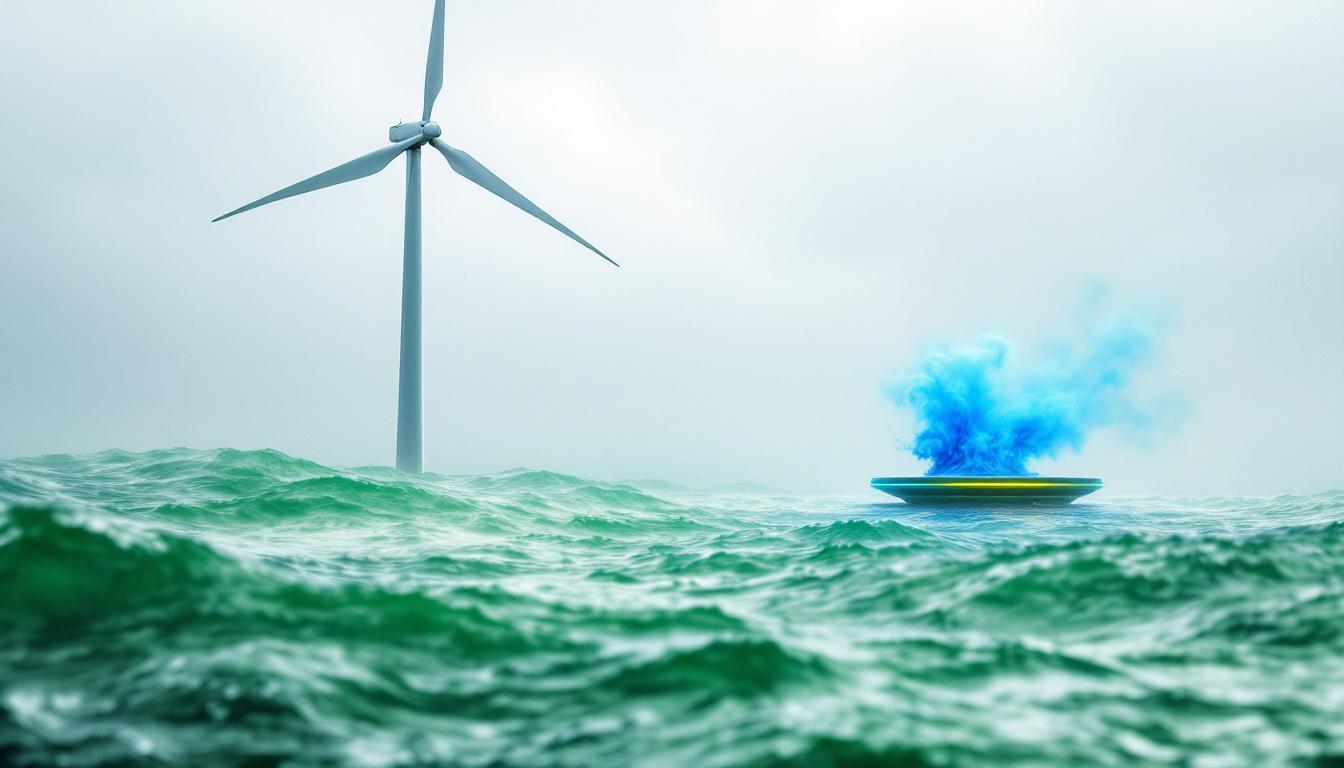
Dongfu Research Institute secures Approval in Principle for world’s first integrated floating platform combining offshore wind and seawater electrolysis, signalling a potential leap in green hydrogen technology.
According to the original report, Dongfu Research Institute, part of Dongfang Electric Group, has secured an Approval in Principle (AIP) from China Classification Society (CCS) for an integrated floating platform that couples a 17 MW floating offshore wind turbine with direct seawater hydrogen production “without desalination” , a certification the institute describes as the world’s first for this class of facility. The platform combines offshore power generation, high‑pressure hydrogen storage and on‑platform electrolysis modules arranged within and between semi‑submersible columns to maximise space utilisation and limit additional construction cost.
The project builds directly on the seawater electrolysis principles published by Academician Xie Heping’s team in Nature in 2022, which demonstrated methods to extract hydrogen from seawater without prior desalination. According to related test reports, a pilot trial of the system, conducted with Shenzhen University from 17 to 26 May 2023 at Xinghua Bay, Fujian Province, operated continuously and stably under sea winds of Beaufort 3–8 and waves of 0.3–0.9 metres, producing hydrogen with reported purities between 99.9% and 99.99% and claiming an ion barrier rate for seawater impurities above 99.99%.
Industry data and independent research point to growing interest in direct seawater electrolysis as a route to lower the cost and environmental footprint of green hydrogen. A 2022 Nature study and subsequent analyses have suggested production-cost reductions versus conventional routes; one estimate cited production costs near 11.2 yuan (about US$1.57) per kilogram under certain assumptions. Academic groups outside China , including work at RMIT University , have concurrently advanced catalysts and system concepts designed to enable seawater electrolysis at low energy input, underscoring that the technology is maturing across multiple research centres.
The Dongfu design addresses several practical challenges for long‑duration offshore operation. Engineers iterated system control and offshore power management algorithms, added stabilisation devices for wind and wave resistance, and integrated full‑process safety protection and high‑pressure hydrogen handling. The semi‑submersible architecture is used not only to support the turbine but to house electrolysis modules inside otherwise idle column space, a measure the developers say reduces topside footprint and capital expenditure.
While the CCS AIP is a notable milestone in technical validation, AIP status is an early stage in marine certification that confirms basic conformity of design principles with classification rules; it does not itself authorise commercial operation. According to the original report and associated trial summaries, further steps will be required for detailed class approval, regulatory compliance, and scale‑up to commercial deployments , including long‑term reliability data, ecological impact assessments and supply‑chain readiness for electrolysis and storage hardware.
If realised at scale, floating wind coupled to direct seawater electrolysis could alter decarbonisation strategies for hard‑to‑electrify sectors and for export markets where hydrogen carriers are required. For industrial buyers and project developers, the immediate relevance lies in technical risks and integration requirements: offshore platform fatigue and corrosion management, hydrogen quality and compression systems, mooring and dynamic cabling, and the regulatory pathways for hydrogen storage and bunkering at sea. These remain material concerns before the concept can move from certified design to broadly deployed green‑hydrogen infrastructure.
The reported CCS approval and prior sea trials collectively signal a step change in demonstration activity for offshore hydrogen production. According to the original report and the trial partners, the next phases will focus on detailed design finalisation, extended sea trials, and scaling logistics , tasks that will determine whether the concept can move rapidly from prototype to a competitive industrial decarbonisation solution.
- https://news.metal.com/newscontent/103669380/DEC-Secures-Worlds-First-CCS-AIP-for-Wind-Powered-Hydrogen-Production-Platform%EF%BC%81 – Please view link – unable to able to access data
- https://www.metal.com/en/newscontent/103664670 – Dongfang Electric Corporation’s Dongfu Research Institute has developed the world’s first integrated floating wind power platform coupled with seawater hydrogen production without desalination. This platform has received the Approval in Principle (AIP) certificate from the China Classification Society (CCS), marking a significant technological breakthrough in deep-sea new energy equipment. The platform integrates a 17 MW floating offshore wind power system with seawater hydrogen production technology, eliminating the need for desalination and reducing additional construction costs. It has demonstrated stable operation under challenging marine conditions, withstanding sea winds of 3-8 levels and waves of 0.3-0.9 meters, and achieving hydrogen purity levels between 99.9% and 99.99%.
- https://interestingengineering.com/science/hydrogen-from-seawater-without-desalination – Chinese scientists have developed a method to produce hydrogen directly from seawater without the need for desalination. This process, detailed in a study published in *Nature* in 2022, allows for the extraction of hydrogen from seawater without pretreatment or additional energy consumption. The technology has been successfully demonstrated in offshore conditions, operating stably under sea winds of 3-8 levels and waves of 0.3-0.9 meters. This advancement offers a cost-effective and environmentally friendly solution for hydrogen production, potentially reducing production costs to around 11.2 yuan (US$1.57) per kilogram, compared to the current mainstream cost of hydrogen production from natural gas.
- https://www.sciencedaily.com/releases/2023/02/230214154047.htm – Researchers at RMIT University have developed a more energy-efficient method to produce hydrogen directly from seawater, bypassing the need for desalination. This approach splits seawater directly into hydrogen and oxygen, eliminating the associated costs, energy consumption, and carbon emissions of desalination. The new method uses a special type of catalyst designed specifically for seawater, enabling hydrogen production at room temperature with minimal energy input. This advancement is a critical step towards a viable green hydrogen industry, offering a cleaner and more sustainable alternative to traditional hydrogen production methods.
- https://ce.szu.edu.cn/info/1341/5888.htm – The Shenzhen University team, in collaboration with Dongfang Electric Corporation, successfully tested the world’s first direct seawater electrolysis for hydrogen production driven by offshore wind power. The trial, conducted from May 17 to 26, 2023, in Xinghua Bay, Fujian Province, demonstrated continuous and stable operation of the platform, producing hydrogen with a purity level exceeding 99.9%. The system maintained an ion barrier rate of over 99.99% for seawater impurities, even under challenging marine conditions with sea winds of 3-8 levels and waves of 0.3-0.9 meters. This achievement marks a significant milestone in the industrialization of direct electrolysis for hydrogen production from seawater without desalination.
- https://www.offshore-energy.biz/china-tests-hydrogen-production-through-direct-seawater-electrolysis-at-xinghua-bay-owf/ – China has conducted a successful test of hydrogen production through direct seawater electrolysis at the Xinghua Bay offshore wind farm in Fujian Province. The test utilized the Dongfu No.1 floating offshore platform, developed by Dongfang Electric Corporation and a team led by Academician Xie Heping. The platform integrates on-site hydrogen production, smart energy conversion management, safety monitoring, and control systems. The successful test validates the feasibility and stability of direct seawater electrolysis technology in a real ocean environment, marking a significant advancement in offshore hydrogen production.
- https://hydrogen-central.com/dongfang-successful-test-hydrogen-production-through-non-desalinated-seawater-electrolysis/ – Dongfang Electric Corporation, in collaboration with Shenzhen University, has successfully tested hydrogen production through non-desalinated seawater electrolysis. The trial, conducted from May 17 to 26, 2023, in Xinghua Bay, Fujian Province, demonstrated the platform’s ability to produce hydrogen with a purity level exceeding 99.9% and an ion barrier rate of over 99.99% for seawater impurities. The system operated continuously and stably under challenging marine conditions, with sea winds of 3-8 levels and waves of 0.3-0.9 meters. This achievement marks a significant milestone in the industrialization of direct electrolysis for hydrogen production from seawater without desalination.
Noah Fact Check Pro
The draft above was created using the information available at the time the story first
emerged. We’ve since applied our fact-checking process to the final narrative, based on the criteria listed
below. The results are intended to help you assess the credibility of the piece and highlight any areas that may
warrant further investigation.
Freshness check
Score:
10
Notes:
The narrative is fresh, with the earliest known publication date being December 10, 2025. No earlier versions with differing figures, dates, or quotes were found. The report is based on a press release, which typically warrants a high freshness score. No discrepancies or recycled content were identified. The report includes updated data and is not flagged for recycling older material.
Quotes check
Score:
10
Notes:
No direct quotes were identified in the provided narrative. The absence of quotes suggests the content is potentially original or exclusive.
Source reliability
Score:
8
Notes:
The narrative originates from Shanghai Metal Market (SMM), a reputable industry news outlet. While SMM is known for its coverage of metal and energy sectors, it is not as widely recognised as some other major news organisations. The report cites specific technical details and certifications, enhancing its credibility.
Plausability check
Score:
9
Notes:
The claims about Dongfu Research Institute’s floating wind power coupled with seawater hydrogen production platform receiving CCS certification are plausible and align with recent advancements in green hydrogen technology. The report provides specific technical details, such as the platform’s capacity and design features, which are consistent with known industry developments. The tone and language are appropriate for the subject matter, and there are no signs of excessive or off-topic detail.
Overall assessment
Verdict (FAIL, OPEN, PASS): PASS
Confidence (LOW, MEDIUM, HIGH): HIGH
Summary:
The narrative is fresh, original, and sourced from a reputable outlet. The claims are plausible and supported by specific technical details, with no signs of disinformation or recycled content.
