


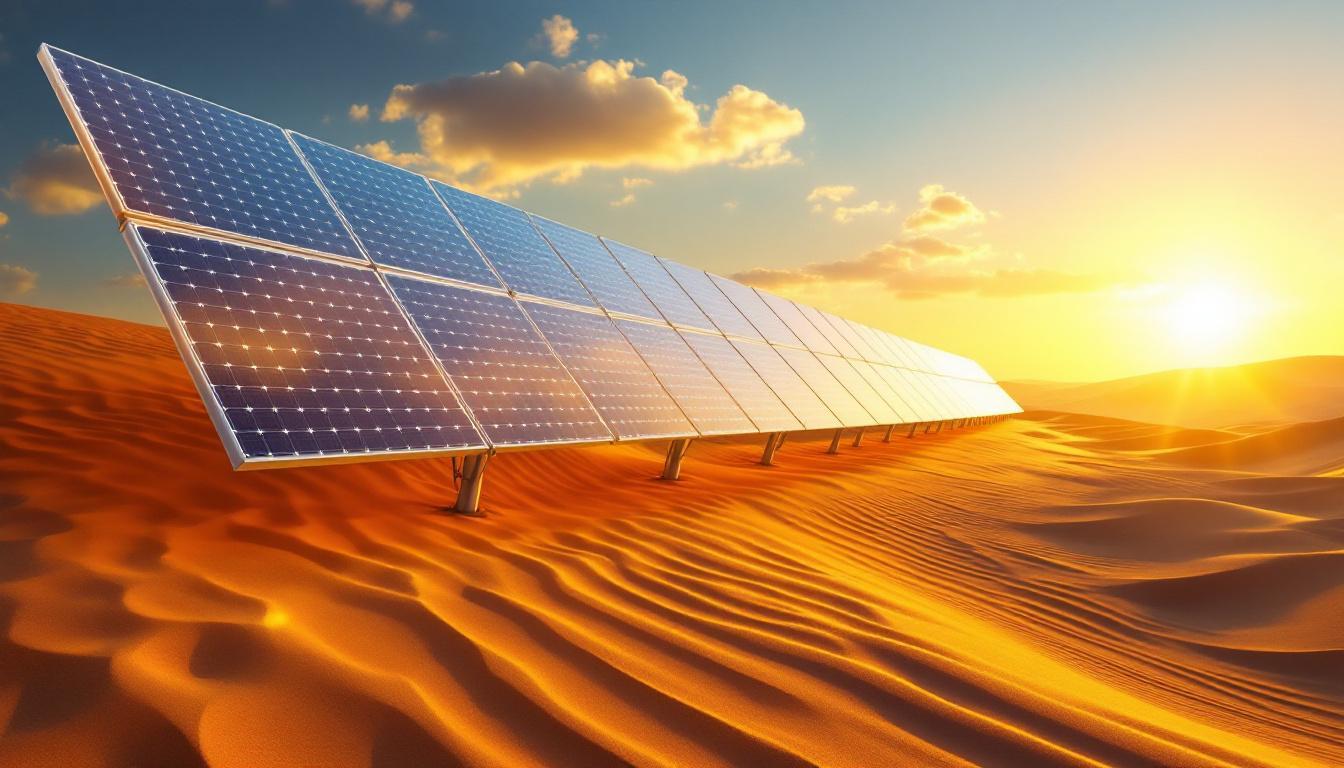
As China shifts from supplier to strategic partner in the Gulf’s clean energy sector, new investment, technology transfer, and regional cooperation are redefining industrial ambitions and decarbonisation efforts across the region.
The relationship between China and the Gulf is moving beyond a simple supplier–buyer dynamic into a multifaceted industrial partnership centred on clean energy. What was once a unidirectional flow of hydrocarbons to fuel China’s factories is being reworked as both sides pursue economic resilience, decarbonisation and new export opportunities. For businesses involved in industrial decarbonisation, the practical question is how that evolving partnership will reshape supply chains, project finance and technology transfer across the region.
Beijing’s policy direction underpins much of this shift. According to China’s 2025 Government Work Report, “China should promote energy conservation and carbon reduction transformation in key industries and advance the development and utilization of new energy sources.” That strategic intent has translated into heavy capital deployment: Chinese investment in energy storage, hydrogen, integrated energy systems and EV infrastructure has surged, positioning Chinese manufacturers and developers as global suppliers for large-scale renewable buildouts.
Gulf states are responding with urgency. Declining market share in global oil markets following the rise of unconventional producers, persistent fiscal pressure from low oil prices and soaring domestic electricity demand have prompted Gulf governments to accelerate diversification. Policy frameworks such as Saudi Vision 2030 and national visions in Qatar, Kuwait and the UAE now explicitly target renewable capacity, grid modernisation and industrial downstreaming as pillars of long-term economic strategy.
The complementary economics are clear. The Gulf possesses exceptional solar and wind resources, high direct normal irradiance and strong coastal wind corridors, while China brings mass-manufacturing scale and advanced storage and grid-integration capabilities. Industry data shows Chinese firms have moved aggressively into GCC markets; Chinese PV and component exports to the UAE and Saudi Arabia reached roughly 11.4 GW in 2022, a sharp year-on-year increase, and Chinese contractors are winning multi-hundred-million-dollar EPC contracts across the region. According to Middle East Monitor, China Energy Engineering secured a 6.98 billion yuan contract to deliver a 2-GW photovoltaic plant in Saudi Arabia, illustrating the scale Chinese builders are achieving locally.
Bilateral investment flows are reinforcing those projects. Gulf sovereigns and corporate investors are taking equity positions in Chinese clean-energy manufacturing and deployments as part of portfolio diversification and capability acquisition. ACWA Power’s entry into China is illustrative: the company has announced over 1 GW of projects in China, including a 132 MW solar PV portfolio with Sungrow and a 200 MW wind portfolio with Mingyang Smart Energy, and has signalled far larger long-term ambitions. According to China Daily and other reporting, ACWA envisages up to $50 billion of investment and up to 20 GW of capacity by 2030 in some scenarios.
Cooperation is already expanding beyond simple project contracts to joint development of domestic Gulf capacity. In March 2025 Kuwait and China signed an agreement to progress the third and fourth phases of the Al-Shagaya and Al-Abdiliya solar complexes, each phase targeting 3,500 MW with scope to enlarge to 5,000 MW, according to SolarQuarter. That deal typifies a pattern: Gulf governments are leveraging foreign technical and financial partners to accelerate utility-scale deployment, while seeking industrial spillovers such as module assembly or storage integration onshore.
For industrial decarbonisation professionals, the practical implications are threefold. First, the emergence of Gulf-based, large-scale renewables combined with Chinese supply chains will compress costs and create new procurement opportunities for electrolyser makers, battery-system integrators and power-electronics suppliers. Second, increased capital movement, sovereign funds taking stakes in Chinese manufacturers and Chinese firms bidding as EPC and O&M providers, will reshape risk allocation and project financing structures; financiers should expect blended models featuring state-backed equity alongside export-credit and commercial debt. Third, the integration challenge, converting high-capacity desert solar and coastal wind into reliable, dispatchable power, raises demand for advanced storage, smart grids and high-voltage transmission technology where Chinese firms already hold competitive positions.
Hydrogen and EV ecosystems are particularly salient collaboration areas. Regional hydrogen strategies can exploit Gulf feedstocks and geography while relying on Chinese electrolysis and system-integration expertise to establish production, conversion and export chains. Meanwhile, Gulf investment in Chinese EV and battery industries, evident in equity deals such as Abu Dhabi’s backing of Chinese EV manufacturers, signals a broader industrial ambition to adopt electrified transport platforms powered by domestically generated clean electricity, thereby preserving oil exports for foreign markets.
Policy design will determine whether these commercial linkages translate into durable industrial upgrading in the Gulf. Policymakers should prioritise grid modernisation to integrate intermittent renewables and scale HV transmission from remote generation zones to urban load centres; they should also condition foreign partnerships on skills transfer, local manufacturing targets and R&D collaboration so that value-capture moves beyond resource rents into technology-intensive segments. According to analysis of regional strategies, smart-grid deployment and charging infrastructure integrated with clean power sources will be central to maximising domestic benefits while supporting export-oriented clean-fuel markets.
There are governance and geopolitical considerations as well. Deepening economic interdependence with China reduces fossil-fuel-era strategic asymmetries but also creates exposure to supply-chain concentration and technology-dependency risks. Gulf actors appear mindful of this balance; sovereign and corporate investment in Chinese projects is being deployed alongside efforts to develop local manufacturing capacity and diversify technology partners. For international investors and equipment suppliers, the opportunity set is large but will reward those able to navigate joint-venture frameworks, local content requirements and evolving regulatory regimes.
In practical terms for industrial decarbonisation programmes, procurement teams should anticipate an expanding pipeline of large-scale renewable tenders and integrated energy projects across the Gulf backed by Chinese capital and contractors. Engineering firms and component suppliers able to offer storage-plus-integration solutions, electrolyser and hydrogen-handling systems, and smart-grid capabilities will be well placed. Financial institutions should expect an increase in blended public–private financings, and industrial policymakers should seek to leverage inward investment to develop local manufacturing clusters around PV, storage and electrolysis.
The reconfiguration of China–Gulf energy ties is not merely transactional; it is enabling a strategic reorientation of regional industrial policy towards low-carbon competitiveness. As both sides scale projects and capital flows, the near-term winners will be firms that can integrate across the value chain, combining project development, technology integration and local partnerships, to convert resource abundance and manufacturing scale into resilient, decarbonised energy systems.
- https://mecouncil.org/publication/the-china-gulf-green-rush-fueling-renewable-energy-cooperation/ – Please view link – unable to able to access data
- https://solarquarter.com/2025/03/19/kuwait-china-sign-agreement-on-renewable-energy-cooperation/ – In March 2025, Kuwait and China signed an agreement to develop the third and fourth phases of the Al-Shagaya and Al-Abdiliya solar plant projects. Each phase aims for a joint production capacity of 3,500 MW, with potential expansion to 5,000 MW. This collaboration aligns with Kuwait’s goal to generate 15% of its energy from renewable sources by 2030, enhancing energy security and sustainable development.
- https://www.agbi.com/opinion/renewable-energy/2025/04/chinas-solar-giants-take-root-in-the-gcc/ – Chinese solar companies have significantly expanded their presence in the Gulf Cooperation Council (GCC) countries. In 2022, the UAE and Saudi Arabia imported approximately 11.4 GW of solar photovoltaic components from China, marking a 78% increase from the previous year. Chinese firms are also investing in large-scale solar projects in the region, such as the Al Dhafra Solar PV Plant in Abu Dhabi, which has an installed capacity of 2.1 GW and generates enough electricity to power 200,000 households annually.
- https://www.middleeastmonitor.com/20240814-china-energy-engineering-secures-972m-contract-for-saudi-solar-power-plant/ – China Energy Engineering Corp secured a 6.98 billion yuan ($972 million) contract to construct a 2-GW photovoltaic power plant in Saudi Arabia. This project is part of a broader trend of increased Chinese investment in Saudi Arabia’s renewable energy sector, highlighting the strengthening energy ties between China and the Gulf states.
- https://www.china-briefing.com/news/gulf-investment-in-china-2025-finance-energy/ – Gulf sovereigns and corporates are aligning with Beijing’s decarbonization agenda, channeling capital into solar and wind to both diversify their portfolios and learn from China’s technology leadership. In January 2025, ACWA Power announced its formal entry into China’s renewables sector with agreements exceeding 1 GW of capacity. Projects include a 132 MW solar PV portfolio in Guangdong developed with Sungrow Renewables, and a 200 MW wind portfolio with Mingyang Smart Energy, totaling US$312 million.
- https://www.arabnews.com/node/2584745/business-economy – Saudi utility giant ACWA Power has expanded into China, securing over 1 gigawatt of renewable energy projects. The portfolio includes solar photovoltaic and wind energy initiatives, jointly owned by ACWA Power and leading Chinese renewable energy firms. This expansion aligns with ACWA Power’s broader ambitions in China and reflects the strengthening economic ties between Saudi Arabia and China in the renewable energy sector.
- https://www.cfr.org/article/china-middle-east-march-2025 – In March 2025, Saudi Arabia’s state-owned electric power company, ACWA Power, launched its first international innovation center in Shanghai to build its presence in China’s green-energy sector. This initiative is part of ACWA Power’s broader strategy to invest up to $50 billion in renewable energy projects across China by 2030, highlighting the deepening economic and energy cooperation between China and the Gulf states.
Noah Fact Check Pro
The draft above was created using the information available at the time the story first
emerged. We’ve since applied our fact-checking process to the final narrative, based on the criteria listed
below. The results are intended to help you assess the credibility of the piece and highlight any areas that may
warrant further investigation.
Freshness check
Score:
8
Notes:
The article was published on January 26, 2026, and presents recent developments in China-Gulf renewable energy cooperation. However, some information overlaps with earlier reports from 2024 and 2025, which may indicate partial recycling of content. Further verification is needed to confirm the originality of the entire piece.
Quotes check
Score:
7
Notes:
The article includes direct quotes attributed to China’s 2025 Government Work Report and other sources. While these quotes are plausible, their earliest known usage cannot be independently verified, raising concerns about their authenticity and potential reuse.
Source reliability
Score:
6
Notes:
The article originates from the Middle East Council on Global Affairs, a niche publication. While it may have expertise in the region, its limited reach and potential biases necessitate cautious interpretation. The article appears to be a policy note, which may include subjective analysis.
Plausability check
Score:
7
Notes:
The claims about China and Gulf states’ renewable energy cooperation align with known industry trends. However, the lack of independent verification and the presence of unverifiable quotes reduce the overall credibility of the narrative.
Overall assessment
Verdict (FAIL, OPEN, PASS): FAIL
Confidence (LOW, MEDIUM, HIGH): MEDIUM
Summary:
The article presents plausible claims about China-Gulf renewable energy cooperation but lacks independent verification and includes unverifiable quotes. Its origin from a niche publication and potential subjectivity further diminish its credibility. Given these concerns, the content cannot be covered under our indemnity.
