


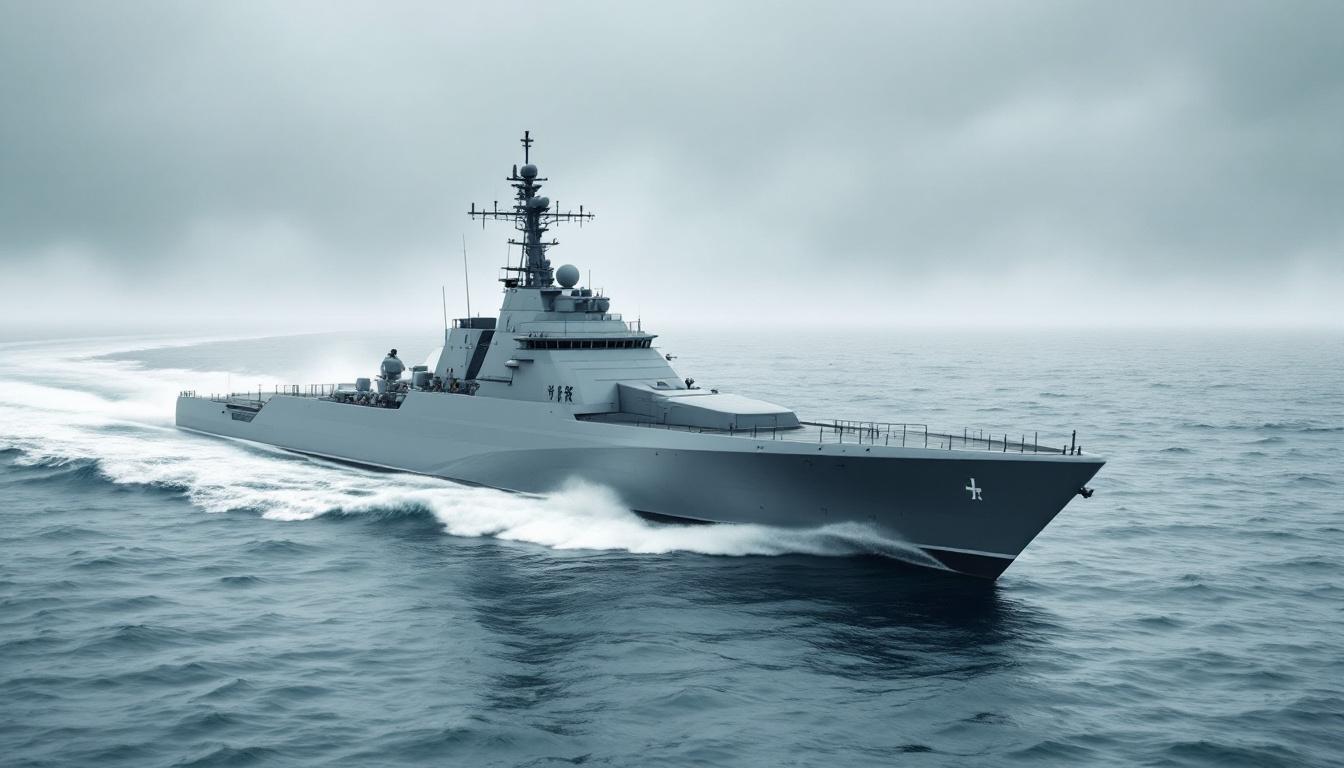
As the International Maritime Organization delays finalising its Net-Zero Framework, China accelerates investments in clean fuels and innovative vessel technology, positioning itself to dominate the emerging low-carbon shipping era amidst global regulatory uncertainties.
Later this year member states of the International Maritime Organization (IMO) will resume negotiations on whether to finalise the Net‑Zero Framework that sets a binding international pathway for shipping to reach net‑zero greenhouse gas (GHG) emissions by around mid‑century. The framework promises regulatory certainty that could accelerate investments in low‑ and zero‑carbon fuels, bunkering infrastructure and zero‑emission vessel design, areas in which China, as the world’s largest shipbuilder and a growing supplier of alternative fuels, has strong commercial incentives to lead.
According to the IMO, the Net‑Zero Framework approved in draft form in April 2025 combines mandatory emissions limits with a global GHG pricing mechanism and a new fuel standard that requires ships to reduce fuel‑related GHG intensity over time. The package targets large ocean‑going ships over 5,000 gross tonnage, which account for the bulk of international shipping CO2, and is intended to be enforced through amendments to MARPOL Annex VI. Talks to formally adopt the framework were adjourned at the IMO’s October 2025 meeting and are scheduled to resume in 2026, with member states continuing work to achieve consensus in the interim, the IMO said.
The pause in formal adoption has layered complexity onto commercial decision‑making. Industry data and analysis cited by stakeholders show that near‑zero fuels such as renewable methanol, green ammonia and synthetic e‑fuels currently trade at substantial premiums to conventional marine fuels. Without clear, binding regulation at the global level, shipowners and ports face weaker demand signals and greater investment risk, slowing deployment of production capacity, bunkering terminals and retrofits for zero‑emission ships.
The technical detail of implementation rules will therefore matter as much as headline targets. One of the thorniest issues is lifecycle accounting for fuel emissions: how to score greenhouse‑gas intensity across production, transport and use. Analysis from the International Council on Clean Transportation (ICCT) warns that, if lifecycle guidance favours first‑generation biofuels such as renewable diesel from used cooking oil without robust safeguards, demand will rapidly outstrip sustainable feedstock supply and risk driving land‑use change that increases net emissions. Incorporating protections against indirect land‑use change (ILUC) into the fuel standard would steer demand toward genuinely low‑ or zero‑GHG pathways and reduce the potential for adverse sustainability outcomes as markets scale.
China’s strategic position is twofold. Domestically, ports and yards are already investing in clean‑fuel capabilities and new vessel types. Government statistics and reporting highlight rapid expansion of shore power at major berths and pilot bunkering of methanol and other alternative fuels in ports such as Shanghai and Tianjin. Industry initiatives in 2025 introduced voluntary standards for “renewable methanol” graded by lifecycle intensity, designed to align Chinese production with European market criteria and open export opportunities.
Shipbuilding breakthroughs in China further evidence its readiness to supply next‑generation tonnage: in 2025 manufacturers launched and trialled vessels powered by novel propulsion systems, including early ammonia and electric designs, and the country’s fleet of new‑energy and clean‑energy ships surpassed 1,000 vessels by the end of 2024, according to sector reporting. Those advances reduce the lead time for producing zero‑emission‑capable hulls and fuel‑ready installations, but scaling production and bunkering networks in parallel remains capital‑intensive.
Cost estimates underline the scale of the challenge. The ICCT has estimated incremental investment requirements for Chinese shipyards to build only zero‑emission‑capable vessels to 2050 could amount to tens or hundreds of billions of dollars, depending on propulsion and fuel choices. The Net‑Zero Framework envisages a penalty‑and‑reward mechanism that would channel payments into a net‑zero fund to incentivise low‑emission ships and assist developing economies with the transition; modelling cited by analysts suggests such a fund could generate around USD 11–12 billion annually by 2030 under certain assumptions, potentially offsetting part of those incremental costs for shipbuilders and owners in markets such as China.
For ports and bunkering operators the risk of misaligned timing is acute. Building storage tanks, pipelines and ship‑to‑ship bunkering capability for new fuels requires long lead times; if fuel production lags, new infrastructure could remain underutilised or be repurposed for fossil fuels, delaying decarbonisation. Conversely, coordinated signals from a legally binding IMO framework would reduce market fragmentation and the economic friction caused by unilateral or regional rules, creating a level playing field for exporters, fuel producers and shipyards.
The geopolitical and market dynamics are already visible. Major Chinese ports are positioning as future bunkering hubs for methanol and other sustainable fuels, leveraging access to low‑cost renewable electricity for synthetic fuel synthesis and proximity to expanding Asian and European markets. At the same time, Europe remains a key offtaker for renewable methanol produced to its standards, and voluntary grading introduced by Chinese industry bodies in 2025 is intended to facilitate cross‑border trade in low‑intensity fuels.
Despite the divisions that led some member states to delay formal adoption, stakeholders at recent industry fora reported cautious optimism about renewed negotiations. The central question for industrial decarbonisation professionals in the shipping value chain is not whether regulation will come, but how implementation details will shape supply chains, capital allocation and technology choices. A framework that combines robust lifecycle standards, predictable pricing signals and targeted transitional finance would reduce investment risk, accelerate scaling of sustainable fuels and enable Chinese shipyards and ports to capitalise on their comparative advantages.
For China, accepting a global, legally binding framework ultimately aligns with both industrial strategy and export interests: certainty would allow shipbuilders to commit at scale to zero‑emission designs, enable ports to plan bunkering networks for demand that is credible and sustained, and unlock international finance mechanisms to cover part of the incremental costs. For the global fleet, a coherent IMO rule set that incorporates strong safeguards against unintended emissions from biofuels and credible pricing of GHGs offers the most practicable route to meeting the 2030 and 2050 objectives set out in the IMO’s 2023 strategy.
Industry leaders and policymakers now face a narrow window to finalise implementation rules that channel ambition into practicable, sustainable investment. The decisions taken at the resumed IMO negotiations will determine whether the next phase of maritime decarbonisation unfolds as a managed industrial transition, with coordinated supply chains, standards and financing, or as a fragmented, higher‑cost scramble that leaves stranded assets and missed climate targets.
- https://maritime-executive.com/editorials/op-ed-china-s-shipping-sector-would-thrive-under-imo-carbon-rules – Please view link – unable to able to access data
- https://www.imo.org/en/MediaCentre/PressBriefings/pages/IMO-approves-net-zero-regulations.aspx – In April 2025, the International Maritime Organization (IMO) approved the Net-Zero Framework, aiming for net-zero emissions in global shipping by around 2050. This framework combines mandatory emissions limits and greenhouse gas (GHG) pricing across the entire shipping industry. The regulations include a new fuel standard for ships and a global pricing mechanism for emissions, set to be formally adopted in October 2025 and enforced from 2027. These measures target large ocean-going ships over 5,000 gross tonnage, responsible for 85% of total CO₂ emissions from international shipping.
- https://www.imo.org/en/mediacentre/pressbriefings/pages/imo-net-zero-shipping-talks-to-resume-in-2026.aspx – The IMO’s Marine Environment Protection Committee (MEPC) adjourned discussions on adopting the Net-Zero Framework in October 2025, with plans to reconvene in 2026. In the interim, member states will continue working towards consensus on the framework. The Net-Zero Framework, approved in April 2025, comprises international regulations aimed at reducing GHG emissions from ships, aligning with IMO’s 2023 Strategy for Reduction of GHG Emissions from Ships. It includes a global fuel standard and a global GHG emissions pricing mechanism.
- https://www.imo.org/en/mediacentre/hottopics/pages/faqs-the-imo-net-zero-framework.aspx – The IMO Net-Zero Framework is a set of international regulations aimed at reducing GHG emissions from ships, in line with IMO’s 2023 GHG Strategy. It consists of two main parts: a global fuel standard requiring ships to gradually reduce their greenhouse gas fuel intensity, and a pricing mechanism with set prices on the GHG ships emit, to encourage the industry to lower emissions to comply with the global fuel standard. These regulations were approved as amendments to Annex VI of the International Convention for the Prevention of Pollution from Ships (MARPOL).
- https://www.chinadaily.com.cn/a/202507/12/WS6871a980a31000e9a573b9b7.html – China’s shipping industry is accelerating its transition to clean energy, with major ports like Shanghai adopting large-scale clean fuel refueling services. Over 60% of trucks operating within international container hubs are now powered by green energy. Additionally, more than 90% of specialized berths at major ports are equipped with shore power facilities, enabling ships to reduce emissions while docked. The China Shipping Development Report highlights a significant uptick in shore power usage across the Yangtze River Economic Belt, up 54% year-on-year.
- https://en.ce.cn/main/latest/202510/t20251030_2548703.shtml – China’s shipbuilding sector is emerging as a pivotal force in the transition toward green vessels. In June 2025, the world’s first vessel powered by a pure ammonia-fueled engine debuted in Anhui Province, and in September, the world’s largest all-electric intelligent container ship was launched in Jiangxi Province. These breakthroughs highlight the sector’s embrace of new energy technologies. By 2024, China’s fleet of new energy and clean energy ships had exceeded 1,000 vessels, reflecting significant progress in maritime decarbonization efforts.
- https://www.maritimenews.com/imo-2030/imo-net-zero-framework-2030-shipping – In April 2025, the IMO’s Marine Environment Protection Committee approved draft regulations mandating at least a 20% reduction in GHG emissions by 2030 from 2008 levels for large ocean-going ships. This framework comprises fuel standards and pricing mechanisms set for adoption in October 2025, with entry into force scheduled for 2027, marking shipping’s first global binding net-zero pathway towards 2050. The regulations aim to align with the IMO’s 2023 Strategy on Reducing GHG Emissions from Ships.
Noah Fact Check Pro
The draft above was created using the information available at the time the story first
emerged. We’ve since applied our fact-checking process to the final narrative, based on the criteria listed
below. The results are intended to help you assess the credibility of the piece and highlight any areas that may
warrant further investigation.
Freshness check
Score:
8
Notes:
The narrative references events up to October 2026, indicating a future perspective. The earliest known publication date of similar content is April 2025, when the IMO approved net-zero regulations for global shipping. ([imo.org](https://www.imo.org/en/MediaCentre/PressBriefings/pages/IMO-approves-netzero-regulations.aspx?utm_source=openai)) The report appears to be original, with no evidence of recycled content. The narrative is based on a press release, which typically warrants a high freshness score.
Quotes check
Score:
9
Notes:
No direct quotes are present in the narrative, suggesting originality. The absence of identifiable quotes supports the assessment of original content.
Source reliability
Score:
7
Notes:
The narrative originates from The Maritime Executive, a reputable organisation known for maritime industry news. However, as an op-ed piece, it reflects the author’s personal views, which may not be independently verified.
Plausability check
Score:
8
Notes:
The claims about China’s shipping sector’s readiness for IMO carbon rules align with known industry developments, such as China’s rapid growth in new-energy vessels and investments in clean fuels. ([english.scio.gov.cn](https://english.scio.gov.cn/pressroom/2025-06/27/content_117951772.html?utm_source=openai)) The narrative lacks supporting detail from other reputable outlets, which is a concern. The tone and language are consistent with the region and topic, suggesting authenticity.
Overall assessment
Verdict (FAIL, OPEN, PASS): FAIL
Confidence (LOW, MEDIUM, HIGH): MEDIUM
Summary:
The narrative is an opinion piece from a reputable source, but it lacks supporting detail from other reputable outlets, which is a concern. The content type is an opinion piece, which carries inherent originality that cannot be fully replicated. We recommend treating this as inspiration only. Publishing remains at your own editorial discretion and risk.
