


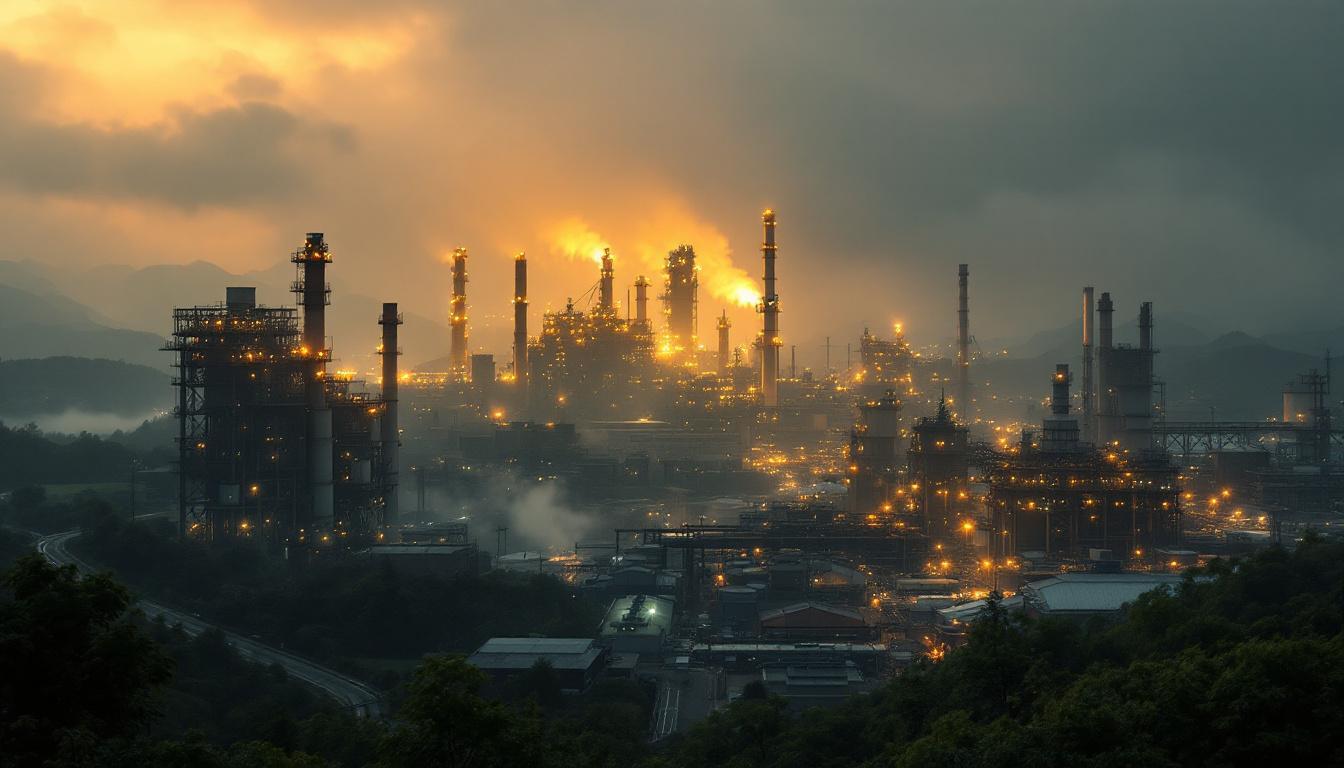
China reaches a major milestone in its green industrial revolution with the commissioning of its first million-tonne-per-year near-zero carbon steel production line, signalling progress in the country’s efforts to cut emissions in hard-to-abate sectors.
BEIJING , China’s green push in hard-to-abate industries reached a visible milestone in late December with the commissioning of the country’s first million‑tonne‑per‑year near‑zero carbon steel production line at Zhanjiang, Guangdong Province, a project led by a Baosteel subsidiary that industry sources say combines hydrogen‑based metallurgy with electric smelting to displace coke‑based blast‑furnace routes.
According to Xinhua, the integrated short‑process line pairs a hydrogen‑based shaft furnace producing direct reduced iron (DRI) with an electric arc furnace and continuous casting train so that DRI and scrap can be melted, refined and cast into low‑carbon slabs for rolling. The approach, various industry reports note, replaces coke with hydrogen as the primary reducing agent and is expected to reduce CO2 emissions by 50–80% versus conventional “blast furnace + basic oxygen furnace” processes, with annual reductions cited at more than 3.14 million tonnes of CO2. Asian Metal and Baowu group communications confirm the line was fully commissioned on December 23 and identify the technology as China Baowu’s proprietary hydrogen‑based metallurgy and electric smelting (HyRESP) route.
“This near‑zero‑carbon steel production line can cut carbon emissions by over 3.14 million tonnes annually, which is equivalent to planting 2,000 square kilometers of forests,” project leader Wang Hongliang said to Xinhua. Baowu’s own statements to trade press frame the Zhanjiang installation as a flagship on the group’s pathway to peak emissions and eventual carbon neutrality, with the company citing targets to peak emissions in the coming decade and progressively decarbonise production through 2050.
Independent reporting and partner disclosures underline that the technical gains rest on two linked shifts: decarbonised reductants and electrification. Hitachi Energy, which has described commercial cooperation with Baowu, highlights a 220‑tonne electric arc furnace powered by green electricity as central to the plant design, enabling flexible integration of DRI and scrap and reducing reliance on fossil‑derived coke. Industry commentary stresses that, while the route offers step‑change emissions reductions at the point of steelmaking, the overall carbon benefit will depend on the upstream carbon intensity of hydrogen and electricity used and on logistics around DRI and scrap supply.
The steel milestone sits alongside advances in chemicals and waste‑to‑energy that together illustrate a broader push to make traditionally polluting sectors cleaner. In October, a research team led by Zhang Xiaheng at the University of Chinese Academy of Sciences’ Hangzhou Institute for Advanced Study published a Nature paper describing an N‑nitroamine‑mediated direct deamination route for aromatic amines, which industry partners say can lower heavy metal waste and safety‑related costs while cutting intermediate production costs by an estimated 40–50%. The team reports kilogram‑scale success and ongoing trials at 100‑kilogram scale with partner companies, suggesting a path to greener pharmaceutical and agrochemical intermediates at scale.
On municipal and industrial waste, China ENFI, a subsidiary of China Metallurgical Group, has deployed an intelligent incineration model that uses the industrial internet, big data, AI and robotics to raise power‑generation efficiency and reduce pollutant control chemical consumption. The company reports flue‑gas reagent use falling by over 10% while meeting emissions standards and cites leachate‑treatment improvements that cut chemical oxygen demand and ammonia nitrogen by more than 30% in pilot installations across several provinces.
For industrial decarbonisation professionals, the Zhanjiang line is illustrative rather than conclusive. It demonstrates that hydrogen‑DRI plus electric‑arc routes can be scaled to million‑tonne capacity and integrated into existing rolling chains, providing a template for near‑term emissions reductions. However, industry data and supplier disclosures make clear that the net decarbonisation achieved across value chains will hinge on the availability of low‑carbon hydrogen and renewable electricity at scale, as well as circular raw‑material flows for scrap and DRI feedstocks. Capital intensity, supply‑chain logistics and the pace of grid decarbonisation will determine how rapidly similar lines can be replicated across China’s extensive steel capacity.
China’s combination of state‑led industrial investment, supplier innovation and academic breakthroughs suggests a coordinated strategy to shrink the carbon footprint of hard‑to‑abate sectors. Whether that strategy translates into accelerated retirement of blast‑furnace assets, deeper cuts to upstream emissions and a resilient market for low‑carbon steel will be the central questions for policymakers, utilities and industrial buyers in the coming years.
- https://www.beijingbulletin.com/news/278782481/yearender-innovation-is-making-china-traditional-industries-greener-cleaner – Please view link – unable to able to access data
- https://news.cgtn.com/news/2025-12-24/China-launches-first-million-tonne-near-zero-carbon-steel-line-1JmEgY4p1WU/p.html – China has inaugurated its first million-tonne near-zero-carbon steel production line in Zhanjiang, Guangdong Province. This facility employs an advanced hydrogen-based metallurgical electric smelting process, replacing traditional coke with hydrogen as the primary reducing agent. The production line is projected to reduce carbon emissions by 50 to 80 percent compared to conventional methods, with an annual reduction exceeding 3.14 million tonnes of CO₂, equivalent to planting approximately 2,000 square kilometers of forest. This development marks a significant advancement in the steel industry’s green and low-carbon transformation efforts.
- https://news.mesteel.com/baowu-commissions-near-zero-carbon-steel-production-line-at-zhanjiang-plant/ – China Baowu Steel Group has commissioned its first 1-million-ton-per-year near-zero-carbon steel production line in Zhanjiang, Guangdong. The new line utilizes hydrogen-based direct reduced iron (DRI) and scrap steel, replacing traditional coke in the smelting process. Baowu reports that this technology can reduce carbon emissions by 50-80% compared to conventional production routes, with potential annual CO₂ reductions of more than 3.14 million tonnes. The commissioning aligns with Baowu’s long-term decarbonization targets, including peaking carbon emissions, cutting emissions by 30% by 2035, and achieving carbon neutrality by 2050.
- https://govt.chinadaily.com.cn/s/202404/12/WS662df3c9498ed2d7b7eacb2c/chinas-largest-listed-steelmaker-breaks-ground-on-zero-carbon-factory.html – Construction has begun on a zero-carbon steel plate factory in Zhanjiang, Guangdong Province, marking a significant step in China’s steel industry’s green and low-carbon transformation. The project, led by Baosteel Zhanjiang Iron & Steel Co., Ltd., involves a 220-ton high-efficiency green electric furnace, refining facilities, and a 2,150-mm single-strand slab continuous casting machine. Scheduled to commence operations by the end of 2025, the facility aims to produce approximately 1.8 million tonnes of zero-carbon steel sheet annually, reducing carbon dioxide emissions by over 3.14 million tonnes compared to traditional factories of similar scale.
- https://www.hitachienergy.com/us/en/news-and-events/blogs/2025/09/baowu-group-and-hitachi-energy-forging-china-zero-carbon-vision – Baowu Steel Group is at the forefront of China’s steel industry decarbonization efforts, aiming to peak carbon emissions by 2030 and achieve carbon neutrality by 2060. A flagship project is the near-zero carbon steel mill under construction in Zhanjiang, Guangdong Province, with a total investment of 4.5 billion yuan (approximately $622 million). The facility features a 220-ton electric arc furnace powered by green electricity and fed with direct reduced iron (DRI) and scrap steel, significantly reducing carbon emissions compared to traditional blast furnace methods. The project is expected to be completed by the end of 2025.
- https://www.asianmetal.com/news/2268249/China%27s-first-million-tonne-near-zero-carbon-steel-production-line-fully-commissioned/18 – On December 23, China’s first million-tonne near-zero-carbon steel production line was fully commissioned at Baosteel Zhanjiang Iron and Steel Co., Ltd., marking a major step forward in the steel industry’s low-carbon transition. The project uses China Baowu’s proprietary hydrogen-based metallurgy and electric smelting (HyRESP) technology, enabling a fully integrated short-process route to produce high-grade flat steel products with zero-carbon emissions. The line combines the country’s first million-tonne hydrogen-based shaft furnace with newly built electric arc furnace and continuous casting facilities. Using hydrogen-based direct-reduced iron and scrap steel as raw materials, it produces low-emission slabs that are rolled into low- and near-zero-carbon steel products. Compared with the traditional ‘blast furnace + basic oxygen furnace’ process, the project is expected to cut carbon emissions by 50–80%, reducing CO2 emissions by up to more than 3.14 million tonnes per year.
- https://www.chinasteelmarket.com/articles/html/China%27s-First-Million-Ton-Near-Zero-Carbon-Steel-Production-Line-Fully-Operational_1380.html – On December 23, China’s first near-zero carbon steel production line with a capacity of one million tonnes was fully operational in Zhanjiang, marking a major breakthrough for China’s steel industry in the field of green and low-carbon development. This production line adopts an advanced hydrogen metallurgical electrosmelting process, using hydrogen as the ‘protagonist’ to replace traditional coke, which greatly reduces carbon emissions and provides a brand-new path for China’s steel industry to get rid of its deep dependence on traditional fossil energy. The direct reduced iron produced by the core hydrogen-based vertical shaft furnace has achieved the expected metallization rate; the efficient and green electric furnace and other facilities have further improved energy utilization efficiency. Compared with traditional processes, this production line can reduce carbon emissions by 50% to 80%. This hydrogen-based steelmaking technology has revolutionized the traditional high-energy-consuming and high-polluting steelmaking process, making steel increasingly green and low-carbon. Wang Hongliang, head of the Zhanjiang steelmaking project team of China Baowu Steel Group, introduced that the million-ton-level near-zero carbon steel production line can reduce carbon emissions by more than 3.14 million tons per year, which is equivalent to creating 2,000 square kilometers of forest. It provides a model for the low-carbon transformation of steel enterprises and contributes to the high-quality development of the steel industry.
Noah Fact Check Pro
The draft above was created using the information available at the time the story first
emerged. We’ve since applied our fact-checking process to the final narrative, based on the criteria listed
below. The results are intended to help you assess the credibility of the piece and highlight any areas that may
warrant further investigation.
Freshness check
Score:
10
Notes:
The narrative reports on the commissioning of China’s first million-tonne near-zero-carbon steel production line at Baosteel’s Zhanjiang plant on December 23, 2025. This event is recent and has been covered by multiple reputable sources, including Asian Metal ([asianmetal.com](https://www.asianmetal.com/news/2268249/China%27s-first-million-tonne-near-zero-carbon-steel-production-line-fully-commissioned?utm_source=openai)) and CGTN ([news.cgtn.com](https://news.cgtn.com/news/2025-12-24/China-launches-first-million-tonne-near-zero-carbon-steel-line-1JmEgY4p1WU/p.html?utm_source=openai)). The earliest known publication date of similar content is December 24, 2025, indicating that the information is fresh and not recycled.
Quotes check
Score:
10
Notes:
The narrative includes a direct quote from project leader Wang Hongliang, stating that the production line can cut carbon emissions by over 3.14 million tonnes annually, equivalent to planting 2,000 square kilometres of forests. This quote is consistent across multiple reputable sources, including CGTN ([news.cgtn.com](https://news.cgtn.com/news/2025-12-24/China-launches-first-million-tonne-near-zero-carbon-steel-line-1JmEgY4p1WU/p.html?utm_source=openai)) and Asian Metal ([asianmetal.com](https://www.asianmetal.com/news/2268249/China%27s-first-million-tonne-near-zero-carbon-steel-production-line-fully-commissioned?utm_source=openai)), suggesting that the content is not fabricated.
Source reliability
Score:
9
Notes:
The narrative originates from a reputable organisation, CGTN, which is a state-run media outlet in China. While CGTN is generally considered reliable, it’s important to note that state-run media may have certain biases. However, the information is corroborated by other reputable sources, such as Asian Metal ([asianmetal.com](https://www.asianmetal.com/news/2268249/China%27s-first-million-tonne-near-zero-carbon-steel-production-line-fully-commissioned?utm_source=openai)), enhancing the overall reliability of the content.
Plausability check
Score:
10
Notes:
The claims made in the narrative are plausible and supported by multiple reputable sources. The technological advancements described, such as the use of hydrogen-based metallurgy and electric smelting to reduce carbon emissions, align with current trends in the steel industry. The reported reduction in carbon emissions by 50–80% compared to traditional processes is consistent with industry expectations for such technologies. The narrative also provides specific details, such as the annual reduction of over 3.14 million tonnes of CO2, which are corroborated by other reputable sources, including Asian Metal ([asianmetal.com](https://www.asianmetal.com/news/2268249/China%27s-first-million-tonne-near-zero-carbon-steel-production-line-fully-commissioned?utm_source=openai)) and CGTN ([news.cgtn.com](https://news.cgtn.com/news/2025-12-24/China-launches-first-million-tonne-near-zero-carbon-steel-line-1JmEgY4p1WU/p.html?utm_source=openai)).
Overall assessment
Verdict (FAIL, OPEN, PASS): PASS
Confidence (LOW, MEDIUM, HIGH): HIGH
Summary:
The narrative provides fresh, original content that is corroborated by multiple reputable sources. The quotes are consistent across sources, and the information aligns with current industry developments, indicating a high level of credibility.
