


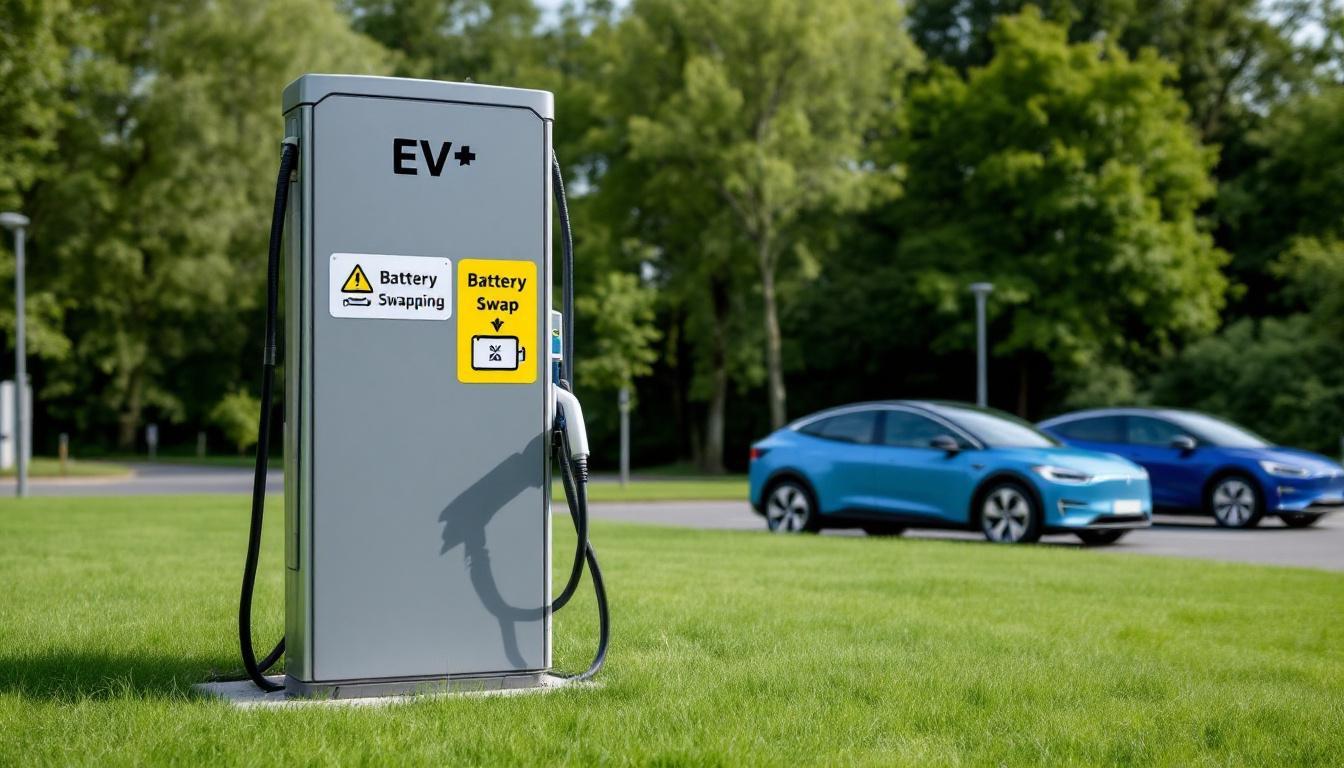
China’s electric-vehicle sector hit a milestone with nearly 147,000 battery swaps in a single day during Spring Festival, signalling a maturing infrastructure that caters to both private and commercial drivers and offers new opportunities for grid integration and global expansion.
China’s electric-vehicle sector demonstrated the operational scale of battery-swapping services in mid-February, as providers completed roughly 146,649 exchanges in a single day during the nation’s Spring Festival travel peak. The volume, reported by industry participants and covered by automotive press, highlights how swapping networks have matured into high-throughput infrastructure that supports both private motorists and commercial fleets. According to NIO, the tally coincided with its busiest day of the holiday period and reflects growing user reliance on rapid exchange services.
Battery swapping replaces a depleted pack with a fully charged one at automated facilities in minutes, offering a predictable turnaround that appeals to ride-hailing, taxi and logistics operators seeking high vehicle utilisation. Proponents contend the approach reduces on-street queuing and can be coordinated to recharge stored batteries during off-peak hours, creating potential value as flexible grid-connected storage. Industry observers note that this operational flexibility becomes more important as renewable generation expands and systems require additional means of smoothing demand.
NIO has been one of the most visible drivers of the model. The company said it reached its 100 millionth cumulative battery swap on 6 February 2026 and operates thousands of swap stations, including a network of facilities sited on major highways to support longer journeys. NIO reported it had deployed 3,790 Power Swap Stations worldwide, of which 1,020 are located along major Chinese expressways, and that it intends to add another 1,000 stations in 2026 to further densify coverage. Earlier company disclosures show a rapid scale-up: NIO recorded tens of millions of swaps and daily averages approaching 97,000 services in 2025 as its nationwide footprint expanded.
Battery manufacturer CATL has pushed complementary moves to broaden market access by proposing standardised, modular battery packs designed for interchangeability across different vehicle platforms. According to industry commentary, such standardisation is a potential enabler for lower per-unit infrastructure cost and wider interoperability, addressing a long-standing obstacle to mass adoption: the multiplicity of battery formats across automakers.
Nonetheless, substantial challenges remain. Constructing and operating automated swap stations entails significant capital outlay for robotic systems, inventory of charged packs, site electrical capacity and integration software. Critics argue that the model imposes heavy upfront costs compared with deploying high-power public chargers, which are increasingly capable of delivering meaningful range in 20–30 minutes and require no stocked battery inventories. The economics will hinge on utilisation rates, equipment lifetime and the ability of operators to monetise grid services or battery-asset subscriptions.
Commercial use-cases are central to the business case. Fleet operators that cannot tolerate long recharging downtimes see clear value in swaps because predictable service windows improve route planning and vehicle uptime. NIO and other providers have sought to monetise battery-as-a-service offerings, separating battery ownership from the vehicle, to lower purchase prices and address concerns over battery degradation. Industry analysis suggests that where fleet density and station accessibility are high, per-swap costs fall markedly, improving economics relative to fast-charging only networks.
Grid interaction is a further vector of potential benefit. Swapping facilities can act as distributed energy resources by timing battery recharge to periods of low demand or surplus renewable output and, in some designs, providing ancillary services back to the grid. Analysts say such aggregation could become an increasingly attractive revenue stream as system operators seek additional flexibility, though realising this requires regulatory frameworks that recognise and remunerate those services.
China’s domestic success has prompted exploratory moves abroad. Manufacturers and infrastructure companies have launched pilot projects in parts of Asia and Europe to test regulatory compatibility and consumer appetite. Observers caution that markets with high home-charging penetration or different travel behaviours may see slower uptake, but the technology is drawing attention from governments and transport planners interested in diversifying decarbonisation pathways for road transport.
Competition at home remains intense, with many manufacturers and energy players jockeying to offer integrated ecosystems of vehicles, batteries, software and energy services. Companies able to bundle vehicle sales with battery management, swapping access and digital fleet optimisation are positioning themselves to capture industry customers that prize total-cost-of-ownership reductions and operational certainty.
The single-day 146,649-swap figure illustrates how, once a threshold of station density and user familiarity is reached, demand can scale rapidly, especially during peak travel windows. For industrial decarbonisation strategists, the development underscores that multiple charging modalities, ultra-fast public chargers, depot charging for fleets and swapping, will likely coexist, with each solution offering distinct trade-offs for capital intensity, grid impacts and operational predictability.
- https://thearabianpost.com/china-logs-146000-ev-battery-swaps/ – Please view link – unable to able to access data
- https://www.nio.com/news/20260206001 – NIO achieved its 100 millionth battery swap on February 6, 2026, marking a significant milestone in its battery swapping service. The company has deployed 3,790 Power Swap Stations worldwide, including 1,020 along major highways in China, effectively eliminating range anxiety for users on long-distance journeys. NIO plans to build an additional 1,000 Power Swap Stations in 2026, further expanding its network and enhancing the convenience of EV ownership.
- https://www.autoblog.com/news/chinas-ev-battery-swap-tech-sets-new-record-over-146000-swaps-on-a-single-day – On February 15, 2026, NIO set a new record by completing 146,649 battery swaps in a single day, coinciding with the start of China’s 2026 Spring Festival holiday. This achievement underscores the growing adoption and efficiency of NIO’s battery swapping technology, offering EV owners a rapid alternative to traditional charging methods during peak travel periods.
- https://www.cnevpost.com/2025/07/09/nio-1000-swap-stations-highways-china/ – NIO reached a significant milestone by launching its 1,000th battery swap station along China’s highways, connecting 550 cities and effectively eliminating range anxiety for drivers. This extensive network expansion highlights NIO’s commitment to providing convenient and accessible charging solutions for electric vehicle users across the country.
- https://www.cnevpost.com/2025/07/19/nio-80-million-battery-swap-milestone/ – NIO achieved a cumulative total of 80 million battery swap services, with an average of about 97,000 services per day. The company operates 3,405 battery swap stations in China, including 1,000 along highways, demonstrating the rapid adoption and scalability of its battery swapping infrastructure.
- https://www.cnevpost.com/2025/02/05/nio-adds-111-swap-stations-china-jan-2025/ – In January 2025, NIO added 111 new battery swap stations in China, bringing the total to 3,106 stations nationwide. The company provided 2,949,969 battery swap services in January, averaging 95,160 services per day, reflecting the growing demand and acceptance of battery swapping as a convenient charging solution.
- https://www.cnevpost.com/2026/02/16/nio-new-single-day-battery-swap-record-peak-travel-china/ – NIO set a new single-day battery swap service record by providing 146,649 services on February 15, 2026, during the peak travel period of China’s Spring Festival holiday. This achievement highlights the efficiency and popularity of NIO’s battery swapping network among EV users during high-demand periods.
Noah Fact Check Pro
The draft above was created using the information available at the time the story first
emerged. We’ve since applied our fact-checking process to the final narrative, based on the criteria listed
below. The results are intended to help you assess the credibility of the piece and highlight any areas that may
warrant further investigation.
Freshness check
Score:
8
Notes:
The article reports on NIO’s achievement of 146,649 battery swaps in a single day during the Spring Festival travel peak. This milestone was first reported on February 15, 2026, by CnEVPost. ([cnevpost.com](https://cnevpost.com/2026/02/16/nio-new-single-day-battery-swap-record-peak-travel-china?utm_source=openai)) The article also mentions NIO’s 100 millionth battery swap on February 6, 2026, which was reported by NIO itself. ([nio.com](https://www.nio.com/news/20260206001?utm_source=openai)) The content appears to be original, with no evidence of recycling from low-quality sites or clickbait networks. However, the article’s reliance on NIO’s press release for the 100 millionth swap figure may warrant a lower freshness score due to potential bias.
Quotes check
Score:
7
Notes:
The article includes direct quotes from NIO’s press release regarding the 100 millionth battery swap. These quotes are consistent with NIO’s official announcement. ([nio.com](https://www.nio.com/news/20260206001?utm_source=openai)) However, the absence of independent verification for these quotes raises concerns about their authenticity.
Source reliability
Score:
6
Notes:
The article cites NIO’s official press release for the 100 millionth battery swap figure, which is a primary source. However, the lack of independent verification for this data and the absence of citations from major news organizations or independent analysts reduce the overall reliability of the source.
Plausibility check
Score:
8
Notes:
The reported figures align with NIO’s previous announcements and industry trends. The rapid expansion of NIO’s battery swap stations and the high volume of swaps during the Spring Festival travel period are plausible. However, the reliance on NIO’s self-reported data without independent verification introduces potential biases.
Overall assessment
Verdict (FAIL, OPEN, PASS): FAIL
Confidence (LOW, MEDIUM, HIGH): MEDIUM
Summary:
The article reports on NIO’s achievement of 146,649 battery swaps in a single day during the Spring Festival travel peak, a figure first reported by CnEVPost on February 15, 2026. ([cnevpost.com](https://cnevpost.com/2026/02/16/nio-new-single-day-battery-swap-record-peak-travel-china?utm_source=openai)) The article also mentions NIO’s 100 millionth battery swap on February 6, 2026, as reported by NIO itself. ([nio.com](https://www.nio.com/news/20260206001?utm_source=openai)) However, the article relies heavily on NIO’s press release for key data points, with limited independent verification. The absence of citations from independent sources or major news organizations raises concerns about the independence of the verification process. Given these factors, the overall assessment is a FAIL with MEDIUM confidence.
