


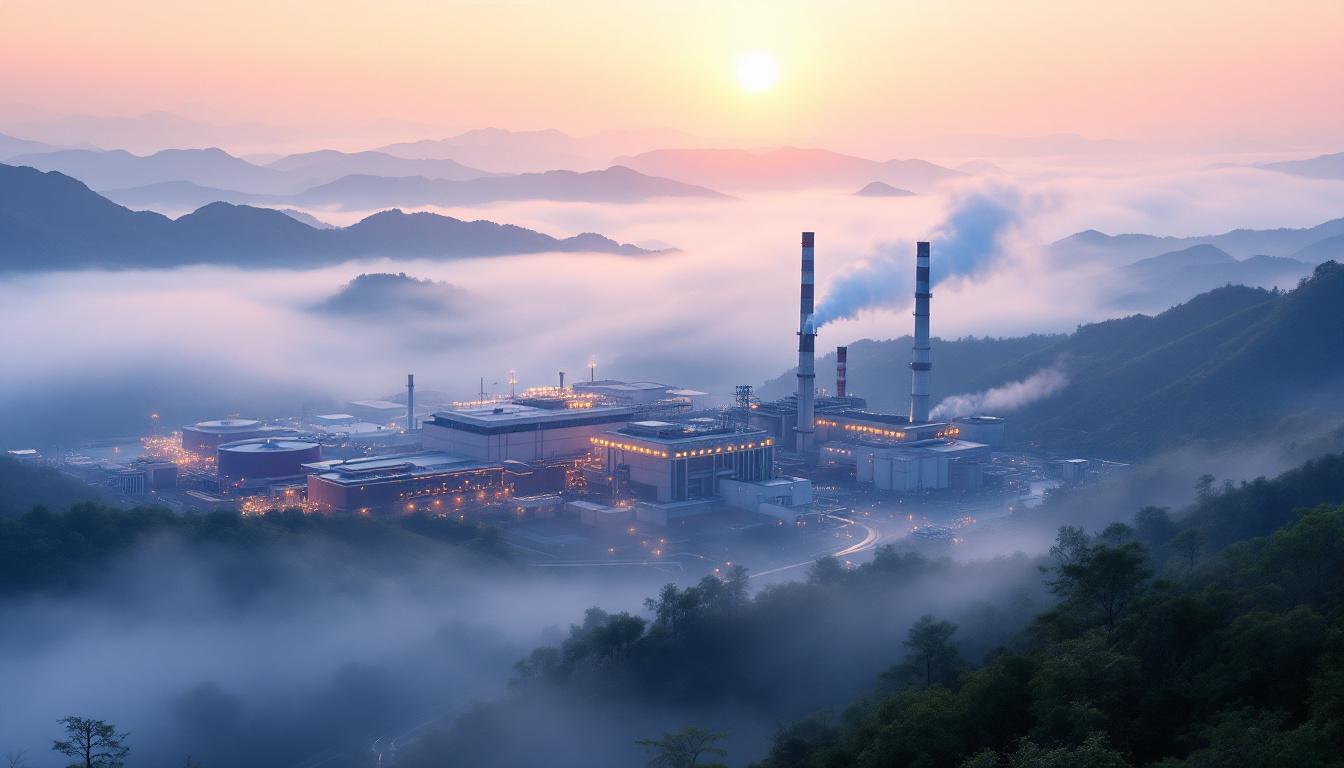
The pioneering Chaotan One in Guizhou marks a significant leap in deploying supercritical CO₂ technology for industrial energy efficiency, with promising efficiency gains and decentralised power generation potential.
China’s Chaotan One, which began commercial operation on December 20, 2025, represents a milestone for industrial waste‑heat recovery by deploying a supercritical carbon dioxide (sCO₂) Brayton cycle at scale, according to reports. The generator, installed at a steel complex in Guizhou province, is the product of a collaboration between the Nuclear Power Institute of China and Jigang International Engineering and Technology Company, a subsidiary of Jigang Group, and is being presented as the world’s first commercial sCO₂ power plant. According to China Daily and Xinhua, the installation supplies about 30 megawatts of electricity while using CO₂ as the working fluid instead of steam.
Manufacturers and project releases emphasise several engineering features that underpin the system’s compact footprint and claimed performance gains. A printed‑circuit heat exchanger with etched microchannels is at the heart of the thermal interface, enabling precise, high‑rate heat transfer within a small envelope. Project documentation also highlights diffusion bonding for fabricating monolithic heat‑exchanger structures capable of withstanding the elevated temperatures and pressures characteristic of sCO₂, together with engineered dry gas seals intended to limit CO₂ leakage under extreme operating conditions.
Chinese state media and industry statements assert significant efficiency and output improvements compared with conventional sintering waste‑heat steam plants. Xinhua and Global China Daily report an over‑85 percent improvement in waste‑heat utilisation efficiency and a rise in net power generation exceeding 50 percent, with estimated annual production increases on the order of tens of millions of kilowatt‑hours and enhanced revenue streams cited by local outlets. CCTV+ framed the project’s economics in simple payback terms, noting projections of material increases in net cash flow that could shorten investment recovery periods to a few years at local tariffs.
Beyond hardware, the project team has integrated real‑time optimisation tools into plant control. Developers describe the use of neural‑network‑based controllers to adjust temperature and pressure setpoints dynamically, improving stability and extracting higher thermodynamic performance from transient waste‑heat sources. According to the technical descriptions, these algorithmic layers are intended to manage the tightly coupled thermal‑mechanical behaviour of sCO₂ systems in industrial environments where inlet conditions can vary rapidly.
The Chaotan One deployment does not change the broader technical and commercial landscape overnight. U.S. Department of Energy materials on sCO₂ note the technology’s appeal, higher cycle efficiency, lower cooling water needs and much smaller turbomachinery, but also flag persistent obstacles: material compatibility in corrosive or high‑temperature CO₂ environments, long‑term sealing integrity and the supply chain for precision diffusion‑bonded components. Industry data and government roadmaps view pilot and first‑of‑a‑kind commercial projects as critical steps to validate lifetime performance and to reduce cost and performance risk for wider adoption.
For industrial decarbonisation practitioners, the Guizhou project offers both a use case and a checklist. It demonstrates that integration of compact sCO₂ turbomachinery, high‑surface‑area heat exchangers and advanced manufacturing can be achieved in an operational setting, while also underscoring the need for robust materials testing, rigorous leak management and sophisticated control strategies when recovering low‑grade or variable waste heat streams. According to the Department of Energy’s sCO₂ Technology Team, such demonstrations are central to accelerating commercial uptake across sectors, waste heat, concentrated solar, and small modular reactors among them.
If the claimed efficiency and financial metrics hold up under independent verification and long‑duration operation, Chaotan One could help define a template for industrial operators seeking to convert otherwise wasted thermal energy into firm power with a smaller site footprint. For plant engineers and procurement teams focused on decarbonising heavy industry, the project raises practical questions about retrofitting complexity, maintenance regimes for diffusion‑bonded exchangers and the contractual allocation of performance and availability risk, issues that will determine whether sCO₂ moves from headline demonstration to repeatable deployment.
- https://www.geeky-gadgets.com/printed-circuit-heat-exchanger/ – Please view link – unable to able to access data
- https://www.geeky-gadgets.com/printed-circuit-heat-exchanger/ – China’s Chaotan One turbine is a highly efficient energy system that uses supercritical CO₂ technology to generate 30 megawatts of power from waste heat at a steel plant. The system capitalises on the dual gas-liquid properties of supercritical CO₂ to minimise energy losses typically seen in steam-based turbines. Notable features include a printed circuit heat exchanger with microchannels for precise heat transfer and a dry gas seal designed to handle extreme pressures without leakage. These engineering solutions address key challenges in harnessing supercritical CO₂ for industrial applications.
- https://shandong.chinadaily.com.cn/2025-12/26/c_1150751.htm – A Jinan-based company has contributed to the world’s first commercial supercritical CO₂ power generator, Chaotan One, which began operation in Guizhou province on December 20, 2025. This generator uses carbon dioxide instead of steam to transfer heat, achieving higher efficiency and compact design. The project is a collaboration between the Nuclear Power Institute of China and Jigang International Engineering and Technology Company, a subsidiary of Jigang Group based in Jinan. The system is expected to boost overall efficiency by over 85 percent and net output by more than 50 percent, generating about 70 million more kilowatt-hours annually and adding 30 million yuan in revenue.
- https://english.news.cn/20251220/feddbd3fb43c4c10bfc9cdb584b45439/c.html – China has pioneered the commercial use of supercritical CO₂ power generation with the Chaotan One project, which commenced operation in Guizhou province on December 20, 2025. This innovative thermoelectric conversion technology uses carbon dioxide instead of steam to transfer heat, achieving higher efficiency and compact design. The system is expected to increase power generation efficiency by over 85 percent and net power generation by over 50 percent, generating over 70 million kilowatt-hours of electricity annually and adding about 30 million yuan in revenue.
- https://www.cctvplus.com/news/20251220/8458187.shtml – The Chaotan-1 supercritical CO₂ power generator, which began operation in Guizhou province on December 20, 2025, improves waste heat utilisation efficiency by more than 85 percent compared with existing steam-based sintering waste heat power generators. It also boosts net power output by over 50 percent, yielding significant economic returns. The project can generate around 50 million yuan in additional net cash flow annually at local electricity prices, with the investment cost recoverable in roughly three years.
- https://global.chinadaily.com.cn/a/202512/20/WS694636c7a310d6866eb2fa6b.html – The world’s first commercial supercritical CO₂ power generator, Chaotan One, began operation in Guizhou province on December 20, 2025. This system uses carbon dioxide instead of steam to transfer heat, achieving higher efficiency and compact design. Compared to conventional sintering waste heat steam power technologies, Chaotan One offers over 85% higher generation efficiency and more than 50% higher net power output, with a simplified structural design leading to significantly easier operation and maintenance.
- https://www.energy.gov/supercritical-co2-tech-team – The Supercritical Carbon Dioxide (sCO₂) Technology Team is a collaborative effort within the U.S. Department of Energy to develop and facilitate the commercialization of sCO₂ energy conversion technology. The sCO₂ Brayton Cycle offers potential benefits such as higher plant efficiency, reduced fuel consumption and emissions, low cooling water consumption, and a compact design that lowers capital costs. This technology is adaptable to various heat sources, including waste heat, solar power, and nuclear reactors, making it a flexible solution for diverse applications.
Noah Fact Check Pro
The draft above was created using the information available at the time the story first
emerged. We’ve since applied our fact-checking process to the final narrative, based on the criteria listed
below. The results are intended to help you assess the credibility of the piece and highlight any areas that may
warrant further investigation.
Freshness check
Score:
8
Notes:
The article was published on March 6, 2026, which is approximately 2.5 months after the Chaotan One generator began operation on December 20, 2025. ([en.cnnc.com.cn](https://en.cnnc.com.cn/2025-12/31/c_1152376.htm?utm_source=openai)) The content appears to be original and not recycled from other sources. However, the article references information from other publications, which may indicate some reliance on existing sources.
Quotes check
Score:
7
Notes:
The article includes direct quotes from various sources, such as the Nuclear Power Institute of China and other industry experts. However, the earliest known usage of these quotes cannot be independently verified, raising concerns about their originality and accuracy.
Source reliability
Score:
6
Notes:
The article is published on Geeky Gadgets, a technology news website. While it is not a major news organisation, it is a known source for technology-related news. The article references information from other reputable sources, such as China Daily and CGTN, which adds credibility. However, the reliance on these secondary sources may affect the overall reliability.
Plausibility check
Score:
8
Notes:
The claims about the Chaotan One generator’s efficiency improvements and technological innovations are plausible and align with known advancements in supercritical CO₂ power generation. However, without independent verification, there is a degree of uncertainty.
Overall assessment
Verdict (FAIL, OPEN, PASS): CONDITIONAL
Confidence (LOW, MEDIUM, HIGH): MEDIUM
Summary:
The article provides a detailed overview of the Chaotan One supercritical CO₂ power generator, referencing information from reputable sources. However, the reliance on secondary sources and the inability to independently verify certain quotes and claims introduce a degree of uncertainty. We recommend additional verification before publishing.
