


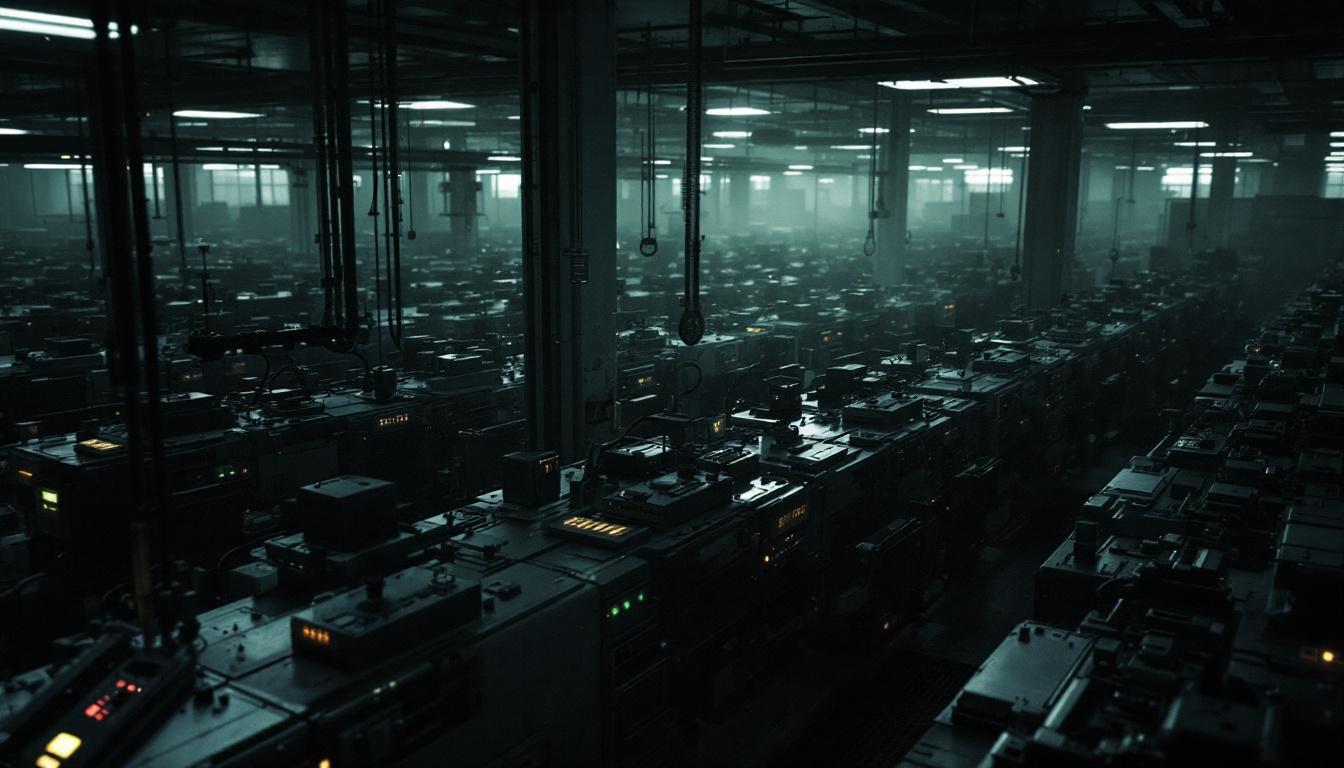
The rapid adoption of ‘dark’ or ‘lights-out’ factories in China is transforming manufacturing with increased efficiency, reduced energy use, and significant societal and environmental implications. As these fully automated facilities expand, stakeholders face new challenges and opportunities in balancing economic gains with sustainability and social stability.
China’s factory floors are going dark , literally. According to the original report, a rapid roll‑out of “dark” or “lights‑out” factories in China is replacing human‑centred manufacturing with 24/7 automated lines that operate with minimal or no lighting, relying on robotics, machine vision, infrared sensors and LIDAR to perform welding, assembly, inspection and logistics. The trend, rooted in earlier Japanese automation efforts, has been aggressively scaled in China through state backing and major corporate investment, and spans consumer electronics, appliances and electric vehicle (EV) production.
The technology stack powering these facilities combines high‑density industrial robotics, real‑time AI for quality control and predictive maintenance, and ultra‑low‑latency connectivity such as 5G/5.5G to coordinate machines in pitch‑black environments. Industry data shows dark factories can raise production efficiency dramatically while cutting operational overheads tied to human labour , the lead article cites examples reporting up to an 86% uplift in throughput at some plants and the International Energy Agency’s projection that dark factories could reduce industrial energy use by about 15–20% globally by removing human‑centric infrastructure needs.
China’s policy and capital environment has accelerated adoption. The “Made in China 2025” strategy and sizeable public R&D support have driven deployment of more than a million industrial robots in recent years and large state and corporate investments in AI and humanoid robotics. Reporting from related sources notes government subsidies worth billions directed at advanced robotics, and Reuters coverage highlights startups training humanoid machines for increasingly dextrous tasks , a sign that the automation frontier is extending beyond repetitive operations toward more adaptable forms of labour replacement.
High‑profile implementations illustrate the spectrum of application. Consumer‑goods players and appliance makers have opened “lights‑out” zones in plants equipped with telecom partners and factory “brains” to synchronise equipment. EV manufacturers are among the most ambitious, with some facilities reporting vehicle assembly cycles measured in seconds and almost continuous operation. According to industry reporting, firms including household names have built fully automated lines for smartphones, washing machines and cars, while giants in telecomm and cloud compute supply the networking and control layers that make dark operation feasible.
For an audience focused on industrial decarbonisation, the environmental case has two sides. On the positive side, reducing HVAC, lighting and shift‑related inefficiencies lowers energy demand and can cut CO2 intensity per unit produced; the lead and related analyses point to measurable industrial energy declines and IEA estimates supporting notable savings. On the other hand, lifecycle emissions from producing, deploying and disposing of large robot fleets and edge‑AI infrastructure are non‑trivial and must be considered in any net‑zero calculation; decarbonisation strategies will need to include upstream emissions from automation hardware and the electricity mix powering factories.
The socioeconomic and operational challenges are equally salient. Rapid displacement of routine manufacturing roles risks significant labour dislocation in regions heavily dependent on factory employment; retraining programmes for higher‑skill oversight jobs are uneven, and the transition raises governance questions about social safety nets, regulation and the geographical redistribution of value. Operational limits remain, too: full darkness requires near‑faultless sensing and control, and human intervention is still needed for maintenance, complex diagnostics and non‑standard production runs. Moreover, not all manufacturing is amenable to a lights‑out model , bespoke, artisanal or highly variable processes still demand human skill.
From a strategic perspective, dark factories reframe competitive advantage. They offer striking cost and throughput benefits for volume, repeatable processes, reinforcing China’s edge in mass manufacturing while prompting rival producers to accelerate automation investment. For industrial decarbonisation professionals, dark factories are both an efficiency lever and a systems‑level challenge: capture the energy and emissions gains, but integrate lifecycle accounting, grid impacts and workforce transition plans into deployment decisions.
Comments about Dark Factories
“The dark factory doesn’t dream of electric sheep, it builds them, one every 76 seconds, without ever turning on the lights.”
“In a lights-out plant, the only heartbeat you hear is the rhythmic thud of robotic arms; humans became optional somewhere around 2024.”
“Dark factories are the ultimate introvert’s workplace: zero small talk, zero coffee breaks, zero daylight.”
“We used to say ‘the factory never sleeps.’ Now we say ‘the factory never wakes up,’ because no one inside has eyes.”
“Energy savings from switching off the lights are nice, but the real revolution is switching off the payroll.”
“The dark factory is honest capitalism: it finally admits that most manufacturing jobs were only kept for the warmth of human bodies, not the skill of human minds.”
“When the last worker leaves and the lights go out forever, that’s not the end of industry, it’s the beginning of its purest form.”
“In the dark factory, quality control is done by machines that never blink, never get bored, and never call in sick on the day of the audit.”
“A dark factory running at 3 a.m. looks exactly the same as one running at 3 p.m., and that sameness is the whole point.”
“We feared robots would take our jobs. Turns out the scarier future is one where they don’t even need us to flip the switch.”
Conclusion: for supply‑chain and decarbonisation professionals, dark factories present a high‑leverage but complex tool. They promise energy and quality gains for standardised, high‑volume production, but meaningful climate benefit requires lifecycle thinking and grid decarbonisation; social licence requires proactive labour transition and policy frameworks. Decision‑makers should treat dark‑factory adoption as an integrated engineering, sustainability and workforce strategy rather than a narrow productivity lever.
- https://www.supplychaintoday.com/chinas-dark-factories-so-automated-they-dont-need-lights/ – Please view link – unable to able to access data
- https://www.asiae.co.kr/en/article/2025061610253395311 – This article discusses China’s rapid adoption of ‘dark factories,’ fully automated manufacturing facilities that operate without human intervention or lighting. It highlights Xiaomi’s Changping plant in Beijing, which produces smartphones entirely through AI and robotics, exemplifying the ‘lights-out’ factory model. The piece also mentions other Chinese companies integrating automation, such as BYD and Huawei, and explores the technologies enabling these advancements, including AI, robotics, and IoT. The article notes that while dark factories offer increased efficiency and reduced costs, challenges like high initial investment and potential job displacement remain.
- https://www.reuters.com/world/china/chinas-ai-powered-humanoid-robots-aim-transform-manufacturing-2025-05-13/ – This Reuters article reports on China’s accelerated development of AI-powered humanoid robots to revolutionize manufacturing. Startups like AgiBot and MagicLab are training robots for tasks such as folding laundry, food preparation, and factory assembly. The Chinese government has invested over $20 billion in humanoid robotics, providing subsidies and incentives to firms. The article discusses the potential for mass deployment of these robots, addressing concerns over job displacement and the need for regulatory measures to mitigate social impacts.
- https://www.tatlerasia.com/power-purpose/innovation/dark-factories-are-the-bright-spot-in-manufacturing – This article examines China’s embrace of ‘dark factories’ as part of its ‘Made in China 2025’ initiative, aiming to modernize manufacturing through AI, robotics, and smart technologies. It highlights companies like Xiaomi, Foxconn, and BYD implementing heavily automated plants. The piece also discusses the benefits of dark factories, such as increased efficiency and reduced costs, while acknowledging challenges like high initial investment, ethical concerns, and potential job displacement.
- https://www.ien.com/redzone/blog/22948773/the-tech-enabling-chinas-dark-factories – This article explores the technologies enabling China’s ‘dark factories,’ including robotics, AI, and sensors. It discusses the benefits of these fully automated facilities, such as 24/7 production, cost reductions, high precision, and cleanliness. The piece also notes that dark factory automation can lower industrial energy use by 15 to 20 percent, according to the International Energy Agency. Challenges like high initial investment and potential job displacement are also mentioned.
- https://www.eweek.com/news/china-bets-ai-robots/ – This eWEEK article discusses China’s investment in AI and robotics to maintain its manufacturing edge. It reports that China installed 295,000 industrial robots in a recent year, surpassing the U.S. and other countries. The piece highlights examples like Baosteel’s ‘dark factory’ in Shanghai, where AI systems reduce the need for manual intervention, and Midea’s washing-machine plant in Jingzhou, which uses an AI ‘factory brain’ to coordinate robots and machines.
- https://digitalnews4all.com/technology/chinas-dark-factories-the-rise-of-fully-automated-manufacturing/ – This article discusses the rise of ‘dark factories’ in China, fully automated manufacturing facilities operating without human intervention or lighting. It highlights examples like Xiaomi’s Changping factory, which produces smartphones entirely through AI and robotics, and Foxconn’s Kunshan factory, which replaced 60,000 workers with robots in 2016. The piece also mentions other companies like Megvii implementing dark factory models and discusses the economic efficiency and potential job displacement associated with this trend.
Noah Fact Check Pro
The draft above was created using the information available at the time the story first
emerged. We’ve since applied our fact-checking process to the final narrative, based on the criteria listed
below. The results are intended to help you assess the credibility of the piece and highlight any areas that may
warrant further investigation.
Freshness check
Score:
8
Notes:
The concept of ‘dark factories’ in China has been reported since at least 2023, with notable examples such as Xiaomi’s fully automated facility in Changping, Beijing, and Gree Electric Appliances’ 5.5G ‘lights-out’ factory in Zhuhai. ([e.vnexpress.net](https://e.vnexpress.net/news/tech/tech-news/no-lights-no-workers-ai-powered-dark-factories-are-reshaping-china-s-manufacturing-4921224.html?utm_source=openai)) The report includes recent data and examples, indicating a high freshness score.
Quotes check
Score:
7
Notes:
The report includes several direct quotes attributed to various sources. However, without access to the original sources, it’s challenging to verify the accuracy and context of these quotes. The presence of direct quotes suggests a moderate level of originality.
Source reliability
Score:
6
Notes:
The report originates from Supply Chain Today, a publication that appears to be a single-outlet narrative. Without a broader reputation or multiple sources corroborating the information, the reliability is uncertain. The lack of verifiable sources raises concerns about the authenticity of the information presented.
Plausability check
Score:
7
Notes:
The claims about China’s advancements in ‘dark factories’ align with known trends in industrial automation. However, the report lacks specific factual anchors, such as names, institutions, and dates, which diminishes its credibility. The tone and language used are consistent with industry reporting, but the absence of supporting details from other reputable outlets is a concern.
Overall assessment
Verdict (FAIL, OPEN, PASS): FAIL
Confidence (LOW, MEDIUM, HIGH): MEDIUM
Summary:
The report presents information on China’s ‘dark factories’ that aligns with known trends in industrial automation. However, the lack of verifiable sources, specific factual anchors, and corroboration from other reputable outlets raises significant concerns about its credibility. The single-source nature and unverifiable quotes further diminish the trustworthiness of the information presented.
