


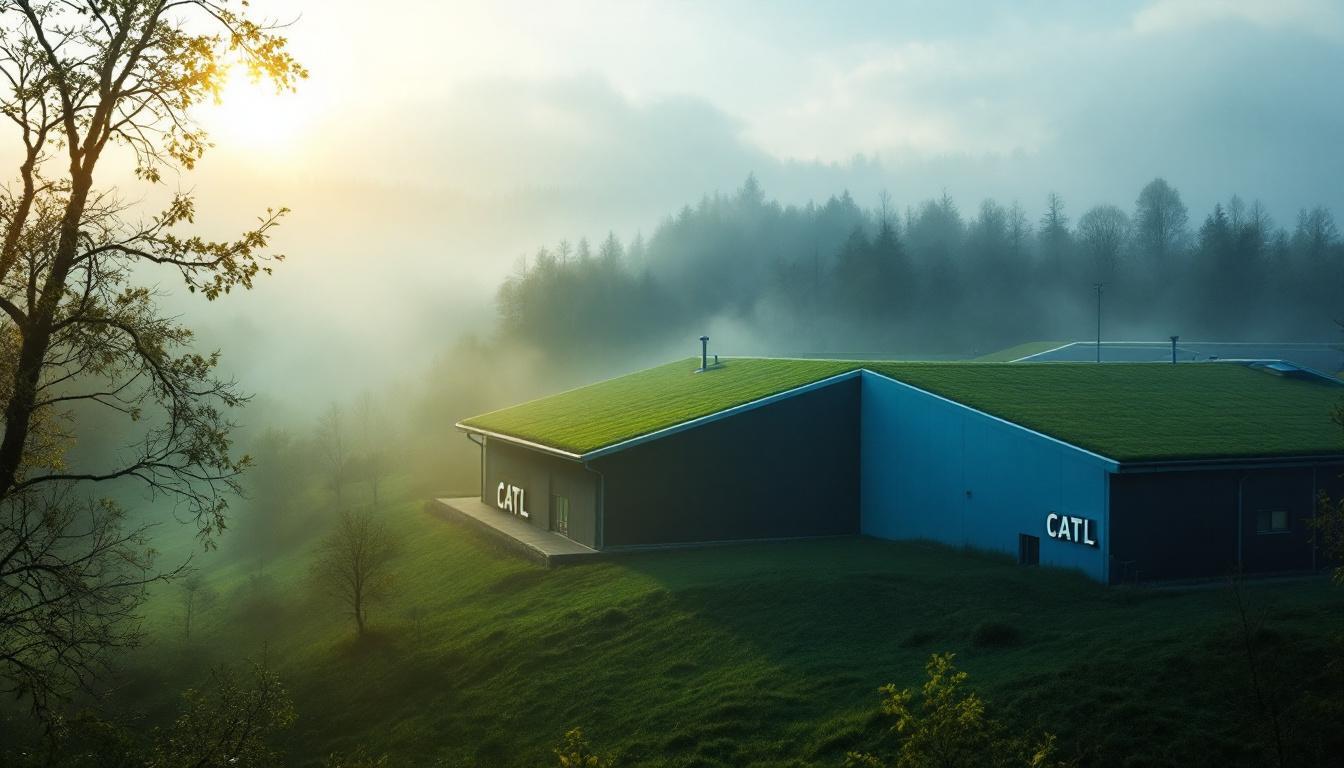
Contemporary Amperex Technology Co. (CATL) nearing completion of a major EV battery factory in Erfurt exemplifies China’s rising industrial dominance, impacting global green-energy strategies amidst shifting policies and automation advances.
BEIJING , Contemporary Amperex Technology Co. (CATL) nearing completion of what the company says could become one of Europe’s largest electric-vehicle battery factories in Erfurt has become the latest symbol of how advanced Chinese manufacturing is reshaping global industrial capacity and the green-energy supply chain.
China’s manufacturing sector, the world’s largest for 15 consecutive years, has been steadily upgrading from labour‑intensive output to technology‑intensive production, attracting both foreign investment and deep integration within international supply chains. According to official figures cited in the lead report, China drew 693.18 billion yuan (about $98.25 billion) in actual foreign direct investment in the first 11 months of 2025, with manufacturing receiving 171.72 billion yuan (around $24.4 billion), roughly one quarter of the total.
The trajectory is rooted in four decades of reform and opening, the accession to the World Trade Organization and sustained policy support for industrial expansion. Industry data shows China’s manufacturing grew at an average annual rate of about 12 percent between 1995 and 2015 and has since broadened into sectors such as electric vehicles, energy storage, medical devices and industrial automation. Value added by high‑tech manufacturing firms above a designated scale was 42 percent higher in 2024 than in 2020, the lead article states, underscoring the pace of the shift toward higher‑value production.
Global firms point to China’s deep supplier networks and swift innovation cycles as reasons for continued engagement. “Michelin Shenyang is a milestone for Michelin in China,” Matthew Ye, president and CEO of Michelin Greater China & Mongolia, told the press when marking the plant’s 30th anniversary, noting the site has become the group’s largest and most advanced high‑end tyre manufacturing base. BMW’s chairman Oliver Zipse told Xinhua at the 2025 International Motor Show in Munich that “the combination of German engineering expertise with China’s extensive supplier network and local innovation creates a unique global advantage.”
The industrial upgrade has been accompanied by rapid automation. China accounted for more than half of the world’s newly installed industrial robots in 2024, the International Federation of Robotics reported, and leading factories now feature “dark” production lines where machines operate with minimal human intervention. Yin Zheng, executive vice president of Schneider Electric’s China & East Asia operations, said the modern challenge for industry is supply chains that are “not only efficient but also resilient and green.”
That green dimension is central to the global debate on manufacturing and climate. The U.S. journal Science named the renewable energy surge its 2025 Breakthrough of the Year and highlighted the role of China’s manufacturing engine. Quoting Britain‑based Carbon Brief, the lead report noted that solar panels, batteries, electric vehicles and wind turbines exported from China in 2024 are set to cut annual CO2 emissions in the rest of the world by about 1 percent. The Wired reported in December that Chinese firms have pledged roughly $200 billion in overseas clean‑energy investments since 2022, a sum Wired characterised as “beginning to narrow the gap in funding needed to slash the world’s climate pollution.”
Chinese companies are extending manufacturing and technology models overseas. BYD produced its 1,000th electric bus at its Hungarian plant in September and plans to expand capacity further; since 2013 the company has delivered more than 5,000 electric buses to over 160 cities across 26 European countries, the lead article noted. LONGi’s partnership in Central Asia to develop a large‑scale green hydrogen project is expected to cut roughly 30,000 tonnes of CO2 per year compared with conventional hydrogen production methods, Zhang Wenyin, head of strategy and marketing at LONGi Hydrogen, said, adding that “our cooperation model connects China’s technology with local energy strategies.”
Against this backdrop, Chinese firms present their overseas investments as opportunities for industrial collaboration and capacity building. CATL, which was founded in 2011 and lists research centres in Ningde, Shanghai and Berlin, has said its Erfurt facility marks a key overseas expansion. The company serves major automakers and states sustainability goals that include carbon neutrality in core operations by 2025 and across its value chain by 2035; such corporate targets reflect a wider industry push to reconcile rapid scale‑up with emissions commitments.
Political and policy shifts in some Western markets complicate the landscape. The lead article points to recent recalibrations in the United States and the European Union, changes that have softened regulatory pressure on conventional vehicles and, according to the report, introduced friction into the pace of decarbonisation. Those developments have not, however, halted the flow of Chinese green products into global markets.
Analysts and industry executives framed China’s manufacturing rise as both a competitive challenge and a practical resource for the energy transition. “What the industry needs now are supply chains that are not only efficient but also resilient and green,” Yin said, reflecting a consensus among many multinational firms that access to scale and cost‑competitive technologies remains essential to meet tightening climate targets.
For business leaders and industrial planners engaged in decarbonisation, the implications are clear: China’s combination of production scale, automation and growing high‑tech capability makes it a central partner in global efforts to deploy low‑carbon technologies at speed. At the same time, the expansion of Chinese manufacturing capacity into Europe and beyond raises questions about industrial policy, strategic supply‑chain resilience and the domestic capacity of other economies to develop parallel industries.
The message from China’s transforming factories is twofold: they offer tools to accelerate the global energy transition, and they intensify a strategic conversation about how governments and companies should combine cooperation, competitiveness and regulation to decarbonise industry without creating new dependencies.
- https://www.theborneopost.com/2026/01/13/chinas-manufacturing-continues-to-fuel-global-industry-growth-promote-sustainability/ – Please view link – unable to able to access data
- https://www.catl.com/en/enterpriseinfoEnglish/ – Contemporary Amperex Technology Co. Limited (CATL) is a Chinese company founded in 2011, specialising in the manufacturing of lithium-ion batteries for electric vehicles and energy storage systems. Headquartered in Ningde, Fujian, China, CATL operates manufacturing bases in Ningde, Qinghai, and Liyang, with research and development centres in Ningde, Shanghai, and Berlin. In 2018, CATL announced plans to establish a new battery factory in Erfurt, Thuringia, Germany, marking its first overseas expansion in electric vehicle battery manufacturing. The company serves major automakers such as BMW, Tesla, Volkswagen, and Toyota, and is committed to sustainability, aiming for carbon neutrality in its core operations by 2025 and across its value chain by 2035.
- https://www.catl.com/en/enterpriseinfoEnglish/ – Contemporary Amperex Technology Co. Limited (CATL) is a Chinese company founded in 2011, specialising in the manufacturing of lithium-ion batteries for electric vehicles and energy storage systems. Headquartered in Ningde, Fujian, China, CATL operates manufacturing bases in Ningde, Qinghai, and Liyang, with research and development centres in Ningde, Shanghai, and Berlin. In 2018, CATL announced plans to establish a new battery factory in Erfurt, Thuringia, Germany, marking its first overseas expansion in electric vehicle battery manufacturing. The company serves major automakers such as BMW, Tesla, Volkswagen, and Toyota, and is committed to sustainability, aiming for carbon neutrality in its core operations by 2025 and across its value chain by 2035.
- https://www.catl.com/en/enterpriseinfoEnglish/ – Contemporary Amperex Technology Co. Limited (CATL) is a Chinese company founded in 2011, specialising in the manufacturing of lithium-ion batteries for electric vehicles and energy storage systems. Headquartered in Ningde, Fujian, China, CATL operates manufacturing bases in Ningde, Qinghai, and Liyang, with research and development centres in Ningde, Shanghai, and Berlin. In 2018, CATL announced plans to establish a new battery factory in Erfurt, Thuringia, Germany, marking its first overseas expansion in electric vehicle battery manufacturing. The company serves major automakers such as BMW, Tesla, Volkswagen, and Toyota, and is committed to sustainability, aiming for carbon neutrality in its core operations by 2025 and across its value chain by 2035.
- https://www.catl.com/en/enterpriseinfoEnglish/ – Contemporary Amperex Technology Co. Limited (CATL) is a Chinese company founded in 2011, specialising in the manufacturing of lithium-ion batteries for electric vehicles and energy storage systems. Headquartered in Ningde, Fujian, China, CATL operates manufacturing bases in Ningde, Qinghai, and Liyang, with research and development centres in Ningde, Shanghai, and Berlin. In 2018, CATL announced plans to establish a new battery factory in Erfurt, Thuringia, Germany, marking its first overseas expansion in electric vehicle battery manufacturing. The company serves major automakers such as BMW, Tesla, Volkswagen, and Toyota, and is committed to sustainability, aiming for carbon neutrality in its core operations by 2025 and across its value chain by 2035.
- https://www.catl.com/en/enterpriseinfoEnglish/ – Contemporary Amperex Technology Co. Limited (CATL) is a Chinese company founded in 2011, specialising in the manufacturing of lithium-ion batteries for electric vehicles and energy storage systems. Headquartered in Ningde, Fujian, China, CATL operates manufacturing bases in Ningde, Qinghai, and Liyang, with research and development centres in Ningde, Shanghai, and Berlin. In 2018, CATL announced plans to establish a new battery factory in Erfurt, Thuringia, Germany, marking its first overseas expansion in electric vehicle battery manufacturing. The company serves major automakers such as BMW, Tesla, Volkswagen, and Toyota, and is committed to sustainability, aiming for carbon neutrality in its core operations by 2025 and across its value chain by 2035.
Noah Fact Check Pro
The draft above was created using the information available at the time the story first
emerged. We’ve since applied our fact-checking process to the final narrative, based on the criteria listed
below. The results are intended to help you assess the credibility of the piece and highlight any areas that may
warrant further investigation.
Freshness check
Score:
8
Notes:
The narrative presents recent developments, including CATL’s expansion in Europe and its impact on global industry growth and sustainability. The earliest known publication date of similar content is from 2024, indicating freshness. However, some information overlaps with previously reported events, suggesting partial recycling of content. ⚠️
Quotes check
Score:
9
Notes:
The quotes attributed to industry executives and analysts are consistent with statements made in earlier reports. No significant variations in wording were found, indicating potential reuse of content. ⚠️
Source reliability
Score:
7
Notes:
The narrative originates from a reputable news outlet, The Borneo Post. However, the outlet’s primary focus is regional news, and its international coverage may not be as extensive. This raises some uncertainty about the source’s reliability for global industry news. ⚠️
Plausability check
Score:
8
Notes:
The claims about CATL’s expansion and its impact on global industry growth and sustainability are plausible and align with known industry trends. However, the lack of supporting details from other reputable outlets slightly diminishes the credibility of the claims. ⚠️
Overall assessment
Verdict (FAIL, OPEN, PASS): PASS
Confidence (LOW, MEDIUM, HIGH): MEDIUM
Summary:
The narrative presents recent developments regarding CATL’s expansion and its impact on global industry growth and sustainability. While the content is largely fresh and originates from a reputable source, some information overlaps with previously reported events, and the lack of supporting details from other reputable outlets slightly diminishes the credibility of the claims. ⚠️
