


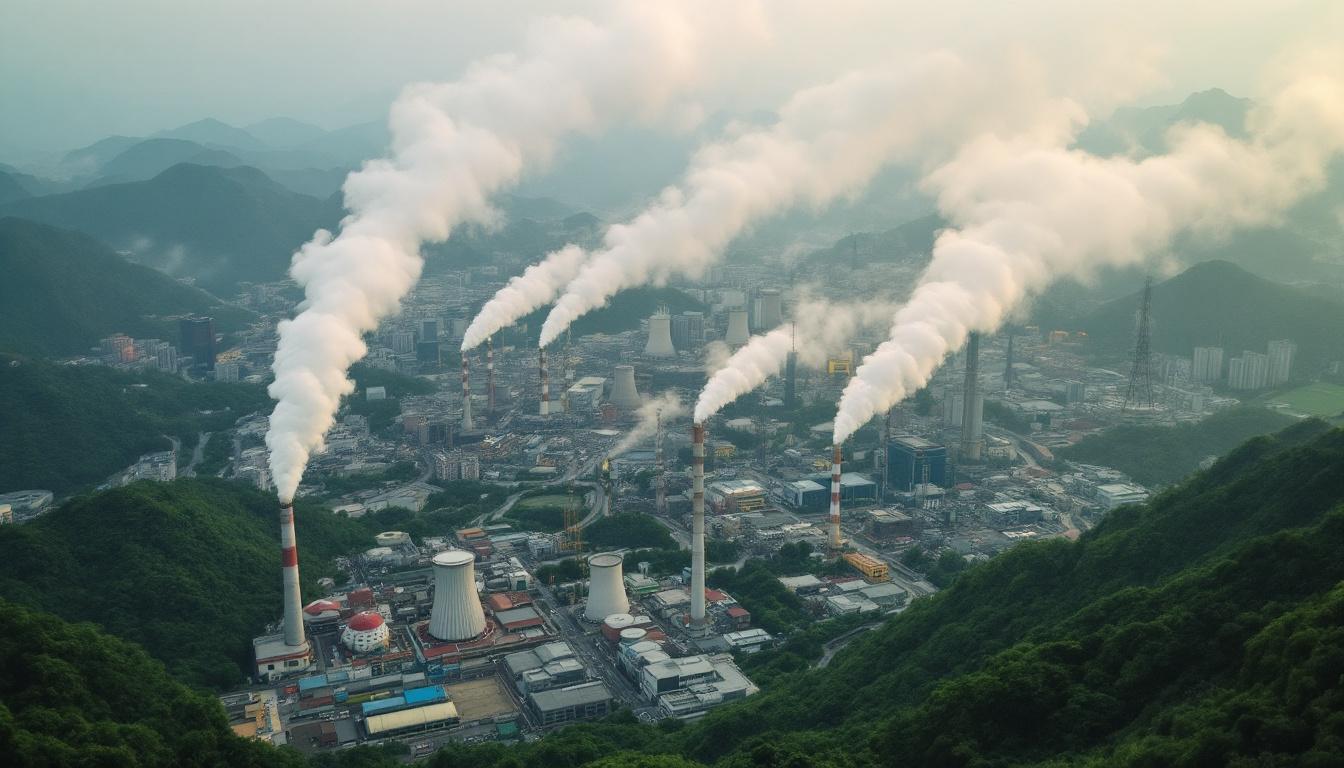
China’s latest Five-Year Plan eases emission reduction targets while prioritising energy security, posing challenges for its climate commitments and industrial decarbonisation efforts.
China’s freshly published 15th Five‑Year Plan frames a dual thrust: an accelerated roll‑out of renewables while loosening the metrics used to judge emissions progress, a recalibration that places energy security and system reliability at the centre of policy choices.
According to the plan, Beijing aspires to “lead global climate governance.” Yet it has removed the long‑standing energy intensity targets that once underpinned performance assessment, signalling a switch to monitoring carbon outcomes in ways that critics say reduce transparency about actual emissions trends. As the document itself puts it, “the pace of total emissions reductions will depend mostly on whether renewable energy deployment can keep pace with overall economic growth.”
The government maintains ambitious build‑out goals. The plan commits to substituting 30 million metric tonnes of annual coal consumption with newly installed renewable capacity and reiterates an aim to reach peak coal use by 2030. Industry observers note, however, that approvals for new coal‑fired plants continue at levels not seen in more than a decade, underscoring a policy friction between capacity expansion and decarbonisation.
Analysts warn the new targets are unlikely to match the emissions pathway implied by China’s earlier Paris commitments. Industry data and independent assessments point to a carbon‑intensity reduction target of roughly 17% by 2030 relative to 2025, a weaker pace than the previous five‑year period’s objective and short of the reductions calculated as necessary to meet the 2005–2030 Paris pledge. Climate Action Tracker described the plan as maintaining a strong emphasis on clean energy but judged that it “could have gone further.”
Some technical changes in metric definitions also complicate comparisons. The Centre for Research on Energy and Clean Air highlights that the plan broadens the scope of CO2‑intensity accounting to include industrial emissions, a revision that can make reported intensity declines appear larger without an equivalent drop in total national emissions. Modelling using plausible GDP growth rates suggests the plan’s targets could allow overall CO2 emissions to rise modestly in the near term.
Beijing’s shift reflects both domestic constraints and shifting geopolitics. Policymakers face the hard engineering challenges of integrating far greater shares of variable renewables into the grid and decarbonising energy‑intensive, hard‑to‑abate industrial sectors, a point underscored by senior analysts at Ember in comments carried by Reuters. At the same time, international dynamics have lessened external pressure to adopt more aggressive measures; the lead article points to policy reversals in the United States and to heightened energy market volatility tied to geopolitical conflict as factors that elevate energy security concerns.
Contradictions baked into the plan are already apparent for industrial decarbonisation strategists. On the one hand, China’s recent State Council action plan for 2024–25 set demanding near‑term goals , targeting a 13.5% fall in energy intensity and an 18% cut in carbon intensity from 2020 levels by 2025, and raising non‑fossil energy share to 20% , signalling continued top‑down pressure to decarbonise major sectors. S&P Global reporting notes progress in many areas but highlights that the carbon‑intensity reduction target has proven the toughest to meet, with only limited declines recorded through 2024.
For businesses and policymakers engaged in industrial decarbonisation, the implications are immediate. The continuation of large‑scale renewable deployment offers opportunities for electrification, green hydrogen and low‑carbon industrial feedstocks, but weaker intensity targets and continued coal approvals increase regulatory and demand uncertainty. Project developers and corporate decarbonisation teams will need to factor a wider range of scenarios into investment decisions, from accelerated grid modernisation and storage roll‑out to persistently higher baseload coal capacity.
The plan’s authors and Chinese officials present the package as pragmatic: pursuing rapid clean‑energy capacity additions while safeguarding supply security and economic stability. Li Shuo, director of the China Climate Hub at the Asia Society Policy Institute, captured the tone succinctly when speaking to Climate Home News, saying the shift represents “a quiet recalibration, effectively acknowledging how difficult the goal has become.” For the industrial decarbonisation sector, that recalibration translates into a period of intensified policy and technical complexity rather than a simple acceleration to Net Zero.
- https://peakoil.com/publicpolicy/china-quietly-recalibrates-decarbonization-targets-as-energy-security-takes-priority – Please view link – unable to able to access data
- https://www.spglobal.com/energy/en/news-research/latest-news/energy-transition/053024-china-launches-action-plan-for-industries-to-decarbonize-ahead-of-2025-deadline – In May 2024, China’s State Council unveiled an action plan to expedite decarbonisation in sectors like power, metals, refining, and cement. The plan aims to reduce energy intensity by 13.5% and carbon intensity by 18% from 2020 levels by 2025. It also targets increasing non-fossil fuel energy consumption to 20% by 2025, with a 2024 interim goal of 18.9%. These measures reflect China’s commitment to meeting its 14th Five-Year Plan targets, despite challenges such as the COVID-19 pandemic and extreme weather events.
- https://www.spglobal.com/energy/en/news-research/latest-news/energy-transition/042425-china-can-meet-most-2025-climate-targets-except-carbon-intensity-goal-report – A report from April 2025 indicates that China is on track to meet most of its climate-related targets set under the 14th Five-Year Plan. However, achieving the carbon intensity reduction goal of 18% from 2020 levels remains challenging, with only a 7.8% reduction achieved between 2021 and 2024. The report highlights the need for intensified efforts to meet this specific target.
- https://climateactiontracker.org/press/reaction-chinas-15th-five-year-plan/ – The Climate Action Tracker’s reaction to China’s 15th Five-Year Plan, published in March 2026, notes that while the plan continues the strong emphasis on clean energy development, it could have gone further. The plan sets a target to reduce CO₂ emissions per unit of GDP by 17% by 2030 from 2025 levels, which is lower than the 18% reduction target set for the 14th Five-Year Plan period (2021-2025).
- https://www.yahoo.com/news/articles/china-announces-climate-targets-5-140509058.html – In March 2026, China announced new climate targets in its 15th Five-Year Plan, aiming for a 17% reduction in carbon intensity by 2030. The plan marks a shift from energy intensity targets to direct emissions reduction metrics. It also includes goals to replace 30 million metric tons of coal annually with renewable energy and to peak coal consumption by 2030, while reaffirming China’s commitment to the Paris Agreement.
- https://www.climateandcapitalmedia.com/while-the-us-goes-to-war-for-oil-china-rolls-out-clean-energy-roadmap/ – An article from March 2026 discusses China’s new clean energy roadmap amid global energy shifts. The plan sets a 2026 target to reduce carbon dioxide emissions per unit of GDP by 3.8%, with a 17% reduction by 2030. However, the plan only targets coal consumption peaking during 2026–2030, with no explicit decline trajectory thereafter, raising concerns about the effectiveness of these measures.
- https://energyandcleanair.org/chinas-15th-five-year-plan-implications-for-climate-and-energy-transition/ – The Centre for Research on Energy and Clean Air’s analysis of China’s 15th Five-Year Plan, published in March 2026, highlights a revision in the definition of CO₂ intensity to include industrial emissions, making it easier to claim higher emission reductions. However, the plan’s carbon intensity target allows for a 3-6% increase in CO₂ emissions over the next five years, assuming 4.5-5.0% GDP growth, raising concerns about its alignment with global climate goals.
Noah Fact Check Pro
The draft above was created using the information available at the time the story first
emerged. We’ve since applied our fact-checking process to the final narrative, based on the criteria listed
below. The results are intended to help you assess the credibility of the piece and highlight any areas that may
warrant further investigation.
Freshness check
Score:
8
Notes:
The article was published on March 10, 2026, and reports on China’s 15th Five-Year Plan, which was released on March 5, 2026. ([carbonbrief.org](https://www.carbonbrief.org/china-briefing-5-march-2026-new-five-year-climate-goals-revealed-at-two-sessions-meeting/?utm_source=openai)) The content appears to be original and not recycled from other sources. However, the article’s reliance on a single source for the main claim raises concerns about source independence.
Quotes check
Score:
6
Notes:
The article includes direct quotes attributed to Greenpeace and Li Shuo. While the Greenpeace statement is cited, the Li Shuo quote lacks a direct source link, making verification challenging. ([yahoo.com](https://www.yahoo.com/news/articles/beijing-quietly-recalibrates-decarbonization-targets-210000644.html?utm_source=openai))
Source reliability
Score:
5
Notes:
The article originates from Yahoo News, which aggregates content from various sources. The specific author, Haley Zaremba, is not widely recognized, and the article does not provide direct links to primary sources, making it difficult to assess the reliability of the information presented.
Plausibility check
Score:
7
Notes:
The claims about China’s 15th Five-Year Plan’s focus on energy security and the shift away from energy intensity targets align with recent reports from reputable sources. ([carbonbrief.org](https://www.carbonbrief.org/china-briefing-5-march-2026-new-five-year-climate-goals-revealed-at-two-sessions-meeting/?utm_source=openai)) However, the article’s lack of direct citations and reliance on a single source for key claims reduces confidence in the overall accuracy.
Overall assessment
Verdict (FAIL, OPEN, PASS): FAIL
Confidence (LOW, MEDIUM, HIGH): MEDIUM
Summary:
The article presents claims about China’s 15th Five-Year Plan’s focus on energy security and the shift away from energy intensity targets. However, it relies heavily on a single source, Yahoo News, which aggregates content from various sources, and lacks direct links to primary sources for key claims. The absence of independent verification and the lack of direct citations for some quotes reduce confidence in the overall accuracy of the information presented.
