


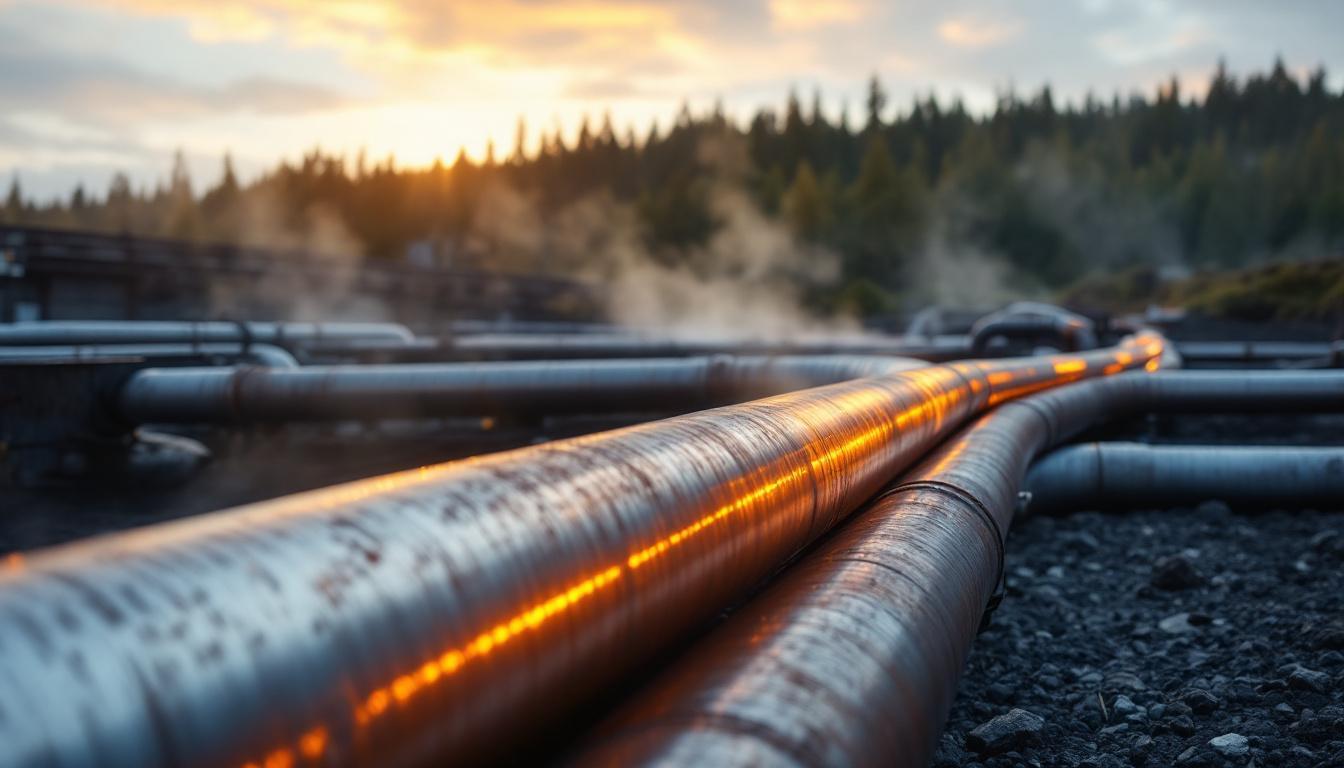
Advances in stainless steels and nickel alloys, coupled with supportive policies and innovative drilling techniques, are driving geothermal energy’s rapid expansion into decarbonising heat and power sectors, highlighting the critical role of material choice in project longevity and cost-effectiveness.
Stainless steels and corrosion-resistant alloys are becoming a quiet enabler of geothermal’s accelerating commercialisation, underpinning projects from low‑temperature district heating schemes to nascent superhot‑rock developments. As operators push into more chemically aggressive brines, deeper reservoirs and engineered systems, material selection is emerging as a deciding factor in plant longevity, maintenance costs and bankability.
The challenge is familiar to industry engineers: geothermal fluids often contain high concentrations of dissolved salts, dissolved gases and aggressive species such as hydrogen sulfide and carbon dioxide that attack conventional carbon‑steel heat‑exchanger surfaces and downhole equipment. According to the lead report by Heat Exchanger World, stainless steels and nickel‑alloys resist scaling and corrosion in those environments, reduce downtime, and allow heat‑transfer equipment to operate at higher temperatures and pressures. That not only improves plant availability but can materially lower life‑cycle costs, an important consideration where high upfront capital remains a barrier to deployment.
Those material advances are arriving in a broader moment of momentum for geothermal. Policy support across the European Union and the United States is directing finance and streamlined permitting toward geothermal projects. The EU’s Net Zero Industry Act has singled out geothermal as a strategic technology for the green transition, while the Council of the European Union in December 2024 approved conclusions calling for faster deployment, easier access to finance, workforce development and strengthened research cooperation to unlock geothermal’s potential for affordable, local heating and stable electricity supply. Industry data compiled by the European Geothermal Energy Council shows an active pipeline across Europe, with roughly 50 power plants under development and a sustained rise in geothermal heat pump sales, more than 154,300 units in the EU in 2023, an 11.7% increase on 2022, reflecting demand for energy security and lower operating costs following recent energy shocks in Europe.
In the United States, federal programmes are explicitly seeking to commercialise the next generation of geothermal technology. The U.S. Department of Energy has launched targeted funding and pilot demonstrations for Enhanced Geothermal Systems (EGS), selecting projects led by major industry and specialist companies to prove EGS in varied geological settings. The DOE’s early 2024 round of EGS demonstration awards, funded through the Infrastructure Investment and Jobs Act, included projects intended to showcase novel drilling and reservoir‑stimulation approaches in California, Utah and Oregon. The DOE describes EGS as the creation of engineered reservoirs in hot, dry rock by injecting fluid to create and circulate fractures; the aim is to open up geothermal resources beyond naturally permeable, hydrothermal fields and thereby deliver firm, zero‑carbon baseload power.
Technological progress is reducing barriers on the drilling side. Industry analyses and recent project experience indicate that advanced drilling techniques, some adapted from oil and gas, can sharply lower the cost of new wells: pilot programmes and modelling suggest drilling costs have fallen substantially after the first few wells as teams optimise rates and workflows. Clean Air Task Force analysis of emerging EGS deployments projects near‑term reductions in drilling costs and estimates that advanced drilling rates have cut costs nearly 50% after a small number of wells, producing average reductions in levelised cost of electricity of around 25% in some scenarios. Complementary innovations promise still bigger shifts: companies developing millimetre‑wave or “gyrotron” drilling systems, designed to reach superdeep targets where temperatures exceed 400°C, seek to access superhot resources without hydraulic fracturing, potentially avoiding induced seismicity and extending the temperature envelope for higher‑efficiency power cycles.
Material choices and system design interact with these developments. Where brines are below about 100°C, Europe’s market has largely favoured district heating. Even at modest temperatures, binary cycles such as Organic Rankine Cycle (ORC) units can convert heat at temperatures as low as 80°C into electricity, provided metallurgy and heat‑exchanger design preserve thermal performance in corrosive fluids. For deeper, hotter resources targeted by EGS and superhot concepts, higher grades of stainless steel and nickel alloys improve reliability under more extreme thermal and chemical conditions, limiting scaling and corrosion that otherwise raise maintenance frequency and cost.
The geopolitical case for geothermal strengthens the business rationale. European governments view locally sourced geothermal heat and power as a hedge against volatile global fuel markets; once operational, geothermal plants provide decades of steady, low‑variable‑cost energy. That stability is attractive for district heating networks, industrial off‑takers and utility portfolios seeking firm, low‑carbon capacity. At the same time, the high initial capital intensity of geothermal development, drilling, reservoir engineering and specialised materials, means public de‑risking and targeted finance remain critical to scale. The EU Council’s call for easier access to finance and the DOE’s demonstration funding both reflect that consensus.
Not all pathways are equally mature. Natural hydrothermal resources underpin most current capacity and district heating projects; EGS remains demonstrative with technical and commercial risks to be resolved at scale. Companies developing deep‑drilling, non‑fracking approaches argue they can overcome geological limits, but those claims require independent demonstration and time. Speaking to policy makers and project developers, industry participants acknowledge the need for standards, rigorous reservoir characterisation and supply‑chain development, including corrosion‑resistant materials and qualified fabricators, to ensure projects meet expected lifetimes and cost profiles.
For industrial decarbonisation, the implications are practical: matching metallurgy to fluid chemistry and temperature is now part of project financeability, and early material investment can deliver outsized returns through reduced downtime and longer intervals between service. As engineering firms and component suppliers refine specifications for stainless steels, duplex alloys and corrosion‑resistant claddings, project owners can better forecast operating expenditure and residual lifetimes, key inputs for developers building business cases for district heating retrofits, industrial heat replacement and firm power contracts.
The convergence of better materials, advanced drilling, targeted public funding and renewed policy urgency is shifting geothermal from niche baseload generation toward a broader role in decarbonising heat and power. The pace of that shift will depend on the outcomes of current EGS demonstrations, the commercial rollout of novel drilling systems, and continued investment in corrosion‑resistant components and standards. For businesses engaged in industrial decarbonisation, the message is clear: attention to materials and supply‑chain readiness is no longer optional; it will determine which projects deliver the durable, low‑carbon energy that industry requires.
- https://heat-exchanger-world.com/from-brine-to-energy-stainless-steel-enables-geothermals-future-growth/ – Please view link – unable to able to access data
- https://www.energy.gov/eere/geothermal/enhanced-geothermal-systems-egs-pilot-demonstrations – In February 2024, the U.S. Department of Energy announced its first round of Enhanced Geothermal Systems (EGS) demonstration projects, funded by the Infrastructure Investment and Jobs Act. Three projects were selected to demonstrate EGS in various geographic locations and geological formations, aiming to advance EGS towards commercial viability and bolster the U.S. geothermal industry. These projects include Chevron New Energies in California, Fervo Energy in Utah, and Mazama Energy in Oregon, each employing innovative drilling and stimulation techniques to access geothermal energy in different settings.
- https://www.thinkgeoenergy.com/egec-2023-geothermal-market-report-highlights-active-project-pipeline-in-europe/ – The European Geothermal Energy Council’s 2023 Geothermal Market Report highlights an active development pipeline in Europe, with approximately 50 geothermal power plants under various stages of development, led by Germany and Turkey. France remains the leader in geothermal district heating capacity in the EU, second only to Iceland in Europe. The report also notes a significant increase in geothermal heat pump sales, with over 154,300 units sold in the EU in 2023, a notable 11.7% increase from 2022, driven by concerns over energy security and affordability following Russia’s invasion of Ukraine.
- https://www.consilium.europa.eu/en/press/press-releases/2024/12/16/geothermal-energy-council-calls-for-faster-deployment/ – In December 2024, the Council of the European Union approved conclusions promoting the faster deployment of geothermal energy. The conclusions highlight geothermal energy’s potential as a local renewable source for affordable and secure heating and cooling, as well as a stable supply of electricity. The Council calls for measures such as easier access to finance to address high upfront investment costs, enhancing the workforce in the geothermal sector, and strengthening cooperation in research on geothermal energy to fully explore and utilise its potential.
- https://www.energy.gov/eere/geothermal/enhanced-geothermal-systems – Enhanced Geothermal Systems (EGS) are human-made geothermal energy systems that create reservoirs in hot, dry rock to tap into geothermal energy. The U.S. Department of Energy supports research, development, and demonstration projects to guide EGS technologies towards commercial viability. EGS involves injecting fluid deep underground to create fractures, allowing fluid to circulate and absorb heat, which is then brought to the surface to generate electricity. EGS has the potential to provide firm, flexible energy nationwide and is considered the next frontier for geothermal energy deployment.
- https://www.catf.us/2025/12/introduction-next-clean-energy-frontier-superhot-rock-geothermal-power-supply-characterization-enhanced-geothermal-systems/ – The Clean Air Task Force discusses the potential of superhot rock geothermal and Enhanced Geothermal Systems (EGS) as a next clean energy frontier. The article highlights that advanced drilling rates, based on recent EGS projects, have demonstrated drilling cost reductions of nearly 50% after drilling approximately three wells. The use of advanced drilling rates resulted in a Levelized Cost of Electricity (LCOE) reduction of nearly 25% on average. The article also discusses the optimal LCOE for EGS development across the contiguous U.S. and the factors influencing drilling costs and depths.
- https://en.wikipedia.org/wiki/Quaise – Quaise, Inc. is developing a millimeter-wave drilling system to access superdeep geothermal energy. The system aims to repurpose existing gyrotron technology to drill 20 kilometers beneath the surface, where temperatures exceed 400°C. This technique avoids the need for fracking, reducing the potential for earthquakes associated with other geothermal systems. The drilling process is designed to be fast, with boreholes completed in 100 days using existing 1MW gyrotrons. Quaise plans to establish its wells on the sites of existing power plants to reduce costs and delays.
Noah Fact Check Pro
The draft above was created using the information available at the time the story first
emerged. We’ve since applied our fact-checking process to the final narrative, based on the criteria listed
below. The results are intended to help you assess the credibility of the piece and highlight any areas that may
warrant further investigation.
Freshness check
Score:
7
Notes:
The article was published on August 26, 2025. A similar piece titled ‘From brine to energy’ was published by Outokumpu on the same date. ([outokumpu.com](https://www.outokumpu.com/en/expertise/industrial-evolution-insights/2025/from-brine-to-energy?utm_source=openai)) This suggests the content may be recycled or republished. The presence of a press release indicates a high freshness score, but the overlap raises concerns about originality.
Quotes check
Score:
6
Notes:
The article includes direct quotes attributed to Heat Exchanger World. However, no independent verification of these quotes is available online. This lack of verifiable sources diminishes the credibility of the quotes.
Source reliability
Score:
5
Notes:
The article originates from Heat Exchanger World, a niche publication. While it may be reputable within its niche, its limited reach and potential biases reduce its reliability. Additionally, the article appears to be summarising or aggregating content from other sources, which raises concerns about its originality.
Plausability check
Score:
7
Notes:
The claims about the role of stainless steels and corrosion-resistant alloys in geothermal energy are plausible and align with industry trends. However, the lack of supporting details from other reputable outlets makes it difficult to fully verify these claims. The article also lacks specific factual anchors, such as names, institutions, and dates, which further diminishes its credibility.
Overall assessment
Verdict (FAIL, OPEN, PASS): FAIL
Confidence (LOW, MEDIUM, HIGH): MEDIUM
Summary:
The article raises several concerns, including potential recycling of content, unverifiable quotes, reliance on a niche source, and lack of supporting details from other reputable outlets. These issues collectively diminish the article’s credibility.
