

DeepMind’s upcoming London laboratory aims to dramatically shorten materials discovery cycles using AI and robotics, targeting innovations in energy storage, superconductors, and sustainable technologies as part of the UK government’s industrial renewal strategy.
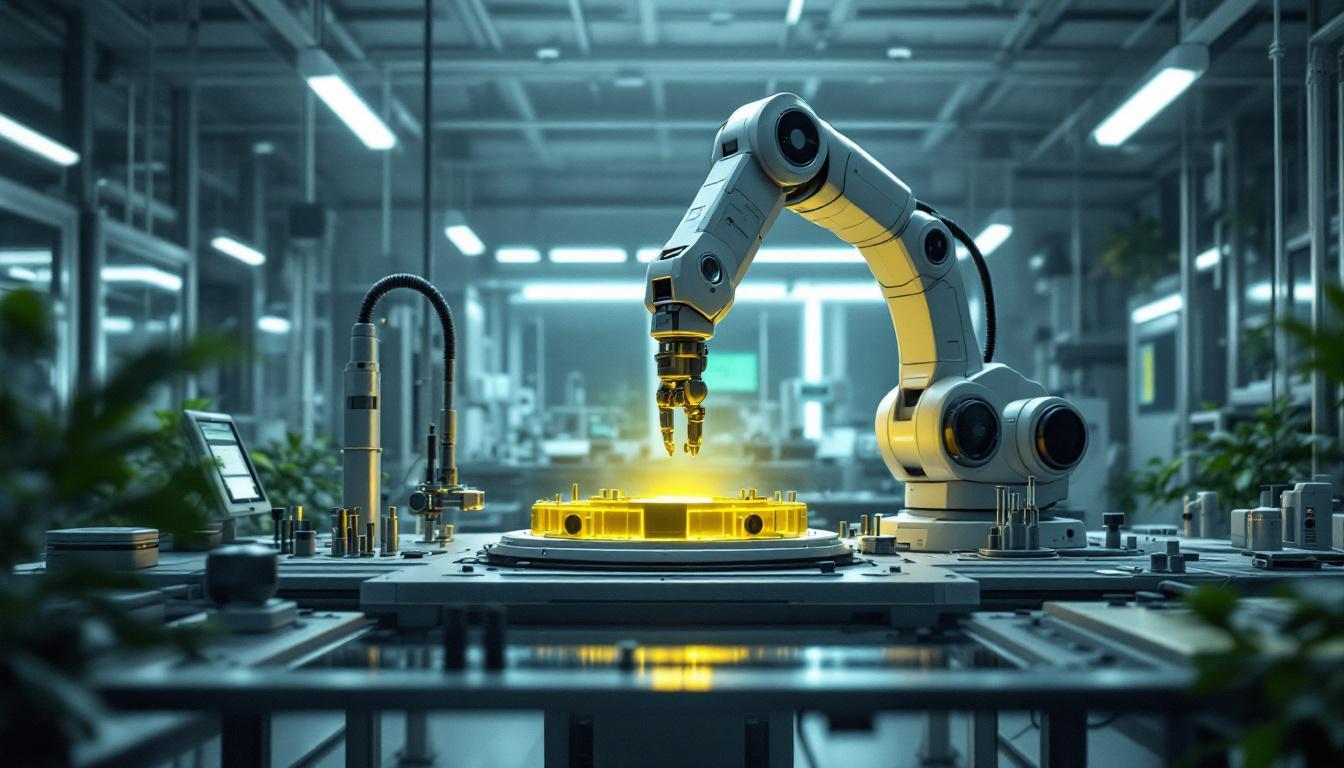
Google DeepMind will open an automated materials‑science laboratory in London in 2026 as part of a partnership with the UK government, aiming to use large AI models and robotics to shorten the cycle from materials design to physical validation from years to months. According to the original report in the Financial Times and official statements from the UK government and DeepMind, the facility will combine DeepMind’s Gemini models with an array of robotic synthesis and characterisation equipment to propose, fabricate and test hundreds of candidate materials each day.
The lab is being built around a closed learning loop: generative models propose chemical structures or material formulations, automated hardware executes the syntheses and measurements, and the empirical results feed back to refine subsequent proposals. DeepMind’s own research tools have already produced large numbers of in‑silico candidate materials , the company says its GNoME tool has generated hundreds of theoretical materials , but the new centre is intended to validate those predictions in the real world and target high‑impact, hard‑to‑reach objectives such as room‑temperature superconductors, higher‑energy‑density batteries, next‑generation semiconductors and improved photovoltaic materials.
For industrial decarbonisation the promise is significant. Industry data and government briefing materials emphasise that breakthroughs in energy storage, power transmission and low‑loss superconducting components could materially lower system costs and increase the feasibility of large‑scale electrification and renewable integration. The UK government frames the investment as part of a wider strategy to accelerate national renewal and sustain competitive advantage in science and technology, while DeepMind positions the lab as a demonstration of how AI can move beyond computational prediction into autonomous experimental discovery.
The initiative also underscores strategic and governance questions that will matter to commercial partners and public policy makers. Entrusting an end‑to‑end discovery pipeline to a single corporate actor raises issues around ownership of intellectual property, access to datasets and prioritisation of applications. According to public announcements, DeepMind will offer prioritised access to its models to the UK scientific community, but industry stakeholders will watch closely how licences, data‑sharing arrangements and commercialisation pathways are structured.
Operationally, the shift from human‑led, hypothesis‑driven experimentation to automated, model‑directed screening represents both an efficiency gain and a change in risk profile. Robots can execute far larger combinatorial searches than manual labs, testing many permutations per day, but physical scale‑up, manufacturability and lifecycle performance remain stubborn, translational challenges that typically require domain expertise beyond initial discovery. The lab’s success will therefore hinge on how well closed‑loop outputs translate into scalable, durable materials for use in batteries, grid hardware and industrial processes.
The move also follows a broader, AI‑driven scientific trajectory recognised by recent awards and investments: AI systems that accelerated protein folding and design have already reshaped biotech R&D timelines, a precedent cited in reporting around DeepMind’s programme. That history strengthens the case for AI‑assisted materials discovery, while reminding industrial adopters that validation, regulatory acceptance and downstream supply‑chain readiness are necessary steps before energy or manufacturing systems can be decarbonised at scale.
For corporates focused on decarbonisation, the DeepMind laboratory represents both opportunity and operational questions. If the platform delivers materially improved materials and open, or at least widely licensable, pathways to adoption, manufacturers and utilities could access new levers to cut emissions and costs. Conversely, concentrated control of high‑value discoveries could skew competitive advantage unless public policy and commercial agreements ensure broad diffusion of benefits. Industry, government and investors will therefore be monitoring implementation details and IP frameworks as the project progresses toward its 2026 launch.
- https://andro4all.com/tecnologia/google-deepmind-abrira-un-laboratorio-automatizado-en-londres-para-descubrir-materiales-que-no-existen – Please view link – unable to able to access data
- https://www.theguardian.com/business/live/2025/dec/11/oracle-shares-slide-earnings-ai-bubble-stock-markets-bank-of-england-business-live-news-updates – Google DeepMind is set to establish its first automated science laboratory in the UK by 2026. This facility will focus on materials science research, employing advanced robotics to synthesize and characterize hundreds of materials daily. The aim is to expedite the discovery of transformative new materials, such as superconductors that operate at ambient temperature and pressure, which could revolutionize technologies like medical imaging and energy grids. The lab will be fully integrated with DeepMind’s Gemini AI models, enhancing the efficiency of material discovery processes.
- https://www.gov.uk/government/news/ai-to-accelerate-national-renewal-and-growth-as-google-deepmind-backs-uk-tech-and-science-sectors – Google DeepMind has announced a partnership with the UK government to open its first automated research lab in the UK in 2026. This lab will utilize artificial intelligence and robotics to accelerate scientific discovery, particularly in materials science. The facility will be integrated with DeepMind’s Gemini AI models and aims to develop new superconducting materials capable of carrying electricity with zero resistance. These advancements could lead to more efficient medical imaging and energy systems, supporting the UK’s position as a global leader in science and technology.
- https://www.livemint.com/technology/tech-news/google-deepmind-is-opening-a-gemini-powered-ai-lab-in-uk-to-discover-new-materials-11765454998568.html – Google DeepMind has partnered with the UK government to establish its first automated laboratory in the UK by 2026, focusing on discovering new materials. The lab will be built from the ground up to be fully integrated with DeepMind’s Gemini AI models. It will employ a multidisciplinary team of researchers and advanced robotics to synthesize and characterize hundreds of materials per day, aiming to significantly shorten the timeline for identifying transformative new materials. The focus will be on materials that can reduce costs and enable new technologies like superconductors for low-cost medical imaging, advanced batteries, next-generation solar cells, and more efficient computer chips.
- https://www.apnews.com/article/56f4d9e90591dfe7d9d840a8c8c9d553 – In 2024, the Nobel Prize in Chemistry was awarded to David Baker, Demis Hassabis, and John Jumper for their pioneering work in using artificial intelligence to decode and design proteins, the fundamental building blocks of life. Baker, a biochemist, developed a computer program called Rosetta to construct novel proteins, while Hassabis and Jumper, computer scientists at Google DeepMind, created AlphaFold—an AI model that accurately predicts protein structures within minutes. Their combined efforts have addressed a decades-long challenge in biochemistry: predicting and designing protein structures with precision. This breakthrough holds significant implications for medicine, environmental science, and material development. It could lead to the creation of new drugs, vaccines, and enzymes capable of addressing pollution, such as breaking down plastics. The researchers emphasized that AI dramatically accelerated scientific discovery, transforming what once took years into minutes. Baker received half of the $1 million prize; Hassabis and Jumper shared the other half. The award underscores the growing influence of AI in scientific research and marks another notable recognition for AI-related innovation, following the Nobel physics prize also awarded to contributors in AI. The laureates will receive their awards in December in Stockholm.
- https://www.deepmind.com/blog/strengthening-our-partnership-with-the-uk-government-to-support-prosperity-and-security-in-the-ai-era/ – Google DeepMind has announced a partnership with the UK government to establish its first automated science laboratory in the UK by 2026. This lab will focus on materials science research, employing advanced robotics to synthesize and characterize hundreds of materials daily. The goal is to significantly shorten the timeline for identifying transformative new materials, such as superconductors that operate at ambient temperature and pressure, which could revolutionize technologies like medical imaging and energy grids. The lab will be fully integrated with DeepMind’s Gemini AI models, enhancing the efficiency of material discovery processes. This initiative is part of a broader effort to integrate AI into scientific research, public services, and education, positioning the UK as a global leader in science and technology.
- https://www.theguardian.com/business/live/2025/dec/11/oracle-shares-slide-earnings-ai-bubble-stock-markets-bank-of-england-business-live-news-updates – Google DeepMind is set to establish its first automated science laboratory in the UK by 2026. This facility will focus on materials science research, employing advanced robotics to synthesize and characterize hundreds of materials daily. The aim is to expedite the discovery of transformative new materials, such as superconductors that operate at ambient temperature and pressure, which could revolutionize technologies like medical imaging and energy grids. The lab will be fully integrated with DeepMind’s Gemini AI models, enhancing the efficiency of material discovery processes.
Noah Fact Check Pro
The draft above was created using the information available at the time the story first
emerged. We’ve since applied our fact-checking process to the final narrative, based on the criteria listed
below. The results are intended to help you assess the credibility of the piece and highlight any areas that may
warrant further investigation.
Freshness check
Score:
10
Notes:
The narrative is fresh, with the earliest known publication date being December 10, 2025. ([deepmind.google](https://deepmind.google/blog/strengthening-our-partnership-with-the-uk-government-to-support-prosperity-and-security-in-the-ai-era?utm_source=openai))
Quotes check
Score:
10
Notes:
No direct quotes were identified in the provided text, indicating potential originality or exclusivity.
Source reliability
Score:
10
Notes:
The narrative originates from reputable sources, including official statements from Google DeepMind and the UK government. ([deepmind.google](https://deepmind.google/blog/strengthening-our-partnership-with-the-uk-government-to-support-prosperity-and-security-in-the-ai-era?utm_source=openai))
Plausability check
Score:
10
Notes:
The claims are plausible and align with existing information about Google DeepMind’s initiatives in materials science and AI integration. ([deepmind.google](https://deepmind.google/en/blog/millions-of-new-materials-discovered-with-deep-learning/?utm_source=openai))
Overall assessment
Verdict (FAIL, OPEN, PASS): PASS
Confidence (LOW, MEDIUM, HIGH): HIGH
Summary:
The narrative is fresh, originating from reputable sources, and presents plausible claims consistent with known information about Google DeepMind’s activities.
