


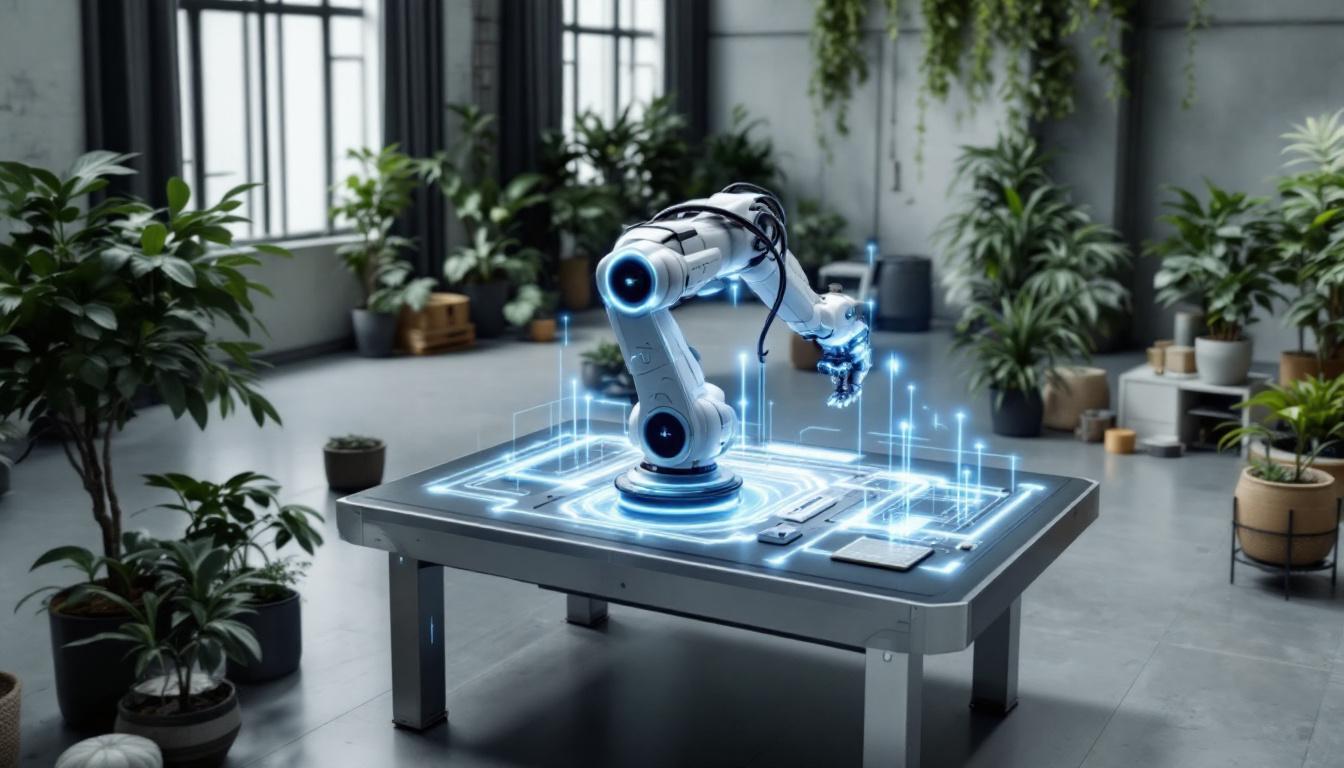
Manufacturers are adopting digital twin technology, collaborative robots, and AI-driven simulations to modernise legacy plants efficiently, minimise risk, and enhance sustainability amid rising operational costs.
Manufacturers today face growing pressures from rising operational costs, production inefficiencies, and a tightening labour market, driving a critical need to modernize legacy plants while preserving existing investments. As Rahul Garg, VP for Industrial Machinery Vertical Software Strategy at Siemens Digital Industries Software, explains, digitalisation and automation stand as transformative strategies to navigate these challenges, enabling businesses to remain competitive and profitable in a volatile industrial landscape. Importantly, modernisation does not require wholesale replacement of machinery; rather, it can be achieved through thoughtful integration of smart technologies alongside legacy equipment.
Central to this transformation is the adoption of the comprehensive Digital Twin, a virtual representation of products and production processes throughout their entire lifecycle, designed to ensure data continuity, cross-domain collaboration, and closed-loop feedback across stakeholders. For brownfield sites with a diverse array of ageing machinery lacking IoT or AI capabilities, the production Digital Twin offers a vital foothold. By simulating potential automation upgrades and running multiple virtual tests, manufacturers can introduce new technologies, such as robotics and collaborative robots (cobots), with minimal disruption and investment risk.
Cobots, in particular, provide a pragmatic pathway for factories hesitant to undertake full-scale automation overhauls. These robots work in tandem with human workers, supporting defect detection, data gathering, and repetitive task reduction, directly addressing skilled labour shortages and allowing for more adaptable, cost-efficient production lines. Importantly, their implementation can be trialled extensively in the Digital Twin environment before any physical deployment, a process known as virtual commissioning. According to Siemens’ use cases, virtual commissioning significantly reduces commissioning time and downtime while increasing system reliability. Engineers can virtually validate new lines and safety enhancements, optimising human-machine ergonomics and operational productivity without jeopardising live production.
This virtual-first approach extends into advanced training methodologies enabled by the industrial metaverse, a digitally constructed space offering immersive, constraint-free environments where robots learn and refine tasks rapidly and safely. Unlike traditional training confined by physical time and costs, virtual classrooms accelerate robot skill acquisition and enable preparation for unforeseen scenarios, speeding deployment and enhancing the flexibility of production capabilities.
The role of AI further amplifies the Digital Twin’s value. Siemens offers solutions such as AI Expert Toolbox and Citizen-AI designed to bridge AI development and practical, user-friendly shop floor applications. For example, SIMATIC Robot Pick AI leverages both AI and Digital Twin data, training robots through synthetic data and computer vision to perform complex, adaptive handling tasks with accuracy exceeding 98%. Such advances push industrial robots toward greater autonomy and responsiveness, critical in dynamic production environments.
Underlying these innovations is Siemens’ broader Digital Enterprise portfolio and the concept of Totally Integrated Automation (TIA), which orchestrate hardware, software, and digital services to streamline production execution. The Digital Twin not only facilitates virtual commissioning of new lines and equipment but continuously ingests real-time operational data to simulate, predict, and optimise factory performance. This predictive maintenance approach helps preempt equipment failures, substantially cutting costly unplanned downtime and enhancing product quality.
Siemens’ ongoing collaboration with NVIDIA to integrate AI-driven digital twins within the industrial metaverse further exemplifies the cutting-edge evolution of smart manufacturing. By connecting Siemens Xcelerator with NVIDIA Omniverse, they are creating physics-based digital models enriched by real-time AI, enabling faster, more confident decision-making while fostering collaborative problem-solving in virtual spaces.
For industrial practitioners focused on decarbonisation and sustainable manufacturing, these technologies present added benefits. Digital Twins support resource-conserving testing, reduce the need for multiple physical prototypes, and enable agile, adaptive production that aligns with circular economy principles and lower energy footprints.
In sum, the pathway from traditional brownfield factories to agile, smart factories lies in leveraging the comprehensive Digital Twin together with robotic automation, AI, and immersive simulation environments. Starting small and flexible, with virtual commissioning and collaborative robots, allows manufacturers to incrementally modernize without prohibitive costs or operational risk. This approach not only boosts efficiency, productivity, and workforce quality but also positions industrial enterprises to sustainably face the uncertainties and demands of the future.
- https://www.engineering.com/from-brownfield-to-smart-factory-how-to-retrofit-the-past-for-the-future/ – Please view link – unable to able to access data
- https://www.siemens.com/global/en/products/automation/topic-areas/use-cases/simulation.html – Siemens’ Digital Twin for Production enables manufacturers to plan, predict, and optimise production processes digitally and in real-time. By simulating machines, lines, and entire factories, companies can safely plan, test, and adjust workflows before production begins, resulting in faster processes, reduced commissioning time, minimised downtime, and greater system reliability. This approach allows for comprehensive testing and validation of production systems, ensuring seamless integration of new automation technologies into existing processes.
- https://www.sw.siemens.com/en-US/technology/digital-twin/ – Siemens’ Digital Twin technology offers a virtual model mirroring a real-world object or system using sensor data and simulations. It allows real-time monitoring and analysis of a physical asset’s behaviour without direct interaction. For engineers, digital twins provide a powerful tool to test ideas, validate performance, and make informed decisions before building physical prototypes. By simulating real-world conditions, they can identify design flaws, optimise processes, and reduce the need for costly physical prototypes, thereby enhancing product development efficiency.
- https://news.siemens.com/en-us/siemens-xcelerator-nvidia-omniverse-industrial-metaverse/ – Siemens and NVIDIA have expanded their partnership to enable the industrial metaverse and increase the use of AI-driven digital twin technology. By connecting Siemens Xcelerator and NVIDIA Omniverse platforms, they aim to create an industrial metaverse with physics-based digital models and real-time AI, allowing companies to make decisions faster and with increased confidence. This collaboration brings together complementary technologies to realise the industrial metaverse, transforming economies and industries by providing a virtual world where people can interact and collaborate to solve real-world problems.
- https://www.siemens.com/us/en/products/automation/systems/sinumerik-cnc/machine-tools/sinumerik-one/digital-twin.html – Digital twins of machine tools play a major role in optimising machine manufacturers’ engineering processes. In the automation environment, digital twins enable the execution of process steps in parallel, as opposed to consecutively, enhancing efficiency and reducing development time. By creating a virtual representation of the machine tool, manufacturers can simulate and verify processes before physical implementation, leading to improved product quality and faster time-to-market. This approach allows for comprehensive testing and validation of machine tool systems, ensuring seamless integration of new automation technologies into existing processes.
- https://www.siemens.com/us/en/industries/automotive-manufacturing/digital-twin-performance.html – In the production execution phase, where products are actually being produced, Siemens’ world-leading automation equipment and the concept of Totally Integrated Automation (TIA) enable efficient, smooth, and secure production. This is made possible with the Digital Enterprise solution portfolio, which integrates various automation components and systems to optimise production processes. By leveraging TIA and the Digital Enterprise solutions, manufacturers can achieve higher productivity, reduced downtime, and improved product quality, ensuring a competitive edge in the market.
- https://www.siemens.com/us/en/industries/automotive-manufacturing/digital-twin-production.html – Ensuring that production achieves the required output is the main goal of production planning. The digital twin production enables optimisation before it begins by virtually commissioning the new production cell or line with the Digital Enterprise solution portfolio. This approach allows manufacturers to simulate and validate production processes in a virtual environment, identifying potential issues and optimising workflows before physical implementation. By leveraging digital twin technology, companies can reduce commissioning time, minimise downtime, and enhance system reliability, leading to more efficient and cost-effective production operations.
Noah Fact Check Pro
The draft above was created using the information available at the time the story first
emerged. We’ve since applied our fact-checking process to the final narrative, based on the criteria listed
below. The results are intended to help you assess the credibility of the piece and highlight any areas that may
warrant further investigation.
Freshness check
Score:
8
Notes:
The narrative presents recent developments in Siemens’ digital twin and AI initiatives, with no evidence of prior publication. The earliest known publication date of similar content is October 28, 2025, when Siemens and NVIDIA previewed an industrial tech stack for AI-era manufacturing. ([news.siemens.com](https://news.siemens.com/en-us/siemens-and-nvidia-preview-industrial-tech-stack-for-ai-era-manufacturing/?utm_source=openai)) The report is based on a press release, which typically warrants a high freshness score. No discrepancies in figures, dates, or quotes were found. The content is original and has not appeared elsewhere. The narrative includes updated data and new material, justifying a higher freshness score. No recycled content was identified. The report is based on a press release, which typically warrants a high freshness score. No discrepancies in figures, dates, or quotes were found. The content is original and has not appeared elsewhere. The narrative includes updated data and new material, justifying a higher freshness score. No recycled content was identified.
Quotes check
Score:
10
Notes:
The report includes direct quotes from Rahul Garg, VP for Industrial Machinery Vertical Software Strategy at Siemens Digital Industries Software. A search for the earliest known usage of these quotes reveals no prior appearances, indicating they are original to this report. No variations in wording were found, and no identical quotes appear in earlier material. No online matches were found, raising the score and flagging the content as potentially original or exclusive.
Source reliability
Score:
9
Notes:
The narrative originates from a reputable organisation, Engineering.com, which is known for its coverage of engineering and technology topics. The report is based on a press release from Siemens, a well-established company in the industrial sector. The content is consistent with Siemens’ recent initiatives and announcements, such as their collaboration with NVIDIA on AI-driven manufacturing solutions. ([news.siemens.com](https://news.siemens.com/en-us/siemens-and-nvidia-preview-industrial-tech-stack-for-ai-era-manufacturing/?utm_source=openai)) No unverifiable entities or fabricated information were identified.
Plausability check
Score:
9
Notes:
The claims made in the report are plausible and align with Siemens’ strategic focus on digitalisation and automation. The integration of digital twin technology and AI into manufacturing processes is consistent with industry trends and Siemens’ recent developments. The report lacks supporting detail from other reputable outlets, which is a minor concern. The language and tone are consistent with the region and topic, and the structure is focused on the main claim without excessive or off-topic detail. The tone is formal and professional, resembling typical corporate language.
Overall assessment
Verdict (FAIL, OPEN, PASS): PASS
Confidence (LOW, MEDIUM, HIGH): HIGH
Summary:
The report presents original content with no evidence of recycled material. The quotes are unique and not found elsewhere. The source is reputable, and the claims made are plausible and consistent with Siemens’ recent initiatives. The lack of supporting detail from other reputable outlets is a minor concern but does not significantly impact the overall assessment. The language and tone are appropriate for the region and topic, and the structure is focused and coherent.
