


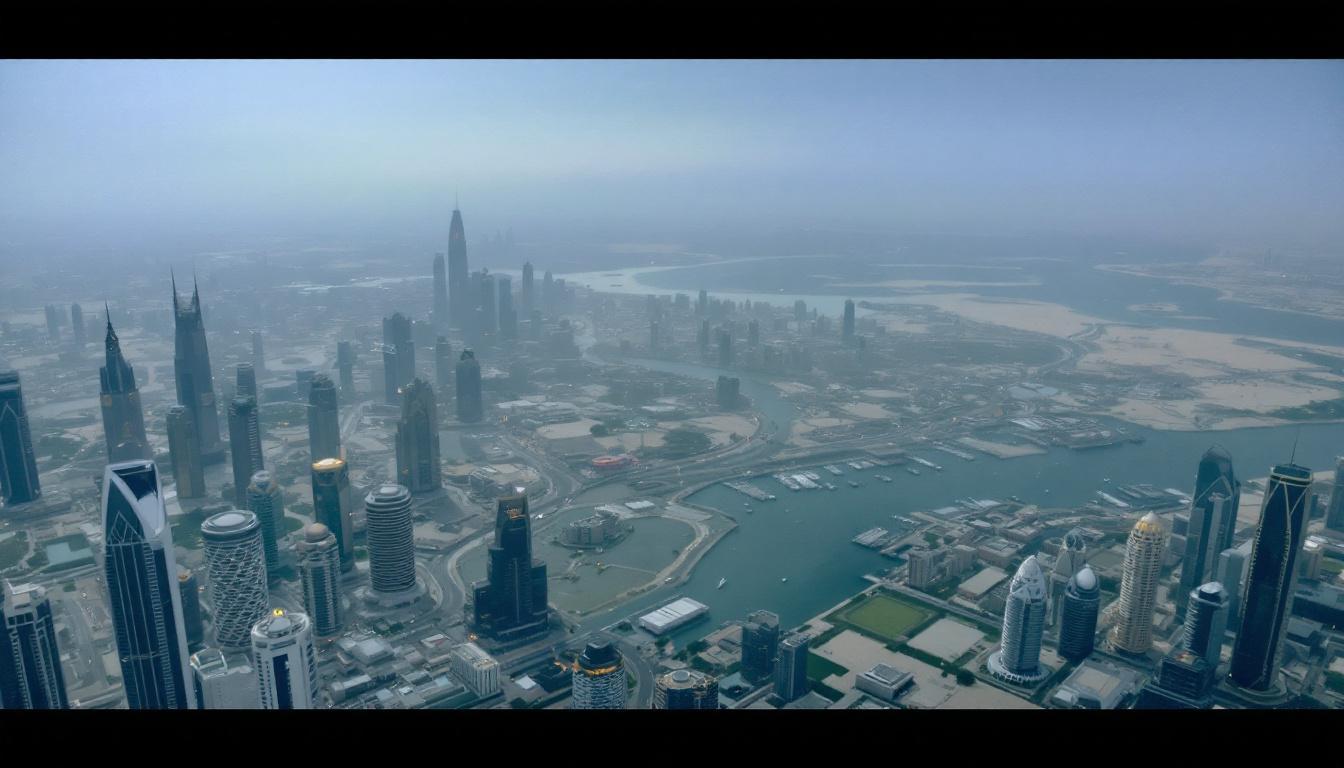
Dubai Electricity and Water Authority is strengthening US collaborations to transform climate commitments into commercially viable projects, focusing on green hydrogen, grid modernisation, and sectoral decarbonisation amid shifting global policies and investments.
Dubai’s state utility is intensifying its engagement with US clean‑technology stakeholders as it seeks to convert climate commitments into commercially viable projects across power, hydrogen and grid innovation.
Officials from Dubai Electricity and Water Authority held a round of talks with a visiting US delegation led in part by Robert Hertzberg, a senior fellow at Mission Possible Partnership and a board member of First Public Hydrogen, exploring opportunities to scale green hydrogen, modernise grid operations and accelerate sectoral decarbonisation. According to DEWA, discussions aimed to broaden cooperation in advanced energy technologies and innovation as the emirate pursues an economy‑wide shift away from fossil fuels.
The engagement builds on projects DEWA has already put in place at the Mohammed bin Rashid Al Maktoum Solar Park, which DEWA says will reach a planned 5,000 MW by 2030 and which now hosts a green hydrogen pilot. DEWA reports the pilot produces roughly 400 kilograms of green hydrogen per day and has been used to test storage, power‑back conversion and mobility applications. Company statements also record that, since its 2021 launch, the hydrogen facility has yielded more than 100 tonnes of hydrogen and supported over 1.15 GWh of clean electricity generation, helping to abate several hundred tonnes of CO2 and supplying hydrogen for vehicle refuelling trials. DEWA frames the pilot as a technical and commercial stepping stone for larger‑scale deployment as market conditions mature.
The conversations come against a backdrop of shifting global policy incentives and capital flows. The United States’ Inflation Reduction Act has channelled significant subsidies into renewables, hydrogen and clean manufacturing, prompting Gulf utilities and project developers to seek partnerships that combine regional solar resources and scale with North American technology and finance. Industry observers say such cross‑border linkages can shorten commercialisation timelines for technologies that must prove themselves at utility scale.
Beyond hydrogen, DEWA is investing in systems to manage rising demand and a more variable generation mix. The utility is building a 250 MW pumped‑storage hydro plant at Hatta, the largest project of its kind in the Gulf Cooperation Council, designed for rapid response to load swings and long operational life. DEWA also highlights deployments of smart metres, automated substations, artificial intelligence and energy storage as core to maintaining reliability while integrating renewables. The utility’s research centre at the solar park pursues robotics, storage, photovoltaic performance and renewable‑driven desalination, reflecting the inseparable link between water and energy in Dubai’s planning.
DEWA’s publicly stated strategy now excludes new fossil‑fuel generation and prioritises cleaner desalination methods, such as reverse osmosis paired with renewable power, as part of Dubai’s broader Net Zero 2050 ambitions. The authority positions international partnerships as essential to meeting those targets, seeking to attract both technology suppliers and investors willing to prove low‑carbon solutions at scale.
For US clean‑tech proponents, access to projects of the solar park’s magnitude offers a platform to demonstrate hydrogen production, long‑duration storage and digital grid management under operational conditions. DEWA’s pilots provide data on round‑trip efficiencies, hydrogen handling and system integration that investors and technology developers require before committing to industrial‑scale rollouts in heavy industry and long‑distance transport.
Nevertheless, translating pilot success into an industrial market remains contingent on several factors: the trajectory of electrolyser and storage costs, the pace of demand development in hard‑to‑abate sectors, and the alignment of regulatory frameworks and offtake arrangements that make large projects bankable. Analysts note that while the UAE aims to capture a substantial share of the low‑carbon hydrogen market, achieving competitive pricing will depend on continued technology cost reductions and stable policy signals from importing markets.
The US‑UAE dialogue therefore represents a pragmatic step toward de‑risking commercial projects through technical collaboration, shared pilots and investor engagement. As DEWA scales its renewable base and refines hydrogen operations, Gulf utilities and international partners will be watching whether these early demonstrations can be converted into repeatable, investable models for industrial decarbonisation.
- https://thearabianpost.com/dewa-deepens-us-clean-energy-dialogue/ – Please view link – unable to able to access data
- https://www.dewa.gov.ae/en/about-us/media-publications/latest-news/2024/05/dewa-supports-netzero – Dubai Electricity and Water Authority (DEWA) has updated its mission to align with Dubai’s 8 Guiding Principles and 50-Year Charter, aiming for a sustainable Net-Zero carbon 2050. DEWA has ceased launching new fossil fuel-based energy projects and focuses on efficient reverse osmosis desalination using clean energy. The Mohammed bin Rashid Al Maktoum Solar Park, the world’s largest single-site solar park, is set to reach a capacity of 5,000 MW by 2030, with current production at 2,627 MW. DEWA has also initiated a green hydrogen project at the solar park, producing about 400 kilograms of green hydrogen daily, marking a significant step towards sustainable energy solutions.
- https://www.dewa.gov.ae/en/about-us/media-publications/latest-news/2023/12/dewas-projects-and-initiatives-support – DEWA is implementing a 250 MW pumped-storage hydroelectric power plant in Hatta, the first of its kind in the GCC region, with a rapid 90-second response to electricity demand and a lifespan of 80 years. The Green Hydrogen Pilot Project, the first in the Middle East and North Africa to produce hydrogen using solar energy, stores hydrogen and converts it into electrical energy for various sectors. The project produces about 400 kilograms of hydrogen daily and supports the UAE’s goal to acquire 25% of the low-carbon hydrogen market, expected to reach over USD 400 billion.
- https://www.dewa.gov.ae/en/about-us/media-publications/latest-news/2023/12/dewa-supports-the-goals-of-cop28 – DEWA supports national and global climate ambitions by utilising innovations and research to drive sustainable development, including the transition towards hydrogen production from renewable energy sources. The Green Hydrogen project at the Mohammed bin Rashid Al Maktoum Solar Park, the first of its kind in the MENA region, produces about 400 kilograms of hydrogen daily and stores it for various applications. The project contributes to achieving competitive prices in green hydrogen production and supports the UAE’s goal to acquire 25% of the low-carbon hydrogen market, expected to reach over USD 400 billion.
- https://www.dewa.gov.ae/en/about-us/media-publications/latest-news/2021/09/he-saeed-mohammed-al-taye – DEWA’s Green Hydrogen project at the Solar Park in Dubai is the first of its kind in the MENA region to produce green hydrogen using renewable energy. The project shows promise as an environmentally friendly energy source produced by water electrolysis, representing a pillar of a sustainable future that depends on accelerating the transition to carbon neutrality to support a green economy by developing the green mobility sector and reducing carbon emissions in different industries.
- https://www.gulftoday.ae/business/2025/09/05/dewa-enhances-clean-energy-cooperation-with-chinese-firms – DEWA’s Green Hydrogen project has produced more than 100 tonnes of green hydrogen since its launch in May 2021. Most of this was used to produce over 1.15 GWh of clean electricity via a hydrogen gas engine, helping to abate more than 515 tonnes of carbon dioxide. Over 11 tonnes were shipped to ENOC, which were used to fuel hydrogen vehicles at ENOC’s Service Station of the Future at Expo 2020 Dubai and to power other industrial applications. The project supports the UAE’s goal to acquire 25% of the low-carbon hydrogen market, expected to reach over USD 400 billion.
- https://dewa.gov.ae/en/about-us/media-publications/latest-news/2023/06/dewa-a-major-supporter – DEWA is a key supporter of the UAE’s efforts in climate action. The Mohammed bin Rashid Al Maktoum Solar Park, with a current production capacity of 2,327 MW, is set to reduce more than 6.5 million tonnes of carbon dioxide emissions annually upon completion. The Green Hydrogen project at the Solar Park, in cooperation with Expo 2020 Dubai and Siemens Energy, is the first of its kind in the MENA region to produce hydrogen using solar energy, supporting the UAE’s efforts to achieve global competitiveness in the green hydrogen market.
Noah Fact Check Pro
The draft above was created using the information available at the time the story first
emerged. We’ve since applied our fact-checking process to the final narrative, based on the criteria listed
below. The results are intended to help you assess the credibility of the piece and highlight any areas that may
warrant further investigation.
Freshness check
Score:
6
Notes:
The article discusses DEWA’s ongoing engagement with US clean-technology stakeholders, including a recent meeting with a US delegation led by Robert Hertzberg. While the specific date of this meeting is not provided, the content aligns with DEWA’s previously reported initiatives, such as the green hydrogen project at the Mohammed bin Rashid Al Maktoum Solar Park. ([dewa.gov.ae](https://www.dewa.gov.ae/en/about-us/media-publications/latest-news/2024/12/dubais-production-of-green-hydrogen-generates?utm_source=openai)) However, the lack of a clear publication date raises concerns about the freshness of the information.
Quotes check
Score:
5
Notes:
The article includes direct quotes attributed to DEWA officials and Robert Hertzberg. However, these quotes do not appear in the provided search results, making independent verification challenging. The absence of verifiable sources for these quotes is a significant concern.
Source reliability
Score:
4
Notes:
The article originates from The Arabian Post, a publication that does not have a widely recognized reputation. The lack of a clear publication date and the absence of verifiable sources for the quotes further diminish the reliability of this source.
Plausibility check
Score:
7
Notes:
The article’s claims about DEWA’s engagement with US clean-technology stakeholders and the green hydrogen project at the Mohammed bin Rashid Al Maktoum Solar Park are plausible and consistent with DEWA’s known initiatives. However, the lack of specific dates and verifiable sources raises questions about the accuracy of the information.
Overall assessment
Verdict (FAIL, OPEN, PASS): FAIL
Confidence (LOW, MEDIUM, HIGH): MEDIUM
Summary:
The article presents information about DEWA’s engagement with US clean-technology stakeholders and the green hydrogen project at the Mohammed bin Rashid Al Maktoum Solar Park. However, the absence of a clear publication date, unverified quotes, and reliance on a less reputable source raise significant concerns about the accuracy and reliability of the information. Given these issues, the content cannot be confidently verified, leading to a FAIL verdict with MEDIUM confidence.
