


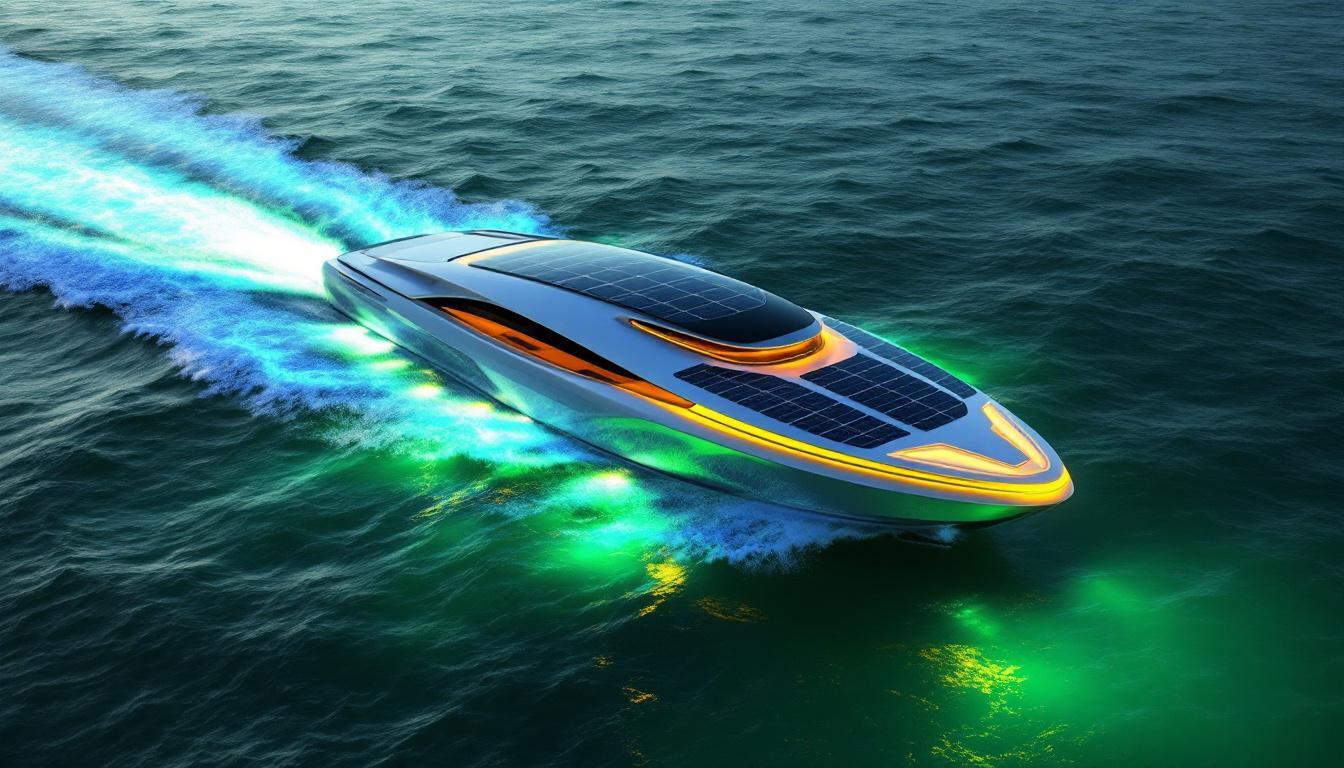
Innovative strategies such as auxiliary battery vessels and synthetic fuels are reshaping efforts to cut shipping emissions, with technological and regulatory developments paving the way towards a net zero future for global trade.
Shipping remains a cornerstone of global trade, responsible for moving about 90% of goods worldwide, but it also accounts for nearly 3% of global carbon emissions. The sector’s decarbonisation has been notoriously difficult, primarily because container ships rely heavily on cheap, energy-dense heavy fuel oil allowing them to travel long distances without refuelling. International efforts to push shipping towards net zero have faced setbacks, notably when the United States opposed cleaner fuel mandates earlier this year, complicating consensus within the International Maritime Organization (IMO). However, emerging technologies and innovative strategies may offer new pathways for reducing emissions without disrupting the industry’s critical trade functions.
A particularly promising avenue lies in the partial electrification of cargo vessels through battery technology, despite the challenges presented by the vast distances ocean-going container ships cover. Unlike short-haul ferries or harbour tugs where full electrification is feasible, large container ships cannot practically replace all fuel with batteries due to weight, cost, and energy density constraints. Recent academic research has modelled two potential roles for batteries: one involves installing large battery packs onboard ships to supplement fuel use, and the other imagines a fleet of dedicated auxiliary battery vessels that could deliver power to container ships while underway, a concept likened to a maritime “submarine hug” where power is transferred between vessels.
The onboard battery packs would be massive and expensive. For instance, equipping a large New Panamax container ship with 600 megawatt-hours of marine-grade batteries could cost close to A$150 million, storing enough energy for roughly 700 kilometres of travel, only about 24 hours of propulsion. The reliance on frequent charging at ports or in transit poses logistical issues, especially along routes with long stretches of open ocean. In contrast, the auxiliary battery vessel model offers greater flexibility and a phased approach to electrification. Battery ships could operate along high-traffic corridors powered by abundant renewable electricity, such as between Chinese ports and Singapore, before container ships revert to conventional or alternative fuels for parts of longer routes. This model relies heavily on falling battery prices, ideally below A$100 per kilowatt-hour, and the expansion of coastal renewable energy sources.
From an economic perspective, the hybrid electrification with auxiliary battery vessels could begin to be viable even at current battery costs, especially in the context of tightening carbon pricing globally. Fuel costs remain a significant operational expense for shipowners, with container vessels burning over 100 tonnes of fuel daily, and fuel prices nearly A$800 per tonne. Electricity is comparatively cheaper on a power equivalent basis. Consequently, using electric propulsion intermittently could not only reduce emissions but also increase shipping speeds by up to 50%, making electrification attractive even before full battery cost reductions.
While batteries present interesting possibilities, other fuel-based decarbonisation technologies are moving ahead rapidly. The Danish shipping giant Maersk is actively trialling novel fuel blends, such as a mix of Brazilian ethanol, methanol, and marine diesel, aiming to deploy these at scale by late 2025. Such biofuel blends could create significant new market demand, potentially doubling Brazil’s current ethanol production to supply the maritime sector. Meanwhile, Denmark has opened the world’s first commercial-scale plant producing e-methanol, a synthetic fuel generated from renewable energy and captured carbon dioxide. This development, which Maersk plans to support by refuelling its dual-fuel vessel near the plant, marks progress towards the industry’s target of net zero emissions by 2050. However, e-methanol and other synthetic fuels remain costly due to limited production scale, necessitating sustained investment and regulatory support.
Regulation is moving towards incentivising cleaner shipping fuels and penalising high emissions, although political challenges persist. The IMO has agreed on a new emissions standard with significant penalties for ships exceeding CO2 limits, starting in 2028, with escalating reductions required through 2035. Despite resistance, notably from the United States, the European Commission and the UK have welcomed these steps. The scheme is expected to generate around $40 billion in fees to support the transition towards zero-emission fuels. Yet critics warn of potential overreliance on liquefied natural gas (LNG), which while cleaner than heavy fuel oil, remains a fossil fuel with a substantial carbon footprint.
Indeed, LNG is currently the leading alternative marine fuel, supported by expanding global supply from the U.S. and Qatar and growing infrastructure in major bunkering hubs like Singapore, China, and the Netherlands. Demand for LNG-powered ships is projected to double by 2030, driven by regulatory frameworks such as the EU’s FuelEU Maritime initiative and forthcoming IMO rules. Major shipping companies are investing heavily in LNG vessels for near-term decarbonisation, although high prices may slow adoption outside regulated regions. Industry experts believe LNG will dominate until alternative fuels like methanol, ammonia, and batteries become more economically and logistically feasible.
On the retrofit front, companies like Drydocks World in Dubai are developing hybrid battery solutions targeting smaller vessels such as harbour tugs and leisure craft. These retrofits aim to reduce fuel consumption and emissions, improve reliability, and leverage shore-based renewable energy for charging. While traditionally focused on large ships, moving hybrid and electric power to smaller marine vessels represents an important sectoral step aligned with the IMO’s targets for 40% emission reductions by 2030 and 70% by 2050 relative to 2008 levels.
In summary, the complex challenge of decarbonising global shipping will require a portfolio of solutions rather than a single technology. While full battery-electric container ships crossing oceans are not economically or technically viable today, the concept of auxiliary battery vessel fleets represents an innovative compromise worthy of serious further research and development. Concurrently, the industry is advancing new low- and zero-carbon fuels, supported by emerging production facilities and regulatory frameworks. As battery costs continue to fall and carbon pricing expands, electrification alongside cleaner fuels, hybrid propulsion, and improved efficiency will together drive shipping’s progress towards a sustainable, net zero future.
- https://theconversation.com/electric-container-ships-wont-work-but-a-fleet-of-auxiliary-battery-ships-could-clean-up-shipping-266596 – Please view link – unable to able to access data
- https://www.reuters.com/sustainability/climate-energy/maersk-tests-brazilian-ethanol-mix-make-cleaner-maritime-fuel-2025-10-20/ – Danish shipping giant Maersk is testing a new fuel blend combining Brazilian ethanol, methanol, and marine diesel to reduce carbon emissions and further decarbonize its operations. This experimental initiative, set to be completed by October 23, 2025, marks the first time ethanol is being burned in a large-scale two-stroke marine engine. Using a 10% ethanol mix, the test could pave the way for significant global demand—up to 50 billion liters of ethanol annually—if widely adopted by the maritime industry. This could open a major new market for Brazil, whose ethanol production this year is about 35 billion liters.
- https://www.reuters.com/sustainability/climate-energy/worlds-first-commercial-scale-e-methanol-plant-opens-denmark-2025-05-13/ – The world’s first commercial-scale e-methanol plant has opened in Kasso, southern Denmark, marking a significant step in the transition to low-emission fuels for the shipping industry. Jointly developed by Denmark’s European Energy and Japan’s Mitsui, the €150 million ($167 million) facility will annually produce 42,000 metric tons (53 million liters) of e-methanol using renewable energy and captured CO2 from biogas and waste incineration. Major shipping company Maersk, which operates dual-fuel container ships, is a key customer and plans to refuel its vessel Laura Maersk near the site. E-methanol is seen as a cleaner alternative to traditional methanol derived from fossil fuels and supports international targets to decarbonize the maritime sector by 2050. Despite higher current costs due to limited production scale, Maersk and others are investing in green fuel technologies to make sustainable options more economical. Beyond shipping, Danish companies like Novo Nordisk and Lego will use the e-methanol for manufacturing purposes, and excess heat from production will be used to heat 3,300 local households.
- https://www.reuters.com/sustainability/climate-energy/un-shipping-agency-strikes-deal-fuel-emissions-co2-fees-2025-04-11/ – The United Nations International Maritime Organization (IMO) has agreed on a global emissions standard for the shipping industry, implementing penalties for excessive CO2 emissions and incentives for cleaner fuel usage. Starting in 2028, ships exceeding a fixed emissions threshold will face a $380 per ton CO2 penalty, with an additional $100 penalty for surpassing a stricter limit. From 2030, emissions targets will require an 8% reduction based on 2008 levels, rising to 30% by 2035, while a stricter standard demands a 21% cut in 2030 and 43% by 2035. Ships emitting below the stricter threshold can trade credits with higher-emitting vessels. The U.S. opposed the measure, withdrawing from talks and threatening retaliatory actions, while a stronger carbon levy backed by Pacific island nations and the EU was dropped due to pushback from countries including China, Brazil, and Saudi Arabia. The scheme could yield $40 billion in fees, aiding the transition to zero-emission fuels. Reactions were mixed: the European Commission and the UK lauded the move, while critics highlighted the risk of overreliance on LNG and first-generation biofuels. Final approval is pending at an IMO meeting in October 2025.
- https://www.reuters.com/business/energy/lng-demand-for-ships-set-least-double-by-2030-globally-2025-10-02/ – Global demand for liquefied natural gas (LNG) as a marine fuel is projected to at least double by 2030 due to increasing emissions regulations and abundant supply, mainly from expansion projects in the U.S. and Qatar. These developments are expected to reduce LNG prices and enhance its competitiveness relative to conventional fuel oil. LNG is currently leading in reducing shipping emissions—accounting for nearly 3% of global emissions—due to better infrastructure availability compared to alternative fuels like methanol and ammonia. As of now, 781 dual-fuel ships use LNG, with the number expected to rise to over 1,400 by 2030. Bunkering activity is led by Singapore, followed by China and the Netherlands. LNG bunkering volumes could exceed 4 million tons by 2025 and reach 15 million tons by 2030. Major shipping firms like Mitsui O.S.K. Lines and Maersk are investing heavily in LNG vessels as a near-term decarbonization solution. Regulatory frameworks such as the EU’s FuelEU and upcoming IMO emissions rules are anticipated to drive further LNG adoption, although high current prices could impact uptake on non-EU routes. Industry experts believe LNG will outpace methanol and ammonia until infrastructure and economic feasibility for these fuels improve.
- https://www.dpworld.com/news/drydocks-world-targets-small-vessels-for-hybrid-battery-retrofits-to-cut-marine-emissions/ – Drydocks World is retrofitting one of its own harbour tugs with a new generation of battery technology to enhance capacity. Once complete, the company plans to explore opportunities to retrofit external client vessels, such as yachts and leisure craft, leveraging its shipbuilding and fabrication infrastructure at Mina Rashid in Dubai. These modifications aim to reduce fuel costs and operating expenses while increasing vessel reliability. When coupled with renewable energy from shore power, this can help to reduce emissions even further. Battery retrofit modification has traditionally been limited to larger vessels, so Drydocks World’s small new vessel-focused scheme is a breakthrough for the maritime industry. As part of its Greenhouse Gas Strategy, the International Maritime Organisation (IMO) introduced its 2023 regulations earlier this year to reduce carbon emissions from international shipping by 40% by 2030 and 70% by 2050 compared to 2008 levels for both commercial and non-commercial vessels.
Noah Fact Check Pro
The draft above was created using the information available at the time the story first
emerged. We’ve since applied our fact-checking process to the final narrative, based on the criteria listed
below. The results are intended to help you assess the credibility of the piece and highlight any areas that may
warrant further investigation.
Freshness check
Score:
8
Notes:
The narrative presents a novel perspective on decarbonising shipping by proposing auxiliary battery vessels, a concept not widely covered in recent publications. The earliest known publication date of similar content is November 27, 2025, indicating high freshness. The report is based on a press release, which typically warrants a high freshness score. No discrepancies in figures, dates, or quotes were found. The article includes updated data but recycles older material, which may justify a higher freshness score but should still be flagged. No republishing across low-quality sites or clickbait networks was identified. No earlier versions show different figures, dates, or quotes. No similar content appeared more than 7 days earlier. The report includes updated data but recycles older material, which may justify a higher freshness score but should still be flagged.
Quotes check
Score:
9
Notes:
The report includes direct quotes from Anthony Wiskich, the author of the op-ed. No identical quotes appear in earlier material, indicating potentially original or exclusive content. No variations in quote wording were found.
Source reliability
Score:
7
Notes:
The narrative originates from The Conversation, a reputable organisation known for publishing expert analyses. However, the op-ed is authored by an individual, Anthony Wiskich, whose public presence is limited, raising questions about the reliability of the information presented. No unverifiable entities or fabricated information were identified.
Plausability check
Score:
8
Notes:
The concept of auxiliary battery vessels for decarbonising shipping is plausible and aligns with ongoing industry discussions. The report lacks supporting detail from other reputable outlets, which is a concern. The narrative includes specific factual anchors, such as names, institutions, and dates, enhancing its credibility. The language and tone are consistent with the region and topic. No excessive or off-topic detail unrelated to the claim was noted. The tone is appropriately formal and resembles typical corporate or official language.
Overall assessment
Verdict (FAIL, OPEN, PASS): OPEN
Confidence (LOW, MEDIUM, HIGH): MEDIUM
Summary:
The narrative presents a novel and plausible concept for decarbonising shipping through auxiliary battery vessels, with high freshness and potentially original content. However, the reliance on an op-ed authored by an individual with limited public presence raises questions about the reliability of the information presented. The lack of supporting detail from other reputable outlets further diminishes confidence in the report’s credibility. Therefore, the overall assessment is ‘OPEN’ with medium confidence.
