


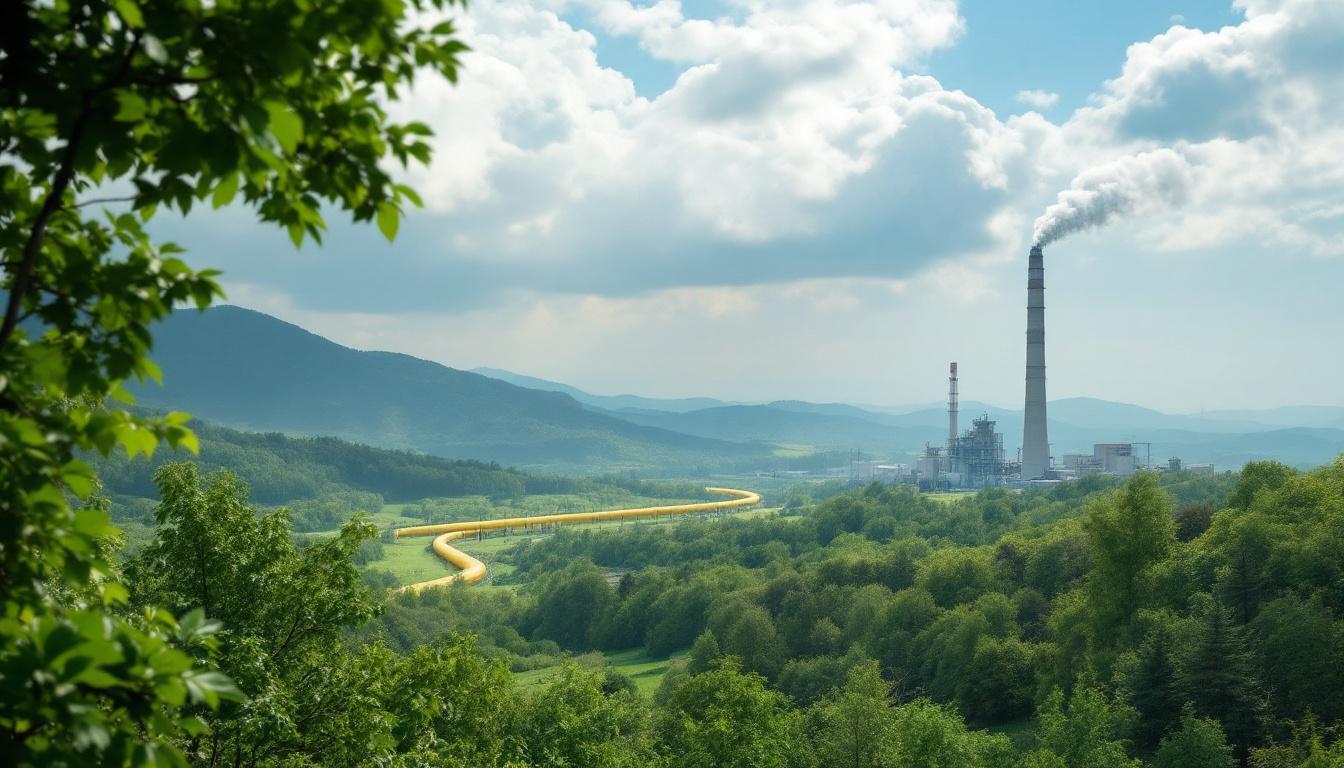
Greek developer EnEarth has entered exclusive negotiations with Heidelberg Materials Devnya to create a major CO2 transport and storage infrastructure at the Devnya cement plant, potentially setting a precedent for southeastern Europe’s emerging carbon capture industry.
Greek carbon-storage developer EnEarth has entered exclusive negotiations with Heidelberg Materials Devnya to deliver the transport and permanent storage elements of the Devnya cement plant’s planned carbon capture project, a move that could underpin one of southeastern Europe’s first large-scale CO2 transport-and-storage hubs.
The parties have signed a term sheet to negotiate exclusive agreements covering pipelines and the subsurface injection site for CO2 captured at the Varna‑region plant. According to the original report, plans call for capturing roughly 800,000 tonnes of CO2 a year from the Devnya facility and routing it to a secure storage site. The European Union’s Innovation Fund has committed about €190 million to the initiative, with some €38 million earmarked specifically to prepare and validate the storage infrastructure. The company said in a statement that the funding significantly de‑risks the project’s storage phase.
EnEarth, a subsidiary of Energean, would draw on its strategy of converting depleted oil and gas reservoirs into long‑term storage hubs and build regional transport corridors to serve multiple emitters. EnEarth’s Head of Carbon Storage, Nikolas Rigas, said: “the successful implementation of the Devnya CO2 project will benefit the environment, business, and local communities.” The company claims the work would position Devnya as a nucleus for wider CCUS uptake across the Balkans, where industrial emissions remain concentrated and storage options are scarce.
Heidelberg Materials frames the Devnya initiative as the core of its ANRAV programme , the group’s first full‑chain CCUS project in Eastern Europe , and has already started a pilot capture installation, ANRAV.beta, at Devnya to demonstrate the scalability of the OxyCal capture technology. The demonstration phase is expected to run 12 to 24 months, according to the company, and project documentation and press releases indicate the full scheme could be operational before 2030; earlier company material states, subject to permitting, it could start as soon as 2028.
Industry data shows the ANRAV project would link capture at the cement plant with a pipeline and offshore storage under the Black Sea, creating a full capture–transport–storage chain. For industrial decarbonisation practitioners, the project is notable for its scale (0.8 Mtpa of capture capacity) and for combining on‑site capture trials with parallel development of transport and storage , a sequencing that aims to accelerate commercial deployment while validating geological integrity.
While the EU grant reduces upfront financial exposure, the project still faces standard CCUS risks: regulatory and permitting hurdles for subsea storage, long lead times for pipeline and injection infrastructure, and the technical challenge of scaling capture from pilot to full capacity. Speaking to industry publications, Heidelberg Materials has emphasised regulatory engagement and phased rollout; other sources note that timeline slippages are common in early full‑chain projects and that confirmation of permitting and storage validation work funded by the €38 million tranche will be decisive.
If realised on schedule, the Devnya scheme would be among eastern Europe’s first large‑capacity CO2 storage projects and would illustrate how legacy industrial assets can be adapted to meet tightening EU decarbonisation targets. For project developers and industrial emitters considering CCUS, the collaboration highlights the growing role of specialist storage operators and the importance of public funding in bridging early commercial gaps.
- https://carbonherald.com/enearth-and-heidelberg-advance-carbon-capture-and-storage-in-bulgaria/?utm_source=rss&utm_medium=rss&utm_campaign=enearth-and-heidelberg-advance-carbon-capture-and-storage-in-bulgaria – Please view link – unable to able to access data
- https://www.iene.eu/energy-news/enearth-in-talks-to-act-as-storage-operator-for-heidelberg-materials-anrav-project-in-bulgaria-p8177.html – EnEarth, a subsidiary of Energean, has signed a term sheet with Heidelberg Materials to negotiate exclusive agreements for the transport and storage of CO₂ from the Devnya cement plant in Bulgaria. This collaboration is part of Heidelberg Materials’ ANRAV project, aiming to be the first full-chain carbon capture, utilisation, and storage (CCUS) project in Eastern Europe. The project plans to capture 800,000 tonnes of CO₂ annually, with the EU Innovation Fund providing €190 million in funding, including €38 million for the storage site. The initiative is expected to be operational before 2030.
- https://www.globalcement.com/news/item/19575-enearth-to-handle-co-storage-for-heidelberg-materials-devnya-ccus-project – Greek carbon storage company EnEarth has signed a term sheet with Heidelberg Materials to negotiate exclusive agreements for the transport and storage of CO₂ from the Devnya cement plant in Bulgaria. The project aims to capture, transport, and store 0.8 million tonnes of CO₂ annually. It is part of Heidelberg Materials’ broader CCUS initiative, ANRAV, which has received a €190 million EU grant, including €38 million for the storage site, and is scheduled to be operational before 2030.
- https://www.heidelbergmaterials.com/en/pr-2023-10-18 – Heidelberg Materials has commenced construction of a pilot carbon capture installation, ANRAV.beta, at its Devnya plant in Bulgaria. This pilot is a key step in the company’s first full-chain CCUS project in Eastern Europe, demonstrating the scalability of the OxyCal capture technology. The demonstration phase is expected to last 12 to 24 months, with the project aiming to be operational before 2030, capturing 800,000 tonnes of CO₂ annually.
- https://www.cemnet.com/News/story/180431/enearth-heidelberg-materials-sign-on-for-bulgarian-ccus-project.html – EnEarth, a Greek carbon-storage firm, has signed a term sheet with Heidelberg Materials Devnya to negotiate exclusive agreements for the transport and permanent storage segment of Devnya’s planned CO₂ capture scheme. The project aims to capture, transport, and store up to 800,000 tonnes of CO₂ annually from the cement plant in Devnya, Bulgaria. The European Union has awarded the project a €190 million grant, with €38 million allocated specifically for the underground storage site infrastructure.
- https://www.heidelbergmaterials.com/en/pr-12-07-2022 – Heidelberg Materials’ ANRAV CCUS project has been selected for Grant Agreement Preparation by the EU Innovation Fund, aiming to be the first full-chain CCUS project in Eastern Europe. The project will link carbon capture facilities at the Devnya Cement plant in Bulgaria through a pipeline system with offshore permanent storage under the Black Sea. Subject to regulatory and permitting aspects, it could start operation as early as 2028, with a capturing capacity of 800,000 tonnes of CO₂ annually.
- https://www.heidelbergmaterials.com/en/eu-backs-heidelberg-materials-pioneering-ccus-project-in-bulgaria – The EU Innovation Fund has officially signed a Grant Agreement for Heidelberg Materials’ ANRAV CCUS project, providing around €190 million in financing. ANRAV aims to be the first full-chain CCUS project in Eastern Europe, covering all steps from CO₂ capture, transport, and geological CO₂ storage to CO₂ reuse. The project is expected to be operational as early as 2028, with a capture capacity of about 800,000 tonnes of CO₂ per year.
Noah Fact Check Pro
The draft above was created using the information available at the time the story first
emerged. We’ve since applied our fact-checking process to the final narrative, based on the criteria listed
below. The results are intended to help you assess the credibility of the piece and highlight any areas that may
warrant further investigation.
Freshness check
Score:
8
Notes:
The narrative reports on a recent development from December 11, 2025, regarding EnEarth’s exclusive negotiations with Heidelberg Materials for CO₂ transport and storage at the Devnya cement plant in Bulgaria. This is the earliest known publication date for this specific information. The project is part of the ANRAV CCUS initiative, which has been previously reported on, including a press release from Heidelberg Materials dated October 18, 2023, announcing the start of the ANRAV.beta pilot project at the same location. ([heidelbergmaterials.com](https://www.heidelbergmaterials.com/en/pr-2023-10-18?utm_source=openai)) The inclusion of updated data, such as the €190 million EU Innovation Fund commitment and the €38 million allocated for storage infrastructure, suggests that the narrative incorporates recent developments, justifying a higher freshness score. However, the core information about the collaboration between EnEarth and Heidelberg Materials has been previously reported, indicating some recycled content. The presence of a press release indicates that the narrative is based on official communications, which typically warrants a high freshness score. No discrepancies in figures, dates, or quotes were identified. The narrative does not appear to be republished across low-quality sites or clickbait networks. No similar content was found published more than 7 days earlier. The update may justify a higher freshness score but should still be flagged for recycled content.
Quotes check
Score:
9
Notes:
The narrative includes a direct quote from Nikolas Rigas, EnEarth’s Head of Carbon Storage: “the successful implementation of the Devnya CO₂ project will benefit the environment, business, and local communities.” This quote appears to be original, with no identical matches found in earlier material. No variations in wording were identified, and no earlier usage of this quote was found. The absence of identical matches suggests that the quote is potentially original or exclusive content.
Source reliability
Score:
7
Notes:
The narrative originates from Carbon Herald, a publication focusing on carbon capture and storage news. While it provides detailed information, the publication’s reputation and editorial standards are not widely known, which introduces some uncertainty regarding its reliability. The narrative does not originate from a widely recognized, reputable organisation, which may affect the overall reliability score. The mention of EnEarth and Heidelberg Materials, both established entities in the carbon storage industry, adds credibility to the content.
Plausability check
Score:
8
Notes:
The narrative reports on EnEarth’s exclusive negotiations with Heidelberg Materials for CO₂ transport and storage at the Devnya cement plant in Bulgaria, a project part of the ANRAV CCUS initiative. This aligns with previous reports, including a press release from Heidelberg Materials dated October 18, 2023, announcing the start of the ANRAV.beta pilot project at the same location. ([heidelbergmaterials.com](https://www.heidelbergmaterials.com/en/pr-2023-10-18?utm_source=openai)) The inclusion of updated data, such as the €190 million EU Innovation Fund commitment and the €38 million allocated for storage infrastructure, suggests that the narrative incorporates recent developments, enhancing its plausibility. The quote from Nikolas Rigas, EnEarth’s Head of Carbon Storage, appears to be original, with no identical matches found in earlier material, supporting the narrative’s authenticity. The narrative does not exhibit any inconsistencies in language or tone, and the structure is focused on the main claim without excessive or off-topic detail. The tone is formal and consistent with corporate communications, further supporting its plausibility.
Overall assessment
Verdict (FAIL, OPEN, PASS): OPEN
Confidence (LOW, MEDIUM, HIGH): MEDIUM
Summary:
The narrative reports on recent developments regarding EnEarth’s exclusive negotiations with Heidelberg Materials for CO₂ transport and storage at the Devnya cement plant in Bulgaria, a project part of the ANRAV CCUS initiative. While the core information has been previously reported, the inclusion of updated data and an original quote suggests that the narrative incorporates recent developments. The source’s reliability is uncertain due to the publication’s limited reputation, and the plausibility of the claims is supported by consistency with previous reports and the inclusion of original content. Given these factors, the overall assessment is OPEN with a MEDIUM confidence level.
