


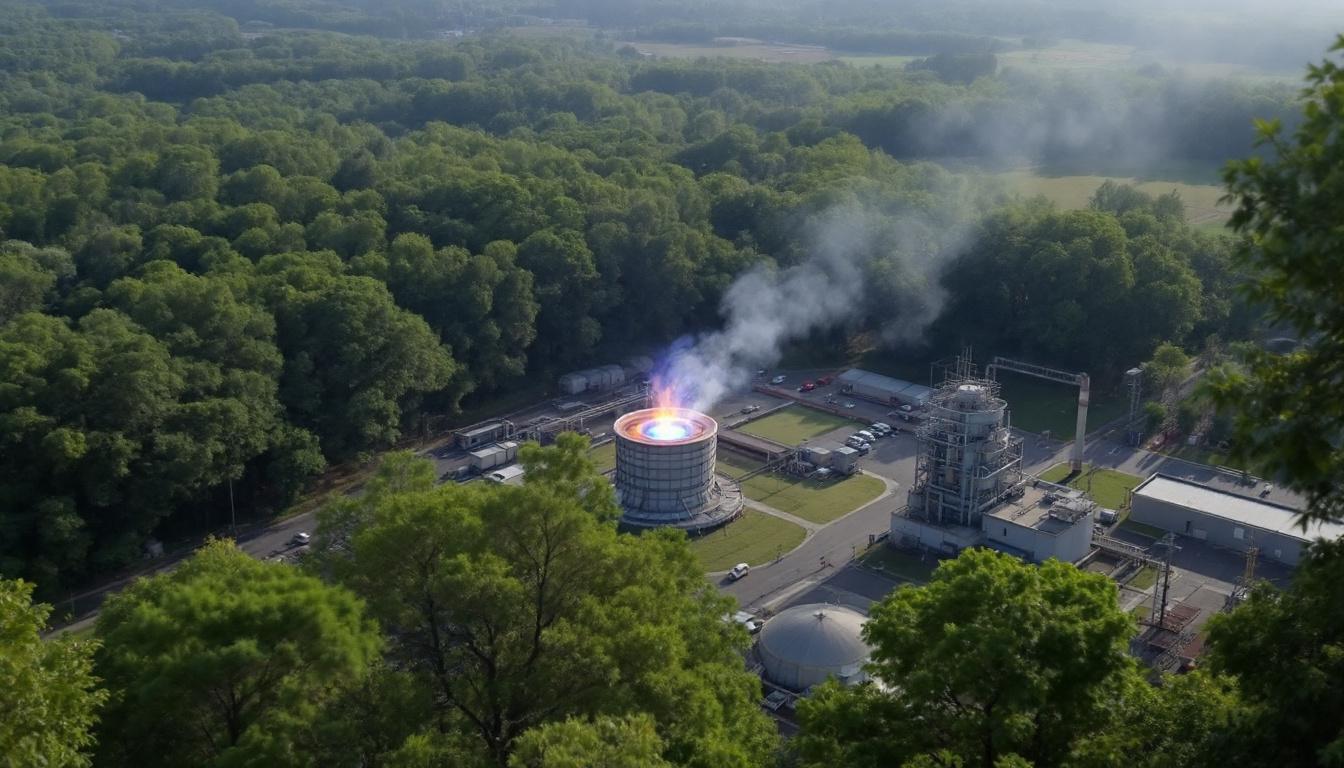
A European Union-funded project at a Barcelona steel plant is testing hybrid hydrogen burners to cut emissions from steel reheating processes, promising a feasible and cost-effective pathway to cleaner steel production amid infrastructure challenges.
EU-backed tests of hydrogen-fired burners at a Barcelona steel plant are being pitched as a pragmatic route to cut one of the last pockets of fossil-fuel CO2 in electric-arc, scrap-based steelmaking without halting production.
According to the original report, CELSA Group is leading TWINGHY, an R&D consortium that has developed hybrid burners designed to run on hydrogen, natural gas or blends of the two for reheating furnaces used before rolling. “We need to reduce the impact of the steel industry, and this is one of the ways we can do that,” said Raquel Torruella Martínez, project manager at CELSA, reflecting the project’s aim to tackle the natural-gas reheating stage that remains a significant emissions source even in scrap-based mills.
TWINGHY is funded under the EU Research Fund for Coal and Steel (RFCS) Big Ticket programme. Industry material supplied with the project states it runs from 2023 to 2027 with a total budget of €8.575 million, half provided by the EU. The consortium comprises nine partners, including burner designers, refractory specialists and digital-modelling institutions, pooling engineering, materials and computational expertise to deliver a market-ready retrofit solution.
Trial timetable and engineering challenges
Trials are scheduled to start in early 2026 with hydrogen deliveries to CELSA’s Barcelona site; the hybrid burners were installed during routine maintenance and are currently operating on natural gas while awaiting hydrogen feedstock. “In Catalonia, hydrogen infrastructure is not yet ready to provide enough supply, particularly of green hydrogen,” Torruella Martínez said, noting that the project has secured limited quantities for trials.
Burner development has been led by partners such as FIVES, which built the demonstrator hardware. “Hydrogen burns faster,” said Sébastien Caillat, combustion chief expert at FIVES, explaining a core combustion challenge: shorter, hotter flames change heat distribution inside furnaces. To manage that, TWINGHY’s engineers have produced hybrid designs that maintain flame stability and even heat while allowing operators to vary hydrogen share according to availability. “Even in the future, it’s unlikely steel companies will always have enough hydrogen,” Caillat said. “Flexibility is key.”
Materials, oxy-firing and supplier activity
Project partners are also probing the downstream impacts of hydrogen-enriched combustion. Refractory specialist Calderys joined TWINGHY to study effects on furnace linings and to develop materials suited to hydrogen–natural gas–oxygen mixtures, signalling that feedstock change has implications beyond burner geometry.
Nippon Gases is contributing operational burner hardware and oxy-firing expertise, while CELSA emphasises the retrofit nature of the system as a cost-efficient route to emissions reduction that avoids replacing existing furnaces.
Digital twin and supercomputing
A central element is a digital twin of the furnace, developed with support from the Barcelona Supercomputing Center. “The digital twin is updated in real time with operational data,” Torruella Martínez said, adding that high-fidelity models of heat and gas flows will help teams predict hydrogen combustion behaviour and optimise controls. “The supercomputing power of BSC allows us to model highly complex physical processes that would otherwise be impossible to test in real time,” she said. The twin is expected to be fully operational in 2026 and will be used to refine burner settings, forecast efficiency and quantify emissions impacts.
Market context and competing solutions
The TWINGHY approach sits within a broader supplier movement: other major equipment makers have launched burners designed for arbitrary hydrogen–gas blends and flameless operation. Industry examples include SMS group’s ZeroFlame HY² burner and Tenova’s TSX SmartBurner, both described by their manufacturers as capable of 100% hydrogen operation while controlling NOx and maintaining heat uniformity. Those suppliers claim improvements in emissivity and efficiency that can complement CO2 reductions from fuel switching.
Industry data shows steel accounts for roughly 8% of global CO2 emissions, making decarbonisation of reheating furnaces an urgent target. The TWINGHY team is positioning hybrid, retrofittable burners plus digital control as a lower-risk near-term pathway compared with full electrification or green-hydrogen-only strategies.
Barriers to uptake
Despite technological progress, project partners caution that the economics hinge on hydrogen availability and cost. “The technology is ready,” Torruella Martínez said. “The question is whether hydrogen supply will keep pace. Investment in clean steel depends on that.” New burners carry a premium and, without assurance of reliable green-hydrogen supply, steelmakers may defer purchases, potentially slowing market roll-out even if vendors can deliver certified equipment.
Outlook for industrial decarbonisation
TWINGHY seeks to demonstrate a pragmatic balance: maintain production and process continuity while progressively replacing fossil fuels. According to the original report, if trials validate performance and the digital twin proves effective, the burners could reach the market before the project ends in 2027, rapid by steel-industry standards. For industrial decarbonisation professionals, the project illustrates how integrated solutions, combining combustion engineering, materials science and real-time simulation, can de-risk the transition and provide modular options that align with staggered hydrogen infrastructure deployment.
For companies planning plant upgrades, the TWINGHY work underscores two practical considerations: select burner technologies that handle mixed fuels and ensure refractory and control systems are adapted for the altered combustion regime. Government support, supply-chain investment in green hydrogen, and supplier guarantees on performance and retrofit compatibility will determine whether such demonstrators translate into widescale emissions reduction across Europe’s steel fleet.
- https://techxplore.com/news/2025-11-steel-carbon-pollution-problem.html – Please view link – unable to able to access data
- https://twinghy.eu/ – The TWINGHY project aims to introduce hydrogen as a fuel to replace natural gas in reheating furnaces within the steel industry. Coordinated by CELSA, the project involves nine partners and is funded by the European Union’s RFCS Big Ticket programme. It focuses on developing hybrid burners and a digital twin to optimise furnace operations and reduce CO₂ emissions. The project is scheduled to run from 2023 to 2027, with a total budget of €8.575 million, half of which is contributed by the EU.
- https://calderys.com/news-and-media/calderys-joins-twinghy-green-hydrogen-project-steel-industry – Calderys, a refractory solutions provider, has joined the TWINGHY project to support the decarbonisation of the steel industry. The project, initiated in the summer of 2023 and concluding in 2027, aims to replace natural gas with hydrogen in reheating furnaces. Calderys will study how these modifications affect refractory linings and develop suitable materials for furnaces operating on hydrogen-natural gas-oxygen mixtures.
- https://www.sms-group.com/insights/all-insights/a-burner-for-all-mix-ratios-of-natural-gas-and-hydrogen – SMS group has developed the ZeroFlame HY² burner, capable of operating with any mixture of natural gas and hydrogen, including 100% hydrogen. This flameless burner achieves low nitrogen oxide emissions and offers up to 5% higher emissivity compared to traditional natural gas burners, contributing to substantial CO₂ reduction. Available in power sizes from 500 kW to 3,000 kW, it is designed to enhance energy efficiency in reheating furnaces.
- https://tenova.com/newsroom/press-releases/tenovas-flameless-smartburner-enabling-hydrogen-based-decarbonization – Tenova has introduced the TSX SmartBurner, a flameless combustion system capable of burning any mixture of natural gas and hydrogen, up to 100% hydrogen. Integrated with Tenova’s advanced digital solutions, this burner maintains low NOx emissions and optimal heat transfer uniformity within furnaces, supporting the decarbonisation of steel production processes.
- https://nippongases.com/no-en/announcements/twinghy – Nippon Gases is contributing to the TWINGHY project by developing and installing innovative Oxy-Natural Gas/Hydrogen burners in operational industrial-scale reheating furnaces. The project aims to decarbonise the reheating process by progressively replacing natural gas with hydrogen and oxygen, enhancing energy efficiency and maintaining low emissions. Funded by the Research Fund for Coal and Steel (RFCS), TWINGHY is scheduled to conclude in 2027.
- https://www.fivesgroup.com/newspress/detail-view/twinghy-progress-and-innovations-for-a-green-steel-industry – Fives Group and CELSA are collaborating on the TWINGHY project to decarbonise the reheating process in the steel industry. The project involves testing hybrid burners capable of operating on hydrogen and natural gas mixtures, with final tests scheduled for early 2026. Additionally, digital twin technology is being developed to monitor and optimise furnace operations, contributing to the reduction of CO₂ emissions in steel production.
Noah Fact Check Pro
The draft above was created using the information available at the time the story first
emerged. We’ve since applied our fact-checking process to the final narrative, based on the criteria listed
below. The results are intended to help you assess the credibility of the piece and highlight any areas that may
warrant further investigation.
Freshness check
Score:
9
Notes:
The narrative is recent, published on November 26, 2025. The TWINGHY project has been ongoing since early 2023, with significant developments reported in 2024 and 2025. The article provides updated information on the project’s progress, including the installation of hybrid burners and the development of a digital twin for furnace operations. No evidence of recycled content or republishing across low-quality sites was found. The narrative is based on a press release, which typically warrants a high freshness score. No discrepancies in figures, dates, or quotes were identified. The inclusion of updated data alongside older material is noted, but the recent updates justify a higher freshness score.
Quotes check
Score:
10
Notes:
The direct quotes from Raquel Torruella Martínez and Sébastien Caillat are unique to this narrative. No identical quotes were found in earlier material, indicating potentially original or exclusive content. No variations in quote wording were noted.
Source reliability
Score:
8
Notes:
The narrative originates from TechXplore, a reputable science and technology news outlet. The TWINGHY project is led by CELSA Group, a well-established steel manufacturer, and involves multiple reputable partners, including Fives Group and the Barcelona Supercomputing Center. The involvement of these reputable organizations strengthens the reliability of the information presented.
Plausability check
Score:
9
Notes:
The claims about the TWINGHY project’s objectives and progress are plausible and align with information from other reputable sources. The narrative includes specific details about the project’s timeline, partners, and technological developments, which are consistent with known facts. The language and tone are appropriate for the subject matter and region. No excessive or off-topic details were noted, and the tone is consistent with typical corporate communications.
Overall assessment
Verdict (FAIL, OPEN, PASS): PASS
Confidence (LOW, MEDIUM, HIGH): HIGH
Summary:
The narrative is recent, with unique quotes and information from reputable sources, presenting plausible and consistent claims about the TWINGHY project’s progress and objectives.
