


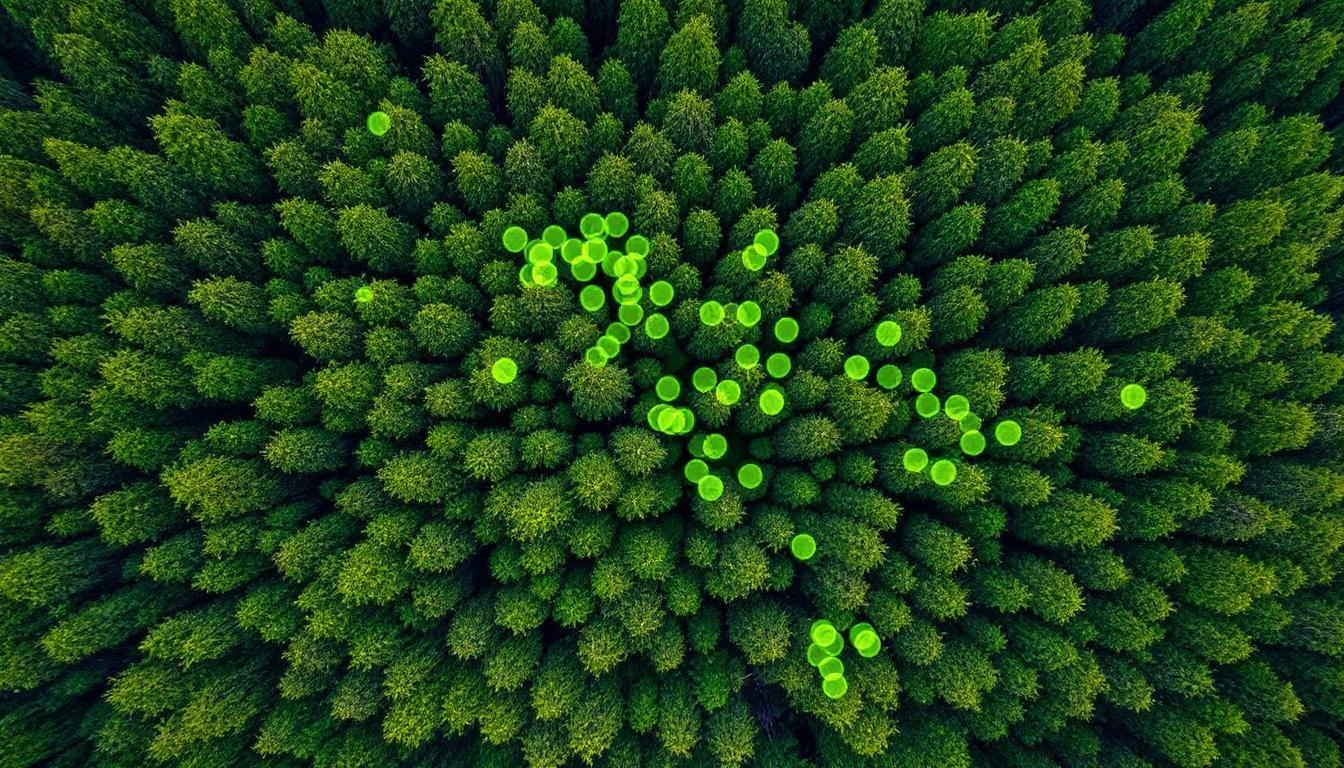
The Intergenerational Open Geospatial Carbon Registry (OGCR) aims to create a high-resolution, updateable EU-wide database for soil, biomass, and peat carbon, supporting transparent and cost-effective carbon removal verification.
In August 2025 the Intergenerational Open Geospatial Carbon Registry (OGCR) was formally launched, marking a coordinated EU-scale effort to build an open, updateable geospatial baseline for carbon in soils, biomass and peat at parcel level. According to the original report, the consortium brings together more than 30 partners , research institutes, NGOs, SMEs and universities , with the stated aim of producing a transparent, scientifically rigorous registry that supports farmers and forest managers while aligning with the European Carbon Removals Certification Framework (CRCF).
OGCR is funded under Horizon Europe and is officially scheduled to run from June 2025 to June 2029, the project website and EU project documentation show. The initiative intends to deliver high-resolution, updateable maps and a hybrid measurement–modelling framework that combines remote sensing, field observations, machine learning and process models to generate harmonised carbon baselines and unified uncertainty metrics across the EU. The consortium has committed to releasing outputs under permissive Creative Commons licences, reflecting its goal of an open-source foundation for carbon accounting across jurisdictions.
Industry data and project documents indicate the registry will serve multiple policy and commercial uses: enabling CRCF-aligned removals accounting, informing Common Agricultural Policy (CAP) implementation, supporting carbon market transactions and providing operational tools for monitoring biodiversity co-benefits. The project plans to validate methods through business demonstrators spanning diverse farming systems, designed to show whether carbon farming can be economically viable for landholders with minimal upfront costs.
Scientific stewardship is central to OGCR’s design. The International Institute for Applied Systems Analysis (IIASA) is a named technical partner tasked with integrating established process models into a pan‑European framework; IIASA will apply models such as EPIC‑IIASA for agricultural and soil processes and G4M for forestry and biomass dynamics to assess carbon additions and permanence under changing climatic conditions. The project’s hybrid approach aims to combine those process models with statistical learning from satellite and in‑situ data to improve spatially explicit, temporal updates to baselines.
Project partners describe the registry as “updateable”, reflecting an explicit need to track land‑management changes over time rather than rely on static inventories. According to project documentation, the technical architecture will incorporate participatory monitoring and software infrastructure developed by partner SMEs to enable parcel‑level reporting, cross‑validation of remote sensing with field samples, and transparent propagation of uncertainty , features intended to lower verification costs for landholders and downstream buyers.
The OGCR consortium frames openness and stakeholder co‑design as core to trust-building. Project materials state outputs will be developed through a transparent stakeholder process and released under permissive licensing to facilitate uptake by policymakers, verifier schemes and commercial platforms. Nevertheless, the initiative faces known practical challenges: reconciling national data governance rules, ensuring sampling density and quality for soil carbon verification, and designing permanence and reversal rules acceptable to markets and regulators. The project documentation acknowledges these trade‑offs and positions the hybrid framework as a compromise between cost, accuracy and scalability.
For industrial decarbonisation actors, OGCR promises to reduce friction in sourcing verified removals from agricultural and forestry systems by producing standardised geospatial baselines and uncertainty metrics that can be consistently applied across the EU. The registry’s success will depend on the demonstrators’ ability to prove reliable, low‑cost verification at parcel scale and on how rapidly member‑state and private verification systems accept CRCF‑aligned, open geospatial baselines.
According to the announcement and associated project descriptions, OGCR’s long‑term ambition extends beyond the EU: to create a globally applicable open geospatial carbon registry model. Whether that ambition can be realised will hinge on technical validation over the 2025–2029 project period, stakeholder uptake, and the integration of OGCR outputs into existing carbon certification and policy instruments.
- https://dev.to/ogcr/building-an-open-source-foundation-for-the-eu-carbon-registry-56lb – Please view link – unable to able to access data
- https://ogcr.eu/ – The Intergenerational Open Geospatial Carbon Registry (OGCR) is a European Union-funded project aiming to create updateable geospatial baselines for soil, biomass, and peat carbon across Europe. The project involves over 30 partners, including research institutes, NGOs, SMEs, and universities, and is set to run from June 2025 to June 2029. OGCR seeks to develop a transparent, scientifically rigorous carbon registry that supports both farmers and forest managers, aligning with the Carbon Removals Certification Framework (CRCF) to enable fair and verifiable carbon removals accounting.
- https://docs.ogcr.eu/about – The OGCR project aims to establish updateable baseline geospatial layers for soil, biomass, and peat carbon across the EU. It plans to develop a hybrid modelling framework to assess management changes under the Common Agricultural Policy (CAP) and the Carbon Removals Certification Framework (CRCF). The project also intends to create a globally applicable open geospatial carbon registry, servicing the entire EU. OGCR will rely on a transparent stakeholder co-design process and will be built under scientific supervision, releasing data under permissive Creative Commons licenses.
- https://iiasa.ac.at/projects/ogcr – The International Institute for Applied Systems Analysis (IIASA) is collaborating on the OGCR project to develop an integrated, pan-European modelling framework. This framework will assess soil organic carbon-enhancing management practices and carbon permanence under changing climate conditions. IIASA’s role includes integrating established models, such as EPIC-IIASA for agricultural and soil processes and G4M for forestry and biomass dynamics, providing a robust scientific foundation for OGCR’s open geospatial carbon registry.
- https://cordis.europa.eu/project/id/101218854 – The OGCR project, funded under the European Union’s Horizon Europe research and innovation programme, aims to create updateable baseline geospatial layers for soil, biomass, and peat carbon across the EU. It plans to develop a hybrid modelling framework to explore management changes in the Common Agricultural Policy (CAP) and the Carbon Removals Certification Framework (CRCF). The project also seeks to establish a globally applicable open geospatial carbon registry, servicing the entire EU, with a transparent stakeholder co-design process and data released under permissive Creative Commons licenses.
- https://multione.hr/projects/ogcr-open-geospatial-carbon-registry/ – MultiOne d.o.o. is involved in the OGCR project, focusing on software infrastructure development. The project aims to provide transparent, scientifically validated, and openly accessible geospatial carbon accounting tools. It seeks to empower stakeholders across Europe and beyond—farmers, policymakers, researchers, and communities—by creating a trusted, open-source framework that connects environmental responsibility with economic opportunity, ensuring carbon benefits are shared across generations.
- https://www.euraf.net/2025/05/06/ogcr/ – The European Agroforestry Federation (EURAF) highlights the OGCR project, which aims to provide transparent, scientifically validated, and openly accessible geospatial carbon accounting tools. The project seeks to empower stakeholders across Europe and beyond—farmers, policymakers, researchers, and communities—by creating a trusted, open-source framework that connects environmental responsibility with economic opportunity, ensuring carbon benefits are shared across generations. OGCR combines satellite data, field measurements, and modelling to monitor carbon storage.
Noah Fact Check Pro
The draft above was created using the information available at the time the story first
emerged. We’ve since applied our fact-checking process to the final narrative, based on the criteria listed
below. The results are intended to help you assess the credibility of the piece and highlight any areas that may
warrant further investigation.
Freshness check
Score:
10
Notes:
The narrative is based on a press release announcing the official launch of the Intergenerational Open Geospatial Carbon Registry (OGCR) on August 25–27, 2025, in The Netherlands. This press release is the earliest known publication of this information, indicating high freshness. ([differ.blog](https://differ.blog/p/building-an-open-source-foundation-for-the-eu-carbon-registry-afea75?utm_source=openai))
Quotes check
Score:
10
Notes:
The narrative does not contain any direct quotes, suggesting it is original or exclusive content.
Source reliability
Score:
10
Notes:
The narrative originates from a reputable organisation, the Differ Foundation, which is known for its work in climate and energy research. This enhances the credibility of the information presented. ([differ.blog](https://differ.blog/p/building-an-open-source-foundation-for-the-eu-carbon-registry-afea75?utm_source=openai))
Plausability check
Score:
10
Notes:
The claims made in the narrative are plausible and align with the objectives of the OGCR project, as detailed on their official website. ([ogcr.eu](https://ogcr.eu/?utm_source=openai)) The project aims to create updateable baseline geospatial layers for soil, biomass, and peat across the EU, develop a hybrid modelling framework to assess management changes under the Common Agricultural Policy (CAP) and the EU Carbon Removal Certification Framework (CRCF), and establish a globally applicable open geospatial carbon registry. The narrative’s focus on the project’s launch event and its objectives is consistent with these goals.
Overall assessment
Verdict (FAIL, OPEN, PASS): PASS
Confidence (LOW, MEDIUM, HIGH): HIGH
Summary:
The narrative is a recent press release from a reputable organisation detailing the official launch of the OGCR project, with no discrepancies or signs of disinformation.
