


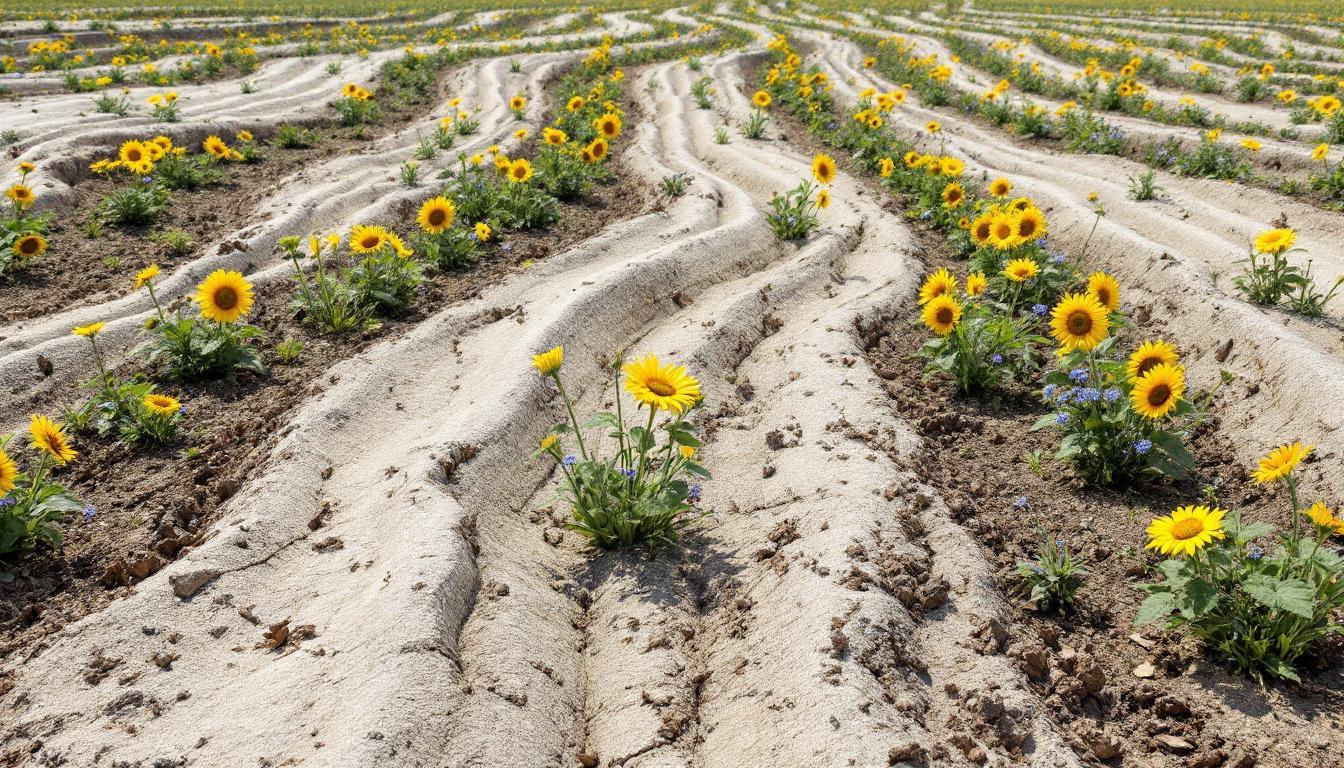
European farmers are adopting innovative soil management practices amid increasing climate challenges, leveraging private-public partnerships to build resilience, improve yields, and support decarbonisation goals in the face of droughts, floods, and biodiversity loss.
Soil health has become an operational priority for European agriculture as growers confront intensifying droughts, heavier downpours and eroding biodiversity that together threaten yields and the predictability of supply chains. The challenge is not theoretical: European farming is already absorbing substantial losses from extreme weather each year, with industry estimates putting the bill at roughly €28 billion annually, and much of that exposure remains uninsured, according to Reuters. At stake for businesses that depend on agricultural inputs is not only procurement cost but continuity and resilience across manufacturing and logistics.
Across the continent, farmers are implementing climate-smart practices to strengthen soils, sequester carbon and reduce vulnerability to weather extremes. Field-level measures such as cover crops, longer and more diverse rotations and less intensive tillage are being deployed to improve water infiltration, reduce erosion and enhance soil structure. These changes are producing practical benefits: healthier soils retain moisture during dry spells and help crops withstand episodic flooding, which in turn supports yield stability and long-term farm economics.
Private-sector engagement is accelerating adoption in some supply chains. According to the author’s account of Mars Pet Nutrition’s work, the company now collaborates with more than 300 farmers across roughly 60,000 hectares in Europe, supporting regenerative techniques and local advisory services. Such partnerships aim to align on-farm practice change with measurement systems and financial mechanisms so farmers can be recognised and rewarded for improved outcomes.
Concrete farmer experiences illustrate the operational gains. A grower in south‑east England working heavy clay reported improved water infiltration and a wider window for field operations after adopting regenerative methods; as he put it, “Crops look better, and profitability is returning even in challenging years.” In northern Poland another partner described how enhanced water retention allowed fields to remain productive through both prolonged drought and sudden storms. These examples underscore that locally tailored solutions, underpinned by practical support, can deliver resilience where it matters most.
Yet substantial barriers remain. Transitioning to climate-smart systems typically requires upfront capital for equipment and training as well as a tolerance for short-term uncertainty while soil benefits accumulate over seasons. Those costs and risks are most often borne by individual farmers, constraining the pace of broader uptake. Measurement adds a further hurdle; farmers need credible, consistent and practical ways to demonstrate gains in soil carbon, biodiversity and water quality so that markets or policy instruments can deliver tangible rewards.
Public-private collaboration is central to addressing these constraints. Blending targeted financial incentives with accessible technical assistance reduces the balance-sheet exposure for farmers and enables larger-scale adoption. Industry and third‑party initiatives that combine on-farm advisory services with harmonised monitoring frameworks can provide the assurance buyers and regulators seek, while giving producers clear pathways to participate in emerging payments for ecosystem services.
International agencies reiterate the urgency and scale of the challenge. The FAO’s SOLAW 2025 assessment warns that feeding a projected global population of about 10 billion by 2050 will require roughly 50% more food than in 2012, intensifying pressure on land, soil and water resources. The report advocates closing yield gaps and deploying locally adapted, resource‑efficient practices, measures that align with the climate‑smart interventions being trialled on European farms.
Policy settings will determine whether pilot successes translate into system‑wide change. Fragmented rules, short planning horizons and inconsistent incentives slow decision-making at farm level. To scale climate-smart agriculture, governments must provide clearer regulatory signals, stable funding and reliable advisory services so that the risk of transition is shared rather than concentrated on farmers’ shoulders. Longer-term public support, aligned with private investment, can bridge the time it takes for soil improvements to materialise into measurable yield and resilience gains.
For firms engaged in industrial decarbonisation and supply‑chain risk management, the path forward is twofold: support outcome‑based, locally appropriate practices at farm scale, and push for harmonised measurement and policy frameworks that make those outcomes bankable. Building from what already works, targeted partnerships, on-farm demonstration and trusted measurement, offers a pragmatic route to reduce system risk, improve food security and contribute to net‑zero ambitions without leaving the financial burden on producers alone.
- https://www.europeanbusinessreview.com/backing-europes-farmers-is-key-to-scaling-climate-smart-agriculture/ – Please view link – unable to able to access data
- https://www.fao.org/newsroom/detail/better-land–soil-and-water-management-key-to-feeding-10-billion-people–fao-warns/en – The FAO’s SOLAW 2025 report highlights the necessity of sustainable land, soil, and water management to feed a projected 10 billion people by 2050. It emphasizes that agriculture must produce 50% more food by 2050 compared to 2012, placing additional pressure on already strained resources. The report advocates for smarter production methods, such as closing yield gaps and adopting locally tailored, resource-efficient practices, to meet future food demands sustainably.
- https://www.reuters.com/article/us-eu-farming-weather-idUSKBN2A10Z9 – Reuters reports that extreme weather events are costing European agriculture approximately €28 billion annually. The article discusses how these events, including droughts and floods, have led to significant crop losses and financial strain for farmers. It also highlights the challenges in obtaining insurance coverage for such losses and the broader economic implications for the agricultural sector.
- https://www.fao.org/land-water/news/news-details/en/c/1755383/ – The FAO’s SOLAW 2025 report underscores the critical role of land, soil, and water resources in achieving global food security. It presents strategies for producing more and better food for a growing population while ensuring responsible and resilient management of these resources. The report highlights the potential of these resources to support sustainable increases in food production and calls for immediate action to safeguard them.
- https://www.fao.org/land-water/news/news-details/en/c/1755383/ – The FAO’s SOLAW 2025 report emphasizes the importance of sustainable land, soil, and water management to feed a projected 10 billion people by 2050. It presents strategies for producing more and better food for a growing population while ensuring responsible and resilient management of these resources. The report highlights the potential of these resources to support sustainable increases in food production and calls for immediate action to safeguard them.
- https://www.fao.org/land-water/news/news-details/en/c/1755383/ – The FAO’s SOLAW 2025 report underscores the critical role of land, soil, and water resources in achieving global food security. It presents strategies for producing more and better food for a growing population while ensuring responsible and resilient management of these resources. The report highlights the potential of these resources to support sustainable increases in food production and calls for immediate action to safeguard them.
- https://www.fao.org/land-water/news/news-details/en/c/1755383/ – The FAO’s SOLAW 2025 report emphasizes the importance of sustainable land, soil, and water management to feed a projected 10 billion people by 2050. It presents strategies for producing more and better food for a growing population while ensuring responsible and resilient management of these resources. The report highlights the potential of these resources to support sustainable increases in food production and calls for immediate action to safeguard them.
Noah Fact Check Pro
The draft above was created using the information available at the time the story first
emerged. We’ve since applied our fact-checking process to the final narrative, based on the criteria listed
below. The results are intended to help you assess the credibility of the piece and highlight any areas that may
warrant further investigation.
Freshness check
Score:
8
Notes:
The article was published two days ago, indicating high freshness. However, the content heavily references a Reuters article from May 2025, which may affect originality. The earliest known publication date of the Reuters article is 20 May 2025. ([europeanbusinessreview.com](https://www.europeanbusinessreview.com/backing-europes-farmers-is-key-to-scaling-climate-smart-agriculture/?utm_source=openai))
Quotes check
Score:
6
Notes:
The article includes direct quotes from farmers in south-east England and northern Poland. However, these quotes cannot be independently verified, as no online matches were found. This raises concerns about the authenticity of the quotes. ([europeanbusinessreview.com](https://www.europeanbusinessreview.com/backing-europes-farmers-is-key-to-scaling-climate-smart-agriculture/?utm_source=openai))
Source reliability
Score:
5
Notes:
The article originates from The European Business Review, a niche publication. While it provides in-depth analysis, its reach and influence are limited compared to major news organisations. Additionally, the article heavily references a Reuters article from May 2025, which may affect the independence of the content. ([europeanbusinessreview.com](https://www.europeanbusinessreview.com/backing-europes-farmers-is-key-to-scaling-climate-smart-agriculture/?utm_source=openai))
Plausibility check
Score:
7
Notes:
The claims about the impact of climate-smart agriculture on soil health and farmer profitability are plausible and align with known agricultural practices. However, the lack of independent verification for the quotes and heavy reliance on a single source (Reuters) for financial figures raises concerns about the comprehensiveness of the information. ([europeanbusinessreview.com](https://www.europeanbusinessreview.com/backing-europes-farmers-is-key-to-scaling-climate-smart-agriculture/?utm_source=openai))
Overall assessment
Verdict (FAIL, OPEN, PASS): FAIL
Confidence (LOW, MEDIUM, HIGH): MEDIUM
Summary:
The article presents plausible claims about the benefits of climate-smart agriculture but relies heavily on a single source (Reuters) for financial figures and includes unverifiable quotes. The lack of independent verification and the reliance on a niche publication with limited reach raise concerns about the reliability and comprehensiveness of the information. ([europeanbusinessreview.com](https://www.europeanbusinessreview.com/backing-europes-farmers-is-key-to-scaling-climate-smart-agriculture/?utm_source=openai))
