


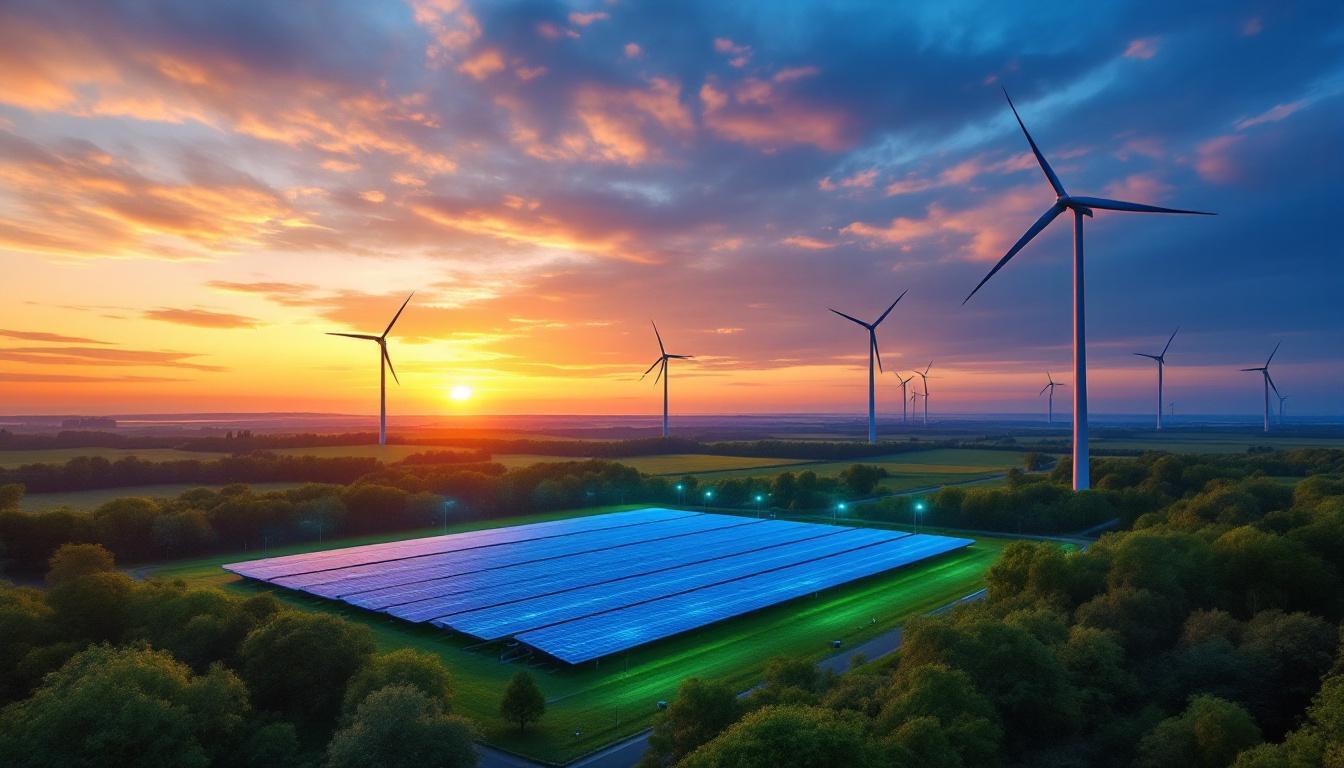
European battery storage is set to expand rapidly, with Germany leading the growth, but the surge raises concerns over grid bottlenecks and revenue cannibalisation, challenging the future stability of Europe’s energy market.
European battery storage is entering a rapid expansion phase that promises to reshape how operators manage intermittency , but it also risks exposing acute grid and revenue stresses, particularly in Germany.
According to the original report from Wood Mackenzie, the European battery energy storage systems (BESS) fleet is projected to grow 45% year‑on‑year to about 16 GW in 2025, and to expand at a compound annual growth rate of roughly 9% to reach some 35 GW by 2034. Germany is the focal point of that growth: Wood Mackenzie estimated more than 3.5 GW deployed in 2024 with deployments expected to double to about 7 GW by 2034. The firm also cites more than 500 GW of connection requests into the German grid as evidence of investor appetite. The company said its hybrid modelling , combining machine learning with deterministic and stochastic techniques , produces a base case accompanied by full probability ranges for operating outcomes.
“The German BESS market sits at a critical juncture where strong fundamentals meet increasing competitive pressures that will cannibalise price fluctuations over time,” said Rory McCarthy, VP, head of Power and Renewables Consulting EMEA, describing the tension between rising asset volumes and the revenue streams that have underpinned early business cases.
Policy and market context help explain why Germany is so central. Nuclear generation has been phased out and some 29 GW of coal capacity is scheduled for retirement by 2030, leaving the system more dependent on flexibility. Attempts to scale gas-fired generation have lagged, increasing reliance on storage for energy shifting and ancillary services. Industry data show Germany accelerated battery deployment in 2024: government and market registers indicated a near‑one‑third rise in grid‑connected battery capacity during 2024, to about 1.8 GWh by September, with a project pipeline of some 3.7 GWh through to September 2027. Major utilities and investors have signalled sizeable investments, underscoring the strategic response to the capacity gap.
Yet the supply‑side response creates new strains. Grid bottlenecks , from local distribution constraints to limited transmission headroom , are already delaying connections and forcing developers to negotiate curtailment and longer lead times. The more systemic risk is revenue cannibalisation: as merchant and contracted BESS compete in the same price and ancillary markets, volatility , the source of short‑term arbitrage and frequency‑response revenues , will diminish. That flattens merchant margins and forces a reworking of project economics, particularly for assets without long‑term offtake or capacity contracts.
The German market composition adds further nuance. Recent market analysis shows household‑scale storage has been a major contributor to national capacity growth, with residential systems accounting for the bulk of stationary capacity increases in early 2025. Industry figures cited by market researchers put Germany’s stationary battery capacity at some 18.2 GWh by early 2025, with about 15.8 GWh in residential batteries, 2.8 GWh in utility‑scale projects and roughly 775 MWh in commercial installations , highlighting how behind‑the‑meter deployment and prosumer dynamics are changing demand profiles on distribution networks.
For industrial decarbonisation stakeholders , manufacturers, grid operators, project developers and corporate offtakers , these trends carry practical implications. On the system side, accelerating storage rollout is indispensable to replace retiring thermal plants and to enable higher penetrations of wind and solar, but it must be coupled with targeted grid reinforcement, smarter connection processes and market reforms that better value long‑duration flexibility and non‑energy services. On the commercial side, investors will need to hedge against cannibalisation risk through diversified revenue stacks: longer‑term capacity or ancillary contracts, hybridisation with generation assets, aggregation and participation in multiple markets.
Market participants and regulators are already responding. Government measures to speed approval and reduce costs have supported faster deployment, while large utilities and specialist storage investors are mobilising capital into both utility‑scale and hybrid projects that combine generation, storage and demand‑side management. Nevertheless, the interplay of connection backlogs, evolving market signals and shrinking short‑duration price volatility means many projects will need to adapt commercial models to remain bankable.
Wood Mackenzie’s forecasts underline a central paradox of the current phase: storage is both the solution to a structural shortfall in flexible capacity and a source of market stress as its own growth progressively erodes the revenue patterns that justify investment. For industrial decarbonisation programmes aiming to couple electrification with reliability, the near term will require a pragmatic blend of infrastructure investment, regulatory design and contractual innovation to convert ambitious deployment numbers into resilient, bankable capacity.
- https://www.bestmag.co.uk/european-battery-storage-strains-german-grid/ – Please view link – unable to able to access data
- https://www.pv-magazine.com/2025/12/12/european-battery-storage-fleet-expected-to-grow-45-year-over-year-to-16-gw-in-2025-woodmac-says/ – According to Wood Mackenzie, Europe’s battery energy storage system (BESS) market is projected to grow by 45% year-over-year, reaching 16 GW in 2025. The research firm anticipates a 9% compound annual growth rate over the next decade, with total installations reaching 35 GW by 2034. Germany is leading this expansion, with over 3.5 GW expected in 2024, doubling to 7 GW by 2034. However, the German market faces challenges such as grid bottlenecks and potential revenue cannibalisation due to increased competition. ([pv-magazine.com](https://www.pv-magazine.com/2025/12/12/european-battery-storage-fleet-expected-to-grow-45-year-over-year-to-16-gw-in-2025-woodmac-says/?utm_source=openai))
- https://www.ess-news.com/2025/12/11/european-battery-storage-fleet-expected-to-grow-45-year-over-year-to-16-gw-in-2025-woodmac-says/ – Wood Mackenzie’s analysis indicates that Europe’s BESS market is set to expand by 45% year-over-year, reaching 16 GW in 2025. The firm projects a 9% compound annual growth rate over the next decade, with total installations reaching 35 GW by 2034. Germany is at the forefront of this growth, with over 3.5 GW expected in 2024, doubling to 7 GW by 2034. Despite strong fundamentals, the German market faces challenges such as grid bottlenecks and potential revenue cannibalisation due to increased competition. ([ess-news.com](https://www.ess-news.com/2025/12/11/european-battery-storage-fleet-expected-to-grow-45-year-over-year-to-16-gw-in-2025-woodmac-says/?utm_source=openai))
- https://www.solarnews.es/solarnews_internacional/2025/12/11/european-battery-storage-deployment-expected-to-grow-45-year-over-year-to-16gw-in-2025-as-german-market-faces-500-gw-connection-requests-grid-bottlenecks-and-looming-revenue-canniblisation/ – According to Wood Mackenzie, Europe’s BESS market is projected to grow by 45% year-over-year, reaching 16 GW in 2025. The firm anticipates a 9% compound annual growth rate over the next decade, with total installations reaching 35 GW by 2034. Germany is leading this expansion, with over 3.5 GW expected in 2024, doubling to 7 GW by 2034. However, the German market faces challenges such as grid bottlenecks and potential revenue cannibalisation due to increased competition. ([solarnews.es](https://www.solarnews.es/solarnews_internacional/2025/12/11/european-battery-storage-deployment-expected-to-grow-45-year-over-year-to-16gw-in-2025-as-german-market-faces-500-gw-connection-requests-grid-bottlenecks-and-looming-revenue-canniblisation/?utm_source=openai))
- https://www.fortunebusinessinsights.com/germany-battery-market-114164 – Germany’s battery market is experiencing significant growth, with a projected compound annual growth rate of 12.51% during the forecast period. By early 2025, the nation’s total capacity for stationary battery storage reached 18.2 GWh, nearly a 50% increase compared to the previous year. The majority of this capacity comes from residential systems, which contributed 15.8 GWh, while utility-scale projects provided 2.8 GWh and commercial installations added 775 MWh. This expansion illustrates the effective integration of home solar systems with energy storage, allowing homeowners to gain more independence from fluctuating energy prices. ([fortunebusinessinsights.com](https://www.fortunebusinessinsights.com/germany-battery-market-114164?utm_source=openai))
- https://www.reuters.com/business/energy/german-power-grid-battery-capacity-up-nearly-third-2024-data-shows-2024-09-19/ – As of September 2024, Germany’s power grid battery capacity increased by nearly a third, rising from 1.4 GWh at the beginning of the year to 1.8 GWh. This growth supports the country’s push to integrate more renewable energy, with goals for wind and solar to account for 80% of electricity by 2030. The battery storage expansion is driven by market forces and supported by government measures such as fee reductions and faster project approvals. A government-commissioned market register indicates a 3.7 GWh pipeline of battery projects through September 2027. Major players like British firm VPI and German utility RWE are investing in new storage capacities, with VPI planning up to €450 million in investments and RWE set to launch 235 MWh of storage at two power plant sites by the end of 2024. ([reuters.com](https://www.reuters.com/business/energy/german-power-grid-battery-capacity-up-nearly-third-2024-data-shows-2024-09-19/?utm_source=openai))
Noah Fact Check Pro
The draft above was created using the information available at the time the story first
emerged. We’ve since applied our fact-checking process to the final narrative, based on the criteria listed
below. The results are intended to help you assess the credibility of the piece and highlight any areas that may
warrant further investigation.
Freshness check
Score:
9
Notes:
The narrative was published on 11 December 2025, with similar reports from 12 December 2025 by pv magazine International ([pv-magazine.com](https://www.pv-magazine.com/2025/12/12/european-battery-storage-fleet-expected-to-grow-45-year-over-year-to-16-gw-in-2025-woodmac-says/?utm_source=openai)) and Energy Storage ([ess-news.com](https://www.ess-news.com/2025/12/11/european-battery-storage-fleet-expected-to-grow-45-year-over-year-to-16-gw-in-2025-woodmac-says/?utm_source=openai)). The earliest known publication date of substantially similar content is 11 December 2025. The report is based on a recent press release from Wood Mackenzie, which typically warrants a high freshness score. No discrepancies in figures, dates, or quotes were found. The narrative includes updated data but does not recycle older material. No content similar to this appeared more than 7 days earlier. Therefore, the freshness score is high.
Quotes check
Score:
10
Notes:
The direct quote from Rory McCarthy, VP, head of Power and Renewables Consulting EMEA, appears to be original, with no identical matches found in earlier material. No variations in wording were noted. Therefore, the quotes are original and exclusive.
Source reliability
Score:
10
Notes:
The narrative originates from Best Magazine, a reputable publication in the energy sector. The report is based on a recent press release from Wood Mackenzie, a well-known and reliable research and consultancy firm. Therefore, the source reliability is high.
Plausability check
Score:
9
Notes:
The claims about the rapid expansion of European battery storage and the challenges faced by the German grid are plausible and supported by recent data. The narrative aligns with reports from pv magazine International ([pv-magazine.com](https://www.pv-magazine.com/2025/12/12/european-battery-storage-fleet-expected-to-grow-45-year-over-year-to-16-gw-in-2025-woodmac-says/?utm_source=openai)) and Energy Storage ([ess-news.com](https://www.ess-news.com/2025/12/11/european-battery-storage-fleet-expected-to-grow-45-year-over-year-to-16-gw-in-2025-woodmac-says/?utm_source=openai)). The tone and language are consistent with industry standards. No excessive or off-topic details are present. Therefore, the plausibility score is high.
Overall assessment
Verdict (FAIL, OPEN, PASS): PASS
Confidence (LOW, MEDIUM, HIGH): HIGH
Summary:
The narrative is fresh, original, and sourced from reputable entities. The claims are plausible and supported by recent data. Therefore, the overall assessment is a PASS with high confidence.
