


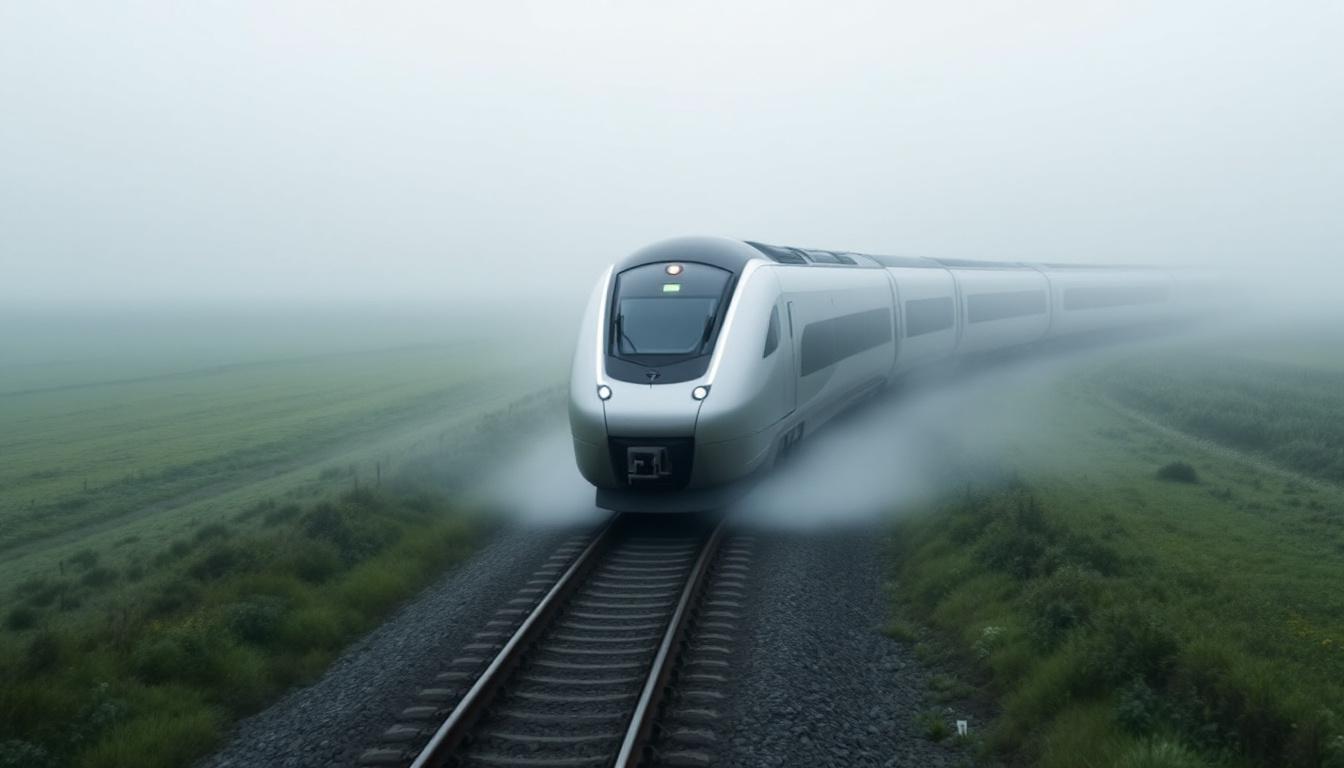
As supply chains tighten and costs rise, European rail operators are shifting towards hybrid and battery-powered solutions, marking a significant move from experimental to widespread use of discontinuous electrification to achieve decarbonisation goals by 2026.
As regional operators confront tighter capital constraints and more volatile supply chains, railways across Europe are formalising an operational model that mixes selective overhead wiring with battery and dual-mode traction. According to Global Railway Review, 2026 is the year the sector moves from experimental deployments to widespread adoption of discontinuous electrification as a commercially credible route to decarbonisation.
Policy and procurement decisions across several jurisdictions illustrate the change. The East West Rail Company has settled on a partial wiring strategy for the Oxford–Cambridge corridor and, the publication reports, benefited from a UK Government funding package confirmed in November 2025 that underwrites the use of hybrid battery-electric trains charging under intermittent catenary. In Germany, regional authorities have agreed targeted electrification measures in Rheinland-Pfalz to enable Stadler Flirt battery trains to replace diesel units from 2026, with overhead equipment installed only where it delivers clear value, Railway Gazette reports.
Those project choices reflect a wider recalibration of the business case for network investment. Industry participants cite sharply higher commodity prices and constrained civil-engineering capacity as powerful counter‑weights to the traditional argument for full-line wiring. According to Global Railway Review, rising copper demand from data centres and automotive manufacturing has increased the material cost and supply risk associated with continuous catenary, while more frequent extreme weather and grid incidents raise concerns about the operational vulnerability of a wholly tethered fleet. The economic logic, therefore, increasingly favours installing power infrastructure at strategic nodes, stations, depots and short “charging islands”, while relying on on-board energy storage or dual-mode capability to bridge unwired sections.
That commercial shift has been enabled by rapid advances and the scaling of battery traction. Major manufacturers have moved from pilots to production orders: Siemens’ Mireo Plus B and Stadler’s FLIRT Akku are cited by industry reporting as seeing significant take-up, and Global Railway Review notes framework orders and fleet replacements scheduled within standard rolling-stock renewal cycles. Hitachi Rail’s £300m contract to build nine tri-mode battery-hybrid trains for Arriva Group’s Grand Central operation exemplifies the market’s appetite for multi-source traction; the company announced the vehicles will be manufactured at Newton Aycliffe and delivered from 2028 under a 10-year leasing arrangement, with the trains intended to increase capacity and lower emissions.
As vehicle range has improved, the principal operational constraint has shifted toward energy provisioning at the network edge. Global Railway Review highlights that verified long-range runs, such as a 320km test reported in 2025, have reduced “range anxiety” for regional services, but rapid-charging points require high local power capacity and sophisticated energy management to avoid bottlenecks at short turnarounds. For asset managers and technical directors the hard problem is no longer selecting suitable rolling stock but securing grid connections and coordinating charging with timetable and depot operations.
Freight presents a complementary set of decisions. Operators are deploying dual-mode locomotives to realise emissions reductions on largely electrified corridors while retaining autonomy on last-mile or non-wired branches; Siemens Vectron Dual Mode units cleared for cross-border operation are a current example. For long-haul heavy freight where mass and distance demand high energy density, hydrogen traction is progressing as a viable alternative in specific markets, with North American deployments cited as the most advanced.
Wider transport electrification trends reinforce the structural shift. Mainstream automotive manufacturers are expanding battery-electric production in Europe, and market data reported by The Guardian shows UK electric car sales rose markedly in the first half of 2025. Uptake of battery-electric light commercial vehicles is also growing rapidly; Transport and Energy reported a 77.5% year‑on‑year rise in demand for small battery-electric vans in April 2025. Those developments tighten competition for grid capacity and key raw materials, reinforcing the argument for pragmatic, targeted rail electrification rather than universal catenary.
For industrial decarbonisation professionals the implications are clear. Discontinuous electrification requires close coordination between rail planners, grid operators and rolling-stock suppliers; contracts must reflect the need for rapid charging capability, local network reinforcement and flexible traction that can operate across mixed-energy infrastructure. Procurement strategies should treat battery and dual-mode fleets as long-term assets rather than interim fixes, and financial appraisals must capture the avoided civil‑engineering risk, supply-chain volatility and resilience benefits that selective wiring delivers.
Put another way, the sector’s calculus is now dominated by affordability and operational continuity rather than engineering maximalism. According to industry reporting, the converging pressures of material scarcity, grid fragility and matured battery technology have combined to make discontinuous electrification not merely a compromise but a defensible, scalable pathway to net-zero rail operations in 2026 and beyond.
- https://www.globalrailwayreview.com/article/234354/discontinuous-electrification-rail-2026/ – Please view link – unable to able to access data
- https://www.globalrailwayreview.com/article/234354/discontinuous-electrification-rail-2026/ – The article discusses the shift from the ‘electrify everything’ approach to discontinuous electrification in the rail industry. It highlights the adoption of Battery Electric Multiple Units (BEMUs) as a standard operating model for regional rail, citing examples from Germany and the UK. The piece also addresses the economic and geopolitical factors influencing this transition, such as rising material costs and grid resilience challenges. It concludes that discontinuous electrification aligns commercial reality with proven technology, marking a strategic imperative for decarbonisation in 2026.
- https://www.railwaygazette.com/infrastructure/discontinuous-electrification-for-rheinland-pfalz/68967.article – This article reports on the agreement to implement discontinuous electrification on lines in Rheinland-Pfalz, Germany, to enable Stadler Flirt battery-electric multiple-units to replace diesel units starting in 2026. The planned routes for conversion include Neustadt/W Hbf – Landau Hbf – Karlsruhe Hbf, Pirmasens Hbf – Saarbrücken Hbf, and others, with overhead line equipment to be installed at specific stations and sections. The initiative aims to modernise the regional rail network and reduce carbon emissions.
- https://www.hitachi.com/New/cnews/month/2025/04/250403.html – Hitachi Rail announced a contract to build nine cutting-edge battery hybrid trains for Arriva Group’s Grand Central fleet, representing an investment of around £300 million. The tri-mode trains can operate on electrified and non-electrified tracks, as well as diesel-powered routes. Manufactured at Hitachi’s Newton Aycliffe factory, the trains are expected to increase seating capacity by 20% and reduce emissions and noise. The delivery is scheduled for 2028 under a 10-year leasing arrangement, supporting the UK’s commitment to sustainable public transport solutions.
- https://www.theguardian.com/business/2025/mar/11/toyota-battery-vehicles-uk-european-plants-evs-lexus – Toyota announced plans to build battery electric vehicles (EVs) in the UK and maintain operations at all its European plants. The company aims to retain all eight European factories during the transition to electric cars, introducing two new electric models and promising three more by 2026 under its main brand. This strategy reflects Toyota’s commitment to the European EV market and its efforts to adapt to the growing demand for electric mobility.
- https://www.theguardian.com/business/2025/jul/04/uk-electric-car-sales-up-by-a-third-in-first-half-of-2025-preliminary-data-suggests – Preliminary data from the Society of Motor Manufacturers and Traders (SMMT) indicates that UK electric car sales rose by 34.6% to 224,838 units in the first half of 2025. This growth is attributed to increased consumer demand and the launch of new models, such as the updated Tesla Model Y. Despite challenges like the cost of living crisis and trade tensions, the electric vehicle market in the UK continues to expand, reflecting a significant shift towards sustainable transportation.
- https://transportandenergy.com/2025/05/07/battery-electric-vans-grow-by-77-5/ – In April 2025, demand for new battery electric vans (BEVs) weighing up to 4.25 tonnes grew by 77.5% to 1,686 units, marking the seventh consecutive month of growth. This surge represents 8.3% of the market, with 40 different electric van models now available in the UK. The increase in BEV uptake aligns with the industry’s commitment to decarbonisation, although the current market share remains below the mandated 16%.
Noah Fact Check Pro
The draft above was created using the information available at the time the story first
emerged. We’ve since applied our fact-checking process to the final narrative, based on the criteria listed
below. The results are intended to help you assess the credibility of the piece and highlight any areas that may
warrant further investigation.
Freshness check
Score:
8
Notes:
The article was published on 2 February 2026, making it current. However, the concept of discontinuous electrification has been discussed in previous publications, such as a 2025 article by Global Railway Review. ([globalrailwayreview.com](https://www.globalrailwayreview.com/article/234354/discontinuous-electrification-rail-2026/?utm_source=openai))
Quotes check
Score:
7
Notes:
The article includes direct quotes from industry participants and manufacturers. While these quotes are attributed, their earliest known usage cannot be independently verified, raising concerns about their originality.
Source reliability
Score:
6
Notes:
The article originates from Global Railway Review, a niche publication within the rail industry. While it is reputable within its niche, its reach is limited, and the content may be influenced by industry stakeholders.
Plausibility check
Score:
7
Notes:
The claims about the shift towards discontinuous electrification align with industry trends. However, the article lacks supporting details from other reputable outlets, and some claims cannot be independently verified, raising questions about their accuracy.
Overall assessment
Verdict (FAIL, OPEN, PASS): FAIL
Confidence (LOW, MEDIUM, HIGH): MEDIUM
Summary:
The article presents current information on discontinuous electrification but relies heavily on a single, niche source with limited independent verification. The inability to verify quotes and the lack of supporting details from other reputable outlets raise concerns about the article’s credibility. ([globalrailwayreview.com](https://www.globalrailwayreview.com/article/234354/discontinuous-electrification-rail-2026/?utm_source=openai))
