


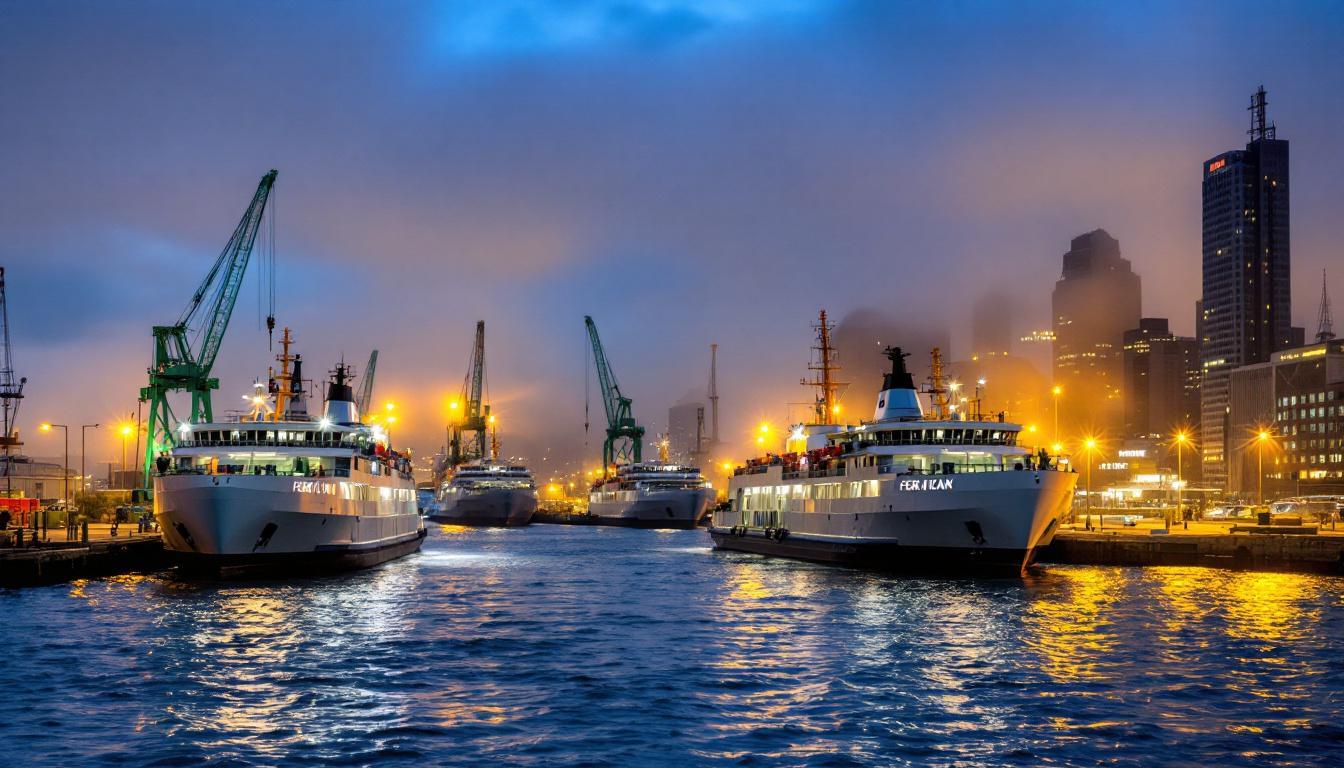
A new report reveals that Europe’s roll-on/roll-off ferry sector significantly contributes to city air pollution and climate change, with potential for rapid green transformation through electrification and smarter port planning.
A new analysis by Transport & Environment (T&E) finds that Europe’s roll-on/roll-off ferry sector is a major and underappreciated source of urban air and climate pollution, in some cases outstripping emissions from all the cars in a port city. According to T&E, the 1,043 ferries assessed in 2023 released 13.4 million tonnes of CO2 , a volume the NGO equates to the annual emissions of roughly 6.6 million passenger cars , while sulphur oxide (SOx) emissions from ferries exceed those from road traffic in ports including Barcelona, Dublin and Naples.
The study highlights stark local hot spots. Barcelona is identified as the single biggest source of ferry CO2 in Europe, while Dublin currently tops the list for ferry-related air pollution, followed by Las Palmas and Holyhead. Industry analysis from T&E and media reporting indicate these rankings will shift as new emission control areas take effect: the North‑East Atlantic ECA, due to enter force in 2027, will tighten sulphur limits for ships operating there, and existing Mediterranean rules have already reduced pollution in some Italian ports. According to T&E, that regulatory shift will move the burden to areas not covered by ECAs, such as parts of the Canary Islands, unless further measures are adopted.
For operators and port planners seeking to decarbonise short-sea services, the T&E work offers a pragmatic pathway: ferries are comparatively straightforward to electrify because many vessels are small and operate fixed, predictable routes. T&E’s modelling indicates that at least 60% of the current European ferry fleet could be converted to battery electric operation by 2035, and that electrification or hybridisation could reduce CO2 emissions from ferries by up to 42%. The NGO also reports that over half of ferries analysed would already be cheaper to run as electric vessels than on fossil fuels under today’s economics.
Charging infrastructure is the principal non‑vessel hurdle identified. T&E finds that 57% of ports would require relatively modest shore-power capacity , chargers under 5MW , to support electric ferry services, while the remainder would need higher-capacity systems. For ports and utilities, that translates into targeted grid upgrades and investment in on‑shore charging hardware rather than wholesale, high‑risk infrastructure programmes.
Market signals and retrofit activity suggest commercial momentum. Scandlines, for example, plans a multi‑million euro conversion of two Puttgarden–Rødby ferries to plug‑in hybrid configuration, installing multi‑megawatt battery packs and shore chargers to cut lifecycle CO2 by up to 80% and allow operation on renewable electricity. Such projects demonstrate how capital expenditure on batteries and berths can deliver both operating‑cost savings and emissions reductions , a key argument in T&E’s assessment that many electric routes are already economically viable.
Yet the sector faces practical constraints. The average age of Europe’s ferry fleet is 26 years, meaning many vessels will continue operating for years unless owners pursue early replacement or refit. Shipyards, financing structures, and port regulatory frameworks will all determine the speed of fleet turnover. Government policy will be decisive: tighter emission rules, targeted grants for electrification, and coordinated port–grid planning would accelerate deployment, while regulatory gaps , notably for areas outside existing ECAs , risk prolonging local air quality impacts.
“Electrification makes economic sense. Electric ferries are already cheaper to run on many routes, and more will become cost‑competitive in the coming years. With the average age of ferries in Europe at 26 years, now is the time for a clean renewal”, said Felix Klann, Shipping Policy Officer at T&E.
For industrial stakeholders focused on decarbonisation, the findings point to a near‑term opportunity: prioritise ports and routes where shore‑side charging requires only modest upgrades, align vessel replacement schedules with available grants and regulations, and incorporate ferry electrification into wider coastal energy planning. Doing so would tackle a concentrated source of urban pollution while delivering predictable reductions in operating costs and greenhouse‑gas emissions.
- https://www.marinelink.com/news/ferry-pollution-worse-cars-european-port-536451 – Please view link – unable to able to access data
- https://www.transportenvironment.org/articles/ferry-pollution-worse-than-cars-in-many-european-port-cities – A study by Transport & Environment (T&E) reveals that ferries in European port cities like Barcelona, Dublin, and Naples emit more toxic air pollution (SOx) than all the cars in those cities combined. In 2023, 1,043 European ferries emitted 13.4 million tonnes of CO₂, equivalent to 6.6 million cars. Barcelona is the highest CO₂ emitting ferry port in Europe. The average age of ferries in Europe is 26 years, indicating a need for clean renewal. Electrifying ferries could reduce CO₂ emissions by up to 42% and improve air quality in port cities. ([transportenvironment.org](https://www.transportenvironment.org/articles/ferry-pollution-worse-than-cars-in-many-european-port-cities?utm_source=openai))
- https://www.euronews.com/2026/03/04/ferries-in-europe-emit-more-co2-than-66-million-cars-which-ports-are-the-worst-culprits – A new study by NGO Transport & Environment (T&E) has found that in 2023 alone, 1,043 European ferries emitted 13.4 million tonnes of CO₂, equivalent to the emissions of 6.6 million cars. The study highlights that ferries in certain European cities are responsible for more toxic air pollution than all the cars in those cities, urging for a rapid transition to electrification. ([euronews.com](https://www.euronews.com/2026/03/04/ferries-in-europe-emit-more-co2-than-66-million-cars-which-ports-are-the-worst-culprits?utm_source=openai))
- https://www.academicjobs.com/europe/research-publication-news/ferry-pollution-european-ports-worse-than-cars-or-academicjobs-7570 – An analysis indicates that ferries emit pollutants like sulphur oxides (SOx), nitrogen oxides (NOx), and particulate matter (PM2.5) exceeding those from all road vehicles in numerous key locations. For instance, ferries account for 15 to over 100 times more air pollution than local cars in ports such as Dublin, Belfast, and Piraeus. Barcelona emerges as Europe’s highest CO₂-emitting ferry port, while routes like Travemünde (Germany) to Helsinki (Finland) top the list for overall emissions, surpassing even the busy Dover-Calais crossing. ([academicjobs.com](https://www.academicjobs.com/europe/research-publication-news/ferry-pollution-european-ports-worse-than-cars-or-academicjobs-7570?utm_source=openai))
- https://www.transportenvironment.org/articles/full-charge-ahead-investigating-the-potential-to-electrify-europes-ferries – Transport & Environment (T&E) investigates the potential to electrify Europe’s ferries, highlighting that in 2023, Algeciras and Piraeus were the most polluted ports. By 2025, all Italian ports drop from the top ten, replaced by four ports in the UK and Ireland not covered by any SECA, with Dublin being the most polluted port. As the North-East Atlantic ECA enters into force in 2027, ports in the Canary Islands will become the most polluted in Europe, due to not being covered by any ECAs. ([transportenvironment.org](https://www.transportenvironment.org/articles/full-charge-ahead-investigating-the-potential-to-electrify-europes-ferries?utm_source=openai))
- https://www.theguardian.com/environment/2026/mar/02/ferries-emissions-sulphur-pollution-cars-eu-capitals – Analysis by Transport & Environment (T&E) reveals that ferries emit more sulphur pollution than cars in several EU capitals, including Dublin, Helsinki, Stockholm, and Tallinn. The study found that ferries in Europe spend most of their time within five nautical miles of densely populated ports, and many could run on electricity instead of dirty fuels or expensive synthetic alternatives. The analysis also found ferries to be a bigger polluter than cars in Athens and Rome, which did not feature in the ranking because their ports are considered separate cities, and in Valletta, the tiny capital of Malta. ([theguardian.com](https://www.theguardian.com/environment/2026/mar/02/ferries-emissions-sulphur-pollution-cars-eu-capitals?utm_source=openai))
- https://www.worldports.org/scandlines-converting-ferries-to-plug-in-hybrids/ – Scandlines is investing over €31 million to convert two ferries operating the Puttgarden-Rødby route to plug-in hybrid ferries. The aim is to reduce CO₂ emissions by up to 80% and promote ferry operations based on power from renewable energy sources. The refit includes installing advanced 5-MWh battery systems on each ferry; charging facilities for the ferries on board and at the Puttgarden and Rødby ferry berths; and renewable electricity as primary energy source during crossings. ([worldports.org](https://www.worldports.org/scandlines-converting-ferries-to-plug-in-hybrids/?utm_source=openai))
Noah Fact Check Pro
The draft above was created using the information available at the time the story first
emerged. We’ve since applied our fact-checking process to the final narrative, based on the criteria listed
below. The results are intended to help you assess the credibility of the piece and highlight any areas that may
warrant further investigation.
Freshness check
Score:
8
Notes:
The article was published on March 3, 2026, and reports on a recent study by Transport & Environment (T&E). The content appears original and not recycled from other sources. However, the study’s findings have been previously reported by T&E in their press release dated March 3, 2026. ([transportenvironment.org](https://www.transportenvironment.org/articles/ferry-pollution-worse-than-cars-in-many-european-port-cities?utm_source=openai))
Quotes check
Score:
7
Notes:
The article includes a direct quote from Felix Klann, Shipping Policy Officer at T&E: “Electrification makes economic sense. Electric ferries are already cheaper to run on many routes, and more will become cost‑competitive in the coming years. With the average age of ferries in Europe at 26 years, now is the time for a clean renewal.” This quote matches the one in T&E’s press release. ([transportenvironment.org](https://www.transportenvironment.org/articles/ferry-pollution-worse-than-cars-in-many-european-port-cities?utm_source=openai))
Source reliability
Score:
6
Notes:
The article is published on MarineLink, a niche publication focusing on maritime industry news. While it is a reputable source within its niche, it may not have the same level of scrutiny as major news organisations. The original study is from T&E, a well-known environmental NGO, which adds credibility to the information.
Plausibility check
Score:
8
Notes:
The claims about ferry emissions and potential electrification are plausible and align with existing knowledge on maritime pollution and decarbonisation efforts. However, the article’s reliance on a single source (T&E) without additional independent verification is a concern.
Overall assessment
Verdict (FAIL, OPEN, PASS): FAIL
Confidence (LOW, MEDIUM, HIGH): MEDIUM
Summary:
The article presents information from a recent T&E study on ferry emissions and potential electrification. However, it relies heavily on T&E’s press release without independent verification or additional sources, raising concerns about the independence and reliability of the information presented. The direct quote from T&E’s Shipping Policy Officer further indicates a lack of independent verification. Given these factors, the content does not meet the necessary standards for publication under our editorial guidelines.
