


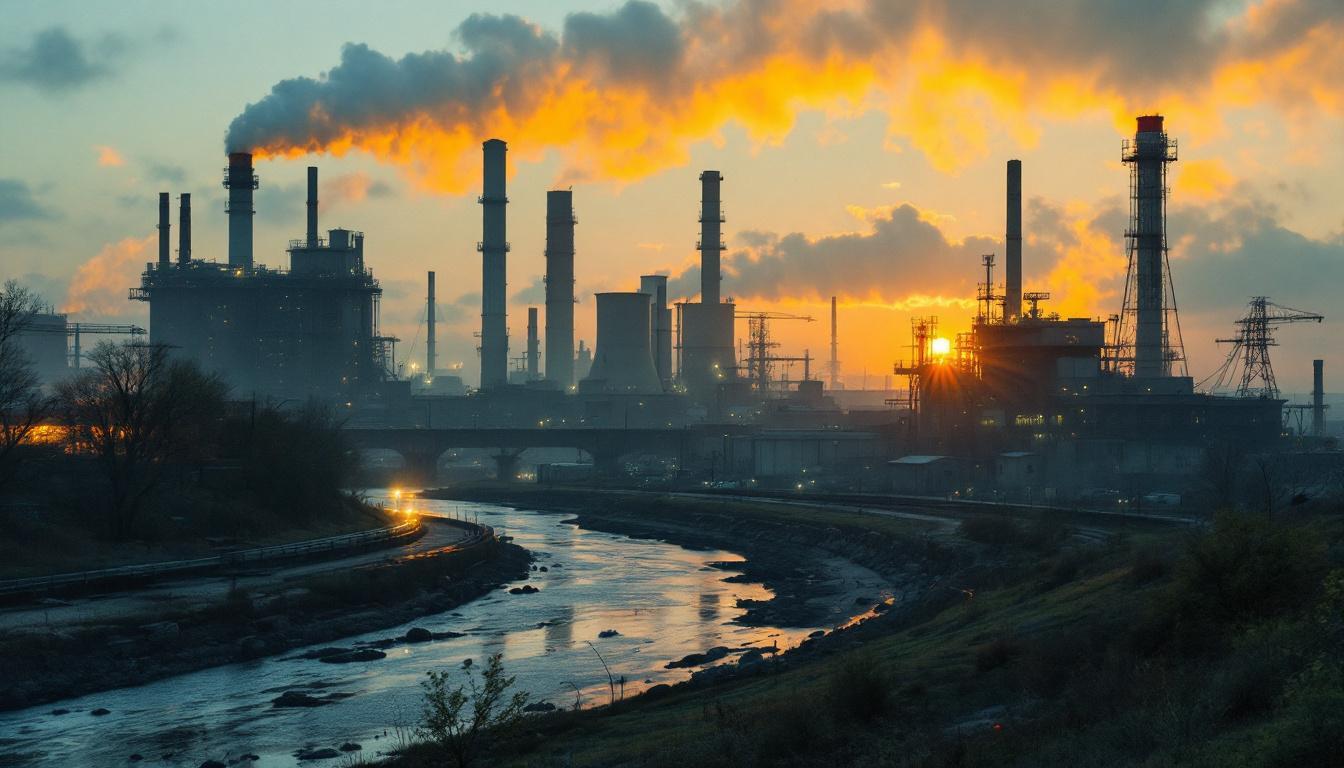
Despite significant progress in reducing emissions since 2000, European industrial sectors face a slowing momentum and mounting societal costs. A new briefing highlights the need for transformative reforms in manufacturing processes to further cut pollution and enhance economic resilience.
Emissions from Europe’s most energy-intensive manufacturing sectors have fallen substantially since the turn of the century, but momentum has slowed and the societal price of pollution remains large, according to a new briefing by the European Environment Agency. The analysis argues that deeper restructuring of industrial processes , not only incremental technology upgrades , will be necessary to push emissions and air pollutants down further while protecting competitiveness.
According to the EEA briefing, energy-hungry sectors such as iron and steel, cement and lime, aluminium, pulp and paper, glass and ceramics, and chemicals still generate roughly 27% of industrial greenhouse gas emissions in the EU and account for a major share of emissions of sulphur oxides and nitrogen oxides. Over the past two decades greenhouse gas emissions from these industries declined by about 42%, with marked falls in several air pollutants , dioxins by 63%, nickel by 64% and NOx by 55% , yet the briefing calculates external health and environmental costs at approximately €73 billion a year.
The EEA notes that stronger reductions recorded after 2020 coincided with a downturn in these sectors’ gross value added, signalling that structural economic shifts have contributed alongside cleaner processes. Industry’s energy intensity also left firms exposed during the EU energy crisis; the briefing highlights that electricity prices in the bloc have been two to four times higher than those facing major trading rivals, compounding competitiveness pressures amid weak demand and global overcapacity in markets such as steel.
To secure further gains the EEA calls for full application of existing EU environmental and climate rules and for more transformative changes in production pathways. It identifies a cluster of strategic approaches , electrification of heat and processes, switching to alternative feedstocks, and increasing the use of secondary raw materials , that deliver co-benefits for climate mitigation, pollution prevention and resource efficiency. The briefing warns, however, that different pathways may create trade-offs between environmental objectives and therefore require tailored, sector-specific planning.
Complementary research from the European Commission’s Joint Research Centre suggests the scale of the opportunity: adopting circular-economy measures in heavy industry could lower greenhouse gas emissions by an estimated 189–231 million tonnes of CO2 equivalent annually, while also reducing dependence on imported energy and raw materials. Such shifts, the JRC argues, would bolster both decarbonisation and the EU’s economic resilience.
The EEA recommends that policy-makers embed an integrated perspective when prioritising investments, shaping permit regimes, and setting procurement and product standards , for example for low-emission steel , so that funding and regulation favour interventions that reduce emissions and limit health impacts at the lowest cost. It also places the analysis within the EU’s Clean Industrial Deal, which aims to accelerate structural change while sustaining industrial competitiveness.
For business leaders and investors in industrial decarbonisation, the briefing underscores a twin imperative: accelerate deployment of low-carbon technologies and circular practices, and ensure regulatory and financial frameworks align to lower the total societal burden of pollution. The EEA’s evidence suggests that without more fundamental transformation, gains to date risk plateauing and the significant external costs associated with industrial pollution will persist.
- https://europeantimes.news/2026/02/industrial-transformation-key-to-cutting-emissions-and-pollution-further-in-europes-energy-intensive-industries-press-releases/ – Please view link – unable to able to access data
- https://www.eea.europa.eu/en/newsroom/news/industrial-transformation-key-to-cutting-emissions-and-pollution-further-in-europes-energy-intensive-industries – The European Environment Agency (EEA) reports that emissions from Europe’s energy-intensive industries have significantly decreased over the past two decades. However, progress has stalled, and the health-related costs of pollution remain high. The EEA’s briefing, ‘Zero pollution, decarbonisation and circular economy in energy-intensive industries’, analyses long-term trends in greenhouse gas and air pollutant emissions, projected reductions, and outlines pathways for further progress. Energy-intensive industries account for around 27% of EU industrial greenhouse gas emissions and a large share of key air pollutants, including sulphur oxides (SOx) and nitrogen oxides (NOx). Despite progress, the external costs of pollution from these industries remain high, at around €73 billion per year. Supporting transformation in these sectors towards decarbonisation, pollution prevention, and circularity would offer multiple benefits for the climate, environment, and public health, strengthening the EU’s overall competitiveness by reducing societal costs.
- https://www.eea.europa.eu/en/analysis/publications/zero-pollution-decarbonisation-and-circular-economy-in-energy-intensive-industries – The EEA’s briefing, ‘Zero pollution, decarbonisation and circular economy in energy-intensive industries’, analyses long-term trends in greenhouse gas and air pollutant emissions, projected reductions, and outlines pathways for further progress. Energy-intensive industries account for around 27% of EU industrial greenhouse gas emissions and a large share of key air pollutants, including sulphur oxides (SOx) and nitrogen oxides (NOx). Despite progress, the external costs of pollution from these industries remain high, at around €73 billion per year. Supporting transformation in these sectors towards decarbonisation, pollution prevention, and circularity would offer multiple benefits for the climate, environment, and public health, strengthening the EU’s overall competitiveness by reducing societal costs.
- https://joint-research-centre.ec.europa.eu/jrc-news-and-updates/circular-economy-could-slash-231-million-tonnes-co2-heavy-industry-year-2025-10-03_en – A report from the European Commission’s Joint Research Centre indicates that implementing circular economy practices in energy-intensive industries could significantly reduce greenhouse gas emissions. Sectors such as steel, aluminium, cement, and concrete, which currently account for nearly 15% of the EU’s total emissions, could see reductions of between 189 and 231 million tonnes of CO₂ equivalent per year. This approach not only contributes to climate mitigation but also enhances the EU’s energy and economic security by reducing import dependency.
- https://www.eea.europa.eu/en/analysis/publications/zero-pollution-decarbonisation-and-circular-economy-in-energy-intensive-industries/co2eq-and-other-pollutants-emissions – The EEA’s briefing provides data on CO₂ equivalent and other pollutant emissions by energy-intensive industries as a percentage of industry total for the EU-27. This information is compared to emissions from the ‘Energy supply’ sector, offering insights into the environmental impact of various industrial activities. The data highlights the significant contribution of energy-intensive industries to overall emissions and underscores the need for targeted measures to reduce their environmental footprint.
- https://www.eea.europa.eu/en/analysis/publications/zero-pollution-decarbonisation-and-circular-economy-in-energy-intensive-industries/historical-gva-ghg-and-air – The EEA’s briefing presents indexed trends for greenhouse gas emissions (GHG, CO₂e) and four pollutants across six energy-intensive sectors, alongside indexed Gross Value Added (GVA) for contextualisation. The data includes emissions from auto-generation of energy and process emissions, excluding upstream emissions from energy purchased elsewhere and downstream emissions, including from transport and handling of goods. This comprehensive analysis provides insights into the relationship between industrial output and environmental impact over time.
- https://www.eea.europa.eu/en/analysis/publications/zero-pollution-decarbonisation-and-circular-economy-in-energy-intensive-industries – The EEA’s briefing, ‘Zero pollution, decarbonisation and circular economy in energy-intensive industries’, analyses long-term trends in greenhouse gas and air pollutant emissions, projected reductions, and outlines pathways for further progress. Energy-intensive industries account for around 27% of EU industrial greenhouse gas emissions and a large share of key air pollutants, including sulphur oxides (SOx) and nitrogen oxides (NOx). Despite progress, the external costs of pollution from these industries remain high, at around €73 billion per year. Supporting transformation in these sectors towards decarbonisation, pollution prevention, and circularity would offer multiple benefits for the climate, environment, and public health, strengthening the EU’s overall competitiveness by reducing societal costs.
Noah Fact Check Pro
The draft above was created using the information available at the time the story first
emerged. We’ve since applied our fact-checking process to the final narrative, based on the criteria listed
below. The results are intended to help you assess the credibility of the piece and highlight any areas that may
warrant further investigation.
Freshness check
Score:
10
Notes:
The article is based on a press release from the European Environment Agency (EEA) dated 25 February 2026, indicating high freshness. The content appears original and not recycled from other sources. No discrepancies in figures, dates, or quotes were found.
Quotes check
Score:
10
Notes:
The article does not contain direct quotes. All information is paraphrased from the EEA briefing, which is publicly accessible. No unverifiable quotes are present.
Source reliability
Score:
10
Notes:
The source is the European Environment Agency, a reputable EU agency responsible for environmental monitoring and assessment. The EEA’s publications are authoritative and widely recognised.
Plausibility check
Score:
10
Notes:
The claims made in the article align with known trends in industrial emissions and environmental policy. The EEA’s findings are consistent with previous reports on industrial pollution and decarbonisation efforts in Europe.
Overall assessment
Verdict (FAIL, OPEN, PASS): PASS
Confidence (LOW, MEDIUM, HIGH): HIGH
Summary:
The article is based on a recent, original press release from the European Environment Agency, summarising their briefing on emissions in Europe’s energy-intensive industries. The content is accurate, with no discrepancies or unverifiable quotes. The source is highly reliable, and the information aligns with known environmental trends. No paywalled content is involved, and the content type is appropriate for factual reporting. Verification sources are independent and credible.
