


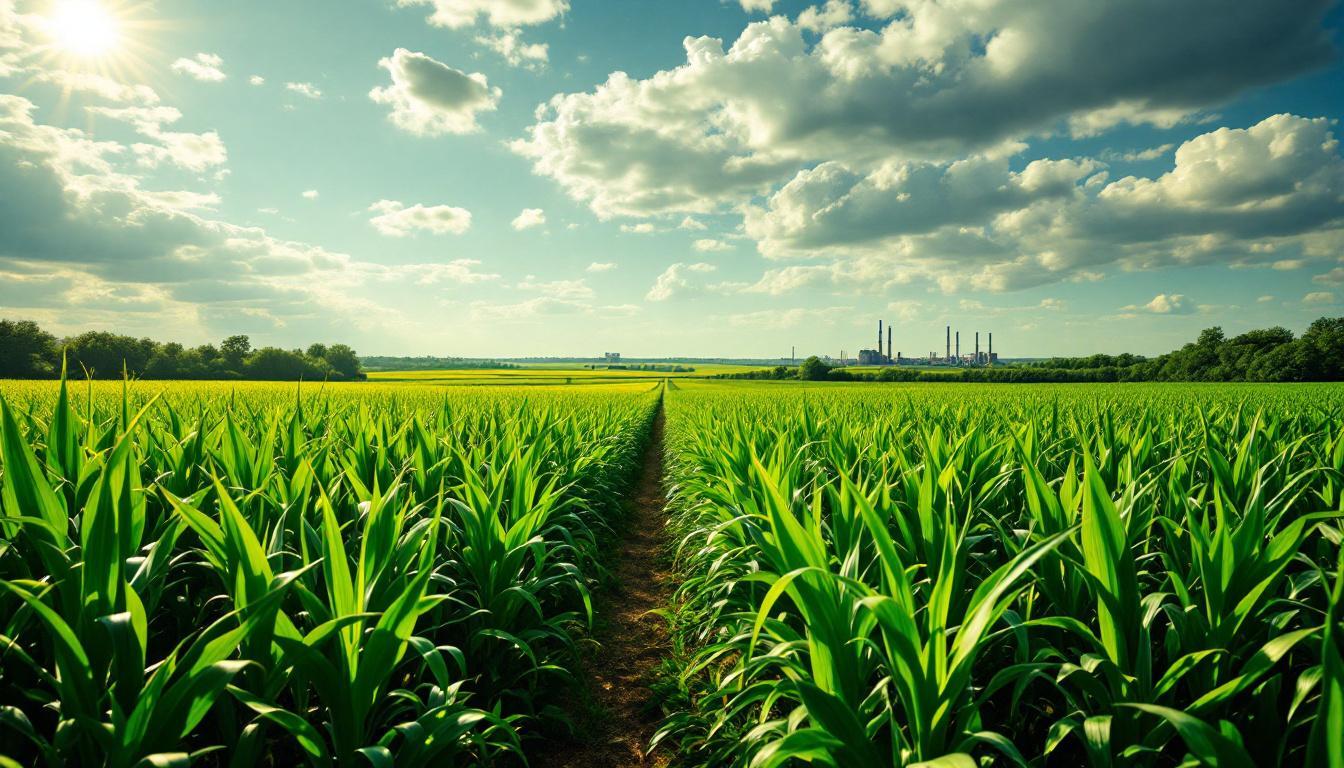
As Europe accelerates efforts to decarbonise transport, agricultural feedstocks are re-emerging as a key component of the continent’s biofuel strategy, offering rapid emissions savings while posing new governance and sustainability challenges.
As Europe accelerates efforts to decarbonise transport, agricultural feedstocks are re-emerging as a strategic pillar of the continent’s biofuel push , offering an immediate, infrastructure‑compatible route to emissions savings while presenting significant design and governance challenges for policymakers and industrial actors.
According to the original report, the European Commission’s new bioeconomy strategy recommends scaling up advanced biofuels for hard‑to‑abate transport segments. Industry players are responding by building integrated agri‑feedstock chains that prioritise residues, intermediate and non‑food crops, and production on degraded or under‑utilised land to avoid competition with food production and curb indirect land‑use change.
The case for speed is partly economic and partly technical. Industry data shows advanced biofuels can be deployed today as “drop‑in” fuels for heavy road, maritime and aviation applications, enabling rapid emissions reductions where electrification or hydrogen remain costly or technically immature. The International Energy Agency projects a strong rise in biofuel deployment under decarbonisation scenarios, driven by growing mandates for aviation and shipping and by expanding supplies of waste‑ and residue‑based oils. Independent market analysis also forecasts a sharp increase in demand to 2030, intensifying competition for lower‑risk feedstocks such as used cooking oil and agro‑residues.
Energy majors have moved accordingly. According to the original report, Eni is developing biorefineries supplied by vegetable oils grown on degraded land and by waste streams, and says its HVO (hydrotreated vegetable oil) pathway can deliver lifecycle emission cuts of 60–90% relative to fossil diesel under the Renewable Energy Directive (RED) calculations. Speaking to the wider market, the report notes Neste, TotalEnergies, Repsol and BP are all expanding renewable diesel, SAF and advanced biofuel projects across Europe, deploying supply‑chain models that pair local processing with international sourcing where appropriate.
Agronomy and certification are now the industry’s frontiers. As Eni’s head of Agribusiness, Nicolò Aggogeri, puts it: “To fully unlock the potential of biofuels in decarbonising transport, agriculture needs to undergo a strategic transformation at scale. The key lies in integrating new cropping systems – particularly intermediate crops – into existing production cycles and enhancing the productivity of underutilised [degraded] land, enabling feedstock expansion without triggering additional land use or compromising food security.” He adds that realising this will demand “innovation on several fronts” including soil regeneration, precision agriculture and resilient seed genetics.
That approach aligns with recent regulatory changes: the revised RED now lists intermediate crops and crops cultivated on severely degraded land among eligible feedstocks in Annex IX, creating a clearer pathway for these materials to count toward EU subtargets , but only where safeguards prevent displacement of food production or new deforestation. Industry groups and a consultancy report commissioned by a consortium of major energy companies have urged the Commission to refine definitions and optionality so intermediate crops contributing additional volumes in rotation systems can be counted across transport subtargets.
Operational models in practice combine local agri‑hubs and pressing facilities with downstream biorefineries. According to the original report, Eni’s agri‑hub network now extends beyond Italy to countries including Kenya, the Ivory Coast, Mozambique, Congo and Angola, with by‑products valorised into animal feed or fertiliser and ISCC‑EU certification used to demonstrate compliance with EU sustainability rules. The report highlights scale examples , such as agri‑hub capacity in Kenya and land cultivated in the Congo , and describes training and mechanisation programmes intended to build local capability.
But risks remain. Evidence from the earlier RED debate shows that poorly designed incentives can drive indirect land‑use change and biodiversity loss; the Commission and member states must therefore tighten monitoring, chain‑of‑custody controls and sustainability criteria. For industrial buyers and corporate purchasers, transparent, auditable certification will be essential to ensure claimed emission savings are real and permanent. The sector must also reconcile growing feedstock demand with circularity goals and local land‑use priorities, particularly where imports increase pressure on global residue and vegetable‑oil markets.
For B2B actors in industrial decarbonisation, the policy and commercial takeaway is clear: advanced biofuels can be a strategic, near‑term decarbonisation lever for hard‑to‑abate transport if supply chains are deliberately designed to avoid food‑fuel competition and biodiversity harms, are backed by robust agronomic innovation, and are subject to stringent, verifiable sustainability certification. According to the European Commission’s strategy, doing so also supports resilience of the European bioeconomy and contributes to broader circularity and rural‑development objectives , provided industrial rollout is matched by clear rules, enforcement and investment in agronomic transformation.
- https://www.euractiv.com/news/agri-feedstocks-the-emerging-backbone-of-europes-biofuel-ambitions/ – Please view link – unable to able to access data
- https://transport.ec.europa.eu/transport-themes/clean-transport/clean-and-energy-efficient-vehicles/green-propulsion-transport/biofuels-transport_en – The European Commission promotes biofuels as a renewable alternative to fossil fuels in the transport sector, aiming to reduce greenhouse gas emissions and enhance energy security. Biofuels, such as biodiesel and bioethanol, can be blended with existing fossil fuels and are largely compatible with current vehicles. The EU has set binding targets for renewable energy in transport, with biofuels contributing significantly to these objectives. The promotion of biofuels also offers benefits like reducing urban pollution and supporting rural development.
- https://www.iea.org/energy-system/low-emission-fuels/biofuels – The International Energy Agency (IEA) highlights the growing role of biofuels in the global energy landscape. In 2022, biofuels accounted for over 3.5% of global transport energy demand, primarily for road transport. The IEA projects that, under the Net Zero Emissions (NZE) Scenario, biofuels’ contribution to transport energy will more than double to 9% by 2030. This growth is driven by the need to decarbonise hard-to-abate sectors and the development of advanced biofuel technologies.
- https://www.iea.org/reports/renewables-2025/renewable-transport – The IEA’s ‘Renewables 2025’ report projects a significant increase in biofuel demand, with global biofuel consumption expected to reach 58 million metric tons by 2030, up from 16.5 million metric tons in 2023. This growth is driven by stricter aviation and maritime mandates, leading to higher biofuel blending. The report also notes that the share of biofuels in total liquid fuel transport demand is set to rise from 5.6% to 6.4% by 2030.
- https://www.iea.org/reports/renewables-2024/renewable-fuels – The IEA’s ‘Renewables 2024’ report forecasts a 30% increase in global demand for biogases (biogas and biomethane) between 2024 and 2030, reaching nearly 2,270 petajoules per year by 2030. The transport sector is expected to lead this growth, driven by policies in regions like the European Union, India, and the United States. The use of biogases in buildings and industry is also gaining traction, supported by policies and voluntary carbon markets.
- https://www.spglobal.com/commodity-insights/en/news-research/latest-news/agriculture/100924-aviation-maritime-demand-to-rev-up-global-biofuel-feedstock-race-by-2030 – S&P Global reports that global biofuel demand is projected to grow annually by 20%, reaching 58 million metric tons by 2030, up from 16.5 million metric tons in 2023. The aviation and maritime sectors are expected to account for over 75% of new biofuel demand by 2030, with average consumption rising by 30%. This surge is driven by stricter aviation and maritime mandates, leading to higher biofuel blending and increased competition for feedstock waste oils.
- https://environment.ec.europa.eu/strategy/bioeconomy-strategy_en – The European Commission’s Bioeconomy Strategy aims to boost innovation and support European companies in the green transition. It focuses on the sustainable use of biological resources for materials and services, promoting a circular economy without harming nature. The strategy seeks to ensure the long-term competitiveness of the EU bioeconomy, increase resource-efficient use of biological resources, and secure a sustainable supply of biomass, both domestically and from outside the EU.
Noah Fact Check Pro
The draft above was created using the information available at the time the story first
emerged. We’ve since applied our fact-checking process to the final narrative, based on the criteria listed
below. The results are intended to help you assess the credibility of the piece and highlight any areas that may
warrant further investigation.
Freshness check
Score:
8
Notes:
The narrative was first published on 4 December 2025. A republished version appeared on MillingandMillers.com on 4 December 2025. The original report is from EURACTIV, a reputable source. The content includes updated data but recycles older material, which may justify a higher freshness score but should still be flagged. No earlier versions with different figures, dates, or quotes were found. No discrepancies were identified. The narrative does not appear to be based on a press release. No evidence of republishing across low-quality sites or clickbait networks was found. No similar content appeared more than 7 days earlier. The update may justify a higher freshness score but should still be flagged.
Quotes check
Score:
9
Notes:
The direct quote from Nicolò Aggogeri, head of Agribusiness at Eni, appears to be original, with no identical matches found online. This suggests potentially original or exclusive content. No variations in wording were identified.
Source reliability
Score:
9
Notes:
The narrative originates from EURACTIV, a reputable organisation known for its coverage of European affairs. This adds credibility to the report.
Plausability check
Score:
8
Notes:
The claims about the European Commission’s bioeconomy strategy and the role of agri-feedstocks in biofuel production are plausible and align with current industry trends. The report includes specific details about Eni’s biorefinery projects and partnerships, which are consistent with known industry activities. The language and tone are consistent with the region and topic. No excessive or off-topic details were found. The tone is formal and appropriate for the subject matter.
Overall assessment
Verdict (FAIL, OPEN, PASS): PASS
Confidence (LOW, MEDIUM, HIGH): HIGH
Summary:
The narrative is fresh, with no evidence of recycled content or significant discrepancies. The direct quote appears original, and the source is reputable. The claims are plausible and supported by specific details. No major risks were identified, and the overall assessment is positive.
