


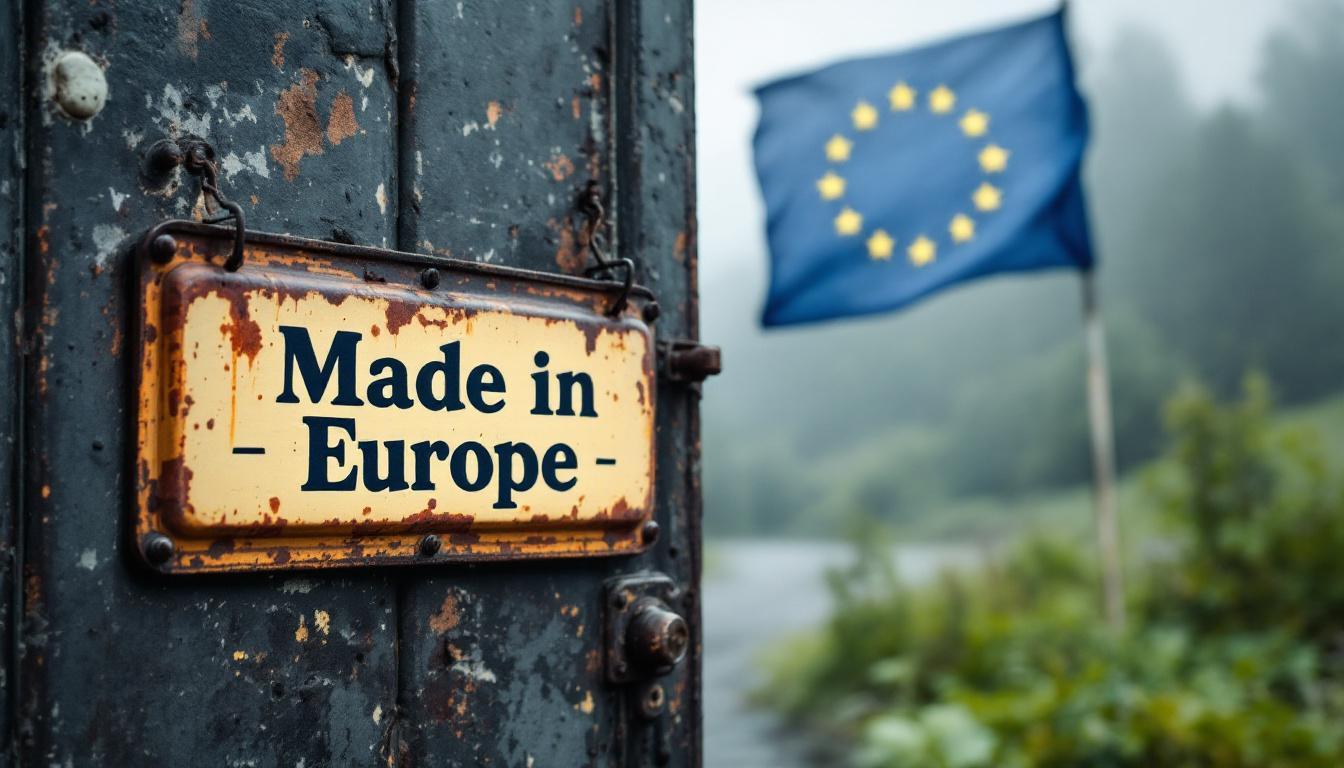
The EU prepares to unveil a new ‘Made in Europe’ strategy amid rising global protectionism, internal disagreements, and efforts to strengthen its manufacturing base and supply chains in a changing geopolitical landscape.
Two decades ago, the European Commission explored the idea of implementing a regulation requiring products to be labelled as “Made in Europe,” aiming to tap into consumers’ desire for traceability and to leverage Europe’s reputation for quality manufacturing. The initiative was intended to boost sales of European goods and preserve manufacturing jobs amid growing global competition. However, after extensive industry consultation, the enthusiasm for a pan-European origin label was limited primarily to a few sectors such as furniture, luggage, and Spanish ceramics. Many European countries preferred to maintain their traditional country-specific branding, such as “Made in Germany” or “tradition française,” reflecting deeply entrenched national identities and marketing values. Furthermore, international trading partners did not recognise a broad European origin label, preferring clarity on individual countries of production despite the existence of the EU single market.
One of the few surviving examples of this initiative is in the luggage sector, where Samsonite uses a voluntary “Made in Europe” label, though this remains a private sector practice rather than a mandated regulation from the EU.
Now, after a long hiatus, the concept of “Made in Europe” is experiencing a resurgence amidst shifting global economic and geopolitical dynamics. Other global powers have moved decisively to protect and stimulate their domestic manufacturing bases. The United States, for instance, launched extensive measures such as the Inflation Reduction Act and tariff policies aimed at reshoring production and prioritising local procurement, particularly in manufacturing-heavy regions of the country. Similarly, India’s “Made in India” initiative has gained momentum with financial incentives, deregulation, and promotion efforts to boost domestic industries, while China’s “Made in China 2015-25” plan focuses on subsidising key sectors with tax breaks and low-interest loans. These government-led interventions have also influenced the international trade landscape, making new WTO agreements on government procurement less likely to include China or India.
Against this backdrop, the European Commission plans to unveil a new “Made in Europe” policy proposal on 10 December, aiming to empower member states to prioritise domestic products in procurement, encourage the purchase of European-made vehicles and technology, and heavily subsidise strategic industries such as battery manufacturing. While the full details remain under wraps, the proposal is expected to allow greater latitude for member states to support European production both directly and indirectly, possibly through eco-scheme incentives that favour European green technologies.
This approach comes at a critical time for Europe’s industrial base, particularly as it seeks to reduce dependence on China and the United States for essential supply chains and bolster its competitiveness in emerging technologies. Yet, the discussion over “Made in Europe” is poised to expose rifts within the EU. Northern member states, including Germany and others traditionally sceptical of protectionism, are wary of breaking WTO rules or adopting trade-distorting subsidies, viewing such measures as economically unsound and potentially harmful to consumer costs and single market integrity. Northern countries also raise concerns that “Made in Europe” rules might privilege certain countries over others, thus fracturing the EU’s internal market.
Conversely, southern and some eastern member states, grappling with significant manufacturing job losses to Asia and weakened industrial bases, are more inclined to support firm protectionist policies, even if they risk conflicting with international trade commitments. They believe such measures are necessary to halt economic decline and revive domestic manufacturing.
The tension reflects ongoing debates from a decade ago when the European Parliament disccussed mandatory country-of-origin labelling for consumer goods. Back in 2013, the European Commission proposed labelling products as “Made in the European Union” or by specific member states, aiming for transparency and a level playing field. However, the proposal met strong resistance from countries like Austria, Belgium, and Germany, which cited concerns about trade relations and implementation complexity. Members of the European Parliament advocated for mandatory “Made in” labels on imports to counteract competition from third countries, ensuring consumers could make informed choices and protecting European industry. Despite these calls, the policy did not advance, leaving the matter largely unresolved.
Looking ahead, the Commission’s new proposals are expected to undergo intense scrutiny and negotiation within the Council and Parliament. The challenge will be to design a balanced framework that supports European industry without violating WTO rules that prohibit local content requirements and discrimination against imported products. The European Commission is aware of these risks but faces increasing pressure from the global context and internal market realities to act.
The reaction from trade partners remains uncertain. China, which is likely to be most affected, may challenge the EU measures. The US and India, conversely, might not object given their own protectionist policies and diminishing faith in WTO dispute mechanisms.
Industry stakeholders and policymakers will be watching closely as the EU seeks to craft a “Made in Europe” scheme that harmonises with the single market’s legal framework, respects international commitments, and responds effectively to the challenges of industrial decarbonisation and supply chain resilience. For a region whose economy is heavily service-oriented, the proposal currently seems to prioritise tangible goods, particularly in sectors like automotive and battery manufacturing, with limited focus on fostering European services competitiveness outside infrastructure-related fields.
As the Commission prepares to re-enter the complex arena of product origin labelling and industrial policy, the debate will test Europe’s ability to reconcile diverse national interests, international trade obligations, and the urgent imperative to industrially transform for a sustainable future.
- https://euobserver.com/eu-and-the-world/ardf18c7f3 – Please view link – unable to able to access data
- https://www.politico.eu/article/safety-claim-at-heart-of-tough-fight-over-made-in-eu-label/ – In 2013, the European Parliament debated a proposal requiring consumer goods to display their country of origin. The European Commission suggested that products made within the EU should be labelled as ‘Made in the European Union’ or specify the product’s country of origin. This proposal faced opposition from several EU member states, including Austria, Belgium, and Germany, who were concerned about the potential impact on trade relations and the feasibility of implementing such a regulation.
- https://www.europarl.europa.eu/news/en/press-room/20130114IPR05315/eu-must-require-made-in-labels-on-imports-from-third-countries-say-meps – In 2013, Members of the European Parliament (MEPs) called for mandatory ‘Made in’ origin labels on goods imported from third countries. They argued that such labelling would enable consumers to make informed choices and ensure a level playing field for EU manufacturers. The European Commission had previously proposed withdrawing the ‘Made in’ regulation, but MEPs urged for its adoption or the introduction of an alternative measure to protect European consumers and industries.
- https://www.politico.eu/article/safety-claim-at-heart-of-tough-fight-over-made-in-eu-label/ – In 2013, the European Parliament debated a proposal requiring consumer goods to display their country of origin. The European Commission suggested that products made within the EU should be labelled as ‘Made in the European Union’ or specify the product’s country of origin. This proposal faced opposition from several EU member states, including Austria, Belgium, and Germany, who were concerned about the potential impact on trade relations and the feasibility of implementing such a regulation.
- https://www.europarl.europa.eu/news/en/press-room/20130114IPR05315/eu-must-require-made-in-labels-on-imports-from-third-countries-say-meps – In 2013, Members of the European Parliament (MEPs) called for mandatory ‘Made in’ origin labels on goods imported from third countries. They argued that such labelling would enable consumers to make informed choices and ensure a level playing field for EU manufacturers. The European Commission had previously proposed withdrawing the ‘Made in’ regulation, but MEPs urged for its adoption or the introduction of an alternative measure to protect European consumers and industries.
- https://www.politico.eu/article/safety-claim-at-heart-of-tough-fight-over-made-in-eu-label/ – In 2013, the European Parliament debated a proposal requiring consumer goods to display their country of origin. The European Commission suggested that products made within the EU should be labelled as ‘Made in the European Union’ or specify the product’s country of origin. This proposal faced opposition from several EU member states, including Austria, Belgium, and Germany, who were concerned about the potential impact on trade relations and the feasibility of implementing such a regulation.
- https://www.europarl.europa.eu/news/en/press-room/20130114IPR05315/eu-must-require-made-in-labels-on-imports-from-third-countries-say-meps – In 2013, Members of the European Parliament (MEPs) called for mandatory ‘Made in’ origin labels on goods imported from third countries. They argued that such labelling would enable consumers to make informed choices and ensure a level playing field for EU manufacturers. The European Commission had previously proposed withdrawing the ‘Made in’ regulation, but MEPs urged for its adoption or the introduction of an alternative measure to protect European consumers and industries.
Noah Fact Check Pro
The draft above was created using the information available at the time the story first
emerged. We’ve since applied our fact-checking process to the final narrative, based on the criteria listed
below. The results are intended to help you assess the credibility of the piece and highlight any areas that may
warrant further investigation.
Freshness check
Score:
8
Notes:
The narrative discusses the European Commission’s upcoming ‘Made in Europe’ proposal, expected to be announced on 10 December 2025. This aligns with recent reports indicating the Commission’s plans to unveil such a proposal in December 2025. ([lemonde.fr](https://www.lemonde.fr/en/economy/article/2025/02/26/stephane-sejourne-made-in-europe-is-making-its-way-into-european-legislation_6738591_19.html?utm_source=openai)) The article also references historical context from 20 years ago, providing a fresh perspective on the recurring debate. No evidence of recycled content or significant discrepancies with earlier versions was found. The inclusion of updated data and references to current geopolitical dynamics enhances the freshness of the content. However, the article’s publication date is not specified, which limits the ability to assess its timeliness fully. The absence of a clear publication date is a notable concern.
Quotes check
Score:
7
Notes:
The article includes direct quotes from an interview with Stéphane Séjourné, Executive Vice President of the European Commission for Prosperity and Industrial Strategy, published in February 2025. ([lemonde.fr](https://www.lemonde.fr/en/economy/article/2025/02/26/stephane-sejourne-made-in-europe-is-making-its-way-into-european-legislation_6738591_19.html?utm_source=openai)) These quotes are consistent with the original source, indicating accurate reporting. No significant variations in wording were found. The use of these quotes adds credibility to the narrative. However, the reliance on a single source for direct quotes may limit the diversity of perspectives presented.
Source reliability
Score:
6
Notes:
The narrative originates from EUobserver, a publication known for its coverage of European Union affairs. While EUobserver is generally considered reputable, it is not as widely recognised as major outlets like the Financial Times or Reuters. The article references an interview with Stéphane Séjourné, which is verifiable through other reputable sources. However, the lack of a clear publication date for the article raises questions about its timeliness and potential biases. The absence of a publication date is a significant concern.
Plausability check
Score:
8
Notes:
The narrative presents a plausible scenario regarding the European Commission’s ‘Made in Europe’ proposal, aligning with recent developments in EU industrial policy. The discussion of potential rifts within the EU and the challenges of balancing protectionist measures with international trade obligations is consistent with ongoing debates. The article’s tone and language are appropriate for the topic and region. However, the lack of a clear publication date and the absence of supporting details from other reputable outlets are notable concerns. The absence of a publication date is a significant issue.
Overall assessment
Verdict (FAIL, OPEN, PASS): OPEN
Confidence (LOW, MEDIUM, HIGH): MEDIUM
Summary:
The narrative provides a timely and plausible discussion of the European Commission’s upcoming ‘Made in Europe’ proposal, supported by verifiable quotes and consistent with recent developments. However, the lack of a clear publication date and the absence of supporting details from other reputable outlets raise concerns about its timeliness and comprehensiveness. The absence of a publication date is a significant issue.
