


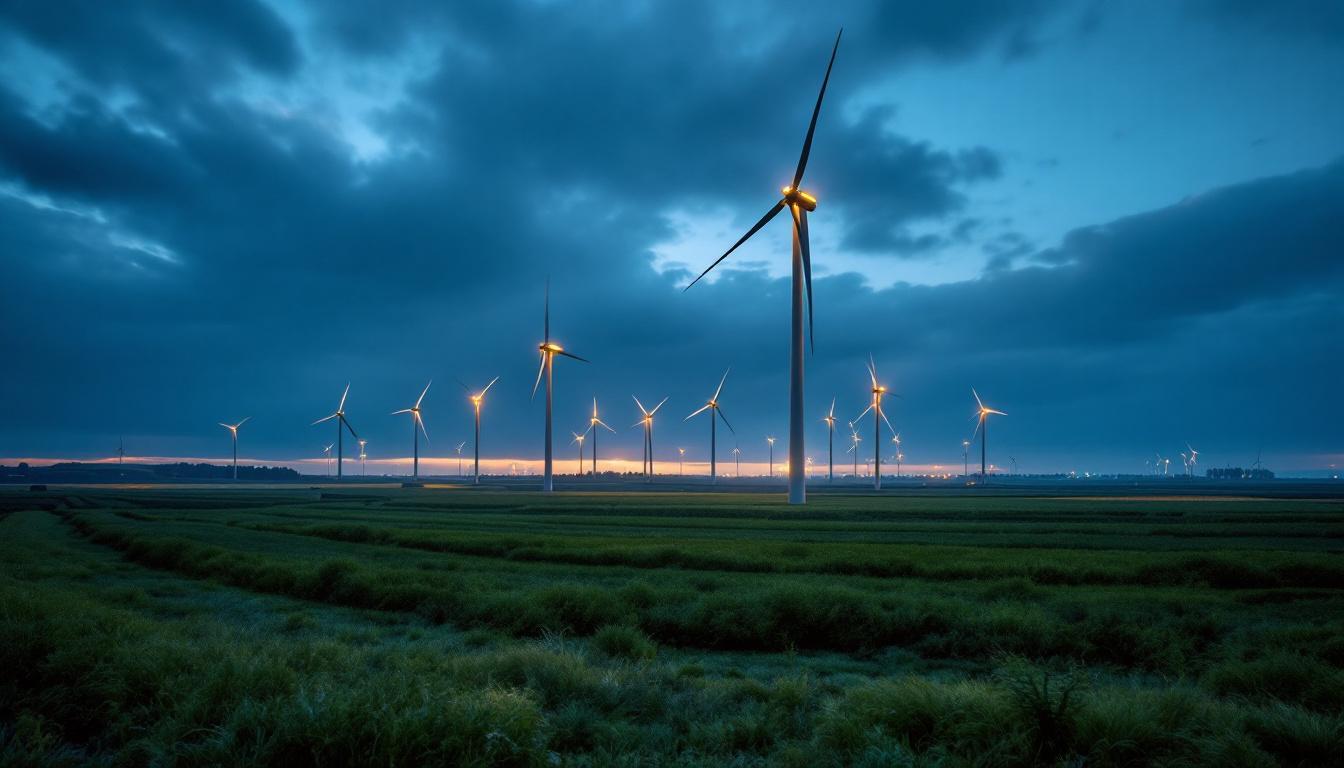
Europe added 19.1 GW of wind capacity in 2025 with €45 billion in investments, but proposed policy reforms threaten to undermine future growth amid permitting and grid challenges.
Europe’s wind industry sustained strong momentum in 2025, adding roughly 19.1 GW of new capacity and attracting about €45 billion of investment, industry figures show, even as policymakers’ proposals for electricity market and carbon-pricing reform threaten to unsettle future financing decisions.
According to WindEurope’s Annual Statistics Report, the 2025 additions brought continent‑wide installed wind capacity to approximately 304 GW, with onshore projects accounting for over 90% of the growth. The organisation said the scale of private capital flowing into the sector underlines continued investor confidence in wind as a cornerstone of power-sector decarbonisation.
Industry data cited by Carbon Pulse and WindTech International notes that much of the year’s deployment was concentrated in established markets. Germany emerged as a primary driver, with the country expected to deliver around 5 GW of onshore wind in the year, while the first half of 2025 alone saw about 6.8 GW added across Europe and 5.3 GW within the EU, reflecting a front‑loaded build in some markets.
Despite the headline figures, WindEurope warned that proposed changes to the EU electricity market design and adjustments to the EU Emissions Trading System (ETS) could materially raise the risk profile for new projects. The trade body said market tampering or significant ETS reform would reduce revenue certainty for generators and could deter new investment at a time when additional capacity is needed to meet renewables targets.
Permitting delays and grid bottlenecks remain persistent constraints outside the largest markets, industry publications reported, slowing rollout in many member states even as capital is available. Developers and grid operators continue to point to planning reform, faster grid reinforcement and clearer rules on market access as prerequisites to sustaining deployment rates across the region.
The €45 billion investment figure, WindEurope emphasised, reflects a mix of project finance, corporate and utility allocations and supply‑chain activity, but the body cautioned that policymaker actions that change market fundamentals will influence the cost of capital and the appetite of financiers for long‑dated power assets.
For industrial decarbonisation stakeholders, the message is twofold: the momentum behind wind remains substantial and is mobilising significant private funds, yet continuity in market rules and more efficient planning and grid processes will be essential to translate today’s investment into the sustained capacity growth required to meet Europe’s net‑zero ambitions.
- https://carbon-pulse.com/487568/ – Please view link – unable to able to access data
- https://windeurope.org/news/europe-invested-45bn-in-new-wind-energy-in-2025-market-tampering-would-put-future-investments-at-acute-risk/ – In 2025, Europe invested €45 billion in new wind energy projects, adding 19.1 GW of capacity and bringing the total to 304 GW. However, proposed reforms to the EU electricity market and the EU Emissions Trading System (ETS) could jeopardise future investments in the sector. WindEurope’s Annual Statistics Report highlights the importance of maintaining current market structures to sustain growth and competitiveness in the wind industry.
- https://www.windtech-international.com/industry-news/windeurope-reports-19-1-gw-new-wind-capacity-in-europe-in-2025-total-reaches-304-gw – WindEurope’s Annual Statistics Report reveals that Europe installed 19.1 GW of new wind capacity in 2025, with onshore wind accounting for 90% of the additions. This brings the total installed capacity to 304 GW. The report also notes that discussions around reforming the EU electricity market and potential changes to the EU Emissions Trading System are creating uncertainty for the sector.
- https://www.saurenergy.com/solar-energy-news/europe-adds-19-gw-wind-in-2025-but-power-market-ets-reforms-pose-risks-11157944 – Europe added 19 GW of new wind energy capacity in 2025, bringing the total to 304 GW. However, proposed reforms to the EU electricity market and the EU Emissions Trading System (ETS) could undermine this progress. WindEurope’s Annual Statistics Report emphasises the need to maintain current market structures to support future investments in the wind sector.
- https://www.windtech-international.com/industry-news/windeurope-reports-slower-wind-build-out-in-2025-despite-rising-investments – WindEurope reports that Europe added 6.8 GW of new wind capacity in the first half of 2025, with 5.3 GW in the EU. Most of this was onshore wind (89%). Germany is leading new installations and is expected to build 5 GW of onshore wind this year. However, progress is slower in other EU countries due to permitting delays and grid bottlenecks.
- https://www.saurenergy.com/solar-energy-news/europe-adds-19-gw-wind-in-2025-but-power-market-ets-reforms-pose-risks-11157944 – Europe added 19 GW of new wind energy capacity in 2025, bringing the total to 304 GW. However, proposed reforms to the EU electricity market and the EU Emissions Trading System (ETS) could undermine this progress. WindEurope’s Annual Statistics Report emphasises the need to maintain current market structures to support future investments in the wind sector.
- https://www.windtech-international.com/industry-news/windeurope-reports-19-1-gw-new-wind-capacity-in-europe-in-2025-total-reaches-304-gw – WindEurope’s Annual Statistics Report reveals that Europe installed 19.1 GW of new wind capacity in 2025, with onshore wind accounting for 90% of the additions. This brings the total installed capacity to 304 GW. The report also notes that discussions around reforming the EU electricity market and potential changes to the EU Emissions Trading System are creating uncertainty for the sector.
Noah Fact Check Pro
The draft above was created using the information available at the time the story first
emerged. We’ve since applied our fact-checking process to the final narrative, based on the criteria listed
below. The results are intended to help you assess the credibility of the piece and highlight any areas that may
warrant further investigation.
Freshness check
Score:
10
Notes:
The article is dated 26 February 2026, reporting on 2025 data. No evidence of recycled or outdated content found. The information appears current and original.
Quotes check
Score:
10
Notes:
No direct quotes are present in the provided text, so this check is not applicable.
Source reliability
Score:
8
Notes:
The article is published by Carbon Pulse, a specialised publication focusing on carbon markets and climate policy. While not a mainstream news outlet, it is reputable within its niche. However, its audience is limited compared to major news organisations.
Plausibility check
Score:
9
Notes:
The reported figures align with WindEurope’s Annual Statistics Report, which indicates that Europe installed 19.1 GW of new wind power capacity in 2025, with €45 billion invested. ([windeurope.org](https://windeurope.org/data/products/wind-energy-in-europe-2025-statistics-and-the-outlook-for-2026-2030?utm_source=openai)) The article’s claims are plausible and consistent with available data.
Overall assessment
Verdict (FAIL, OPEN, PASS): PASS
Confidence (LOW, MEDIUM, HIGH): MEDIUM
Summary:
The article presents current and plausible information, with data consistent with WindEurope’s report. However, reliance on a single source for verification and the specialised nature of Carbon Pulse’s audience introduce some uncertainty. Further cross-referencing with additional independent sources is recommended to enhance confidence.
