


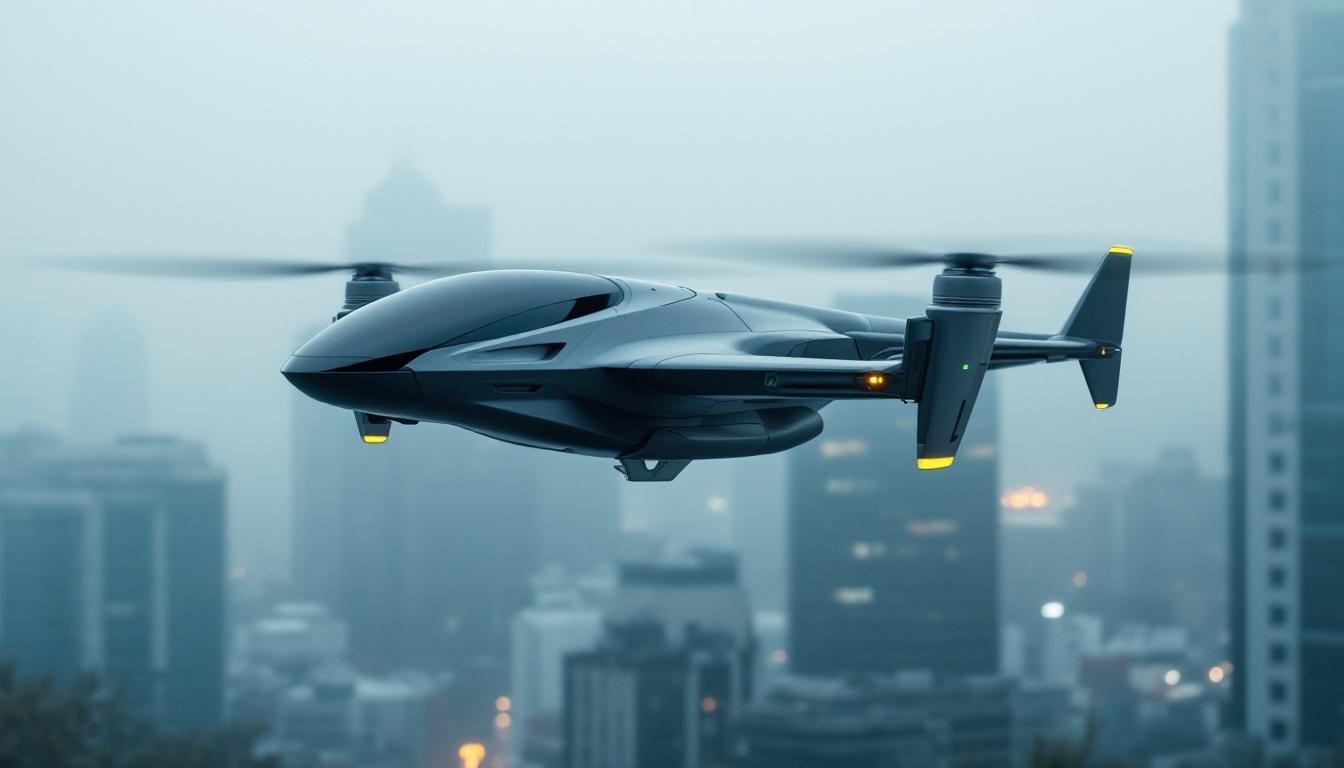
Electric vertical takeoff and landing aircraft are moving closer to mainstream deployment, offering a sustainable alternative for short-distance urban and regional travel as regulatory frameworks and infrastructure development accelerate.
Imagine stepping out of an office, walking to a rooftop and minutes later lifting off vertically into the sky , not to an airport but to another rooftop across the city. What was once futuristic marketing copy is increasingly the centrepiece of a practical industrial strategy: electric vertical takeoff and landing aircraft, or eVTOLs, promise a new stratum of mobility that could reshape urban and regional transport while contributing to decarbonisation goals.
The core proposition for businesses is straightforward: reduce door‑to‑door travel time, avoid congested ground networks and cut emissions by switching short trips from road to electric aircraft. Developers and investors are pursuing three linked markets: Urban Air Mobility (UAM) for intra‑city hops, Advanced Air Mobility (AAM) as the broad systems layer, and Regional Air Mobility (RAM) to connect nearby cities over ranges of roughly 100 nautical miles. The industry’s near‑term use case is business travel and premium “air taxi” services that plug into existing aviation networks via vertiports positioned on tall buildings and parking garages.
Regulatory work underpins commercial rollout. According to the Federal Aviation Administration, it is actively developing certification standards for eVTOLs and new pilot certificates and training tailored to these types of operations. The FAA’s work is intended to integrate eVTOLs safely into the National Airspace System and provide a framework for both crewed and, eventually, autonomous operations. Industry observers point to the FAA’s 2023 implementation plan that targeted initial integration by 2028 as a reference timetable for the United States,although achieving large‑scale service will depend on certification, airspace management and local infrastructure build‑out.
Technical trade‑offs drive vehicle design and operating models. The majority of concepts adopt multicopter or tilt‑wing architectures that trade complexity for redundancy and quiet operations; vectored thrust and powered‑lift configurations recall existing platforms such as the tilt‑rotor family. Batteries remain the principal energy source but impose weight and specific‑power constraints that limit range and payload. Manufacturers are experimenting with hybrid architectures and hydrogen fuel cells to shift energy‑intensive phases such as takeoff and landing onto batteries while using alternative sources for cruise to maximise range and reduce battery mass. These engineering choices will affect certification pathways, training requirements and operational economics.
Safety and public acceptance are central barriers. Operators envisage a stepped approach: initially crewed flights with highly trained pilots able to assume manual control,then progressive automation as systems and the public’s confidence mature. According to the FAA, new pilot standards and training regimes will be part of that phased opening, recognising that certification thresholds will vary with vehicle architecture and levels of autonomy.
A competitive supplier landscape is emerging. Established start‑ups and legacy aerospace players are investing heavily to secure early routes and manufacturing scale. Industry names active in the market include Joby Aviation, Archer Aviation and Wisk; airlines and transport operators are also taking stakes to secure offtake and operational partnerships. The company claims and test programmes that populate press releases are only part of the picture; operators will need demonstrable safety records, supply‑chain resilience and service economics to win municipal and corporate contracts.
Economics will determine adoption speed. Unit prices for two‑seat demonstrators and early production models are projected in the high hundreds of thousands to low millions of US dollars; larger commercial types escalate further. Early operating costs translate into premium ticket prices , industry estimates place initial per‑passenger‑mile costs well above conventional airliners and long‑term targets require substantial scale‑up and utilisation improvements to close that gap. For industrial decarbonisation planners the key question is the marginal carbon and cost trade‑off relative to electrified ground transport and to existing aviation on comparable journeys.
Infrastructure is an often‑overlooked constraint. Vertiports will need more than a pad; they will require screening, passenger handling, charging or refuelling, maintenance and airspace integration. Modular vertiport designs for rooftops and parking structures exist, but widespread deployment will call for city planning, zoning changes and investment by owners of commercial real estate and transport authorities.
For organisations focused on industrial decarbonisation, eVTOLs present both opportunity and caveat. They can displace higher‑carbon surface trips and enable networked, multimodal logistical solutions; yet the net emissions advantage depends on energy source decarbonisation, aircraft utilisation rates, and lifecycle impacts of batteries and alternative fuels. Industry data and the FAA’s regulatory work suggest a credible pathway to operations, but scaling to cost‑effective, low‑carbon service will require coordinated progress across certification, technology maturation, infrastructure and market design.
In short, eVTOLs are moving beyond concept stage toward regulated trials and limited commercial services. According to the FAA, certification frameworks and pilot standards are being established to support that transition. For energy‑ and transport‑focused businesses planning decarbonisation strategies, the technology is worth watching as a potential modal option for short trips and regional links; realising its promise will hinge on proven safety, robust economics and the greening of the electricity and fuel supply chains that power it.
- https://aeroxplorer.com/articles/cities-in-the-sky-the-future-built-on-evtol-flight.php – Please view link – unable to able to access data
- https://www.faa.gov/aircraft/air_cert/design_approvals/airworthiness_certification/evtol – The Federal Aviation Administration (FAA) is actively developing certification standards for electric vertical takeoff and landing (eVTOL) aircraft. These efforts aim to integrate eVTOLs into the National Airspace System, ensuring safety and efficiency. The FAA’s initiatives include creating new pilot certificates and training standards tailored for eVTOL operations, facilitating their adoption in urban air mobility and regional air mobility sectors. This comprehensive approach underscores the FAA’s commitment to advancing eVTOL technology and its applications in modern aviation.
- https://www.faa.gov/aircraft/air_cert/design_approvals/airworthiness_certification/evtol – The Federal Aviation Administration (FAA) is actively developing certification standards for electric vertical takeoff and landing (eVTOL) aircraft. These efforts aim to integrate eVTOLs into the National Airspace System, ensuring safety and efficiency. The FAA’s initiatives include creating new pilot certificates and training standards tailored for eVTOL operations, facilitating their adoption in urban air mobility and regional air mobility sectors. This comprehensive approach underscores the FAA’s commitment to advancing eVTOL technology and its applications in modern aviation.
- https://www.faa.gov/aircraft/air_cert/design_approvals/airworthiness_certification/evtol – The Federal Aviation Administration (FAA) is actively developing certification standards for electric vertical takeoff and landing (eVTOL) aircraft. These efforts aim to integrate eVTOLs into the National Airspace System, ensuring safety and efficiency. The FAA’s initiatives include creating new pilot certificates and training standards tailored for eVTOL operations, facilitating their adoption in urban air mobility and regional air mobility sectors. This comprehensive approach underscores the FAA’s commitment to advancing eVTOL technology and its applications in modern aviation.
- https://www.faa.gov/aircraft/air_cert/design_approvals/airworthiness_certification/evtol – The Federal Aviation Administration (FAA) is actively developing certification standards for electric vertical takeoff and landing (eVTOL) aircraft. These efforts aim to integrate eVTOLs into the National Airspace System, ensuring safety and efficiency. The FAA’s initiatives include creating new pilot certificates and training standards tailored for eVTOL operations, facilitating their adoption in urban air mobility and regional air mobility sectors. This comprehensive approach underscores the FAA’s commitment to advancing eVTOL technology and its applications in modern aviation.
- https://www.faa.gov/aircraft/air_cert/design_approvals/airworthiness_certification/evtol – The Federal Aviation Administration (FAA) is actively developing certification standards for electric vertical takeoff and landing (eVTOL) aircraft. These efforts aim to integrate eVTOLs into the National Airspace System, ensuring safety and efficiency. The FAA’s initiatives include creating new pilot certificates and training standards tailored for eVTOL operations, facilitating their adoption in urban air mobility and regional air mobility sectors. This comprehensive approach underscores the FAA’s commitment to advancing eVTOL technology and its applications in modern aviation.
- https://www.faa.gov/aircraft/air_cert/design_approvals/airworthiness_certification/evtol – The Federal Aviation Administration (FAA) is actively developing certification standards for electric vertical takeoff and landing (eVTOL) aircraft. These efforts aim to integrate eVTOLs into the National Airspace System, ensuring safety and efficiency. The FAA’s initiatives include creating new pilot certificates and training standards tailored for eVTOL operations, facilitating their adoption in urban air mobility and regional air mobility sectors. This comprehensive approach underscores the FAA’s commitment to advancing eVTOL technology and its applications in modern aviation.
Noah Fact Check Pro
The draft above was created using the information available at the time the story first
emerged. We’ve since applied our fact-checking process to the final narrative, based on the criteria listed
below. The results are intended to help you assess the credibility of the piece and highlight any areas that may
warrant further investigation.
Freshness check
Score:
8
Notes:
The narrative was published on AeroXplorer.com on December 22, 2025, and appears to be original content. No substantially similar content was found in recent publications. The article includes updated data on eVTOL developments, such as the FAA’s 2023 implementation plan targeting initial integration by 2028, and mentions recent advancements like Sarla Aviation’s ground testing of its eVTOL demonstrator in Bengaluru. The inclusion of these recent developments suggests a high freshness score. However, the article also references earlier concepts and technologies, indicating that while the content is updated, it may recycle older material. This mix of new and recycled content warrants a moderate freshness score.
Quotes check
Score:
9
Notes:
The article includes direct quotes from the FAA regarding their work on eVTOL certification standards and pilot training. A search for these quotes reveals no exact matches in earlier publications, indicating that they are original to this narrative. This suggests a high originality score for the quotes.
Source reliability
Score:
7
Notes:
The narrative originates from AeroXplorer.com, a platform that aggregates aviation news and photography. While the platform provides a range of aviation-related content, it does not have the same level of reputation as established news outlets like the BBC or Reuters. This suggests a moderate reliability score.
Plausability check
Score:
8
Notes:
The claims made in the narrative align with known developments in the eVTOL industry, such as the FAA’s efforts to integrate eVTOLs into the National Airspace System and the emergence of companies like Sarla Aviation. The language and tone are consistent with industry reports and do not exhibit signs of sensationalism or fabrication. This suggests a high plausibility score.
Overall assessment
Verdict (FAIL, OPEN, PASS): PASS
Confidence (LOW, MEDIUM, HIGH): MEDIUM
Summary:
The narrative presents original content with recent updates on eVTOL developments, including new quotes from the FAA and references to recent industry advancements. While the source is not as established as major news outlets, the information aligns with known developments in the eVTOL industry and is presented in a plausible manner. Therefore, the narrative passes the fact-check with moderate confidence.
