


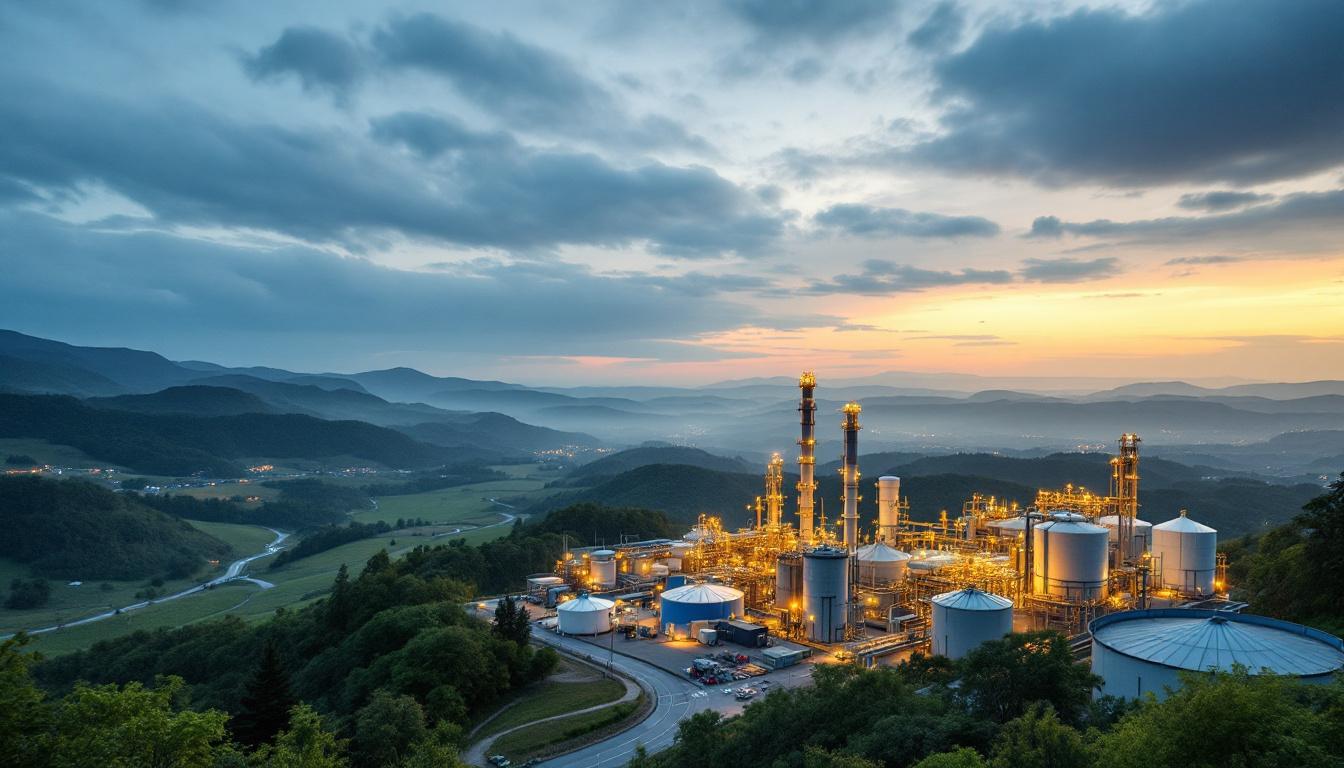
Emerging gas fermentation technology shows promise for converting industrial waste gases into valuable chemicals, but significant engineering, environmental, and scaling challenges remain before widespread adoption can occur.
Gas fermentation is emerging as a practical tool for closing industrial carbon loops and converting waste streams into feedstocks for chemical manufacture, but significant engineering and lifecycle questions remain before the technology can be deployed at scale, according to researchers leading academic and applied efforts.
At the Institute for Biochemical Engineering (IBVT) at the University of Stuttgart, Professor Ralf Takors and colleagues are focusing on bringing microbe-driven gas fermentation out of the laboratory and into industrial settings. The process converts synthesis gas or effluent CO₂-rich streams into short-chain acids and alcohols using specialised anaerobic bacteria, creating potential feedstocks for plastics, solvents and other commodity chemicals that would otherwise be derived from fossil hydrocarbons. By routing hard-to-recycle mixed plastics through gasification and feeding the resulting CO/CO₂/H₂ mix to fermenters, the group aims to recover material value and reduce emissions from waste management while strengthening regional supply chains for chemical inputs.
The technology already has commercial footholds. Research literature documents the conversion of carbon monoxide–heavy off‑gases from steel mills into ethanol, acetate and 2,3‑butanediol, illustrating a pathway by which heavy industry can evolve into circular biorefineries. According to the review literature, adding hydrogen to syngas can improve carbon yields and the range of products that can be obtained, while genetic engineering expands the portfolio of target molecules. Industry demonstrators have also coupled gas fermentation to cement and steel operations to valorise process CO₂ streams into acetate or ethanol that can feed downstream polymer manufacture.
Yet lifecycle and resource trade‑offs must be weighed. Comparative analyses of acetogenic syngas fermentation for acetic acid production indicate that, on a global warming‑potential basis, off‑gas fermentation can outperform conventional routes. However, those same studies flag higher energy and water consumption in some configurations, making the overall environmental benefit dependent on integration choices, energy sourcing and process optimisation. Industry research platforms increasingly promote modular integration with carbon capture and renewable hydrogen to improve carbon balances and scalability.
From an engineering standpoint, two persistent challenges are gas–liquid mass transfer and industrial scaling. Takors’ group emphasises that gases are intrinsically poorly soluble in aqueous media, limiting microbial access to the carbon and reducing volumetric productivity unless reactor design compensates. Scaling bioreactors to industrially relevant volumes, on the order of hundreds of cubic metres, requires validated models to avoid performance losses. The IBVT uses computational fluid dynamics and robust mathematical forecasting to design large‑volume systems and define operating windows; reactor layout, mixing strategy and gas‑delivery hardware must be developed alongside strain and process engineering.
Several applied initiatives illustrate system‑level approaches. A modular platform developed by the National Renewable Energy Technology Centre (CENER) integrates flue‑gas fermentation with CCUS and renewable hydrogen to produce acetate and biomethane, showing how modularity and hybridised energy inputs can reduce net emissions and broaden product streams. Such platforms demonstrate the business case for companies with concentrated emissions: converting an on‑site CO or CO₂ stream into saleable chemicals can create revenue while helping decarbonise hard‑to‑abate sectors.
To reach market maturity, stakeholders will need coordinated progress across strain development, reactor engineering and plant integration, plus transparent lifecycle assessment to demonstrate genuine carbon and resource benefits. Demonstration projects that pair industrial emitters with fermentation developers are already informing techno‑economic and environmental assessments, but widespread uptake will hinge on lowering energy and water penalties, proving long‑term operational reliability at scale, and aligning policy or market incentives that value circular carbon utilisation.
For industrial decarbonisation professionals, gas fermentation offers a compelling route to convert concentrated waste gases into chemical building blocks and to close material loops, yet its near‑term value will be dictated by site‑specific integration opportunities, access to low‑carbon energy and water, and the engineering solutions that enable robust, large‑scale operation.
- https://phys.org/news/2026-02-qa-gas-fermentation-game-changer.html – Please view link – unable to able to access data
- https://www.sciencedirect.com/science/article/pii/S0960852416303972 – This article discusses the use of gas fermentation to convert carbon monoxide-rich off-gases from steel mills into valuable products like ethanol, acetate, and 2,3-butanediol. It highlights the potential of this technology to reduce greenhouse gas emissions and transform steel mills into biorefineries, contributing to a more sustainable industrial process.
- https://www.mdpi.com/2311-5629/11/3/54 – This study assesses the carbon footprint of industrial off-gas fermentation for acetic acid production within the context of the energy transition. It evaluates various fermentation processes, highlighting their environmental impacts and efficiency, and discusses the potential of acetogenic syngas fermentation as an environmentally friendly option despite its energy and water use challenges.
- https://www.cener.com/en/innovation-ecosystem/fermentation-of-industrial-flue-gases-syngas-and-co2/ – This page details a modular platform developed by CENER for fermenting industrial flue gases, syngas, and CO₂. The platform integrates with carbon capture, utilization, and storage (CCUS) and renewable hydrogen to produce products like acetate and biomethane, offering a sustainable solution for industrial emissions and contributing to decarbonization efforts.
- https://www.sciencedirect.com/science/article/pii/S0960852416303972 – This article reviews the technology of gas fermentation of CO-rich gas streams to produce ethanol, acetate, and 2,3-butanediol. It discusses the maturity of this technology, the potential optimization of the carbon balance through hydrogen addition, and the extension of the product portfolio via genetic engineering, aiming to reduce the carbon footprint of heavy industries.
- https://www.mdpi.com/2311-5629/11/3/54 – This study evaluates the environmental impact of acetogenic syngas fermentation for acetic acid production, considering factors like energy and water use. It identifies acetogenic syngas fermentation as the most environmentally friendly option in terms of global warming potential, despite its inefficiencies in energy and water consumption, and discusses the challenges associated with the process.
- https://www.cener.com/en/innovation-ecosystem/fermentation-of-industrial-flue-gases-syngas-and-co2/ – This page describes a modular platform developed by CENER for fermenting industrial flue gases, syngas, and CO₂. The platform integrates with carbon capture, utilization, and storage (CCUS) and renewable hydrogen to produce products like acetate and biomethane, offering a sustainable solution for industrial emissions and contributing to decarbonization efforts.
Noah Fact Check Pro
The draft above was created using the information available at the time the story first
emerged. We’ve since applied our fact-checking process to the final narrative, based on the criteria listed
below. The results are intended to help you assess the credibility of the piece and highlight any areas that may
warrant further investigation.
Freshness check
Score:
8
Notes:
The article was published on February 21, 2026, making it highly recent. However, the content is based on an interview with Professor Ralf Takors from the University of Stuttgart, which may have been conducted earlier. The article does not specify the date of the interview, raising concerns about the freshness of the information. Additionally, the article is hosted on Phys.org, a platform that often republishes content from other sources, which could affect the originality of the material.
Quotes check
Score:
7
Notes:
The article includes direct quotes from Professor Takors. However, these quotes are not independently verifiable through other sources, as they appear exclusively in this article. This lack of external verification raises concerns about the authenticity and accuracy of the statements.
Source reliability
Score:
6
Notes:
Phys.org is a science news aggregator that often republishes content from other sources. This practice can lead to concerns about the originality and independence of the information presented. The article does not provide direct links to the original interview or primary sources, making it difficult to assess the reliability of the information.
Plausibility check
Score:
8
Notes:
The claims about gas fermentation’s potential in the circular economy align with existing scientific literature. However, the article lacks specific details, such as dates, names of involved parties, and concrete examples, which makes it challenging to fully assess the plausibility of the claims. The absence of these details also raises questions about the depth and accuracy of the information provided.
Overall assessment
Verdict (FAIL, OPEN, PASS): FAIL
Confidence (LOW, MEDIUM, HIGH): MEDIUM
Summary:
The article presents information about gas fermentation’s potential in the circular economy, but it relies solely on unverified quotes from Professor Takors and lacks independent verification from other sources. The absence of specific details and the reliance on a single source raise concerns about the accuracy and reliability of the information. Given these issues, the content does not meet the necessary standards for publication.
