


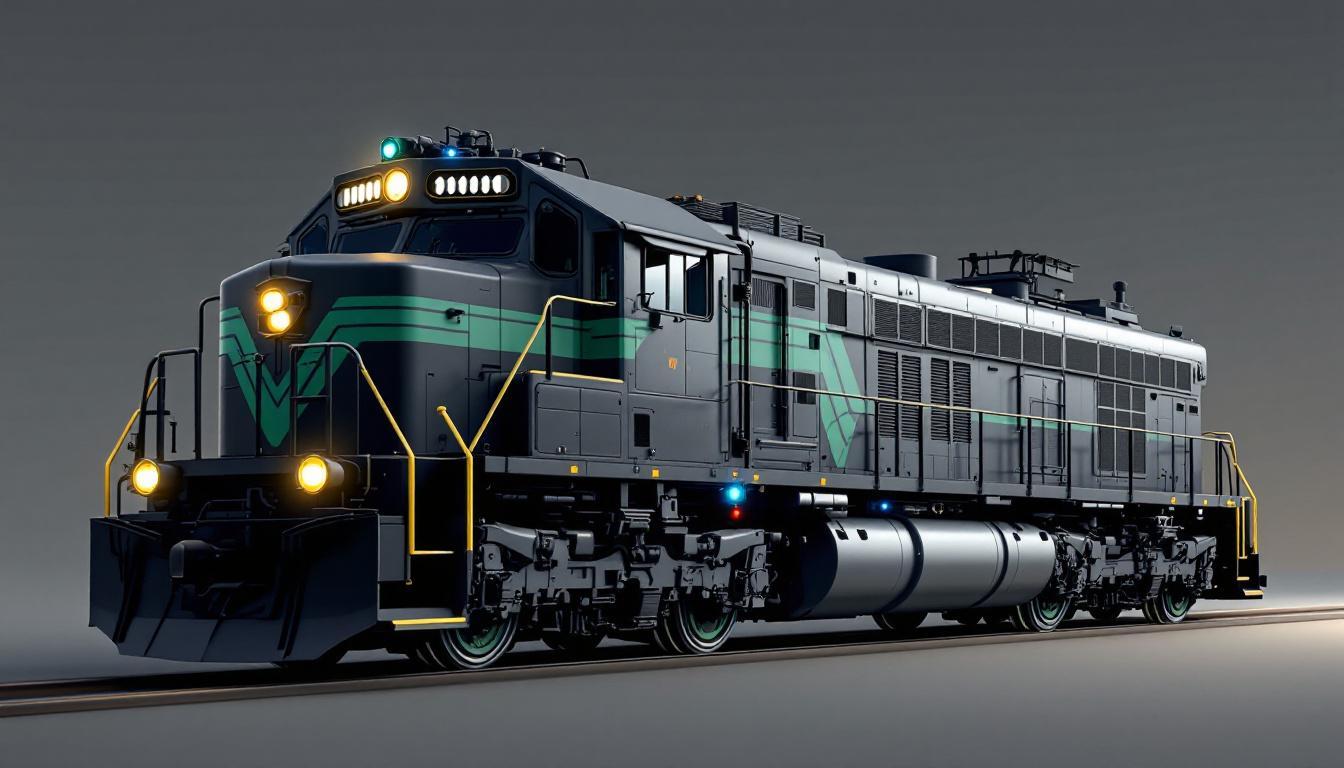
GB Railfreight partners with HyOrc to assess conversion of ageing diesel locomotives into hydrogen-capable units, offering a low-cost, staged route towards greener freight operations amid regulatory and funding challenges.
GB Railfreight has opened a pathway to converting ageing diesel traction to hydrogen-capable propulsion through a memorandum of understanding with US clean-energy developer HyOrc, a move aimed at decarbonising non-electrified freight routes without immediate fleet replacement.
Known as Project Phoenix, the non-binding agreement establishes a feasibility study to evaluate whether an existing freight locomotive’s diesel prime mover can be removed and replaced with HyOrc’s multi‑fuel generator set, scaled from the company’s one‑megawatt factory unit to an anticipated three‑megawatt locomotive installation. According to the announcement by GB Railfreight and HyOrc, the conversion would follow a staged fuel strategy: initial operation on natural gas or LPG to secure near‑term emissions cuts, with a subsequent shift to fully onboard hydrogen as refuelling infrastructure and supply chains mature. HyOrc says its onboard hydrogen conditioning is intended to improve energy efficiency and reduce the cost burden associated with compressed hydrogen logistics.
The proposal targets the long‑serving Class 66 fleet, which remains the backbone of UK freight despite not meeting contemporary emissions norms. GB Railfreight positions the approach as a way to extend the useful life of existing assets and bridge the gap while electrification and other alternatives develop. “Project Phoenix aligns with GBRf’s strategic commitment to lead the rail freight sector towards a more sustainable future and could play a key role in delivering our carbon reduction plan,” Alex Kirk, Commercial Director at GB Railfreight, said. “By retrofitting part of our existing fleet with multi‑fuel technology, it will offer a practical, low‑risk route to decarbonisation. It enables us to extend the value of current assets alongside the introduction of our new fleet of bi‑mode Class 99s.”
HyOrc’s retrofit model has been tried in programme designs for European and Asian markets and is being advanced alongside stationary power and green fuels projects. The company has described ongoing system integration with partners including ZELTECH and has highlighted preparatory work for pilot deployments abroad, notably with Dreamstar Lines in California, while stressing that timetables depend on customer agreements, permits and regulatory clearance. HyOrc has also been developing green methanol production projects in Europe as part of a broader low‑carbon fuels strategy.
Technical assessment in Project Phoenix will encompass integration within the UK loading gauge, tractive performance compared with diesel equivalents, range and refuelling logistics, and the route availability of converted units. Independent verification is already being referenced: HyOrc’s prototype generator system has undergone review by Bureau Veritas, and the pilot would build on that engineering baseline. Safety certification for carriage and storage of gaseous fuels and hydrogen will be a principal regulatory hurdle for any demonstrator.
GB Railfreight’s interest in retrofitting sits alongside its rolling introduction of Class 99 bi‑mode locomotives, outlined in its carbon reduction plan, which envisages the first of 30 Class 99s entering service and eventually replacing Class 66s as they reach the end of their service lives. The Class 99 design is modular, able to operate from overhead electrification and to run off‑wire on a Stage V diesel engine initially configured for renewable diesel, with the option to replace the diesel module with battery power in the future, according to GB Railfreight’s published plan.
HyOrc and GB Railfreight acknowledge the MoU is a framework for evaluation rather than a commitment to deliver conversions. Funding will be necessary to move from study to demonstrator, and HyOrc has said it is exploring structured support via the Connected Places Catapult accelerator to underpin project development. “Project Phoenix is a turning point for the rail industry,” Lisa Carter, CFO of HyOrc, said. “By retrofitting existing assets, we allow operators to decarbonise immediately, bypassing billions in new fleet costs. We are exploring obtaining structured funding through the [Uk government backed] Connected Places Catapult Accelerator.”
The proposed retrofit route presents several potential advantages for freight operators: lower upfront capital than full fleet replacement, incremental deployment to sustain operational availability, and a route to emissions reductions on corridors unlikely to be electrified in the near term. Industry observers note, however, that the approach depends on demonstrable parity in reliability and tractive effort with legacy diesel units, a tractable safety approval pathway for onboard hydrogen systems within UK regulatory practice, and a viable commercial model once fuel and lifecycle costs are factored in.
If progressed, Project Phoenix could offer a template for reducing emissions from diesel‑heavy freight fleets on routes where electrification is not imminent, complementing other decarbonisation measures such as bi‑mode locomotives, battery retrofits and investment in green fuels. Any demonstrator will need to clear funding, regulatory approval and a robust business case before conversions proceed from concept to revenue service.
- https://www.railfreight.com/technology/2026/02/24/gb-railfreight-explores-transition-to-hydrogen/ – Please view link – unable to able to access data
- https://www.globenewswire.com/news-release/2026/02/18/3240409/0/en/GB-Railfreight-and-HyOrc-sign-MOU-to-Advance-Rail-Decarbonisation-in-the-UK.html – GB Railfreight (GBRf) has signed a Memorandum of Understanding (MOU) with US clean technology company HyOrc Corporation to define a pilot pathway for retrofitting part of GBRf’s older diesel locomotive fleet with HyOrc’s zero-emission-ready propulsion technology. The collaboration, known as Project Phoenix, aims to replace the diesel engine of a legacy locomotive, demonstrating a practical, low-risk pathway for transitioning freight locomotives from diesel to sustainable fuels. A key benefit of Project Phoenix is its ability to avoid costly railway electrification infrastructure. The phased approach would initially reduce emissions through the use of onboard Natural Gas or LPG before transitioning to 100% onboard Hydrogen. This final step would be enabled by HyOrc’s proprietary Project Phoenix hydrogen-conditioning technology, designed to improve the economic viability of hydrogen utilisation.
- https://hyorc.com/locomotives/ – HyOrc is developing hydrogen and multi-fuel retrofit programmes for railways in Europe and Asia, alongside its work in stationary power and waste-to-fuel systems. The company’s approach centres on replacing diesel prime movers with gas engines capable of operating on multiple fuels, allowing operators to transition incrementally rather than adopting hydrogen-only traction. This model is intended to reduce capital exposure while maintaining fleet availability during conversion. The proposed UK pilot would scale HyOrc’s one-megawatt factory system, independently assessed by Bureau Veritas, to a three-megawatt locomotive installation. Project Phoenix would examine integration, performance and fuel storage, as well as the commercial case for retrofitting in a market dominated by ageing North American-designed locomotives.
- https://www.h2-tech.com/news/2025/12-2025/hyorc-issued-an-update-on-its-global-hydrogen-locomotive-and-green-methanol-initiatives/ – HyOrc Corporation provided a public update on its global initiatives following increased independent media coverage of the company’s locomotive program. Over the past week, multiple industry news outlets have reported on HyOrc’s work in hydrogen-ready locomotive retrofits and its partnership with Zero-Emission Locomotive Technologies, LLC (ZELTECH). This organic media attention reflects the growing interest in practical, cost-effective decarbonization solutions for heavy freight and passenger rail. HyOrc continues to mature its patented external-combustion engine platform, designed to operate on hydrogen, LPG & natural gas. The company is progressing through system integration steps with its partner ZELTECH, with additional engineering work underway to prepare the platform for pilot deployment with Dreamstar Lines in California (LA-SF) and other rail customers in the UK, EU and India. Deployment dates will depend on individual customer agreements, permitting, regulatory approvals, and operator scheduling.
- https://www.gbrailfreight.com/wp-content/uploads/2025/07/2025-07-21-GBRf-Carbon-Reduction-Plan.pdf – GB Railfreight (GBRf) has outlined its carbon reduction plan, which includes replacing diesel locomotives with Class 99 bi-mode locomotives. The first of the 30 Class 99s is projected to enter service in late 2025. These locomotives will initially be additional to the fleet but will start replacing the Class 66 diesel locomotives once they reach the end of their asset life. The Class 99s are bi-mode, modular locomotives, meaning they can run via electrified lines and, where the infrastructure is lacking, also utilise a Stage V diesel engine. This engine is the most efficient diesel engine of any freight locomotive, and GBRf has already committed to powering the Class 99s with renewable diesel, as and when electrification is not available. In addition, this engine is modular and designed so that the diesel engine can be replaced with a battery once the technology matches the ambition. The Class 99 will then be the first freight locomotive capable of delivering a fully-electric service anywhere on the rail network.
- https://www.globenewswire.com/news-release/2025/12/01/3197218/0/en/HyOrc-Issues-Update-on-Global-Hydrogen-Locomotive-and-Green-Methanol-Initiatives-As-Market-Interest-Grows.html – HyOrc Corporation provided an update on its global hydrogen locomotive and green methanol initiatives. The company is progressing through system integration steps with its partner ZELTECH, with additional engineering work underway to prepare the platform for pilot deployment with Dreamstar Lines in California (LA-SF) and other rail customers in the UK, EU, and India. Deployment dates will depend on individual customer agreements, permitting, regulatory approvals, and operator scheduling. In parallel, HyOrc’s Portugal green fuels joint venture continues to prepare for construction of its first green methanol facility. The project is designed around long-term offtake and project-finance-friendly structures, supporting the company’s broader European expansion strategy.
- https://www.gurufocus.com/news/3075423/hyorc-corporation-announces-effective-market-namesymbol-change-advances-green-methanol-projects-and-hydrogen-locomotive-program–aspz-stock-news – HyOrc Corporation (HYOR) has officially changed its trading symbol to HYOR, marking a significant step in its expansion within the clean energy market. The company previously traded under a different symbol, and this change reflects its growing presence in green fuel technologies. HyOrc is advancing its green methanol initiatives, with production facilities being developed in Scunthorpe, UK, and Porto, Portugal. Each of these plants is designed to produce up to 80 tons of green methanol daily, addressing the increasing demand for low-carbon marine fuels.
Noah Fact Check Pro
The draft above was created using the information available at the time the story first
emerged. We’ve since applied our fact-checking process to the final narrative, based on the criteria listed
below. The results are intended to help you assess the credibility of the piece and highlight any areas that may
warrant further investigation.
Freshness check
Score:
8
Notes:
The news article was published on February 24, 2026, and reports on a Memorandum of Understanding (MOU) signed between GB Railfreight and HyOrc Corporation to advance rail decarbonisation in the UK. The earliest known publication date of substantially similar content is February 18, 2026, indicating that the narrative has appeared before. The earlier version was published by GlobeNewswire and Nasdaq. ([globenewswire.com](https://www.globenewswire.com/news-release/2026/02/18/3240409/0/en/GB-Railfreight-and-HyOrc-sign-MOU-to-Advance-Rail-Decarbonisation-in-the-UK.html?utm_source=openai)) The article includes updated data but recycles older material, which raises concerns about its originality. Additionally, the narrative has appeared more than 7 days earlier, which further reduces the freshness score. Given these factors, the freshness score is 8.
Quotes check
Score:
6
Notes:
The article includes direct quotes from Alex Kirk, Commercial Director at GB Railfreight, and Lisa Carter, CFO of HyOrc. A search for the earliest known usage of these quotes reveals that they were first published in the GlobeNewswire article on February 18, 2026. ([globenewswire.com](https://www.globenewswire.com/news-release/2026/02/18/3240409/0/en/GB-Railfreight-and-HyOrc-sign-MOU-to-Advance-Rail-Decarbonisation-in-the-UK.html?utm_source=openai)) This suggests that the quotes are original to the current article. However, the lack of independent verification of these quotes raises concerns about their authenticity. Given these factors, the quotes score is 6.
Source reliability
Score:
7
Notes:
The article originates from RailFreight.com, a niche publication focusing on rail freight news. While it is reputable within its niche, its reach and influence are limited compared to major news organisations. Additionally, the article appears to be summarising or rewriting content from a press release issued by HyOrc Corporation, which is a corporate source. This raises concerns about the independence and potential bias of the source. Given these factors, the source reliability score is 7.
Plausibility check
Score:
7
Notes:
The article reports on a collaboration between GB Railfreight and HyOrc Corporation to retrofit diesel locomotives with zero-emission-ready propulsion technology. This aligns with industry trends towards decarbonisation in the rail sector. However, the lack of supporting detail from other reputable outlets and the recycling of older material without substantial new information raises questions about the novelty and impact of the claim. Given these factors, the plausibility score is 7.
Overall assessment
Verdict (FAIL, OPEN, PASS): FAIL
Confidence (LOW, MEDIUM, HIGH): MEDIUM
Summary:
The article has been flagged for several concerns, including recycling of older material, reliance on a corporate press release, and lack of independent verification of quotes. These issues raise questions about the originality, independence, and accuracy of the content. Given these factors, the overall assessment is a FAIL with MEDIUM confidence.
