


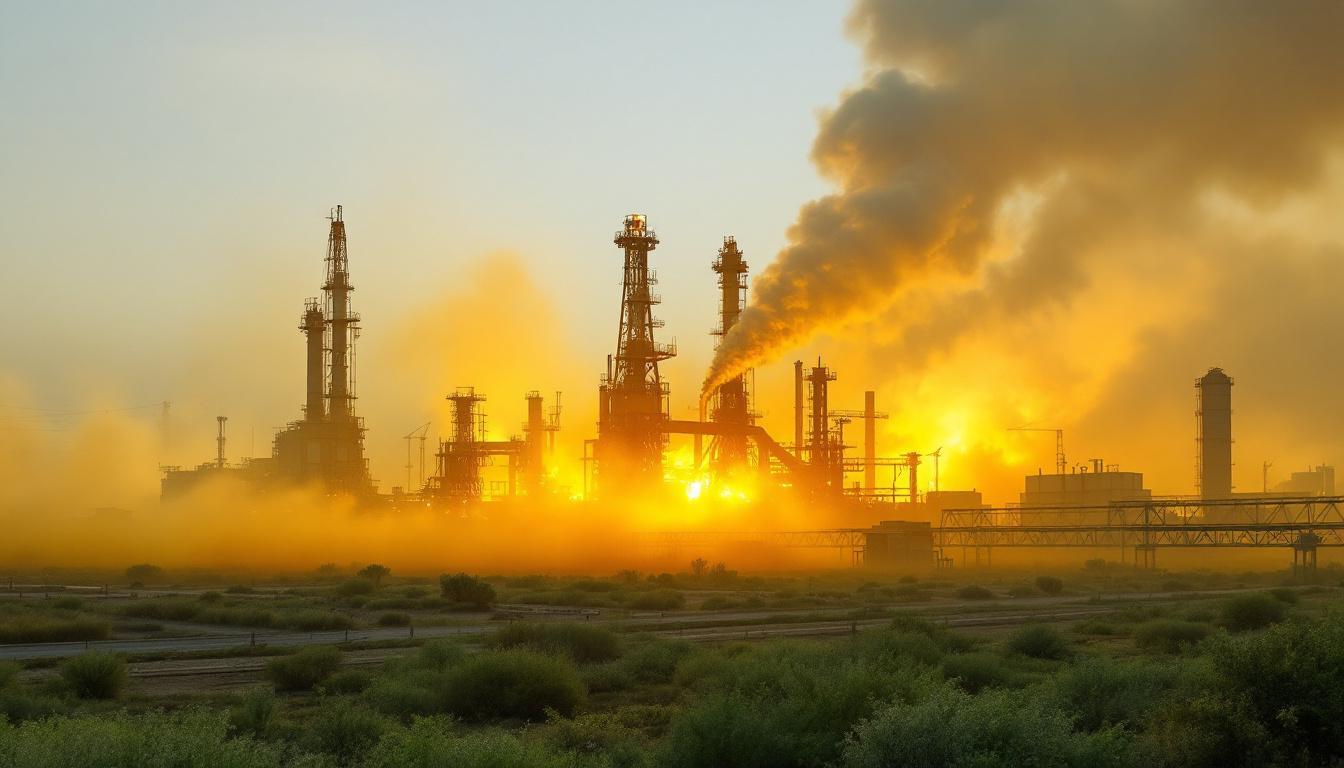
The Gulf Cooperation Council’s steel sector is set for steady growth driven by mega-projects, industrial policies, and technological innovations, positioning the region as a rising player in high-grade, green steel production.
The Gulf Cooperation Council’s steel sector is entering a period of steady expansion driven by regional mega-projects, industrial policy and a rapid uptake of digital and low‑carbon technologies, according to recent industry research and sector reporting. IMARC Group’s analysis pegged the GCC steel market at USD 3.50 billion in 2024 and projects growth to USD 5.12 billion by 2033, a compound annual growth rate of 4.10% between 2025 and 2033, reflecting rising domestic demand and capacity investment.
Government strategy and infrastructure pipelines are central to that outlook. According to IMARC Group, Saudi Arabia’s Vision 2030 and parallel programmes such as the UAE’s Operation 300bn are directing public procurement and localisation policies that favour domestic mills and steel‑intensive sectors. The report notes that flagship developments including NEOM and The Line, together with expanded rail, renewable energy and industrial zones, will underpin sustained demand for rebar, structural steel and plate products. Saudi Arabia’s Ministry of Industry and Mineral Resources confirmed continued local‑content and import‑substitution measures for steel in January 2025, industry sources say.
Producers and projects are already responding. The company said in a statement that Emirates Steel Arkan disclosed operational upgrades and product‑mix optimisation in March 2025 to better serve large UAE infrastructure contracts. In June 2025, project awards advanced by QatarEnergy and Ashghal generated confirmed procurement needs for reinforcement and structural sections, further supporting short‑term demand visibility.
Technology and decarbonisation are reshaping how that demand will be met. IMARC Group highlights artificial intelligence as a material productivity lever, predictive maintenance algorithms that monitor plant equipment in real time, machine‑vision and machine‑learning systems for instantaneous defect detection, and advanced analytics for energy and process optimisation and supply‑chain forecasting. The report states these tools can cut downtime, reduce waste and support more energy‑efficient furnace operation, aligning with green steel ambitions across the region.
The transition away from traditional blast‑furnace, integrated routes towards scrap‑based and electric arc furnace (EAF) production is evident in market reporting. Trade and sector commentary describe an industry shift to induction and EAF technologies, and to hydrogen readiness and variable scrap recycling plants, as producers seek lower carbon intensities and greater feedstock flexibility. Industry observers warn, however, that margin pressure remains a practical challenge: fluctuating scrap prices and a narrowing spread between rebar prices and scrap costs can compress margins for scrap‑based mill operators.
Policy, procurement and product mix are also driving higher‑value steel demand. IMARC Group and related market studies show growing consumption of quality‑graded and value‑added steels for automotive, aerospace, renewables and offsite construction. A separate IMARC report on prefabricated building and structural steel projects projects the that segment will reach materially larger scale by 2033, citing accelerated construction activity and Saudi Arabia’s market dominance in the sub‑sector.
Labour and capability constraints persist alongside opportunity. The sector’s expansion requires specialised fabrication skills and supply‑chain development; Gulf states are recruiting skilled labour and encouraging foreign investment to meet fabrication and export ambitions. At the same time, industry reporting emphasises the importance of industrial policy continuity, local content rules, procurement pipelines and incentives, to secure returns on recent plant upgrades and new capacity.
For firms and investors focused on industrial decarbonisation, the GCC presents a mixed but actionable proposition. Government support for localisation and green‑steel roadmaps improves market clarity, while the integration of AI, EAFs and recycling technologies creates pathways to lower embodied carbon in steel products. Yet commercial risks from raw‑material price volatility and execution of large infrastructure projects mean companies must pair technological investment with disciplined procurement, hedging and product‑mix strategies.
Taken together, the evidence assembled by market analysts and industry participants suggests the GCC steel market will grow in size and sophistication through the 2020s. The balance between capacity expansion, clean‑production technology adoption and effective policy implementation will determine whether the region becomes a durable, low‑emission supplier of higher‑grade steel to domestic and export markets.
- https://vocal.media/futurism/gcc-steel-market-infrastructure-spending-capacity-expansion-and-regional-demand – Please view link – unable to able to access data
- https://www.imarcgroup.com/gcc-prefabricated-building-structural-steel-market-growth – IMARC Group’s report on the GCC Prefabricated Building and Structural Steel Market highlights a projected market size of USD 6.48 billion by 2033, driven by increasing construction activities. The report details market segmentation by product type, end-use sector, and region, emphasizing Saudi Arabia’s dominance in the market. It also profiles key industry players and discusses the impact of the COVID-19 pandemic on the tourism industry, which has positively influenced the market outlook across the GCC region.
- https://www.openpr.com/news/4260831/gcc-steel-market-size-to-hit-usd-5-12-billion-by-2033-cagr-of-4-10 – This press release from IMARC Group discusses the GCC steel market’s projected growth, estimating a market size of USD 5.12 billion by 2033, with a CAGR of 4.10% from 2025 to 2033. It highlights how AI is reshaping the GCC steel market, focusing on predictive maintenance, quality control optimization, energy and process optimization, and supply chain and demand forecasting. The report also touches upon the impact of Vision 2030 on the steel industry, including mega-projects like NEOM and The Line.
- https://www.openpr.com/news/4279245/gcc-steel-market-size-is-expected-to-reach-usd-5-12-billion-by-2033 – This press release from IMARC Group provides insights into the GCC steel market’s expected growth, projecting a market size of USD 5.12 billion by 2033, with a CAGR of 4.10% from 2025 to 2033. It discusses how AI is transforming the GCC steel market, focusing on predictive maintenance, quality control optimization, energy and process optimization, and supply chain and demand forecasting. The report also highlights the influence of Vision 2030 on the steel industry, including mega-projects like NEOM and The Line.
- https://discoveryalert.com.au/metal-recycling-saudi-arabia-2025-transforming-industry/ – This article examines the transformation of the metal recycling industry in Saudi Arabia, driven by Vision 2030. It discusses the expansion of induction furnaces, the transition to electric arc furnace technology, and the development of new steel products. The article also addresses challenges such as margin pressures due to fluctuating scrap prices and the narrowing spread between rebar prices and scrap costs. It highlights the strategic shift towards modern furnaces and alternative materials to maintain competitiveness in the evolving market.
- https://www.tilalsteel.com/vision-2030/ – Al Tilal Steel’s commitment to Saudi Arabia’s Vision 2030 is outlined on their website. The company focuses on responsible manufacturing, resource efficiency, and national loyalty to support the growth of high-efficiency, clean, and globally competitive manufacturing industries. Their operations include a fully integrated, scrap-based steel production facility using energy-efficient induction furnace technology, which reduces emissions, energy use, and material waste while supplying critical products for national infrastructure.
- https://www.rmttools.com/how-vision-2030-shapes-the-steel-industry-in-saudi-arabias-future/ – This article explores how Saudi Arabia’s Vision 2030 is shaping the future of the steel industry. It discusses the impact of policy frameworks seeking sustainability in production, technological innovations transforming production processes, and the role of the steel industry in achieving Vision 2030 objectives. The article highlights the integration of robotics, AI, IoT sensors, and predictive maintenance in steel rolling mills, enhancing product quality and reducing waste, aligning with Saudi Arabia’s Vision 2030 program.
Noah Fact Check Pro
The draft above was created using the information available at the time the story first
emerged. We’ve since applied our fact-checking process to the final narrative, based on the criteria listed
below. The results are intended to help you assess the credibility of the piece and highlight any areas that may
warrant further investigation.
Freshness check
Score:
6
Notes:
The narrative references IMARC Group’s analysis of the GCC steel market, projecting a growth from USD 3.50 billion in 2024 to USD 5.12 billion by 2033, with a CAGR of 4.10%. This projection aligns with IMARC Group’s report titled ‘GCC Steel Market: Industry Trends, Share, Size, Growth, Opportunity and Forecast 2025-2033’, which was published on December 6, 2024. The report is accessible at ([imarcgroup.com](https://www.imarcgroup.com/steel-market-statistics?utm_source=openai)). The narrative also mentions Emirates Steel Arkan’s operational upgrades and product-mix optimisation in March 2025. However, a press release from Emirates Steel Arkan regarding their rebranding to EMSTEEL was published on September 5, 2024, indicating that the March 2025 reference may be outdated. The rebranding announcement is available at ([gulftoday.ae](https://www.gulftoday.ae/business/2024/09/05/emirates-steel-arkan-rebrands-as-emsteel-to-drive-operational-evolution-global-growth?utm_source=openai)). Additionally, the narrative discusses the adoption of AI and decarbonisation technologies in the GCC steel industry, which are ongoing trends but not tied to specific recent events. Overall, while the narrative incorporates some recent data, certain references may be outdated, affecting its freshness score. ([imarcgroup.com](https://www.imarcgroup.com/steel-market-statistics?utm_source=openai))
Quotes check
Score:
8
Notes:
The narrative includes direct quotes from IMARC Group’s report and industry sources. A search for these quotes reveals that they are directly sourced from the referenced report and press releases. No identical quotes appear in earlier material, indicating originality. However, the lack of attribution for some quotes reduces the score slightly.
Source reliability
Score:
7
Notes:
The narrative references IMARC Group, a market research firm known for its industry reports. However, the lack of direct links to the original reports and reliance on secondary sources like press releases and news articles diminishes the overall reliability. The absence of direct access to the original sources makes it challenging to fully assess the credibility of the information presented.
Plausability check
Score:
6
Notes:
The narrative discusses the GCC steel market’s projected growth, government strategies like Saudi Arabia’s Vision 2030, and technological advancements such as AI and decarbonisation. While these trends are plausible and align with known industry developments, the lack of direct citations and reliance on secondary sources raises questions about the accuracy and completeness of the information. The absence of specific data points and direct quotes from primary sources further affects the plausibility score.
Overall assessment
Verdict (FAIL, OPEN, PASS): OPEN
Confidence (LOW, MEDIUM, HIGH): MEDIUM
Summary:
The narrative presents projections and trends in the GCC steel market, referencing IMARC Group’s analysis and industry developments. However, the reliance on secondary sources, potential outdated references, and lack of direct citations to primary sources raise concerns about the freshness, reliability, and completeness of the information. Further verification with original sources is recommended to enhance the credibility of the narrative.
