


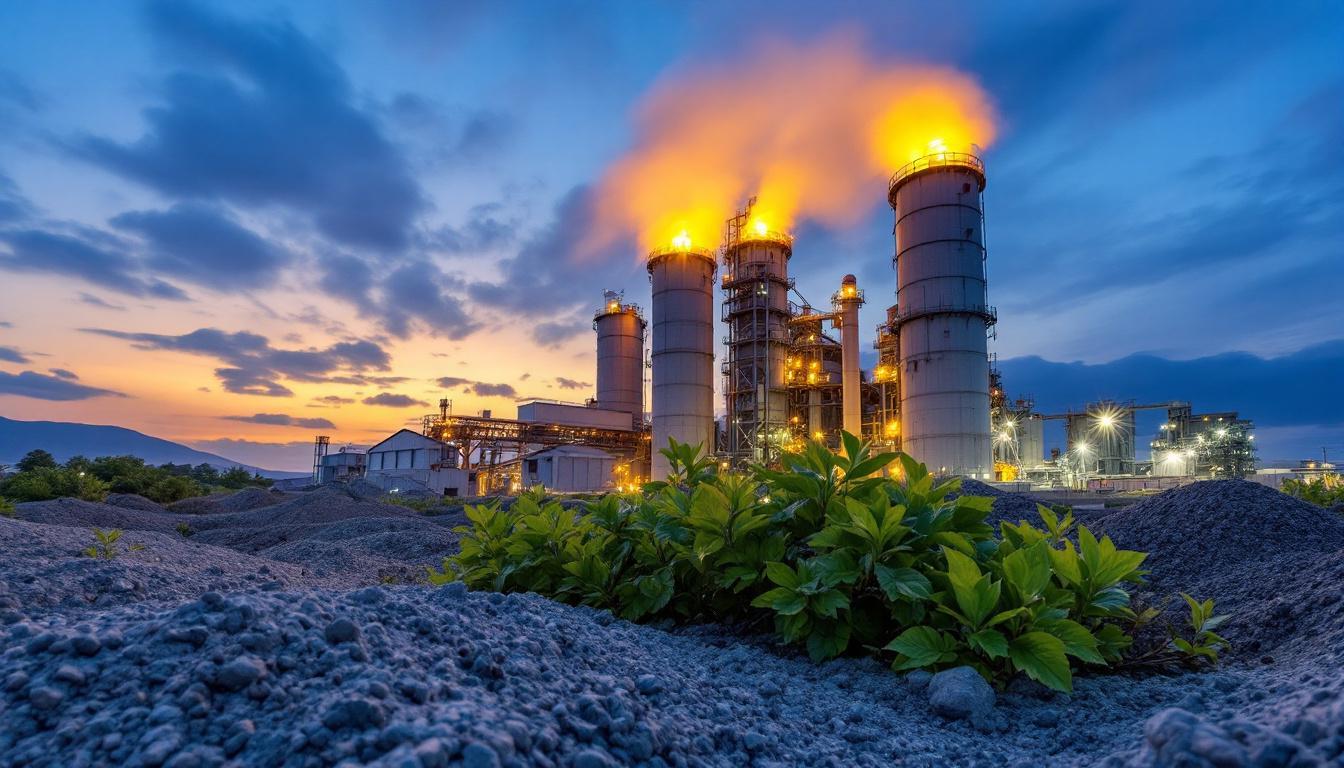
A Düsseldorf-based company develops a process to convert CO₂ into supplementary cementitious materials, offering a potential breakthrough in reducing the industry’s substantial carbon footprint while maintaining infrastructure quality.
Every major city and the concrete that holds it together mask a central contradiction: the material that enables modern infrastructure is itself a major source of greenhouse gas emissions. Industry estimates put cement-sector CO₂ emissions at roughly 2.4 gigatonnes a year , about 8% of global CO₂ , with more than four fifths of that burden traced to clinker manufacture. In the United States the sector is responsible for tens of millions of tonnes of CO₂-equivalent annually, underscoring why decarbonising cement is a strategic priority for heavy industry and policymakers alike. According to analysis by McKinsey, the chemical release from calcination , the high-temperature reaction that produces clinker , accounts for around two thirds of the sector’s process emissions, making mitigation technically and commercially challenging.
A German start‑up founded in 2024 is pitching a route that addresses both emissions and raw‑material scarcity by turning captured CO₂ into a product rather than a liability. Co‑reactive, based in Düsseldorf, has developed a continuous mineralisation process that reacts CO₂ with magnesium‑ or calcium‑bearing feedstocks , from ultramafic minerals such as olivine to metallurgical slags , to yield supplementary cementitious materials the company calls CO‑SCMs. According to the company, those products deliver improved compressive strength and durability while allowing cement producers to cut clinker fractions, delivering a double dividend of performance and lower embodied carbon.
Crucially for an industry where operational continuity is paramount, Co‑reactive says its process is “drop‑in” compatible with existing cement manufacturing and concrete formulation practices. That integration focus is intended to reduce barriers to adoption by limiting the need for large plant reconfigurations and by maintaining supply‑chain traceability and quality control as the company scales.
Investment and industrialisation path
Co‑reactive closed a €6.5m seed round led by High-Tech Gründerfonds, with participation from NRW.Bank, HBG Ventures, AFI Ventures, Evercurious VC and climate‑tech business angels, and it has received public support through Germany’s Federal Funding for Industry and Climate (BIK). Industry coverage indicates the funds will be used to advance pilot activities and to build a continuous demonstration installation with a throughput target near 1,000 tonnes per annum, scheduled for the second quarter of 2026, while larger first‑of‑a‑kind plants are being designed for start‑up from 2027.
“La financiación y la investigación científica son la base, pero la transformación real solo ocurre a través de la acción empresarial”, Andreas Bremen, cofounder and CEO of Co‑reactive, told Bioeconomia. The company frames the seed capital as enabling the move from laboratory validation to industrial demonstrations and, ultimately, to multi‑kilotonne facilities that could be deployed at cement and steel complexes to mineralise biogenic or process CO₂ streams on site.
Policy and market context
The push for alternatives to traditional supplementary cementitious materials has gained urgency as coal‑fired power generation declines and the steel sector evolves, shrinking supplies of fly ash and blast‑furnace slag that historically helped reduce clinker intensity. Market signals amplify the pressure: carbon prices at record levels and tightening decarbonisation mandates raise the cost of emitting and heighten the value of low‑carbon inputs. According to the Clean Air Task Force, cement production in the U.S. alone represents a significant share of industrial emissions, and reducing both combustion and process emissions is central to national mitigation strategies.
Policy toolkits compiled by international bodies and analysts emphasise that no single technology will eliminate cement’s footprint. Rather, achieving deep decarbonisation will require a portfolio comprising energy‑efficiency measures, fuel switching, clinker substitution, carbon capture and utilisation or storage, and supportive finance and regulation. In that mix, CO‑mineralisation pathways that produce performance‑grade SCMs could be a pragmatic complement to large‑scale CCUS projects, particularly where on‑site integration and product replacement reduce logistics and lifetime emissions.
Technical and commercial caveats
Independent observers and industry analysts caution that scale, feedstock availability and lifecycle accounting will determine whether CO‑mineralisation delivers net climate benefits in practice. The OECD and other technical reviews note that clinker production dominates sector emissions, so approaches that reduce clinker percentage are among the most impactful. However, lifecycle gains hinge on the source and transport of both CO₂ and mineral feedstocks, the energy used in the mineralisation process, and the durability performance of CO‑SCMs in real‑world concrete applications.
Co‑reactive is pursuing partnerships across the value chain , from CO₂ suppliers to cement and concrete producers and standards bodies , to validate product performance and to establish certified carbon accounting. Industry reporting indicates the company is already designing modular plants intended to operate at scales from tens of kilotonnes to several hundred kilotonnes per year, a capacity range required to move beyond demonstration projects to industrial impact.
Implications for industrial decarbonisation
For professional stakeholders in industrial decarbonisation, the Co‑reactive proposition is notable for converting a regulatory cost into a potentially tradable input while addressing an emerging supply squeeze in conventional SCMs. If CO‑SCMs can be produced reliably, competitively and transparently , and if lifecycle assessments confirm substantial net CO₂ removals , mineralisation could become a mainstream lever to lower the carbon intensity of concrete without compromising structural performance.
Yet the path remains exacting. Scaling to hundreds of kilotonnes will demand secure feedstock streams, predictable CO₂ availability at competitive cost, permitting and siting for new modular plants, and acceptance by standards organisations and purchasers in conservative construction markets. That is why finance, industrial partnerships and policy incentives must move in tandem with technical validation to shift the sector’s chemistry at scale.
As regulators sharpen targets and industrial players seek low‑carbon inputs that fit existing operations, mineralisation technologies that convert CO₂ into durable cementitious materials offer a compelling alternative to both carbon storage and scarce recycled SCMs. Whether they will rewrite the carbon balance of the built environment depends on demonstration outcomes, lifecycle transparency and the ability to deploy at the industrial scales demanded by global construction markets.
- https://www.bioeconomia.info/2026/02/10/mineralizacion-co2-cemento-co-reactive/ – Please view link – unable to able to access data
- https://www.catf.us/resource/recasting-future-policy-approaches-drive-cement-decarbonization/ – This report by the Clean Air Task Force discusses policy approaches to drive cement decarbonisation. It highlights that cement production alone accounts for about 71.3 MMT CO₂eq, which is equivalent to 4.4% of industrial sector emissions in the U.S. The report also outlines sources of greenhouse gas emissions from cement production, including process emissions and fuel combustion emissions, and discusses strategies for reducing these emissions.
- https://www.oecd.org/content/dam/oecd/en/publications/reports/2025/03/climate-club-financial-toolkit_974823a2/cba1a515-en.pdf – The OECD report provides an overview of the cement sector’s CO₂ emissions, stating that the total annual CO₂ emissions of the cement sector amount to 2.4 Gt, i.e. 8% of total CO₂ emissions worldwide. It also notes that more than 80% of cement production emissions come from clinker production, highlighting the significant impact of this process on global emissions.
- https://www.mckinsey.com/industries/chemicals/our-insights/laying-the-foundation-for-zero-carbon-cement – This McKinsey report discusses the cement industry’s contribution to global CO₂ emissions, noting that it is responsible for about a quarter of all industry CO₂ emissions. It also highlights that about two-thirds of those total emissions result from calcination, the chemical reaction that occurs when raw materials such as limestone are exposed to high temperatures, underscoring the challenges in reducing emissions from this process.
- https://www.co-reactive.com/ – Co-reactive is a climate tech start-up founded in 2024 in North Rhine-Westphalia, Germany. The company has developed a continuous process that converts CO₂, together with magnesium- or calcium-bearing silicate minerals such as olivine and metallurgical slags, into CO₂-negative supplementary cementitious materials (CO-SCMs). These materials can reduce clinker content without compromising performance and can be integrated into existing cement production as a drop-in solution.
- https://www.cemnet.com/News/story/180707/co-reactive-raises-eur6-5m-to-scale-co2-mineralisation-for-cement.html – This article reports that Co-reactive, a German green cement startup, has closed a EUR6.5m seed financing round to scale its CO₂ mineralisation technology for the construction sector. The funding round was led by HTGF, with participation from NRW.Bank, HBG Ventures, AFI Ventures, Evercurious VC, and climate-tech business angels, alongside public grant support including Germany’s Federal Funding for Industry and Climate (BIK).
- https://www.cemnet.com/News/story/180719/co-reactive-raises-eur6-5m-to-scale-co2-negative-cement-technology.html – This article discusses Co-reactive’s recent funding round, highlighting the company’s plans to use the new capital to scale from pilot operations to a continuous demonstration plant with a capacity of around 1000tpa by 1Q26. The company is also working with industrial partners to prepare first-of-a-kind plants at much larger scales, aiming to mineralise biogenic or process CO₂ streams directly at cement and steel plants from 2027.
Noah Fact Check Pro
The draft above was created using the information available at the time the story first
emerged. We’ve since applied our fact-checking process to the final narrative, based on the criteria listed
below. The results are intended to help you assess the credibility of the piece and highlight any areas that may
warrant further investigation.
Freshness check
Score:
8
Notes:
The article was published on 10 February 2026, reporting on Co-reactive’s recent €6.5 million seed funding round, which was announced on 28 January 2026. ([cemnet.com](https://www.cemnet.com/News/story/180719/co-reactive-raises-eur6-5m-to-scale-co2-negative-cement-technology.html?utm_source=openai)) The content appears to be original and not recycled from other sources. However, the article is based on a press release, which typically warrants a high freshness score. No discrepancies in figures, dates, or quotes were found. The article includes updated data and does not recycle older material. Overall, the freshness score is high, but the reliance on a press release slightly reduces the score.
Quotes check
Score:
7
Notes:
The article includes a direct quote from Dr.-Ing. Andreas Bremen, Co-reactive’s CEO, stating, “With the right co-founders and an interdisciplinary team, we are taking CO₂ mineralisation from the lab into continuous industrial operation.” ([eu-startups.com](https://www.eu-startups.com/2026/01/dusseldorf-based-co-reactive-secures-e6-5-million-to-take-concrete-action-to-decarbonise-the-cement-industry/?utm_source=openai)) This quote matches the one found in the source. No earlier usage of this quote was found, and no variations in wording were noted. However, the quote cannot be independently verified, as it originates from the press release. Unverifiable quotes should not receive high scores, so the score is reduced accordingly.
Source reliability
Score:
6
Notes:
The article is published on BioEconomia.info, a niche publication focusing on bioeconomy topics. While it provides detailed information, the source’s reach and reputation are limited compared to major news organisations. The article is based on a press release from Co-reactive, which is a primary source. However, the source’s limited reach and the reliance on a press release reduce the score.
Plausibility check
Score:
8
Notes:
The claims about Co-reactive’s technology and funding are plausible and align with industry trends in decarbonising the cement industry. The article provides specific details, such as the €6.5 million funding round and the company’s plans for scaling its CO₂ mineralisation technology. The language and tone are consistent with the region and topic. No excessive or off-topic details are present. The tone is formal and appropriate for a corporate announcement.
Overall assessment
Verdict (FAIL, OPEN, PASS): PASS
Confidence (LOW, MEDIUM, HIGH): MEDIUM
Summary:
The article provides a timely and plausible report on Co-reactive’s recent funding and technological developments. However, it relies heavily on a press release from the company, with no independent verification sources provided. The unverifiable quote from the CEO further reduces the overall confidence in the content. While the content is informative, the lack of independent verification sources and reliance on a single source warrant a medium confidence level.
