


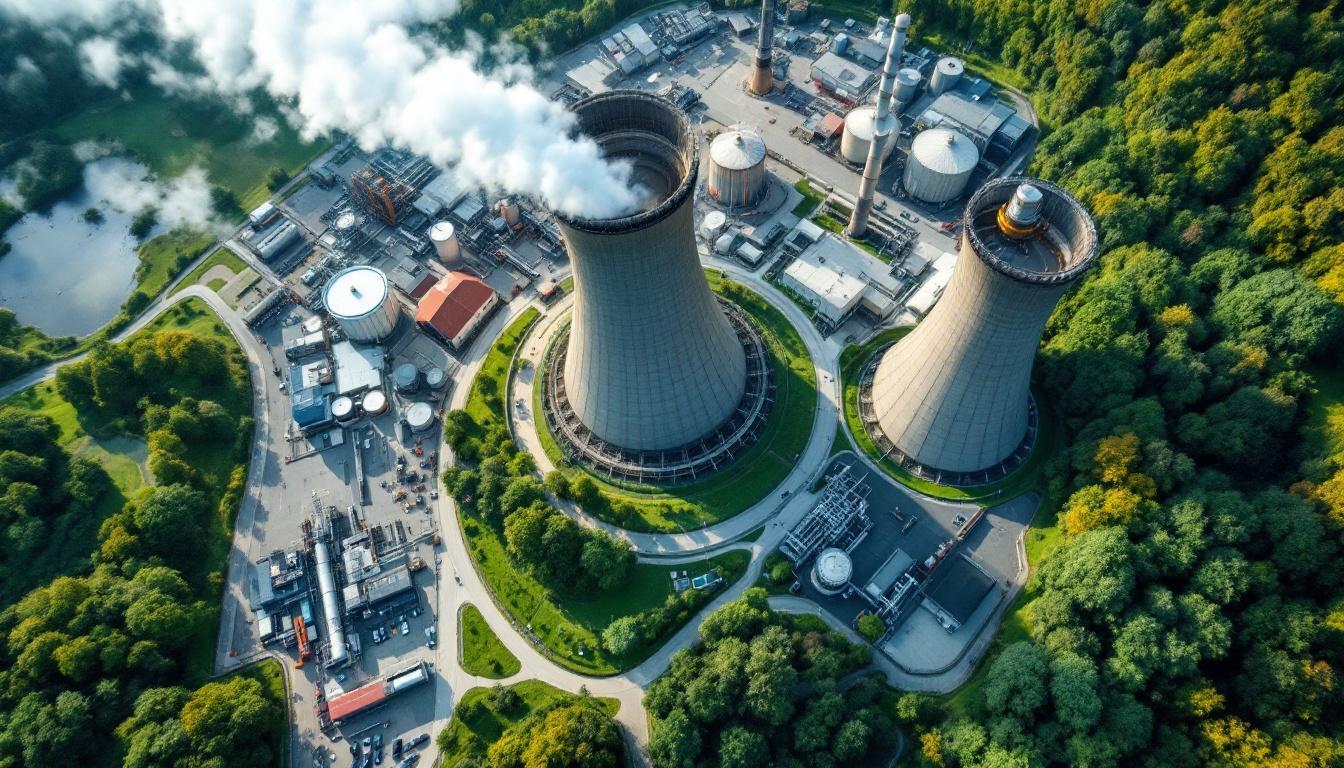
Concrete Chemicals, a joint venture between ENERTRAG and Zaffra, secures €350 million in public financing for Europe’s largest industrial power-to-liquid plant in Schwedt, aiming to produce sustainable aviation fuels and reduce CO2 emissions.
Concrete Chemicals, the joint venture formed by ENERTRAG and Zaffra, has secured a package of public financing totalling €350 million to develop what the partners describe as Germany’s largest industrial-scale power-to-liquid plant for synthetic aviation fuels, pending final approval by the European Commission.
The facility is proposed for Schwedt in Brandenburg and, according to ENERTRAG’s announcement, will convert renewable hydrogen and biogenic carbon dioxide into synthetic kerosene and related products. The project’s planned annual output exceeds 37,000 tonnes of electro‑SAF and a further 7,000 tonnes of e‑naphtha. ENERTRAG has said the scheme could avoid at least 100,000 tonnes of fossil CO2 emissions each year.
Concrete Chemicals has reached agreements for local CO2 supply with recycled paper and cardboard producer LEIPA Georg Leinfelder. Renewable hydrogen is expected to be supplied via Germany’s national Hydrogen Core Network, although that route depends on the network’s completion and any remaining regulatory clearances. The funding package has already been approved at national and state level and, the companies say, is now in the European Commission’s final review phase under the EU’s state‑aid and climate support framework.
Technical planning work is due to begin immediately, with the joint venture targeting a final investment decision by 2027. The partners framed the project as a contribution to Europe’s industrial hydrogen economy and a step towards greater energy sovereignty, language reflected in the companies’ press material.
The plant is being touted as a means to help meet EU policy on sustainable aviation fuels. Under ReFuelEU Aviation, member states must ensure that at least 1.2% of jet fuel supplied at EU airports is synthetically derived by 2030, and the European Commission has recently committed more than €2.9 billion through its Sustainable Transport Investment Plan to accelerate decarbonisation in aviation and shipping. Industry reporting notes the Concrete Chemicals project was financed under provisions of the EU’s Climate, Energy and Environmental Aid Guidelines.
While the JV highlights the potential emissions savings and the scale of the planned output, key elements remain contingent: the Commission’s formal approval of the subsidy package, confirmation of hydrogen delivery from the national network, and the FID timeline. If those milestones are met, the Schwedt plant would add a sizeable industrial‑scale PtL capacity to Europe’s nascent e‑fuel sector, helping airlines and fuel suppliers manage increasing SAF blending obligations.
- https://www.h2-view.com/story/final-eu-funding-decision-inbound-for-e350m-german-esaf-plant/2137063.article/?utm_source=gw&utm_medium=rss_feed&utm_campaign=rss – Please view link – unable to able to access data
- https://enertrag.com/news-and-press/press-releases/2026/concrete-chemicals-receives-350-million-funding-for-germanys-largest-industrial-scale-e-saf-plant – Concrete Chemicals GmbH has secured €350 million in public funding to establish Germany’s largest industrial-scale Electro-Sustainable Aviation Fuels (e-SAF) production facility. The funding, approved at national and regional levels, is currently under final review by the European Commission. This initiative aims to accelerate the development of a competitive clean hydrogen economy and enhance the EU’s energy sovereignty. The project is planned for Schwedt, Brandenburg, and will utilise biogenic CO₂ and renewable hydrogen to produce synthetic kerosene, with an annual capacity exceeding 37,000 tonnes of e-SAF and 7,000 tonnes of e-naphtha, contributing to a reduction of at least 100,000 tonnes of fossil CO₂ emissions annually.
- https://www.safinvestor.com/news/149444/concrete-chemicals/ – Concrete Chemicals, a joint venture between Zaffra and ENERTRAG, has secured €350 million in public funding under the EU’s Climate Energy and Environmental Aid Guidelines (CEEAG) framework. The funding, approved at national and regional levels, is in the final phase of review by the European Commission. The project aims to develop a power-to-liquid synthetic kerosene facility in Schwedt, Germany, with an annual capacity of over 37,000 tonnes of e-SAF and 7,000 tonnes of e-naphtha. The technical planning phase is set to begin immediately, with a final investment decision targeted by 2027, aligning with the EU’s ReFuelEU Aviation Regulation mandating at least 1.2% of jet fuel supplied at EU airports to be synthetically derived by 2030.
- https://www.renewable-energy-industry.com/countries/article-7201-germanys-largest-e-saf-facility-eur350-million-funding-for-power-to-liquid-project-in-schwedt – The joint venture Concrete Chemicals, consisting of ENERTRAG and Zaffra, has received €350 million in funding to build Germany’s largest industrial-scale production facility for sustainable aviation fuels (e-SAF) in Schwedt. The funding, approved at national and state levels, is currently under final review by the European Commission. The project aims to accelerate the development of a competitive clean hydrogen economy and strengthen the EU’s energy sovereignty. The facility will utilise biogenic CO₂ and renewable hydrogen to produce synthetic kerosene, with an annual capacity of over 37,000 tonnes of e-SAF and 7,000 tonnes of e-naphtha, contributing to a reduction of at least 100,000 tonnes of fossil CO₂ emissions annually.
- https://www.indexbox.io/blog/concrete-chemicals-secures-350m-for-germanys-largest-e-saf-plant-in-brandenburg/ – Concrete Chemicals GmbH has secured €350 million in public funding to build the largest industrial-scale production facility for Electro-Sustainable Aviation Fuels (e-SAF) in Germany. The funding, approved at national and regional levels, is under final review by the European Commission. The project, planned for Schwedt in Brandenburg, will utilise a Power-to-Liquid (PtL) process, combining biogenic CO₂ from a cooperation with local paper manufacturer LEIPA Georg Leinfelder GmbH and renewable hydrogen to produce synthetic kerosene. The planned annual production capacity is more than 37,000 tonnes, comprising 30,000 tonnes of e-SAF and 7,000 tonnes of e-naphtha, expected to reduce fossil CO₂ emissions by at least 100,000 tonnes per year.
- https://hydrogen-central.com/enertrag-concrete-chemicals-receives-e350-million-funding-for-germanys-largest-industrial-scale-e-saf-plant/ – Concrete Chemicals GmbH has secured €350 million in public funding to establish Germany’s largest industrial-scale Electro-Sustainable Aviation Fuels (e-SAF) production facility. The funding, approved at national and regional levels, is currently under final review by the European Commission. This initiative aims to accelerate the development of a competitive clean hydrogen economy and enhance the EU’s energy sovereignty. The project is planned for Schwedt, Brandenburg, and will utilise biogenic CO₂ and renewable hydrogen to produce synthetic kerosene, with an annual capacity exceeding 37,000 tonnes of e-SAF and 7,000 tonnes of e-naphtha, contributing to a reduction of at least 100,000 tonnes of fossil CO₂ emissions annually.
- https://www.h2-view.com/story/final-eu-funding-decision-inbound-for-e350m-german-esaf-plant/2137063.article/?utm_source=gw&utm_medium=rss_feed&utm_campaign=rss – Energtrag and Zaffra have secured €350 million in public funding to build Germany’s largest green hydrogen-based e-fuel plant, subject to EU approval. The joint venture, Concrete Chemicals, plans to use the funding for a power-to-liquid synthetic kerosene facility with a planned annual capacity of over 37,000 tonnes of e-SAF and 7,000 tonnes of e-naphtha. The facility, planned for construction in Schwedt on Germany’s eastern border, will utilise biogenic carbon dioxide and green hydrogen as feedstocks. CO₂ will be sourced locally through an agreement with recycled paper and cardboard products maker LEIPA Georg Leinfelder, and hydrogen will be sourced from Germany’s national Hydrogen Core Network, subject to its completion and regulatory approvals. The funding has been approved at national and regional levels, with the European Commission review now in its final phase. The joint venture intends to make a final investment decision by 2027, with production expected to support EU SAF mandates. Under the EU’s RefuelEU Aviation plan, at least 1.2% of jet fuel supplied at EU airports must be synthetically derived by 2030. The EU has also recently pledged over €2.9 billion through various programmes to decarbonise aviation and shipping in its Sustainable Transport Investment Plan.
Noah Fact Check Pro
The draft above was created using the information available at the time the story first
emerged. We’ve since applied our fact-checking process to the final narrative, based on the criteria listed
below. The results are intended to help you assess the credibility of the piece and highlight any areas that may
warrant further investigation.
Freshness check
Score:
8
Notes:
The article reports on a €350 million funding package for Concrete Chemicals’ e-SAF plant in Schwedt, Brandenburg, Germany. This funding was approved at national and regional levels, with the European Commission’s review in its final phase. The project aims to produce over 37,000 tonnes of e-SAF and 7,000 tonnes of e-naphtha annually. The earliest known publication date of similar content is January 29, 2026. The article appears to be original and not recycled from other sources. However, the narrative closely aligns with the press release from ENERTRAG and Zaffra dated January 29, 2026. This suggests that the article may be based on the press release, which typically warrants a high freshness score. Nonetheless, the lack of independent reporting raises concerns about the originality of the content. The article includes updated data but recycles older material from the press release. Given these factors, the freshness score is 8.
Quotes check
Score:
7
Notes:
The article includes direct quotes from Dr. Gunar Hering, CEO at ENERTRAG, and Jan Toschka, CEO of Zaffra. These quotes are identical to those found in the press release dated January 29, 2026. The earliest known usage of these quotes is in the press release. The identical wording across sources suggests potential reuse of content. The lack of independent verification of these quotes raises concerns about their authenticity. Given these factors, the quotes check score is 7.
Source reliability
Score:
6
Notes:
The article originates from H2 View, a publication focusing on hydrogen and energy news. While it is a niche publication, it is not widely known. The article appears to be summarising or aggregating content from the press release by ENERTRAG and Zaffra. This raises concerns about the independence of the source. The lack of independent reporting and reliance on a press release from the companies involved in the project further diminishes the reliability of the source. Given these factors, the source reliability score is 6.
Plausibility check
Score:
7
Notes:
The article reports on a €350 million funding package for Concrete Chemicals’ e-SAF plant in Schwedt, Brandenburg, Germany. This aligns with the press release from ENERTRAG and Zaffra dated January 29, 2026. The project aims to produce over 37,000 tonnes of e-SAF and 7,000 tonnes of e-naphtha annually. The claims made in the article are plausible and consistent with the information provided in the press release. However, the lack of independent verification and reliance on a single source raises concerns about the overall credibility of the information. Given these factors, the plausibility check score is 7.
Overall assessment
Verdict (FAIL, OPEN, PASS): FAIL
Confidence (LOW, MEDIUM, HIGH): MEDIUM
Summary:
The article reports on a €350 million funding package for Concrete Chemicals’ e-SAF plant in Schwedt, Brandenburg, Germany. The content closely aligns with the press release from ENERTRAG and Zaffra dated January 29, 2026, raising concerns about the originality and independence of the reporting. The identical quotes and heavy reliance on a single source further diminish the credibility of the information presented. Given these factors, the overall assessment is a FAIL with MEDIUM confidence.
