


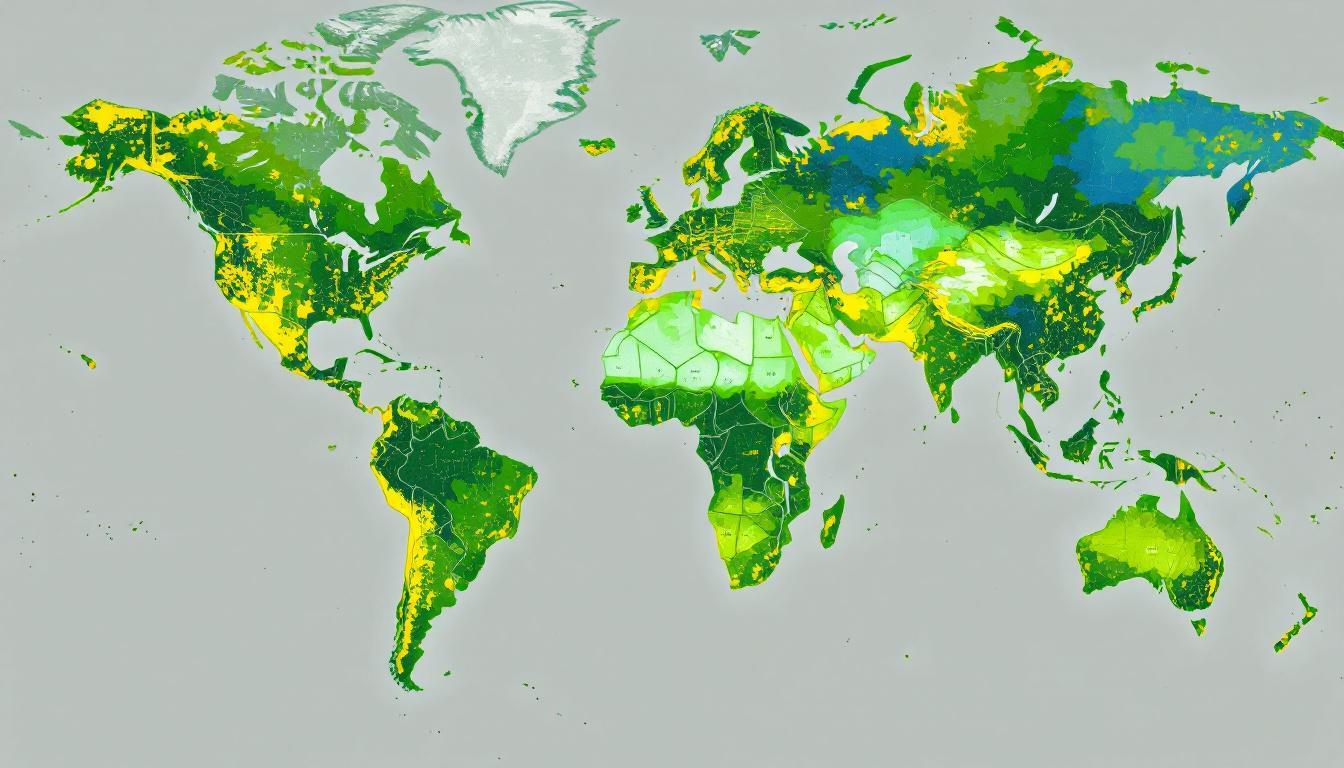
A new high-resolution study identifies key crops and regions driving cropland greenhouse gases, offering actionable insights for tailored decarbonisation strategies and monitoring frameworks.
A new, high-resolution global inventory of cropland greenhouse-gas emissions offers an actionable roadmap for targeting the agricultural sources that matter most to industrial decarbonisation efforts. Published in Nature Climate Change, the study synthesises field measurements, satellite observations, hydrological modelling and crop statistics to produce emissions maps at roughly 10 km resolution, revealing where and why emissions concentrate and which interventions will deliver the biggest returns.
The analysis shows that a small set of crops drives the majority of cropland emissions worldwide. Rice, maize, oil palm and wheat together account for nearly 75% of emissions from croplands, with rice alone responsible for about 43%. The dominant emission pathways vary by crop: methane from flooded rice paddies, carbon dioxide from peatland conversion for oil palm, and nitrous oxide associated with synthetic fertiliser use in intensive maize and wheat systems. The authors quantify the role of management practices, noting, for example, that fertiliser-related emissions represent a notable share of the footprint in high-input cereal systems.
Geography concentrates the problem. Roughly half of cropland emissions occur in the East Asia and Pacific region, with South Asia, Europe and Central Asia contributing most of the remainder. The maps reveal both familiar broad hotspots and finer-scale “micro-regions” where specific cropping systems and local hydrology amplify greenhouse-gas output. That spatial clarity allows policymakers and financiers to channel scarce mitigation funds to the fields, watersheds and supply chains where interventions will most reduce emissions per pound of climate spend.
The study’s lead authors stress that mitigation must be tailored to crop and context rather than applied as a one-size-fits-all suite of measures. “It’s all about rice. That’s where the biggest sources and the biggest opportunities are,” said Mario Herrero, a senior co-author and professor at Cornell University. For rice, breeders and practitioners can combine water-management techniques such as alternate wetting and drying with varietal improvements to cut methane without undermining yields. In peatland palm landscapes, hydrological restoration and rewetting are flagged as essential to prevent extensive CO2 release. For fertiliser-driven nitrous oxide, precision application, enhanced-efficiency products and agronomic optimisation emerge as the principal levers.
The authors also link emissions to production efficiency, a critical consideration for industrial decarbonisation strategies that must avoid trade-offs with food security. By pairing emissions estimates with crop productivity data, the research identifies areas where emissions intensity per tonne of output is high and where improvements could be delivered without reducing food supply. That nuance supports more equitable policy design, helping governments and supply-chain actors prioritise interventions in high-impact, low-efficiency systems rather than penalising efficient producers.
Beyond mitigation design, the new maps have implications for monitoring, reporting and verification frameworks used by corporate buyers, national inventories and carbon markets. By aligning ground measurements with remote sensing, the methodology creates a repeatable basis for continuous tracking of emissions changes at subnational scales, improving transparency for off-takers and investors seeking credible emissions reductions across agricultural supply chains.
The study should also be read alongside recent research into land-based mitigation options. According to a Nature Food analysis, deploying carbon-sequestration practices on agricultural land, such as improved rotations, cover crops and soil management, could materially lower the cost of achieving net-zero land-use emissions by mid-century, boost farmer revenues and reduce overall economy-wide abatement costs. Integrating sequestration opportunities with the hotspot maps could increase the portfolio of viable decarbonisation pathways, particularly in regions where emissions intensity and sequestration potential overlap.
Other complementary mapping work has explored how agricultural land suitability and climate-zone shifts influence where productive, low-emission cropping can be scaled or where extensification would threaten natural carbon stocks. Industry strategists and industrial decarbonisation planners should therefore combine the new emissions atlas with studies on sequestration potential and climate-driven land suitability changes to design resilient, long-term investment strategies.
For business and policy actors focused on supply-chain decarbonisation, several operational implications follow. First, mitigation funding should be prioritised geographically and by commodity to maximise emissions avoided per dollar. Second, interventions must be chosen according to the dominant emission mechanisms at play, water management and breeding for rice, peat hydrology for oil palm, nutrient management for cereals. Third, monitoring systems supporting corporate claims and government reporting should adopt the study’s integration of satellite and field data to deliver verifiable, repeatable metrics at farm or landscape scale.
The authors caution that the maps provide a dynamic baseline rather than a fixed ledger. Rapid changes in cropping patterns, adoption of new technologies and restoration activities will alter emissions over time, so ongoing monitoring is essential. For stakeholders in the industrial decarbonisation space, the study offers both a prioritisation tool and a technical template for durable verification regimes that can support funding flows, corporate procurement standards and national climate commitments.
By isolating the crops, places and practices responsible for the lion’s share of cropland greenhouse gases, the research delivers a practical framework for focusing decarbonisation effort where it will be most effective while preserving productivity. Coupled with land-based sequestration options and climate-resilience mapping, the emissions atlas equips governments, companies and investors with the evidence base needed to scale targeted interventions and measure progress in reducing agriculture’s climate footprint.
- https://bioengineer.org/new-study-produces-most-detailed-map-of-agricultural-emissions-outlining-strategies-to-cut-hotspots/ – Please view link – unable to able to access data
- https://news.cornell.edu/stories/2026/02/unprecedented-emissions-maps-will-hone-mitigation – Cornell researchers have developed high-resolution global maps of cropland greenhouse gas emissions, down to approximately 10 kilometres. These maps, published in Nature Climate Change, integrate data from multiple sources to identify emission hotspots and inform targeted mitigation strategies. The study highlights that four crops—rice, maize, oil palm, and wheat—are responsible for nearly 75% of global cropland emissions, with rice alone accounting for 43%. The findings underscore the need for crop-specific mitigation approaches to effectively reduce emissions. ([news.cornell.edu](https://news.cornell.edu/stories/2026/02/unprecedented-emissions-maps-will-hone-mitigation?utm_source=openai))
- https://www.nature.com/articles/s41558-026-02571-7 – A recent study published in Nature Climate Change provides detailed maps of global cropland greenhouse gas emissions, identifying major emission sources and hotspots. The research reveals that four crops—rice, maize, oil palm, and wheat—account for nearly 75% of global cropland emissions, with rice alone contributing 43%. The study emphasizes the importance of tailored mitigation strategies to address emissions from specific crops and regions. ([nature.com](https://www.nature.com/articles/s41558-026-02571-7?utm_source=openai))
- https://www.nature.com/articles/s41558-026-02558-4 – An article in Nature Climate Change discusses a study that maps global cropland greenhouse gas emissions at a high spatial resolution of approximately 10 kilometres. The research identifies four crops—rice, maize, oil palm, and wheat—as responsible for nearly 75% of global cropland emissions, with rice alone accounting for 43%. The study highlights the need for crop-specific mitigation strategies to effectively reduce emissions. ([nature.com](https://www.nature.com/articles/s41558-026-02571-7?utm_source=openai))
- https://www.nature.com/articles/s43016-024-01056-0 – A study published in Nature Food reveals that carbon sequestration options on agricultural land offer substantial mitigation potential. The research suggests that tapping into this potential could enable net-zero land-use emissions to be achieved by mid-century at lower greenhouse gas prices, increase revenues for farmers, and decrease economy-wide costs of climate action, compared with a scenario that does not consider these options. ([nature.com](https://www.nature.com/articles/s43016-024-01056-0?utm_source=openai))
- https://www.nature.com/articles/s43016-021-00454-y – An article in Nature Food discusses how future climate-zone shifts are threatening steep-slope agriculture. The study provides a high-resolution global map of steep-slope agricultural landscapes and their spatial distribution in the Köppen–Geiger climate zones for the present day and future scenarios. The analysis demonstrates that steep-slope agricultural areas are much more affected by shifting climate zones than average global agricultural lands, especially by the expansion of arid zones. ([nature.com](https://www.nature.com/articles/s43016-021-00454-y?utm_source=openai))
- https://www.nature.com/articles/s41467-025-65201-4 – A study in Nature Communications examines reconciling crop production, climate action, and nature conservation in Europe through agricultural intensification and extensification. The research presents maps showing net carbon sequestration aggregated to 10 km resolution, illustrating the carbon emissions, sequestration, and avoided emissions from suboptimal cropland and crop-switching. The study highlights the potential for balancing agricultural productivity with climate mitigation and conservation efforts. ([nature.com](https://www.nature.com/articles/s41467-025-65201-4?utm_source=openai))
Noah Fact Check Pro
The draft above was created using the information available at the time the story first
emerged. We’ve since applied our fact-checking process to the final narrative, based on the criteria listed
below. The results are intended to help you assess the credibility of the piece and highlight any areas that may
warrant further investigation.
Freshness check
Score:
10
Notes:
The article reports on a study published in Nature Climate Change on February 13, 2026, indicating high freshness. No evidence of prior publication or recycled content was found.
Quotes check
Score:
8
Notes:
Direct quotes from Mario Herrero, a senior co-author and professor at Cornell University, are included. These quotes are consistent with those found in the Cornell Chronicle article published on the same date. However, the bioengineer.org article does not provide direct links to the original study or the Cornell Chronicle article, making independent verification of the quotes challenging.
Source reliability
Score:
6
Notes:
The article originates from bioengineer.org, a niche publication. While it cites a study published in Nature Climate Change, the lack of direct links to the original study or reputable news outlets raises concerns about source reliability. The Cornell Chronicle article, published on the same date, provides more direct access to the study and quotes from the researchers.
Plausibility check
Score:
9
Notes:
The claims about the study’s findings align with existing research on agricultural greenhouse gas emissions. The emphasis on rice, maize, oil palm, and wheat as major contributors is consistent with previous studies. However, the lack of direct links to the original study or reputable news outlets makes independent verification of the claims challenging.
Overall assessment
Verdict (FAIL, OPEN, PASS): FAIL
Confidence (LOW, MEDIUM, HIGH): MEDIUM
Summary:
While the article reports on a recent study published in Nature Climate Change, the reliance on bioengineer.org as the primary source, a niche publication, and the lack of direct links to the original study or reputable news outlets raise concerns about source reliability and verification independence. The quotes from Mario Herrero are consistent with those found in the Cornell Chronicle article published on the same date, but the absence of direct links to the original study or reputable news outlets makes independent verification challenging. Therefore, the overall assessment is a FAIL with MEDIUM confidence.
