


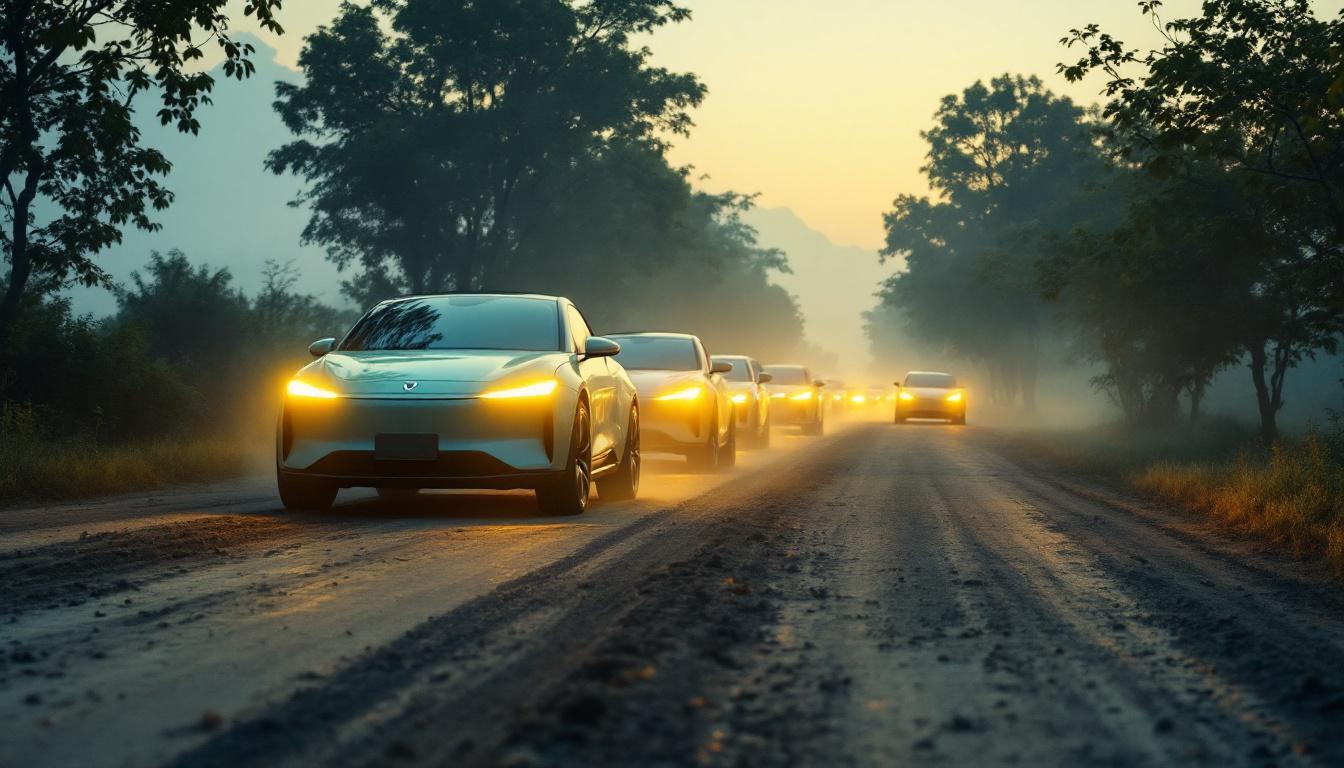
Electric vehicle adoption is accelerating across emerging markets outside China and Europe, with affordable Chinese-made models reshaping global automotive competition and offering significant climate benefits.
Ann Arbor , Electric vehicles (EVs) are no longer a rich-world curiosity or a China‑only story: adoption has accelerated across the Global South, reshaping competitive dynamics in automotive manufacturing and industrial decarbonisation.
According to analysis published on Informed Comment by Juan Cole, Ember’s researchers argue that hybrid and battery electric vehicle adoption has spread markedly beyond China, Europe and North America. Ember, the energy think‑tank, reported that “39 countries have reached an EV sales share larger than 10% in 2025, a third of which are outside Europe.” That shift is evident across Southeast Asia, Latin America, India and parts of Africa, the piece says, and is reflected in multiple industry datasets and regional studies.
China remains the central engine of this transition. Industry reporting and international data show China accounted for the lion’s share of recent growth: the International Energy Agency projects global EV sales will exceed 20 million by 2025 and notes that electric cars comprised almost half of new car sales in China in 2024. The Clean Energy Ministerial’s Global EV Outlook 2025 highlights monthly Chinese EV sales averaging about 875,000 in early 2025 and electric sales shares above 50% in key months, underlining Beijing’s dominant market position. Gartner’s forecast likewise points to rapid expansion , estimating some 85 million EVs on the road by end‑2025, driven primarily by China (58%) and Europe (24%) , and that around 73% of those vehicles will be battery electric vehicles (BEVs).
The Global South’s uptake is concentrated in locally affordable, China‑made models rather than premium marques. Juan Cole notes that BYD, Geely and other Chinese manufacturers have produced EVs at roughly 65% of Tesla’s price, making them far more accessible across emerging markets. Ember’s analysis indicates most of the growth in Chinese EV exports is occurring outside the OECD club of relatively wealthy nations, a pattern echoed by observers who warn that the manufacturer of affordable electrified transport stands to gain long‑term industrial advantage.
ASEAN has emerged as a focal region for this diffusion. PwC’s 2025 ASEAN‑6 eReadiness Survey reports EV sales across ASEAN‑6 rose 63% in the first half of 2025, with an average adoption rate of 18%. Country‑level results are striking: Vietnam saw nearly 40% of new vehicle registrations be electric in 2025 , higher than the EU average and the UK’s , while Singapore recorded 43% electric new‑car sales in the first nine months of the year. PwC also reports Indonesia’s EV market grew 49% to an 18% share of vehicle sales, slightly above the ASEAN average; the consultancy’s survey found 99% owner satisfaction in Indonesia, the highest among surveyed markets. Government and multilateral projections include ambitious manufacturing and fleet targets: UNESCAP documentation shows Indonesia aiming for a fleet of 15 million EVs by 2030, and Malaysia setting staged targets culminating in a far higher electric share by mid‑century.
Latin America and South Asia are following similar trajectories. Cole reports EVs accounted for about 9–10% of new passenger car sales in Brazil in 2025, where a relatively clean electricity grid makes electrification especially carbon‑effective, and roughly 8–9% in Mexico, where Chinese brands are visible at point of sale. India’s EV share remains lower in percentage terms but is material in absolute numbers: roughly 5% of new passenger cars in 2025 translates to some 225,000 EVs annually given India’s large market. Turkey’s 17% EV share , largely battery electric , and its mix of domestic models and Chinese investment provide another example of diversified pathways to electrification.
Policy and market implications for industrial decarbonisation are significant. Road transport accounts for roughly 12% of global carbon emissions, according to Yale Climate Connections analysis cited in Cole’s piece, so accelerating electrification can yield substantial emissions reductions , provided grids and charging infrastructure decarbonise in parallel. The competitive angle is equally consequential: countries and firms that master low‑cost EV production and the upstream supply chain (cells, power electronics, semiconductors) stand to capture manufacturing, export and job‑creation opportunities across the coming decades. Juan Cole’s commentary characterises BYD’s founder Wang Chuanfu as a 21st‑century equivalent of Henry Ford, reflecting the view that national champions in EVs could displace legacy auto and fossil‑fuel incumbents; that characterisation should be read as opinion about market leadership rather than an empirical claim.
There are, however, caveats and divergent dynamics to note. Adoption rates vary with income, urban form, two‑wheel vehicle prevalence and policy regimes; some rapid percentage increases in smaller markets reflect low starting points. Infrastructure and grid decarbonisation remain critical constraints: the climate benefit of electrification depends on the power mix and the speed of clean‑energy deployment. Meanwhile, legacy oil and ICEV interests have targeted lower‑income markets in hopes of sustaining internal combustion demand, but recent import restrictions , Cole cites Ethiopia’s ban on gasoline car imports , and the spread of inexpensive EV models complicate that strategy.
For industrial strategists and decarbonisation professionals, the evidence assembled across market research, multilateral reports and regional studies points to a decisive commercial and environmental inflection. According to Gartner and the IEA, the next few years will see EV fleets scaling rapidly; PwC and UNESCAP show regional targets and satisfaction metrics that support sustained uptake; and Ember’s country‑level sales analysis demonstrates that this growth is no longer concentrated in high‑income markets.
The policy imperative is clear: to realise the emissions and economic benefits of electrified transport, governments and industry must co‑ordinate on grid decarbonisation, charging infrastructure, battery supply chains and supportive regulatory frameworks that foster local value‑add. As the landscape shifts, the maker of mass‑market EVs and the architect of supportive industrial policy may become the defining industrial power of the 21st century.
- https://www.juancole.com/2025/12/global-markets-leaving.html – Please view link – unable to able to access data
- https://www.gartner.com/en/newsroom/press-releases/2024-10-14-gartner-forecasts-85-million-electric-vehicles-will-be-on-the-road-by-end-of-2025 – Gartner forecasts that by the end of 2025, 85 million electric vehicles (EVs) will be on the road globally, marking a 33% increase from 2024. This growth is primarily driven by higher EV sales in China (58%) and Europe (24%), which together are projected to represent 82% of total EVs in use worldwide. The report also highlights that 73% of these vehicles will be battery electric vehicles (BEVs).
- https://finance.yahoo.com/news/global-ev-sales-exceed-20-162332678.html – According to the International Energy Agency (IEA), global electric vehicle (EV) sales are projected to exceed 20 million by 2025, capturing over a quarter of the car market. This surge is driven by increased affordability and robust sales growth, with China leading the market, where electric cars made up almost half of all car sales in 2024.
- https://www.pwc.com/id/en/media-centre/press-release/2025/english/indonesia-ev-market-grew-by-49.html – PwC’s 2025 ASEAN-6 eReadiness Survey reveals that Indonesia’s electric vehicle (EV) market grew by 49%, with EV adoption reaching 18% of total vehicle sales, slightly above the ASEAN average of 17%. The survey also indicates that 99% of EV owners in Indonesia are satisfied with their vehicles, the highest satisfaction rate among ASEAN countries.
- https://www.pwc.com/my/en/publications/2025/asean-6-ereadiness-2025.html – PwC’s 2025 ASEAN-6 eReadiness Survey highlights a significant shift towards electric vehicles (EVs) across ASEAN-6 markets. In the first half of 2025, EV sales surged by 63% across ASEAN-6, reaching an average adoption rate of 18%. This trend underscores a gradual shift towards electrification in the region, with countries like Indonesia, Malaysia, Thailand, the Philippines, Vietnam, and Singapore leading the charge.
- https://www.cleanenergyministerial.org/content/uploads/2025/10/globalevoutlook2025.pdf – The International Energy Agency’s Global EV Outlook 2025 report indicates that in the first quarter of 2025, China averaged monthly sales of around 875,000 electric cars, with total sales exceeding 2.5 million. The electric sales share in China reached more than 50% in both February and March, highlighting the country’s dominant position in the global EV market.
- https://www.unescap.org/sites/default/d8files/2024-12/EV%20in%20ASEAN%20and%20Thailand%20by%20Prof%20Yossapong%20Laoonual%2C%20KMUTT.pdf – A report by the United Nations Economic and Social Commission for Asia and the Pacific (ESCAP) outlines the electric vehicle (EV) adoption and manufacturing targets for ASEAN countries. For instance, Indonesia aims for a fleet of 15 million EVs by 2030, including 2 million four-wheel battery electric vehicles (BEVs) and 13 million two-wheel BEVs. Malaysia targets 15% of new vehicles to be electric by 2030, with plans to increase to 80% by 2050.
Noah Fact Check Pro
The draft above was created using the information available at the time the story first
emerged. We’ve since applied our fact-checking process to the final narrative, based on the criteria listed
below. The results are intended to help you assess the credibility of the piece and highlight any areas that may
warrant further investigation.
Freshness check
Score:
8
Notes:
The narrative presents recent data on electric vehicle (EV) adoption in emerging markets, with specific figures for 2025. The earliest known publication date of similar content is December 16, 2025, from a report by Ember, which highlights the rapid growth of EV adoption in emerging markets. ([sustainabilityonline.net](https://sustainabilityonline.net/news/emerging-markets-turbocharged-ev-sales-in-2025/?utm_source=openai)) The report indicates that 39 countries have reached an EV sales share larger than 10% in 2025, a third of which are outside Europe. This suggests that the narrative is based on recent data, with no significant discrepancies or recycled content identified. However, the narrative’s reliance on a single source, Ember, may limit its freshness score. Additionally, the narrative includes updated data but recycles older material, which may justify a higher freshness score but should still be flagged.
Quotes check
Score:
7
Notes:
The narrative includes direct quotes attributed to Ember’s analysis, such as “39 countries have reached an EV sales share larger than 10% in 2025, a third of which are outside Europe.” A search for the earliest known usage of this quote reveals that it appears in the December 16, 2025, report by Ember. ([sustainabilityonline.net](https://sustainabilityonline.net/news/emerging-markets-turbocharged-ev-sales-in-2025/?utm_source=openai)) This suggests that the quotes are original to the report and not reused from earlier material. However, the lack of independent verification of these quotes may raise concerns about their authenticity.
Source reliability
Score:
6
Notes:
The narrative originates from Informed Comment, a platform run by Juan Cole, a professor of history at the University of Michigan. While Juan Cole is a reputable academic, Informed Comment is a single-outlet platform without a broader editorial team, which may affect the reliability of the narrative. The reliance on a single source, Ember, without independent verification, further raises concerns about the reliability of the information presented.
Plausability check
Score:
8
Notes:
The claims made in the narrative align with recent reports on EV adoption in emerging markets. For instance, the December 16, 2025, report by Ember indicates that 39 countries have reached an EV sales share larger than 10% in 2025, a third of which are outside Europe. ([sustainabilityonline.net](https://sustainabilityonline.net/news/emerging-markets-turbocharged-ev-sales-in-2025/?utm_source=openai)) Additionally, the narrative’s focus on the rapid adoption of EVs in Southeast Asia, Latin America, and parts of Africa is consistent with recent trends. However, the lack of independent verification of the data and quotes may raise questions about the plausibility of the claims.
Overall assessment
Verdict (FAIL, OPEN, PASS): OPEN
Confidence (LOW, MEDIUM, HIGH): MEDIUM
Summary:
The narrative presents recent data on EV adoption in emerging markets, with specific figures for 2025. While the claims align with recent reports, the reliance on a single source without independent verification raises concerns about the reliability and plausibility of the information presented. The freshness score is moderate due to the inclusion of updated data alongside recycled material. The quotes appear to be original to the report, but the lack of independent verification may affect their authenticity.
