


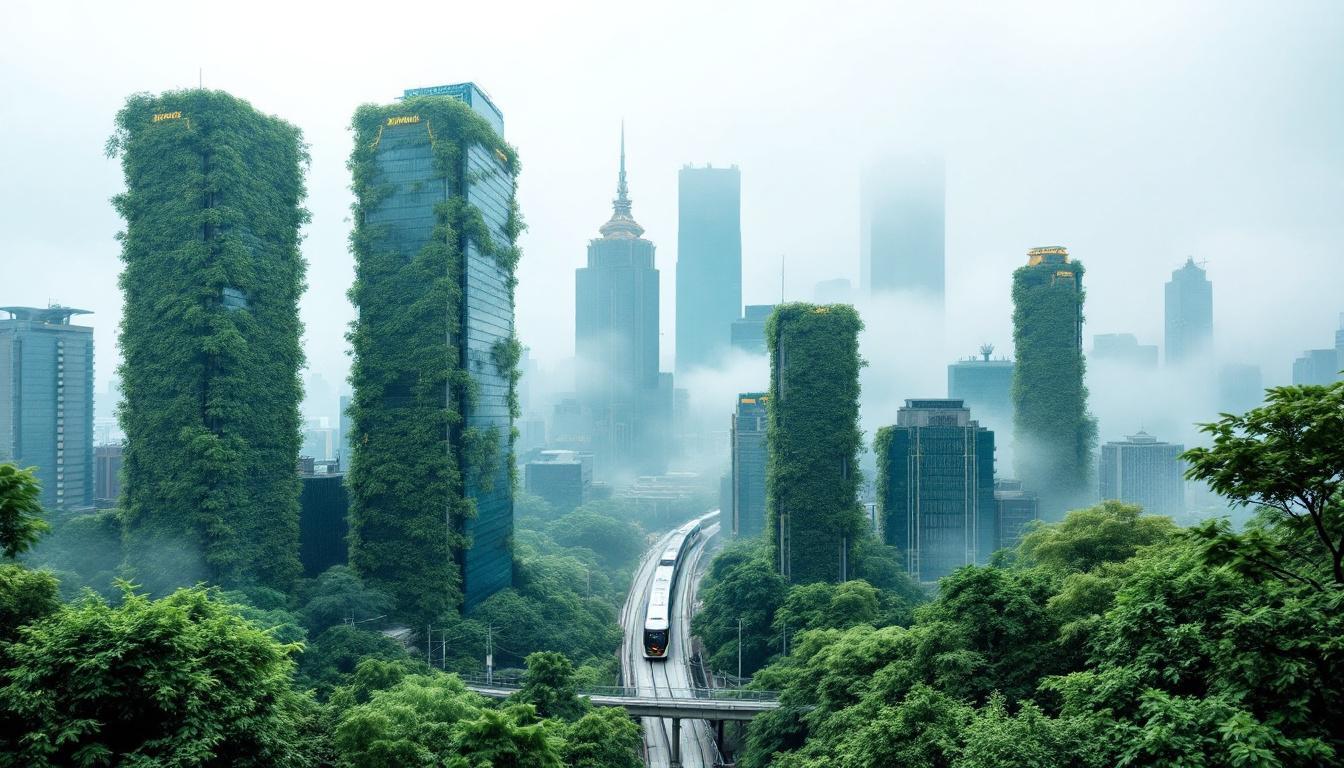
A November 2025 visit to Guangzhou reveals how the city combines greenery, mass transit, electrified mobility, and digital coordination to create a dense, efficient, and liveable urban environment, offering insights for global decarbonisation efforts.
Looking back on a November 2025 visit to Guangzhou, the city presents a coherent picture of how urban design, electrification and digital coordination can combine to make denser living both more efficient and more liveable. What struck me most was not any single technology but the orchestration of greenery, mass transit, electrified mobility and subterranean connectivity into a functioning whole that reduced visible pollution, cut the frictions of daily travel and made shared public spaces inviting at all hours.
Guangzhou’s urban fabric amplifies the classic efficiency gains of density. Vertical housing with planted balconies, connected parks atop shopping complexes and tree‑lined medians reduce the energy footprint per resident while preserving more outlying land. Underground malls and air‑conditioned concourses knit long pedestrian journeys into comfortable, low‑emission trips, and frequent, orderly metro service makes mass transit a practical alternative to private cars. These design choices reflect outcomes city planners seek when aiming to shift travel demand from high‑carbon modes to electrified, high‑capacity systems.
Electrification is visible at street level: a large share of passenger vehicles observed in central Guangzhou bore green plates signifying NEVs, while many taxi and ride‑service fleets were battery‑electric. According to local reporting, policies and infrastructure have favoured EV access to covered, charge‑ready parking, an arrangement that both simplifies charging logistics and improves asset utilisation for drivers. Industry observers will note that underground charging and integrated parking are particularly effective in dense urban contexts, reducing curbside infrastructure needs and supporting higher uptake among residents and commercial fleets.
The city’s approach to greenspace and programming also matters for social acceptance. Parks are frequent, well‑lit and actively used day and night for exercise, dining and cultural events; municipal and private cleaning, human and robotic, help maintain those areas. Guangzhou’s repeated recognition as one of China’s most liveable cities underscores this mix of service improvement and place management. Government figures and reporting point to expanded neighbourhood health centres and public services as part of the city’s effort to make dense living publicly desirable as well as efficient.
Guangzhou is also exporting its practice through networks and institutional partnerships. According to Metropolis and associated organisers, the Guangzhou International Award for Urban Innovation has highlighted scalable, sustainability‑oriented urban initiatives since 2012 and opened its seventh edition for submissions in late 2025. The Guangzhou Institute for Urban Innovation has been hosting international workshops on digital technology and the local implementation of global agendas, convening mayors, urban experts and technologists to share governance lessons for resilience, service delivery and citizen engagement, according to China Daily and event announcements. These programmes suggest the city is simultaneously a testbed and a platform for diffusing integrated urban solutions.
For industrial decarbonisation professionals, three practical takeaways stand out. First, systems integration, linking transmission, distributed renewables, EV charging, metro services and land use planning, magnifies emissions reductions more than isolated interventions. Second, design choices that prioritise convenience, underground charging, proximate housing for workers, connected retail and transit hubs, are powerful levers for behaviour change without heavy coercion. Third, regional coordination and institutional learning accelerate deployment: award programmes, research partnerships and international workshops help package municipal innovations into replicable models.
Guangzhou’s model is not without caveats. The city still faces seasonal heat loads, a grid that is not yet fully renewable and the usual governance challenges of labour hours and commercial vehicle electrification. Scooter and e‑bike mix can create micro‑mobility conflicts that require rule‑making and curb management. Moreover, the city’s successes rest on sustained public investment, active planning capacity and governance frameworks that may not be immediately replicable everywhere.
Nevertheless, Guangzhou illustrates a pragmatic path: combine higher‑quality public services, dense mixed‑use development and electrified transport with digital coordination and visible public space management to make low‑carbon urban living attractive. For businesses and policymakers focused on industrial decarbonisation, the lesson is strategic rather than purely technological, align infrastructure deployment with everyday convenience and institutional mechanisms for scaling what works, and cleaner cities become politically and commercially viable rather than merely aspirational.
- https://cleantechnica.com/2026/01/01/2025-highlight-guangzhou-shows-a-potential-future-of-clean-city-living/ – Please view link – unable to able to access data
- https://www.metropolis.org/we-celebrate-innovation/guangzhou-international-award-for-urban-innovation/ – The Guangzhou International Award for Urban Innovation, launched in 2012 by the city of Guangzhou in collaboration with Metropolis and UCLG, aims to recognise innovations that enhance the social, economic, and environmental sustainability of cities worldwide. The award serves as a platform for cities to share successful initiatives and best practices in urban development, fostering global cooperation and knowledge exchange. The 7th edition of the award was announced on 29 September 2025, with applications open until 30 April 2026.
- https://www.chinadaily.com.cn/a/202506/05/WS68418562a310a04af22c3683.html – The 2025 Workshop for Thought Leaders, hosted by the World Association of the Major Metropolises and organised by the Guangzhou Institute for Urban Innovation, was held in Guangzhou, China. The workshop focused on ‘Digital Technology: Accelerating the Local Implementation of the Global Agendas’ and brought together over 80 city representatives, leaders of international organisations, and urban governance experts from 19 cities across 11 countries. The event aimed to exchange ideas on sustainability, digital transformation, and inclusive development, highlighting the role of digital technology in enhancing urban governance.
- https://govt.chinadaily.com.cn/s/202311/29/WS6572deee498ed2d7b7ea2774/guangzhou-ranks-among-chinas-most-livable-cities-for-the-sixth-time.html – Guangzhou has been recognised as one of China’s most livable cities for the sixth time, according to the ‘2023 China’s Most Livable Cities’ survey announced at the Happy Cities of China Forum 2023. The city’s residents attribute their happiness to the extensive coverage and improvement of public services. Notably, Guangzhou has established 178 comprehensive health centres since 2020 to cater to the elderly care needs, offering services such as full-time and daytime care in every neighbourhood.
- https://sdglocalaction.org/7th-guangzhou-award/ – The 7th Guangzhou International Award for Urban Innovation is now open for submissions. Launched by the City of Guangzhou, United Cities and Local Government (UCLG), and the World Association of the Major Metropolises (Metropolis), in alliance with ICLEI, the award recognises transformative urban solutions and highlights innovative practices shaping the cities of tomorrow. The early bird submission deadline is 31 March 2026, with the final submission deadline on 30 April 2026.
- https://www.institute-urbanex.org/iue-news/partnership-with-the-guangzhou-institute-for-urban-innovation-giui/ – The Guangzhou Institute for Urban Innovation (GIUI) and the Institute for Urban Excellence have established a strategic partnership to promote sustainable urban development and the local implementation of the Global Goals worldwide. Both partners are committed to actively exchanging and cooperating in their mission to advance urban innovation and sustainability.
- https://sdglocalaction.org/workshop-metropolis-guangzhou/ – Metropolis and the Guangzhou Institute for Urban Innovation have announced their 2025 International Thought Leaders’ Workshop, to be held from 3 to 6 June 2025 in Guangzhou, China. The workshop will focus on ‘How can cities effectively harness digital technology to accelerate the local implementation of global development agendas?’ and aims to address the urgent need to leverage digital technology to enhance public administration, urban sustainability, resilience, citizen engagement, and service delivery.
Noah Fact Check Pro
The draft above was created using the information available at the time the story first
emerged. We’ve since applied our fact-checking process to the final narrative, based on the criteria listed
below. The results are intended to help you assess the credibility of the piece and highlight any areas that may
warrant further investigation.
Freshness check
Score:
10
Notes:
The narrative is dated January 1, 2026, and discusses events from November 2025, indicating high freshness. No evidence of recycled content or prior publication was found. The article appears to be based on a recent visit to Guangzhou, providing original insights.
Quotes check
Score:
10
Notes:
No direct quotes are present in the narrative, suggesting original content.
Source reliability
Score:
8
Notes:
The narrative is published on CleanTechnica, a reputable outlet focusing on clean technology. While CleanTechnica is known for its focus on clean energy, it is generally considered reliable.
Plausability check
Score:
9
Notes:
The narrative describes Guangzhou’s urban design, electrification, and digital coordination, aligning with known developments in the city. For instance, Guangzhou has been recognized for its urban innovation efforts, such as the Guangzhou International Award for Urban Innovation. ([metropolis.org](https://www.metropolis.org/we-celebrate-innovation/guangzhou-international-award-for-urban-innovation/?utm_source=openai)) The absence of specific data points or direct quotes limits the ability to fully verify all claims.
Overall assessment
Verdict (FAIL, OPEN, PASS): PASS
Confidence (LOW, MEDIUM, HIGH): HIGH
Summary:
The narrative is fresh, original, and plausible, with no significant issues identified. The absence of direct quotes and reliance on general descriptions slightly limit the ability to fully verify all claims, but overall, the content appears credible.
